A few days ago, late on May 16, 2023 UT, a sunspot group started to rotate onto the side of the Sun facing Earth. At the time it was still partially obscured, but it unleashed a powerful solar flare that can be seen in this far ultraviolet image of the Sun.
In[]:=
Show[Import["https://sdo.gsfc.nasa.gov/assets/img/browse/2023/05/16/20230516_164522_1024_0131.jpg"],ImageSize->600]
Out[]=
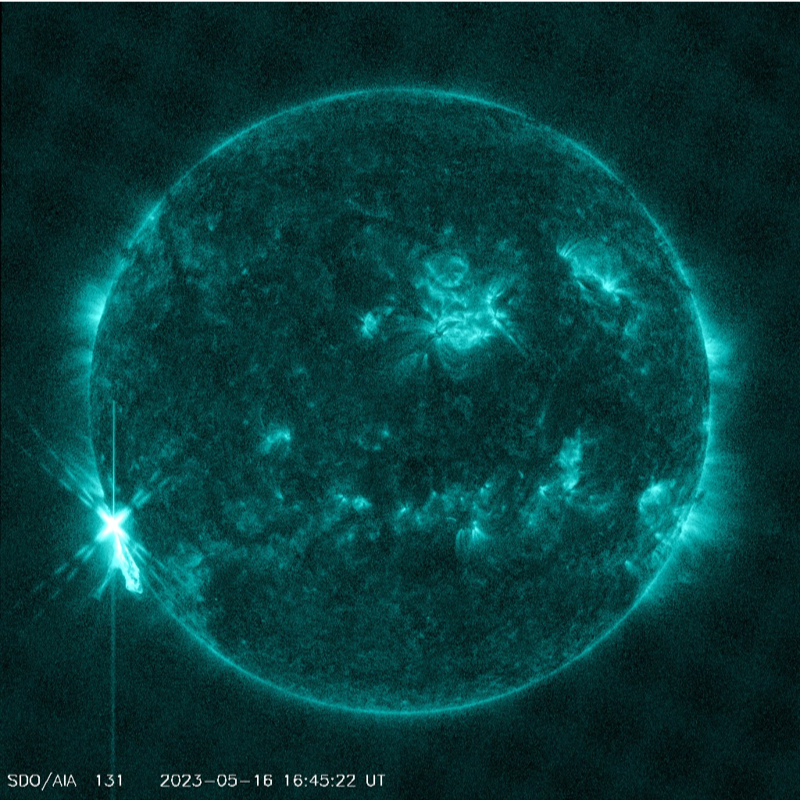
Courtesy of NASA/SDO and the AIA, EVE, and HMI science teams.
As of this post, the responsible sunspot group has continued to rotate toward the Earth and now appears on the lower left of this longer wavelength image (6173 Angstroms):
In[]:=
Show[Import["https://sdo.gsfc.nasa.gov/assets/img/latest/latest_1024_HMIIF.jpg"],ImageSize->600]
Out[]=
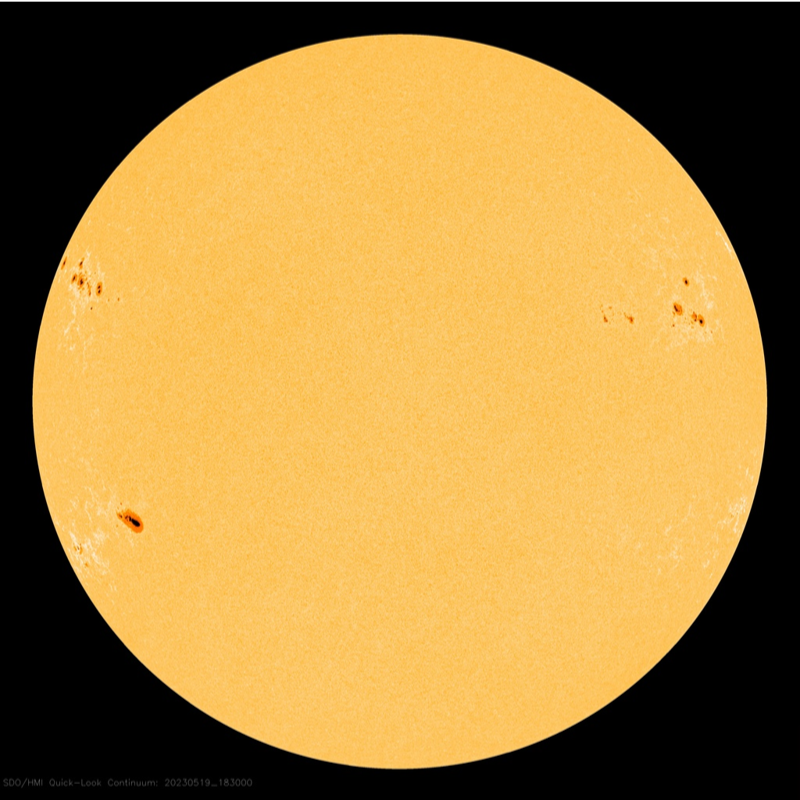
Courtesy of NASA/SDO and the AIA, EVE, and HMI science teams.
The "SpaceWeatherData" Wolfram Function Repository item can be used to plot the X-ray emission from the Sun since then. The large spike on the left is from the powerful flare shown at the top of this post. Since then, the Sun has been crackling with almost constant lower energy (but still powerful) flares.
In[]:=
DateListLogPlotInterval,,{"ShortSolarXRayFlux","LongSolarXRayFlux"},FrameLabel->Automatic,AspectRatio->.3,ImageSize->650
Out[]=
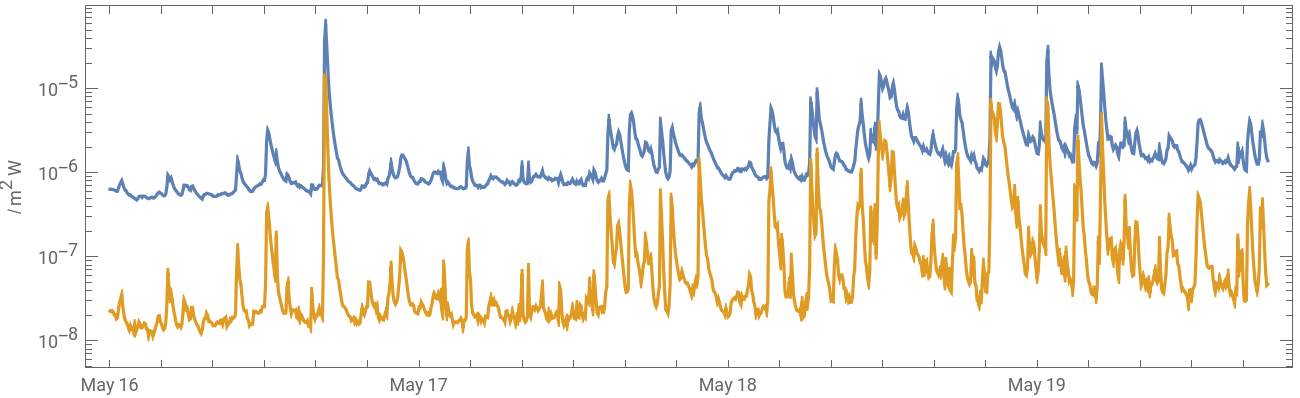
As this sunspot group continues to rotate toward us, it holds the potential for more powerful flares . These could, in turn, trigger coronal mass ejections (CMEs) that are geo-effective . If the magnetic fields of those prospective CMEs are oriented opposite to Earth' s magnetic field, it might trigger auroras .
CITE THIS NOTEBOOK
CITE THIS NOTEBOOK
A very active Sun and powerful solar flare in May 2023
by Jeff Bryant
Wolfram Community, STAFF PICKS, May 19 2023
https://community.wolfram.com/groups/-/m/t/2922149
by Jeff Bryant
Wolfram Community, STAFF PICKS, May 19 2023
https://community.wolfram.com/groups/-/m/t/2922149