Dihedral Group of the Square
Dihedral Group of the Square


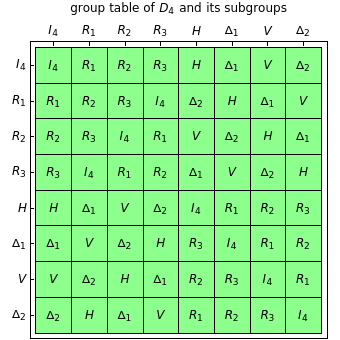
In mathematics, a dihedral group is the group of symmetries of a regular polygon with sides, including both rotations and reflections. This Demonstration shows the subgroups of , the dihedral group of a square.
D
n
n
D
4
Details
Details
A group is a set together with a binary operation on , i.e., a function to (called the group law of ) that combines any two elements and to form another element, denoted or . To qualify as a group, the set and operation, (, ), must satisfy four requirements known as the group axioms: closure, associativity, identity element, and inverse element. If , then the group is commutative or Abelian.
G
•
G
•:G×G
G
G
a
b
a•b
ab
G
•
a•b=b•a
In this Demonstration, the group law is the composition of permutations of the set . For example, .
{1,2,3,4}
•
=
1 | 2 | 3 | 4 |
2 | 3 | 4 | 1 |
1 | 2 | 3 | 4 |
1 | 4 | 3 | 2 |
1 | 2 | 3 | 4 |
2 | 1 | 4 | 3 |
Permanent Citation
Permanent Citation
Gerard Balmens
"Dihedral Group of the Square"
http://demonstrations.wolfram.com/DihedralGroupOfTheSquare/
Wolfram Demonstrations Project
Published: January 27, 2014