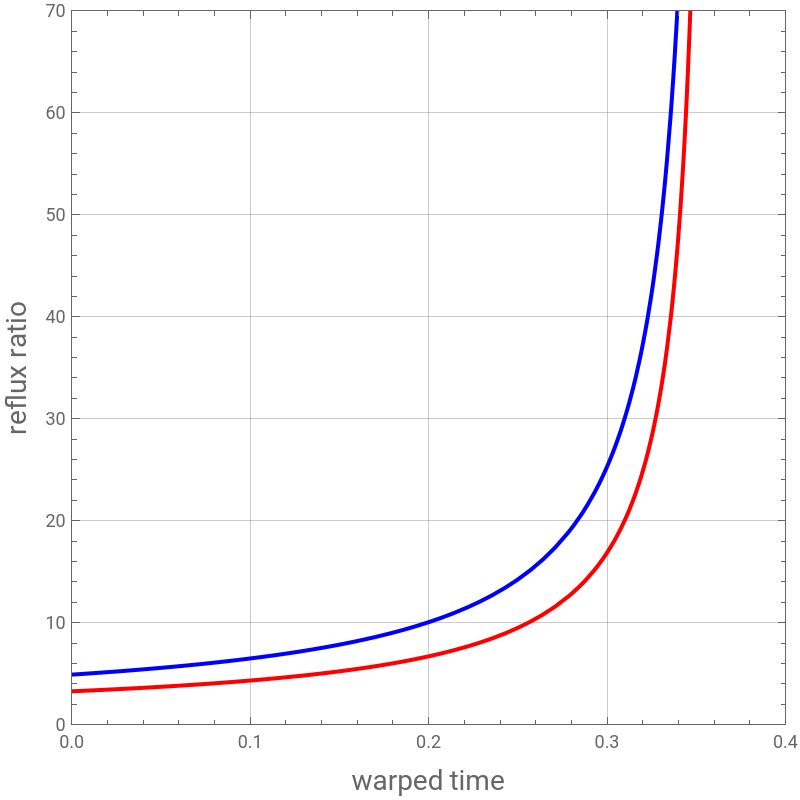
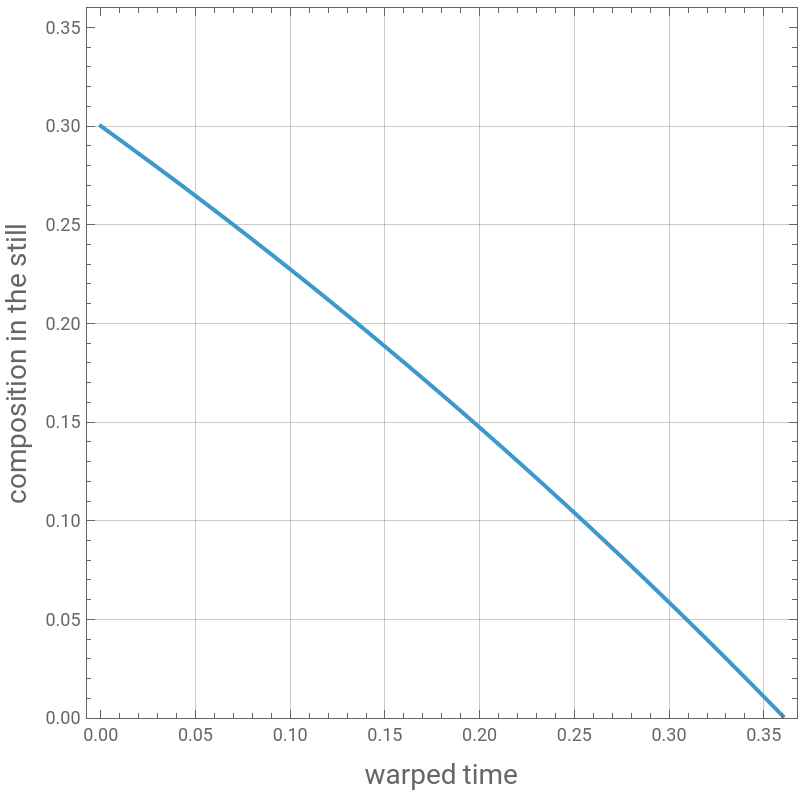
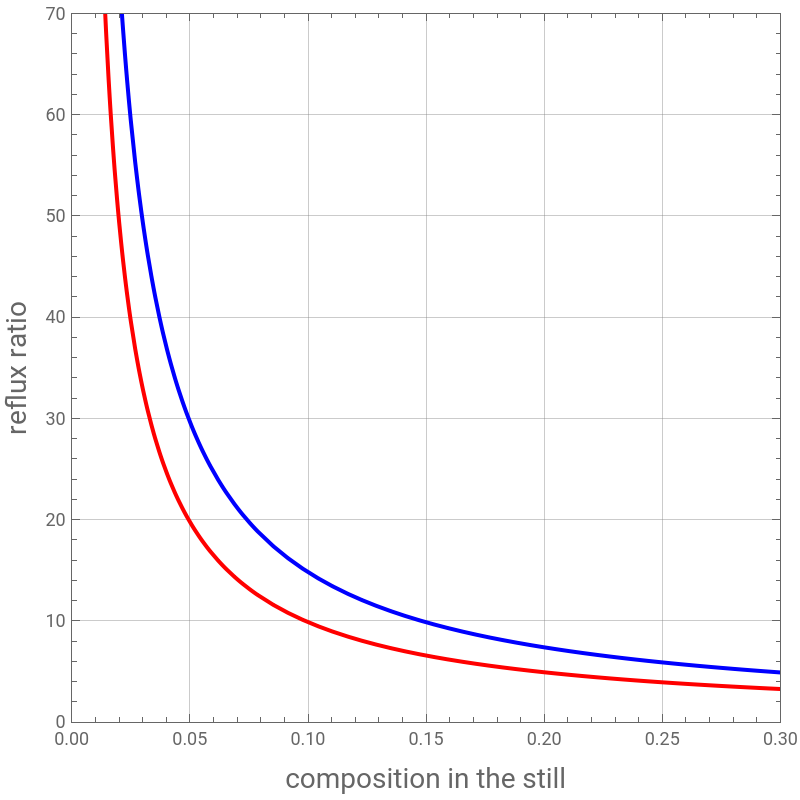
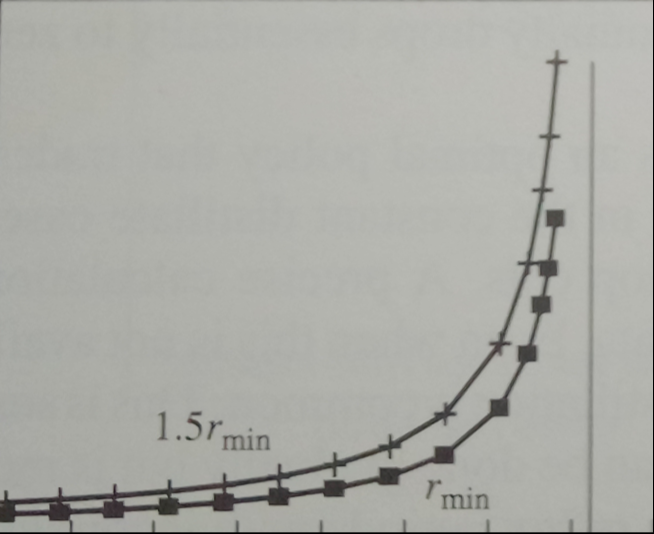
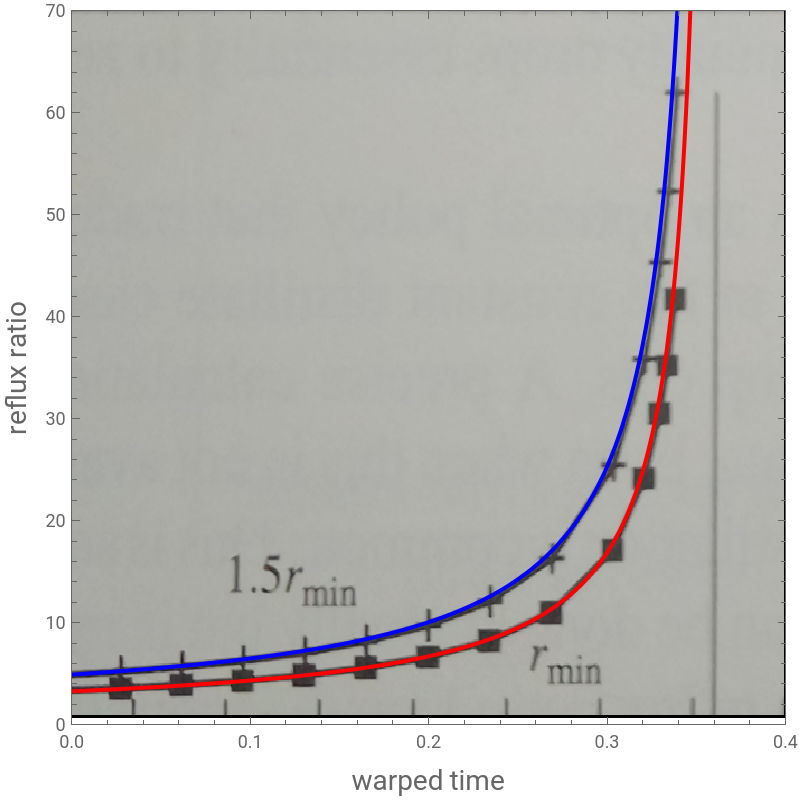
In order to achieve a constant distillate composition for a batch distillation operation, one has to continuously vary the reflux ratio. We present the reflux policy needed to achieve the user-specified constant distillate purity of 99 mol %. The still is initially fed with a binary mixture for which a constant relative volatility () adequately describes the vapor-liquid equilibrium (VLE) data. The feed composition is 30 mol % of the light component. The still's composition varies with warped time, , as follows: (ξ)=+- where is the warped time, is the initial still composition, and is the desired constant distillate composition. Indeed, (ξ) is the solution of the following ODE: =- with I.C. (ξ=0)=.VLE data is given by (i.e., the binary mixture has a constant relative volatility equal 2).Finally, the reflux ratio is given by the following approximation: .We plot the reflux ratio and the still composition as a function of warped time, . In addition, a parametric plot shows the behavior of the reflux ratio versus the still composition.It is obvious that as the warped time increases, the still composition goes to zero (the light component in the still is depleted). Thus, in order to achieve constant distillate compositions, the reflux ratio has to be increased (up to excessively high values) and the cost of the batch distillation operation becomes very high.Our results are compared to those given in Refs. 1-2.
α=2
ξ
x
B
x
D
x
B
0
x
D
ξ
e
ξ
x
B
0
x
D
x
B
x
B
ξ
x
B
x
D
x
B
x
B
0
y=
2x
(1+x)
r=1.5=1.5-y
r
min
x
D
y-
x
B
ξ
proofof=-ybychoosingatthepinch
r
min
x
D
y-
x
B
r
min
In[]:=
Solve[(y-xD)/(xB-xD)==Rmin/(Rmin+1),Rmin]
Out[]=
Rmin
-xD+y
xB-y
In[]:=
XD=0.99;(*constantdistillatecomposition*)XB0=0.3;(*feedcomposition*)
Maximum value of the warped time
In[]:=
NSolve[XD+(XB0-XD)Exp[ξ]==0,ξ,Reals]
Out[]=
{{ξ0.361013}}
In[]:=
(*relfuxratiovs.warpedtime--inbluer=1.5rminandinredrmin*)p1=Plot/.y2xB(1+xB)/.xBXD+(XB0-XD)Exp[ξ],/.y2xB(1+xB)/.xBXD+(XB0-XD)Exp[ξ],{ξ,0,0.35},PlotRange{{0,0.4},{0,70}},FrameTrue,PlotStyle{{Blue,Thick},{Red,Thick}},FrameLabel{Style["warped time",14],Style["reflux ratio",14]},AspectRatio1,GridLines->Automatic,ImageSize{400,400}
1.5(XD-y)
(y-xB)
(XD-y)
(y-xB)
Out[]=
Still composition vs. warped time
Plot[XD+(XB0-XD)Exp[ξ],{ξ,0,0.36},PlotRange{0,0.36},AspectRatio1,FrameTrue,PlotStyleThick,FrameLabel{Style["warped time",14],Style["composition in the still",14]},ImageSize{400,400},GridLines->Automatic]
Out[]=
Reflux ratio vs. warped time -- in blue r=1.5 rmin and in red rmin
p2=ShowParametricPlotXD+(XB0-XD)Exp[ξ],/.y2xB(1+xB)/.xBXD+(XB0-XD)Exp[ξ],{ξ,0,0.35},AspectRatio1,FrameTrue,ImageSize{400,400},GridLines->Automatic,FrameLabel{Style["composition in the still",14],Style["reflux ratio",14]},PlotStyle{Blue,Thick},PlotRange{{0,0.3},{0,70}},ParametricPlotXD+(XB0-XD)Exp[ξ],/.y2xB(1+xB)/.xBXD+(XB0-XD)Exp[ξ],{ξ,0,0.35},AspectRatio1,FrameTrue,ImageSize{400,400},GridLines->Automatic,FrameLabel{Style["composition in the still",14],Style["reflux ratio",14]},PlotStyle{Red,Thick},PlotRange{{0,0.36},{0,70}}
1.5(XD-y)
(y-xB)
(XD-y)
(y-xB)
Out[]=
Comparison with Figure 9.21b of Ref. 1
In[]:=
img1=
;
In[]:=
Show[p1,ImageSize->400{1,1},Prolog->{Raster[ImageData[img1,DataReversed->True],{Scaled[{-0.025,0.01}],Scaled[{1,1.}]}]}]
Out[]=
References
References
◼
[1] M. F. Doherty and M. F. Malone, Conceptual Design of Distillation Systems, New York: McGraw-Hill, 2001.
◼
[2] Y. S. Kim, Optimal Control of Time-Dependent Processes, Ph.D. thesis, University of Massachusetts, Amherst, MA, 1985.
CITE THIS NOTEBOOK
CITE THIS NOTEBOOK
Reflux policy for a batch distillation operation with a constant distillate composition
by Housam Binous and Ahmed Bellagi
Wolfram Community, STAFF PICKS, September 27, 2025
https://community.wolfram.com/groups/-/m/t/3552111
by Housam Binous and Ahmed Bellagi
Wolfram Community, STAFF PICKS, September 27, 2025
https://community.wolfram.com/groups/-/m/t/3552111