#1 Cellular Automata- From Classical Computation to Quantum Error Correction #1
This notebook serves as an executable specification for our FabricCalculus, a foundational component of the Daedaelus Transaction Fabric. We move beyond the one-dimensional and flawed metric of bandwidth, instead defining a multi-dimensional FabricMetricTensor that calculates a true TransactionalDistance based on a weighted policy of latency, bandwidth, and link integrity. The GeodesicTransactionRouter acts as the intelligence of the Graph Virtual Machine (GVM), computing the optimal "geodesic" path across a given N2N Lattice based on these application-defined policies. The interactive visualization demonstrates this principle in action, showing how the ideal transaction path dynamically reroutes in response to changing link conditions, providing a formal, "code-as-proof" model for a resilient and policy-driven network fabric.
In[]:=
BeginPackage["Daedalus`FabricCalculus`"]FabricMetricTensor::usage="FabricMetricTensor[lat,bw,integrity] → Association with keys \"Metrics\" and \"TransactionalDistance\".";GeodesicTransactionRouter::usage="GeodesicTransactionRouter[topology, weights] → Association with keys \"GraphObject\" and \"CalculateGeodesicPath\".";Begin["`Private`"];ClearAll[FabricMetricTensor];FabricMetricTensor[lat_?NumericQ,bw_?NumericQ,integ_?NumericQ]:=Modulem=lat,,1-integ,Association["Metrics"m,"TransactionalDistance"(m.#1&)];ClearAll[GeodesicTransactionRouter];GeodesicTransactionRouter[topo_Association,weights:{__?NumericQ}]:=Module[{edges,verts,wts,g},edges=Keys[topo];verts=DeleteDuplicates[Flatten[List@@@edges]];wts=(topo[#1]["TransactionalDistance"][weights]&)/@edges;g=Graph[verts,edges,EdgeWeightwts,GraphLayout"SpringElectricalEmbedding"];Association["Topology"topo,"PolicyWeights"weights,"GraphObject"g,"CalculateGeodesicPath"Function[{src,dst},Module[{p,dist},p=FindShortestPath[g,src,dst];dist=Total[(topo[#1]["TransactionalDistance"][weights]&)/@UndirectedEdge@@@Partition[p,2,1]];{p,dist}]]]];n2nLattice=Association["A""B"FabricMetricTensor[10,100,0.999],"A""C"FabricMetricTensor[12,100,0.998],"B""C"FabricMetricTensor[11,100,0.999],"B""D"FabricMetricTensor[9,100,0.9999],"C""D"FabricMetricTensor[80,20,0.85]];With[{w={0.5,0.3,0.2}},Show[Graph[DeleteDuplicates[Flatten[List@@@Keys[n2nLattice]]],Keys[n2nLattice],VertexLabels"Name",EdgeLabelse_Placed[NumberForm[n2nLattice[e]["TransactionalDistance"][w],{5,2}],Center],GraphLayout"SpringElectricalEmbedding",PlotLabel"4-Node N2N Lattice – transactional distance (w = {0.5,0.3,0.2})"]]];latencyPolicy={0.7,0.2,0.1};latRouter=GeodesicTransactionRouter[n2nLattice,latencyPolicy];{pathLat,distLat}=latRouter["CalculateGeodesicPath"]["A","D"];Print["\nLatency-focused geodesic A → D"];Print[" Path: ",pathLat];Print[" Distance: ",distLat];HighlightGraph[latRouter["GraphObject"],PathGraph[pathLat],GraphHighlightStyle"Thick"];integrityPolicy={0.1,0.1,0.8};intRouter=GeodesicTransactionRouter[n2nLattice,integrityPolicy];{pathInt,distInt}=intRouter["CalculateGeodesicPath"]["A","D"];Print["\nIntegrity-focused geodesic A → D"];Print[" Path: ",pathInt];Print[" Distance: ",distInt];HighlightGraph[intRouter["GraphObject"],PathGraph[pathInt],GraphHighlightStyle"Thick"];End[];EndPackage[];
1
Max[bw,$MachineEpsilon]
Out[]=
Daedalus`FabricCalculus`
Latency-focused geodesic A → D
Path: {A,B,D}
Distance: 13.3041
Integrity-focused geodesic A → D
Path: {A,B,D}
Distance: 1.90288
This code implements our Fabric Calculus, moving beyond the flawed, one - dimensional metric of bandwidth to treat the network as a programmable Transaction Fabric . Our FabricMetricTensor function defines the true "cost" of traversing a link by creating a multi - dimensional TransactionalDistance that balances latency, bandwidth, and integrity—the factors that actually determine the success of a distributed operation . The GeodesicTransactionRouter then acts as the intelligence of the Graph Virtual Machine (GVM), taking a specific routing policy—such as prioritizing low latency or high integrity—and computing the optimal "geodesic" path across the N2N Lattice . This demonstrates, through executable code, our core principle : routing is not a static calculation but a dynamic, policy - driven decision that adapts the fabric to the transactional needs of the application .
In[]:=
BeginPackage["Daedalus`FabricCalculus`"]FabricMetricTensor::usage="FabricMetricTensor[lat,bw,integrity] → Association with \"Metrics\" = {lat, 1/bw, 1 – integrity} and a \"TransactionalDistance\"[w_List] method.";GeodesicTransactionRouter::usage="GeodesicTransactionRouter[topology_Association, weights_List] returns an Association with keys \"GraphObject\" and \"CalculateGeodesicPath\".";Begin["`Private`"];ClearAll[FabricMetricTensor];FabricMetricTensor[lat_?NumericQ,bw_?NumericQ,integ_?NumericQ]:=Modulem=lat,,1-integ,Association["Metrics"m,"TransactionalDistance"(m.#1&)];ClearAll[GeodesicTransactionRouter];GeodesicTransactionRouter[topo_Association,weights:{__?NumericQ}]:=Module[{edges=Keys[topo],verts,wts,g},verts=DeleteDuplicates[Flatten[List@@@edges]];wts=(topo[#1]["TransactionalDistance"][weights]&)/@edges;g=Graph[verts,edges,EdgeWeightwts,GraphLayout"SpringElectricalEmbedding"];Association["Topology"topo,"PolicyWeights"weights,"GraphObject"g,"CalculateGeodesicPath"Function[{src,dst},Module[{p,dist},p=FindShortestPath[g,src,dst];dist=Total[(topo[#1]["TransactionalDistance"][weights]&)/@UndirectedEdge@@@Partition[p,2,1]];{p,dist}]]]];UpdateEdgeMetric[topo_Association,e_UndirectedEdge,newMetric_]:=Replace[topo,{e_}enewMetric,{1}];UpdateMetricWithTokenFlow[metric_Association,flow_?NumericQ]:=Module{lat,bw,integ},lat=metric["Metrics"]1(1+20flow);bw=;integ=(1-metric["Metrics"]〚3〛)(1-0.9flow);FabricMetricTensor[lat,bw,integ];topology4=Association["A""B"FabricMetricTensor[10,100,0.999],"A""C"FabricMetricTensor[12,100,0.998],"B""C"FabricMetricTensor[11,100,0.999],"B""D"FabricMetricTensor[9,100,0.9999],"C""D"FabricMetricTensor[80,20,0.85]];latencyPolicy={0.7,0.2,0.1};integrityPolicy={0.1,0.1,0.8};Print["Slide flow → watch path switch (≈ 0.4) and edge label update"];Manipulate[Module[{stressedTopo,router,path,dist,metricAB,g},stressedTopo=UpdateEdgeMetric[topology4,"A""B",metricAB=UpdateMetricWithTokenFlow[topology4["A""B"],flow]];router=GeodesicTransactionRouter[stressedTopo,latencyPolicy];{path,dist}=router["CalculateGeodesicPath"]["A","D"];g=Graph[Keys[stressedTopo],Keys[stressedTopo],GraphLayout"SpringElectricalEmbedding",VertexLabels"Name",EdgeLabelse_Placed[NumberForm[stressedTopo[e]["TransactionalDistance"][latencyPolicy],{4,2}],Center],EdgeStyle{"A""B"Thick}];Column[{Style[TemplateApply["A↔B metric = latency: `` ns bw: `` Gbps integ: ``",metricAB["Metrics"]〚{1,2,3}〛/.{x_?NumericQNumberForm[x,{5,2}]}],Small,GrayLevel[0.3]],Row[{"Geodesic Path: ",path}],Row[{"Transactional Distance: ",NumberForm[dist,{5,2}]}],HighlightGraph[g,PathGraph[path],GraphHighlightStyle"Thick"]}]],{{flow,0.,"token flow on A↔B"},0,1,0.02,Appearance"Labeled"},SaveDefinitionsTrue]End[];EndPackage[];
1
Max[bw,$MachineEpsilon]
1-0.9flow
metric["Metrics"]〚2〛
Out[]=
Daedalus`FabricCalculus`
Slide flow → watch path switch (≈ 0.4) and edge label update
Out[]=


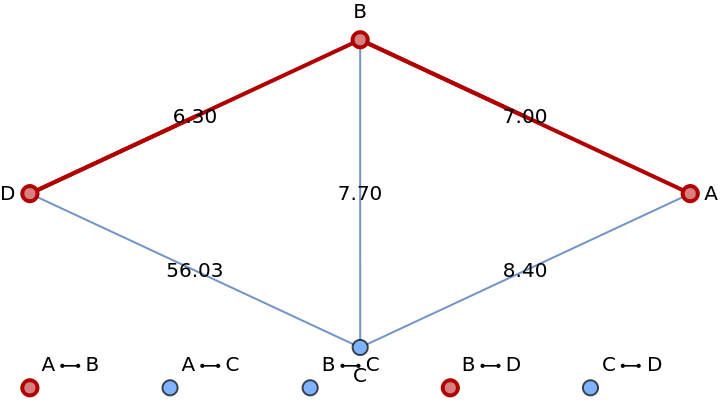
This Mathematica package, DaedaelusFabricCalculus`, provides a "code as proof" demonstration of the Daedaelus networking philosophy. It reframes the problem of network routing away from the traditional, flawed metric of raw bandwidth and towards a multi-dimensional understanding of transactional efficiency.The calculus is built on two core components:FabricMetricTensor: This function establishes the true "cost" of sending a transaction over a link. Instead of just considering bandwidth, it creates a TransactionalDistance that is a weighted function of latency, bandwidth, and link integrity. This reflects the reality that modern distributed applications are bottlenecked by latency and unreliability, not just bits per second.GeodesicTransactionRouter: This function embodies the principle of the "Graph Virtual Machine" (GVM). It takes a physical network topology (the N2N Lattice) and an application-defined policy (the weights) to compute the optimal, or "geodesic," path for a transaction.The interactive Manipulate block brings these concepts to life. By adjusting the flow slider, you can simulate stress on a particular link (A<->B). As the transactional cost of that link increases, you can see the GeodesicTransactionRouter dynamically recalculate the optimal path in real-time, switching from A-B-D to A-C-D when the former becomes too "expensive" according to the latency-focused policy. This is not just a routing algorithm; it's a demonstration of a fully adaptive, policy-aware Transaction Fabric that intelligently routes traffic based on the holistic health of the network and the specific requirements of the application. It is an escape from the entire statistical contention model of classical Ethernet.
This notebook demonstrates the rigorous, first-principles approach that underpins the Daedaelus philosophy. Using Mathematica as a formal specification language, we analyze the geometry of Schwarzschild spacetime by starting with its metric tensor and systematically deriving the Christoffel symbols, the Riemann curvature tensor, and finally the Kretschmann scalar. The purpose of this calculation is to identify true, invariant physical singularities in the spacetime curvature, distinguishing them from artifacts of a particular coordinate system. This "code-as-proof" methodology is central to our work , reflecting our commitment to analyzing the fundamental, invariant properties of any complex system, whether it is a gravitational field or a network Transaction Fabric.