In the WPP, the dimensionality of spacetime isn’t fixed, and it can change as a function of space, time, and scale. Interestingly, the same is also true for vanilla General Relativity (GR) due to presence of dimensional collapsars. Dimensional collapsars are created when wormholes collapse in on themselves, converting their cross-sectional topology into a compact space. An example of this is a collapsing 2-sphere wormhole going from 3+1D to 1+1D with a 2-sphere compact space. As our universe is likely nested within many dimensional collapsars, we should have many compact spaces, though most should be too small for their gauge fields to meaningfully impact the effective stress-energy tensor. GR has a feature known as gravitational waves. In our apparent 3+1D universe, gravitational waves have 2 different polarizations. However, if you add an extra 1-torus compact space, like that in Kaluza-Klein theory, you get 3 more. 2 of them are electromagnetic waves (yes, photons are quantized gravitational waves in this framework), and the other is the dimensional waves this project is about. Dimensional waves affect the dilaton (g₅₅) component of the metric tensor. It’s expected that the WPP has dimensional waves as well, so the results of this project are relevant to the WPP. As these phenomena are extremely sensitive to small length scales, the degree of discretization could have observable effects.
The variance of tensors used is indicated by their accents, so _ means fully covariant, ~ means fully contravariant, ` means mixed-index(specifically contravariant-covariant), and means vector. eigenchris’s 109 video series was used as a resource when making this project. Watching it will aid in understanding.
The variance of tensors used is indicated by their accents, so _ means fully covariant, ~ means fully contravariant, ` means mixed-index(specifically contravariant-covariant), and
v
We start with linearized gravity where is small
h
g
η
h
We then define the Lorenz Gauge
w
h
1
2
η
We can convert back using
h w 1 2 η | w= η w η h 1 2 η η n 2 2-n 2 |
h= 2w 2-n | h w 1 2 η w 1 2 η 2w 2-n w w 2-n η |
where n is the dimensionality. obeys the wave equation shown below
w
□=0
w
The d’Alembert operator is the Laplacian for Minkowski space(). This is actually enough to show that as well. This is left as an exercise to the reader, as is tradition. Another constraint we’ll apply to is
□=∇⋅∇
η
□=0
h
w
∇⋅=0
w
In order to get gravitational waves, we’ll need apply the Transverse-Traceless Gauge to . We will now define some variables
w
U ct | k k b ct x | h A k r |
U
k
k
b
A
A
U
A
k
A
To satisfy the first constraint, all ct components of must be 0. To satisfy the second constraint, all x components of must be 0 as well. To satisfy the third constraint, one element of the diagonals is determined by the other diagonals. For our 5D case, the remaining parts of are
A
A
A
A
0 | 0 | 0 | 0 | 0 |
0 | 0 | 0 | 0 | 0 |
0 | 0 | - A 44 A 55 | A 34 | A 35 |
0 | 0 | A 34 | A 44 | A 45 |
0 | 0 | A 35 | A 45 | A 55 |
In order to visualize the effects of gravitational waves on spacetime, we will have to utilize a linearized approximation of the square root as well.
1+x
≈1+x
2
1
g
1
η
1
A
k
r
1
η
1
2
1
A
k
r
1
A
2
k
r
Vectors applied to the final expression will be periodically distorted by the passing gravitational wave.
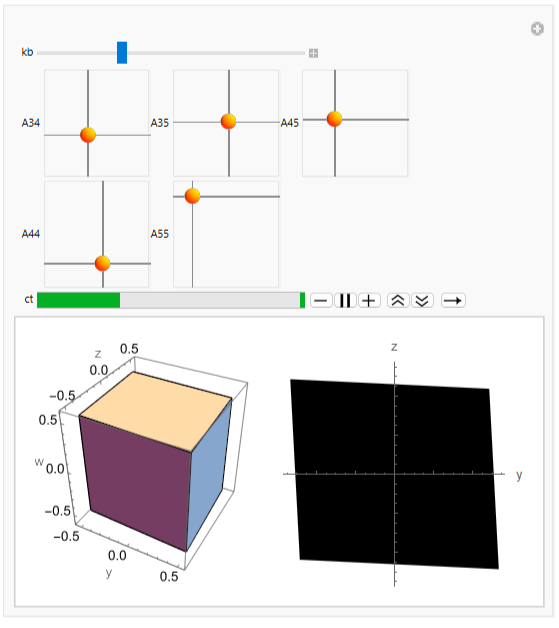
This project is about dimensional waves, and the 5th dimension is compact. As it’s compact, the wave vector can’t have any 5th index components. A₃₅ and A₄₅ are electromagnetic waves, and whilst related to dimensional waves, aren’t what we’re looking for. A₅₅ is the component which corresponds to dimensional waves, as it’s the component which encodes waves in the dilaton field, and how they couple to non-compact spacetime. In our above example, we can see how if the dilaton field expands, the y and z dimensions must shrink, and vice versa. In a patch of spacetime with dimensional waves passing through, the volume of non-compact space will fluctuate, which is fairly different from how normal gravitational waves behave, as they don’t change the volume of space. If the size of the compact space was multiplied by m, the volume of non-compact space would be divided by m.
This project is about dimensional waves, and the 5th dimension is compact. As it’s compact, the wave vector can’t have any 5th index components. A₃₅ and A₄₅ are electromagnetic waves, and whilst related to dimensional waves, aren’t what we’re looking for. A₅₅ is the component which corresponds to dimensional waves, as it’s the component which encodes waves in the dilaton field, and how they couple to non-compact spacetime. In our above example, we can see how if the dilaton field expands, the y and z dimensions must shrink, and vice versa. In a patch of spacetime with dimensional waves passing through, the volume of non-compact space will fluctuate, which is fairly different from how normal gravitational waves behave, as they don’t change the volume of space. If the size of the compact space was multiplied by m, the volume of non-compact space would be divided by m.
Non-Compact Volume: V xyz x 1 y m z m xyz m |
Perceived Non-Compact Volume: P xyz x m y m m z m m xyz 4 m |
The effect might be far more pronounced than the above implies. If the size of particles is coupled to the size of the largest 1-torus(electromagnetic field), as I suspect, then dimensional waves would also alter the size of particles. This has an amplifying effect. If the size of the compact space was multiplied by m, then the actual volume of the particles would be multiplied by m³(3 spatial dimensions) and time would pass m times slower for them(growth in the time dimension, plus light takes longer to circumnavigate them). If the particles were in a box, the volume of the box would appear to be divided by m⁴. It’s not clear if our universe has natural mechanisms which can create dimensional waves, so they still might not be observable. If dark matter is caused by matter sucking in non-compact spacetime and expelling it into compact spaces(similar to black hole coordinates that suck in spacetime), then it’s possible astrophysical phenomena could result in dimensional waves. A change in the relative sizes of compact spaces relevant to our particle physics should result in the relative strengths of fundamental forces changing as well. This could be observed as slight changes to various constants. I should stress that if the size of a compact space determines the size of particles, that means the particle volume altering effects will only occur for dimensional waves in that compact space. I have also not checked whether or not the topology of the compact spaces are important with regard to their dimensional waves. It is a topic for future research, as is dark matter being caused by dilaton fields being locally inflated by matter, and diffusing out over space, creating a localized bump (halo) in the dilaton field.
Other topics for future research are:
Other topics for future research are:
What happens when gravitational waves in general move through spacetime with a static, spatially varying dilaton field? Do they get diffracted, and if so, is it polarization dependent?
If electromagnetic waves are gravitational waves, can we use light to probe for the gravitational memory effect? If we managed to observe it with light, would this constitute proof of the existence of compact spaces?
Can a 5D Kaluza-Klein-Schwarzschild black hole metric be designed such that spacetime isn’t sucked into a singularity and instead expelled into compact spaces? Could this allow for a singularity-free black hole solution?
Could the above metric be modified into a traversable wormhole metric where the dilaton field is used to stabilize a 2-sphere wormhole?
If the size of the 1-torus compact space (dilaton field) controls the size (and rate of time passage) of particles, then does a static, spatially varying dilaton field alone mimic the effect of gravity?
If dark energy is caused by a time-varying dilaton field, how should it behave?
Code:
Code:
In[]:=
gravWaveManip[a___]:=Module[{kb,a44,a55,a34,a35,a45,maxA=0.3,interm1,interm2,aInit=ReIm@PadRight[{a},6,{0,0,0,0,0,1}]},Manipulate[interm1={{-a44-a55,a34,a35},{a34,a44,a45},{a35,a45,a55}}.{1,I}/2;interm2=(1/2)Max/@Transpose@ArrayReshape[Table[1+Abs[(interm1.{1,ry,rz})],{ry,-1,1,2},{rz,-1,1,2}],{4,3}];Dynamic[Grid[{{Graphics3D[GeometricTransformation[Cube[],IdentityMatrix[3]+Re[Exp[-ctkbI]interm1]],PlotRange->Evaluate[{-1,1}#&/@interm2],Axes->True,AxesLabel->{"y","z","w"},Background->Transparent],Graphics[GeometricTransformation[Rectangle[-{1,1}/2],IdentityMatrix[2]+Re[Exp[-ctkbI]interm1[[1;;2,1;;2]]]],PlotRange->Evaluate[{-1,1}#&/@interm2[[1;;2]]],Axes->True,AxesLabel->{"y","z"}]}}]],{{kb,aInit[[6,1]],"kb"},0,5},Row@(Control/@{{{a34,aInit[[1]],"A34"},-maxA{1,1},maxA{1,1}},{{a35,aInit[[2]],"A35"},-maxA{1,1},maxA{1,1}},{{a45,aInit[[3]],"A45"},-maxA{1,1},maxA{1,1}}}),Row@(Control/@{{{a44,aInit[[4]],"A44"},-maxA{1,1},maxA{1,1}},{{a55,aInit[[5]],"A55"},-maxA{1,1},maxA{1,1}}}),{{ct,0,"ct"},0,Infinity},SynchronousUpdating->False]]
In[]:=
gravWaveManip[-0.066-0.075I,0.01+0.015I,-0.144+0.03I,0.032-0.19I,-0.23+0.255I,Pi/2]
CITE THIS NOTEBOOK
CITE THIS NOTEBOOK
Dimensional Waves
by Michael Ostroff
Wolfram Community, STAFF PICKS, January 10, 2024
https://community.wolfram.com/groups/-/m/t/3101088
by Michael Ostroff
Wolfram Community, STAFF PICKS, January 10, 2024
https://community.wolfram.com/groups/-/m/t/3101088