Hopf Bifurcation in a Biased van der Pol Oscillator
Hopf Bifurcation in a Biased van der Pol Oscillator


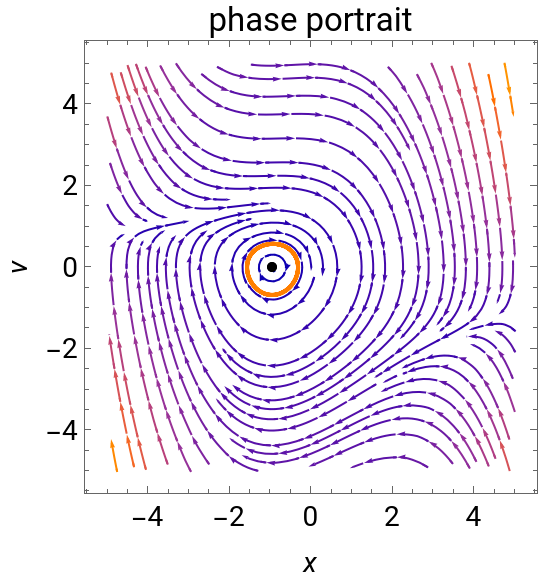

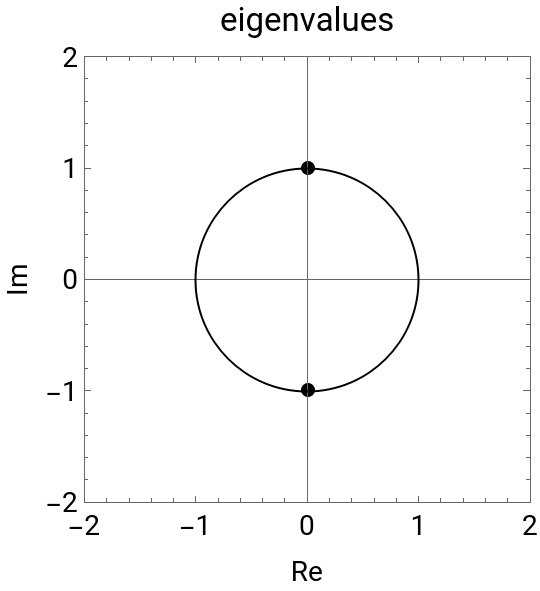
The biased van der Pol oscillator is represented by the nonlinear differential equation +μ(-1)+x=a (see Exercise 8.2.1 of[1]). This system is capable of exhibiting Hopf bifurcations, in which limit cycle attractors or repellers are created. Hopf bifurcations occur when eigenvalues for the fixed point cross the imaginary axis. When , supercritical Hopf bifurcations occur at or , and a stable limit cycle (attractor) is formed for in the phase portrait. When , a subcritical Hopf bifurcation occurs at or , and an unstable limit cycle (repeller) is found for in the phase portrait. For , a degenerate Hopf bifurcation occurs, in which there are an infinite number of periodic solutions but no limit cycles. No limit cycle is found outside the range . In the phase portrait, an attractor is represented as a solid line and a repeller is represented as a dotted line.
..
x
2
x
x
μ>0
a=1
-1
-1<a<1
μ<0
a=1
-1
-1<a<1
μ=0
-1<a<1
References
References
[1] S. H. Strogatz, Nonlinear Dynamics and Chaos: With Applications to Physics, Biology, Chemistry, and Engineering, 2nd ed., Boulder, CO: Westview, 2015.
Permanent Citation
Permanent Citation
Tushar Mollik, Edmon Perkins, Steven H. Strogatz
"Hopf Bifurcation in a Biased van der Pol Oscillator"
http://demonstrations.wolfram.com/HopfBifurcationInABiasedVanDerPolOscillator/
Wolfram Demonstrations Project
Published: October 24, 2018