Trigonometric functions, including sine, cosine, and tangent, are fundamental concepts in mathematics that describe relationships within triangles. These functions have periodic properties, meaning they repeat their values in regular intervals. Specifically, the sine and cosine functions have a period of 2π radians, which means they repeat their values every
2π radians. On the other hand, the tangent function has a period of π radians. Understanding these functions and their periodic nature is crucial not only in mathematics but also in various real-world applications, such as in electronics and signal processing.
2π radians. On the other hand, the tangent function has a period of π radians. Understanding these functions and their periodic nature is crucial not only in mathematics but also in various real-world applications, such as in electronics and signal processing.
Convert radian to degree
Convert radian to degree
a
π
μ
◦
180
If you have an angle in degrees and you want to convert it to radians, you can use the following expression :
θ
In[]:=
degreesToRadians[deg_]:=deg*Pi/180
For example, to convert 45 degrees to radians :
In[]:=
degreesToRadians[45]
Out[]=
π
4
Now, if we want to convert radians to degrees
In[]:=
(Pi/4)*(180Degree/Pi)
Out[]=
45°
Exercise 1
Exercise 1
Calculate the trigonometric values for an angle of
o
750
To calculate the trigonometric values for an angle of , we’ll first need to reduce the angle to its equivalent value between and . Since is more than , the equivalent angle is - = .
◦
750
◦
0
◦
360
◦
750
◦
390
◦
360
◦
390
◦
360
◦
30
In[]:=
angle=Mod[750,360]
Out[]=
30
In[]:=
sinValue=Sin[angleDegree];cosValue=Cos[angleDegree];tanValue=Tan[angleDegree];
In[]:=
{sinValue,cosValue,tanValue}
Out[]=
,,
1
2
3
2
1
3
Exercise 2
Exercise 2
Calculate the trigonometric values of the angle radians.
79π
3
In[]:=
angle=Mod[79*Pi/3,2*Pi];sinValuerad=Sin[angle];cosValuerad=Cos[angle];tanValuerad=Tan[angle];{sinValuerad,cosValuerad,tanValuerad}
Out[]=
,,
3
2
1
2
3
Exercise 3
Exercise 3
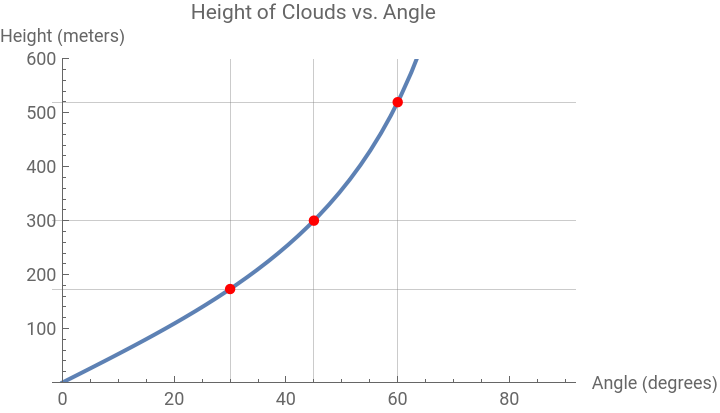
In small airports, they calculate the height of the clouds using a powerful lamp within a parabolic mirror, which is located at a distance of 1000 feet (1 foot ) from the observer' s point . The lamp is placed at a fixed angle, and the observer turns the observation instrument to the point of light reflection from the clouds .
≈0.3m
1
. Determine the height for and .
h
ω,
◦
30
◦
45
◦
60
2
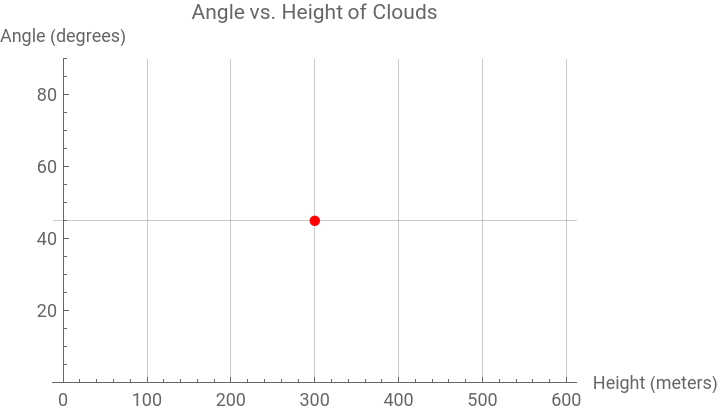
. What is the angle if feet?
ω
h1000
In[]:=
distance=1000*0.3;(*distanceinmeters*)heights=distance*Tan[#Degree]&/@{30,45,60};{heights}
Out[]=
{{173.205,300.,519.615}}
In[]:=
Plot[distance*Tan[omegaDegree],{omega,0,90},AxesLabel->{"Angle (degrees)","Height (meters)"},PlotLabel->"Height of Clouds vs. Angle",GridLines->{{30,45,60},{173.21,300,519.62}},PlotRange->{0,600},Epilog->{Red,PointSize[0.02],Point[{{30,173.21},{45,300},{60,519.62}}]}]
Out[]=
In[]:=
angleFor1000Feet=ArcTan[1000*0.3/distance]*180/Pi
Out[]=
45.
In[]:=
Plot[distance/ArcTan[h/distance]*180/Pi,{h,0,600},AxesLabel->{"Height (meters)","Angle (degrees)"},PlotLabel->"Angle vs. Height of Clouds",GridLines->{Automatic,{45}},PlotRange->{0,90},Epilog->{Red,PointSize[0.02],Point[{300,45}]}]
Out[]=
Trigonometric Table
Trigonometric Table
In[]:=
values=Table[{Inactive[Sin][θ]==Sin[θ],Inactive[Cos][θ]==Cos[θ],Inactive[Tan][θ]==Tan[θ]},{θ,0,2Pi,Pi/12}];
In[]:=
First[values]
Out[]=
{Sin[0]0,Cos[0]1,Tan[0]0}
In[]:=
Grid[Join[{Item[Style[#,FontSizeLarger],BackgroundGrayLevel[0.9]]&/@{Sin[θ],Cos[θ],Tan[θ]}},values/.ComplexInfinityInfinity],DividersAll,Alignment{"",Center}]//TraditionalForm
Out[]//TraditionalForm=
sin(θ) | cos(θ) | tan(θ) |
sin(0)0 | cos(0)1 | tan(0)0 |
sin π 12 3 -12 2 | cos π 12 1+ 3 2 2 | tan π 12 3 |
sin π 6 1 2 | cos π 6 3 2 | tan π 6 1 3 |
sin π 4 1 2 | cos π 4 1 2 | tan π 4 |
sin π 3 3 2 | cos π 3 1 2 | tan π 3 3 |
sin 5π 12 1+ 3 2 2 | cos 5π 12 3 -12 2 | tan 5π 12 3 |
sin π 2 | cos π 2 | tan π 2 |
sin 7π 12 1+ 3 2 2 | cos 7π 12 3 -12 2 | tan 7π 12 3 |
sin 2π 3 3 2 | cos 2π 3 1 2 | tan 2π 3 3 |
sin 3π 4 1 2 | cos 3π 4 1 2 | tan 3π 4 |
sin 5π 6 1 2 | cos 5π 6 3 2 | tan 5π 6 1 3 |
sin 11π 12 3 -12 2 | cos 11π 12 1+ 3 2 2 | tan 11π 12 3 -2 |
sin(π)0 | cos(π)-1 | tan(π)0 |
sin 13π 12 3 -12 2 | cos 13π 12 1+ 3 2 2 | tan 13π 12 3 |
sin 7π 6 1 2 | cos 7π 6 3 2 | tan 7π 6 1 3 |
sin 5π 4 1 2 | cos 5π 4 1 2 | tan 5π 4 |
sin 4π 3 3 2 | cos 4π 3 1 2 | tan 4π 3 3 |
sin 17π 12 1+ 3 2 2 | cos 17π 12 3 -12 2 | tan 17π 12 3 |
sin 3π 2 | cos 3π 2 | tan 3π 2 |
sin 19π 12 1+ 3 2 2 | cos 19π 12 3 -12 2 | tan 19π 12 3 |
sin 5π 3 3 2 | cos 5π 3 1 2 | tan 5π 3 3 |
sin 7π 4 1 2 | cos 7π 4 1 2 | tan 7π 4 |
sin 11π 6 1 2 | cos 11π 6 3 2 | tan 11π 6 1 3 |
sin 23π 12 3 -12 2 | cos 23π 12 1+ 3 2 2 | tan 23π 12 3 -2 |
sin(2π)0 | cos(2π)1 | tan(2π)0 |
Trigonometric Functions
Trigonometric Functions
Exercise 4
Exercise 4
Exercise 5
Exercise 5
Exercise 6
Exercise 6
Exercise 7
Exercise 7
The period is :
Exercise 8
Exercise 8
Exercise 9
Exercise 9
◼
Find the period of the oscillation.
◼
Calculate the difference between the maximum and minimum height.
CITE THIS NOTEBOOK
CITE THIS NOTEBOOK
Understanding the periodic nature of Trigonometric functions
by Athanasios Paraskevopoulos
Wolfram Community, STAFF PICKS, October 22, 2023
https://community.wolfram.com/groups/-/m/t/3053689
by Athanasios Paraskevopoulos
Wolfram Community, STAFF PICKS, October 22, 2023
https://community.wolfram.com/groups/-/m/t/3053689