Symmetry in Graphs of Functions and Relations
Symmetry in Graphs of Functions and Relations



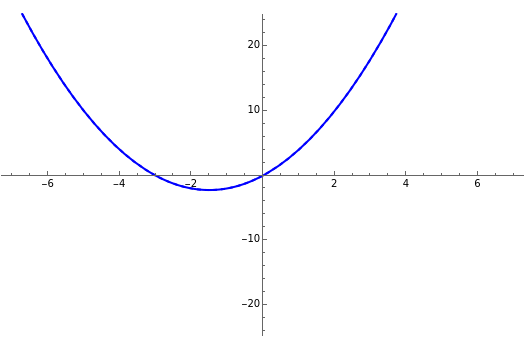
This Demonstration shows the three types of symmetry commonly studied in graphs: symmetry with respect to the axis, the axis, or the origin.
x
y
A graph has symmetry with respect to the axis if reflecting it across the axis yields an identical graph. The graph of an equation has this symmetry if replacing with in the equation yields the identical equation.
x
x
y
-y
A graph has symmetry with respect to the axis if reflecting it across the axis yields an identical graph. The graph of an equation has this symmetry if replacing with in the equation yields the identical equation.
y
y
x
-x
A graph has symmetry with respect to the origin if reflecting the graph across both the axis and axis yields an identical graph. The graph of an equation has this symmetry if replacing with and with in the equation yields the identical equation.
x
y
x
-x
y
-y
Details
Details
The graph of a function that is not identically zero is never symmetric with respect to the axis as it necessarily fails the vertical line test (e.g. =5x- and ). A function whose graph is symmetric with respect to the axis is called even (e.g. and ). A function whose graph is symmetric with respect to the origin is called odd (e.g. ).
x
2
y
3
x
|y|=+1
3
x
y
y=-+25-30+10-3
8
x
6
x
4
x
2
x
y=-2+21+14+1
6
x
4
x
2
x
y=
1
x
Equations that are symmetric to both the axis and axis will necessarily also be symmetric with respect to the origin (e.g. -=1). However, this is not a requirement for a graph to be symmetric with respect to the origin (e.g. ).
x
y
2
y
2
x
y=
1
x
External Links
External Links
Permanent Citation
Permanent Citation
Laura R. Lynch
"Symmetry in Graphs of Functions and Relations"
http://demonstrations.wolfram.com/SymmetryInGraphsOfFunctionsAndRelations/
Wolfram Demonstrations Project
Published: June 5, 2014