Example 18.6-2 reproduced from Ref. 1
Example 18.6-2 reproduced from Ref. 1
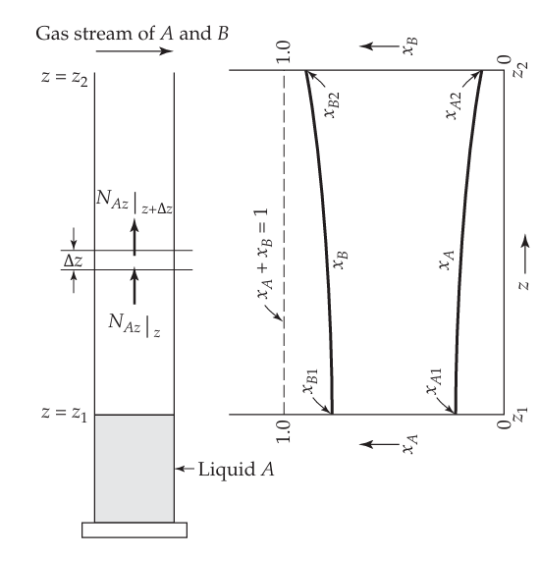
The diffusivity of the gas pair O2-CCl4 is being determined by observing the steady-state evaporation of carbon tetrachloride into a tube containing oxygen, as shown in the Figure below. The distance between the CCl4 liquid level and the top of the tube is z2 − z1 = 17.1 cm. The total pressure on the system is 755 mmHg , and the temperature is 0 °C . The vapor pressure of CCl4 at that temperature is 33 .0 mmHg and its liquid density is 1 .629 g∕cm3 . The cross-sectional area of the diffusion tube is 0.82 cm2 . It is found that 0 .0208 cm3 of liquid CCl4 evaporates in a 10-hour period after steady state has been attained. It may be assumed that the partial pressure of CCl4 at z=z2 is zero. What is the diffusivity of the gas pair O2 - CCl4 ? We consider O2 as stagnant since it is insoluble in liquid CCl4.
TheArnoldcell
Vapor pressure of CCl4 at 0 °C
Antoine Equation where T in K and Psat in bar
In[]:=
A1=4.02291;B1=1221.781;C1=-45.739;
In[]:=
10^(A1-B1/(C1+T))/.T->273.15
Out[]=
0.0447036
In[]:=
%760/1.01325(*vaporpressureofCCl4at0°CexpressedinmmHg*)
Out[]=
33.5304
The molar flux of CCl4
◼
0.0208 cm3 of CCl4 evaporates during 10 hours
◼
liquid density of CCl4 is 1.629 g/cm3
◼
cross-section area is 0.82 cm2
◼
10 hours is 3.6 10^4 seconds
◼
Molecular weight of CCl4 is equal to 153.82 g/mol
In[]:=
MWA=153.82;
In[]:=
NAz=0.02081.629/MWA/0.82/(3.610^4)
Out[]=
7.462×
-9
10
The diffusion of CCl4 in stagnant O2 without neglecting the convection term is governed by:

In[]:=
DIFF1=NAz17.1×82.06273/P/Log[755/722](*dz=17.1cm*)
Out[]=
0.0639602
P
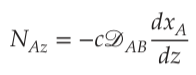
The diffusion of CCl4 in stagnant O2 if we neglect the convection term is governed by:
In[]:=
DIFF2=NAz17.182.06/P273(33/755)^-1
Out[]=
0.0654001
P
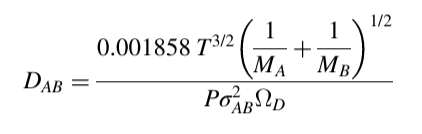
Estimation of the diffusivity of CCl4 in O2 using the relationship of Ref. 2:
In[]:=
Clear[A,B,C1,D1,E1,F,G,H,R,S,W,P]
In[]:=
OMEGA11=A/TS^B+C1/Exp[D1TS]+E1/Exp[FTS]+G/Exp[HTS](*collisionintegralbyNeufeld(seeRef.3)*)
Out[]=
C1+E1+G+A
-D1TS
-FTS
-HTS
-B
TS
In[]:=
A=1.06036;B=0.15610;C1=0.19300;D1=0.47635;E1=1.03587;F=1.52996;G=1.76474;H=3.89411;
In[]:=
sigmaA=5.881;sigmaB=3.433;sigmaAB=1/2(sigmaA+sigmaB)
Out[]=
4.657
In[]:=
EPSILONsurKappaA=327.;EPSILONsurKappaB=113;EPSILONsurKappaAB=Sqrt[EPSILONsurKappaAEPSILONsurKappaB]
Out[]=
192.226
In[]:=
T=273;P=755/760;(*totalpressureinatm*)
In[]:=
DIMENTIONLESStemperature=T/EPSILONsurKappaAB(*dimensionlesstemperature*)
Out[]=
1.4202
In[]:=
OMEGAD=OMEGA11/.TS->DIMENTIONLESStemperature(*collisionintegral*)
Out[]=
1.22691
In[]:=
MWB=32;
In[]:=
DIFF3=0.001858T^1.5/P/sigmaAB^2/OMEGAD(1/MWA+1/MWB)^0.5(*unit:cm2/s*)
Out[]=
0.0616023
Relative errors : we consider DIFF1 as the exact value of the diffusivity obtained using experimental data and without dropping the convection term
In[]:=
DIFF2-DIFF1
Out[]=
0.00144946
In[]:=
%100/DIFF1(*approximately2%relativeerror*)
Out[]=
2.25128
In[]:=
Abs[DIFF3-DIFF1]
Out[]=
0.0027815
In[]:=
%100/DIFF1(*approximately4%relativeerror*)
Out[]=
4.32018
References
References
◼
[1] R. B. Bird, W. E. Stewart, E. N. Lightfoot and D. J. Klingenberg, Introductory Transport Phenomena, NY: Wiley, 2015.
◼
[2] J. O. Hirschfelder, R. B. Bird, and E. L. Spotz, Chem. Rev., 44, 205 (1949).
◼
[3] P. D. Neufeld, A. R. Janzen, and R. A. Aziz, J. Chem. Phys., 57, 1100 (1972).
CITE THIS NOTEBOOK
CITE THIS NOTEBOOK
Diffusivity of carbon tetrachloride into oxygen
by Housam Binous & Ahmed Bellagi
Wolfram Community, STAFF PICKS, March 13, 2025
https://community.wolfram.com/groups/-/m/t/3415906
by Housam Binous & Ahmed Bellagi
Wolfram Community, STAFF PICKS, March 13, 2025
https://community.wolfram.com/groups/-/m/t/3415906