CITE THIS NOTEBOOK: A Philosophical Analysis of The Physicalization of Metamathematics by Lucas Salim. Wolfram Community JAN 13 2023.
Abstract: Physics and Mathematics are generally regarded to have different epistemological status in their methodology; hence, it is not obvious to see the philosophical status of physicalized metamathematics. The goal of this project is to make sense of this physicalization. Moreover, we will try to consider the notion of computation as a duality between the two subjects.
Making philosophical sense of the duality between physics and mathematics
Making philosophical sense of the duality between physics and mathematics
In “Metamathematics: Foundations & Physicalization”, Wolfram makes the astonishing claim that physics and mathematics have the same foundation. It is generally considered that physics is foundational to our scientific knowledge and to our universe (after all, physics is itself the study of fundamental aspects of our world such as space and time, matter, energy, etc), but according to Stephen, there is a more general process underlying everything that gives rise to physics and even mathematics. In fact, it connects these seemingly different areas of sciences on a very deeper level. That is, under the view of this “structure”, physics and mathematics become the same thing.
How are mathematics and physics different?
How are mathematics and physics different?
This duality suggested by Stephen is touching on a complicated issue, in a very deep philosophical sense: the epistemology between mathematics and physics. Mathematics as a formal science is generally considered to use the a priori methodology, not depending on sense experience of experiments. It is true that the mathematician uses pencil and paper and computers to help the proof of mathematical statements, but in principle these “empirical devices” are not required. They serve as an expansion to the incredibly small memory capacity and slow mental calculation of the mathematician’s brain. Physics as a natural science, although uses mathematics as a tool, does depend on experiments to confirm its theories, and is therefore considered empirical; the truths of physical theories are posterior to sense experience. It does use mathematical ideas and theorems in its theories, but no truth in physics exists without confirmation from experiments. To say there is a deep underlying structure that connects both sciences automatically brings into question its own epistemological status (and even ontological). Do we know of it because it is necessarily true? Is it a priori? A posteriori? Does it exist in the physical world?
What is Naturalism?
What is Naturalism?
Posing the difference between the a priori and the a posteriori is one thing, and even though one definition of such distinction was mentioned here, the way in which we conclude things about the epistemology of our sciences will depend on how we define such distinction. Many philosophers on the philosophy of mathematics have placed mathematics in the quasi-empirical category (being almost as empirical as physics) (e.g., Putnam). This is still debatable until today, but as we will see through Quine, one may as well reject any distinction posed between the a priori and the a posteriori. As an empiricist, Quine believed that all knowledge is empirical (posteriori to sense experience). To see this, let us understand Quine's naturalism. Naturalism is the view that philosophy and science belong to the same enterprise. The philosophical realm is continuous with the scientific, it is not prior (nor preferable) to it. Our best theories about the universe are scientific theories (and by “scientific” here, we mean the science that uses empirical investigation). In practice, this means that metaphysical questions should be answered (or at least perpetuated) by our best science. For example, does God exist? The naturalist approach is: does our best scientific theory include the existence of God? Essentially, if a theory is unscientific, it is metaphysically useless. Quine’s view suggests that mathematics and physics only differ in a degree of generality; that is, they have the same empirical and ontological status after all. It does not even make sense to pose the distinction between the a priori and the a posteriori. Everything has to be posterior to sense experience.
Empirical Mathematics
Empirical Mathematics
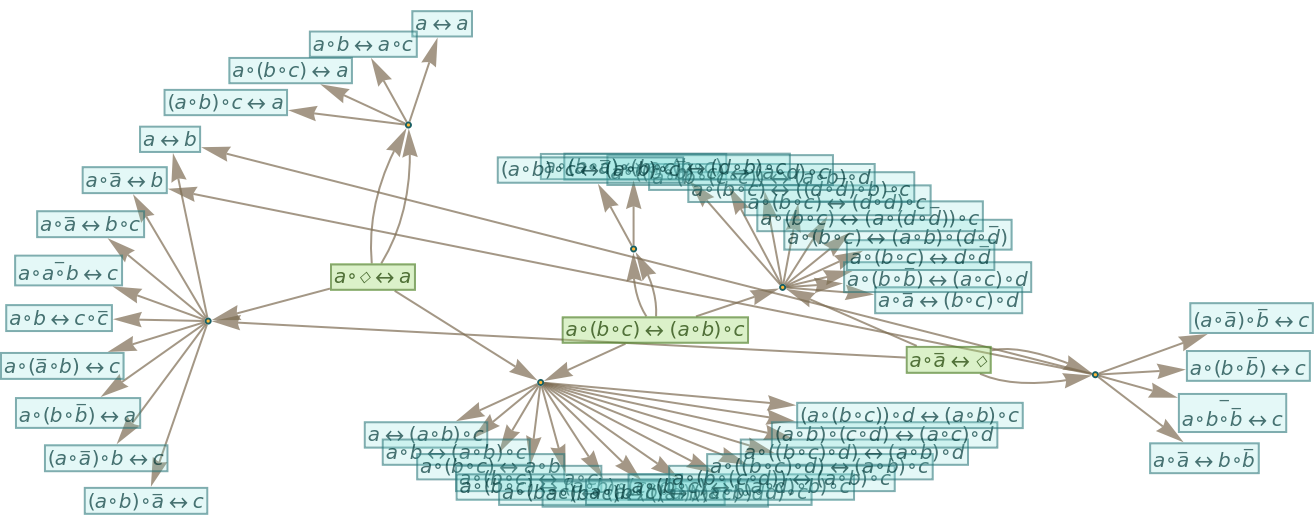
In what sense then can we see the mathematician’s job as an empirical practice? Usually, his job is to come up with some conjecture (for some reason he might find it interesting or valuable) and then try to prove it. Here, however, we are letting computation run from the most basic statements (axioms) to the most complicated theorems. For example, the multiway accumulate evaluation of the group theory axioms using substitution, cosubstitution, and bisubstitution:
Out[]=
,
,
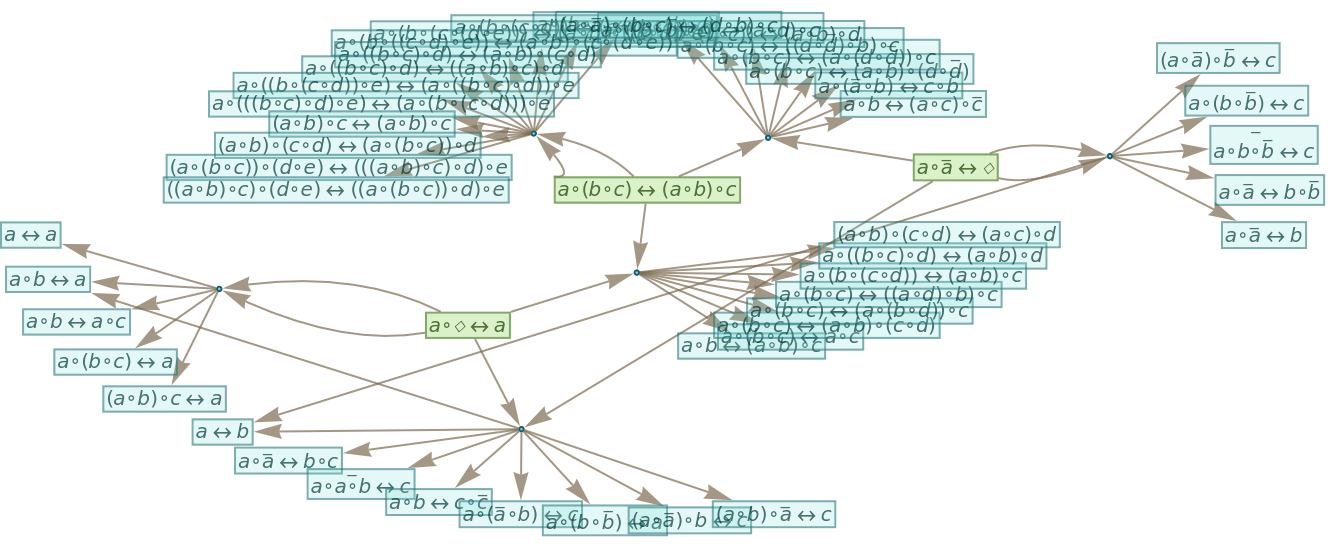
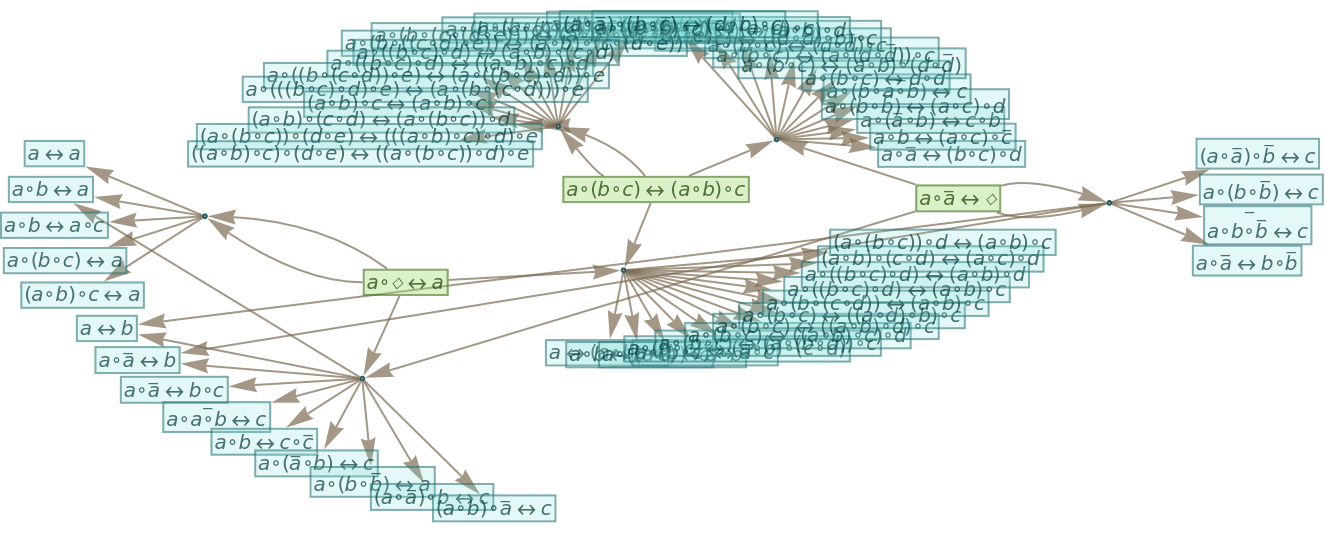
In this sense, the practice of mathematics and the construction of its objects become purely computational, in which computing rewriting systems is the mathematician’s experiment. A mathematical proof, therefore can be seen simply as an output of this computational process. Again, let us consider the axioms from Group Theory:
Out[]=
a∘(b∘c)(a∘b)∘c |
a∘◇a |
a∘ a |
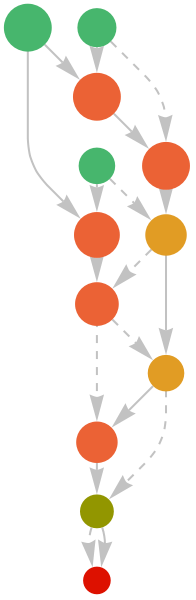
Then by looking at the entailment cone, we can see what follows from the axioms (only using substitution, cosubstitution, and bisubstitution). It turns out that to prove the usual propositions from group theory, such as
Out[]//TraditionalForm=
inverse of inverse | a |
left identity | ◇∘aa |
left inverse | a |
inverse of composite | a∘b b a |
we need to go a bit further than two steps:
Out[]=
,
,
,
inverse of inverse |
left identity |
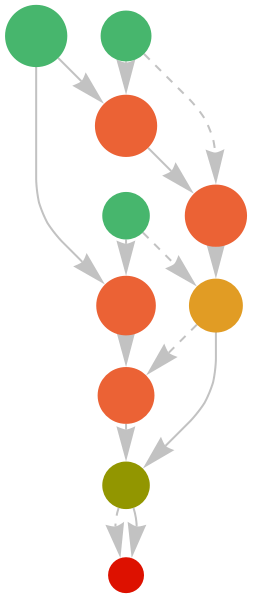
left inverse |
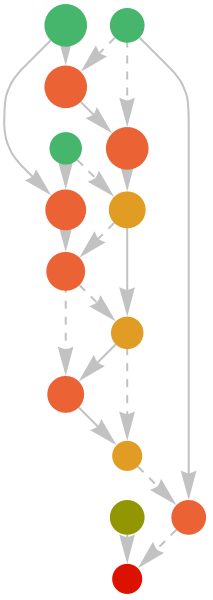
inverse of composite |
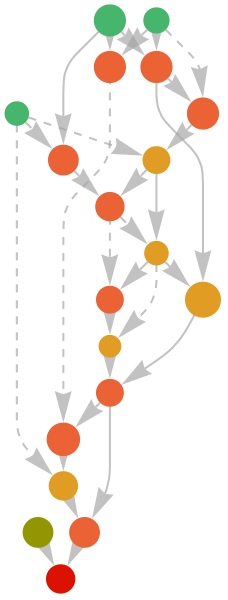
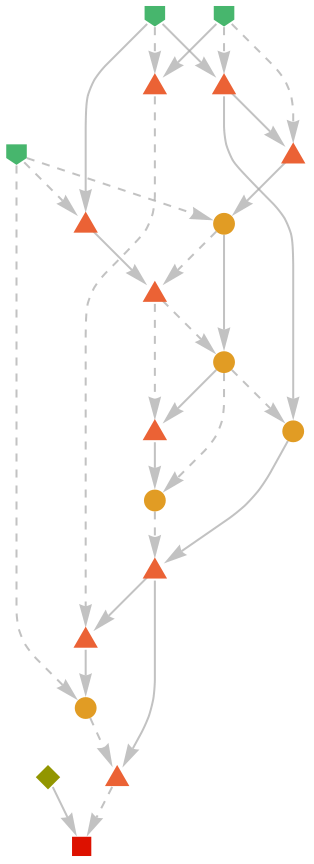
For example, we can generate the proof of "inverse of composite":
In[]:=
groupTheory={ForAll[{a,b,c},g[a,g[b,c]]==g[g[a,b],c]],ForAll[a,g[a,e]==a],ForAll[a,g[a,inv[a]]==e]}
Out[]=
g[a,g[b,c]]g[g[a,b],c],g[a,e]a,g[a,inv[a]]e
∀
{a,b,c}
∀
a
∀
a
In[]:=
proof=FindEquationalProof[ForAll[{a,b},inv[g[a,b]]==g[inv[b],inv[a]]],groupTheory]
Out[]=
ProofObject


In[]:=
proof["ProofGraph"]
Out[]=
Out[]=

Indispensability argument for computational realism and the ruliad
Indispensability argument for computational realism and the ruliad
The physics project also let us treat physical system in the same manner:
These examples suggests that the duality between physics and mathematics, or, as Wolfram puts it, the “physicalized metamathematics” is in its essence computation. In the web of belief of all knowledge, computation serves as a building block of mathematical theorems and physical theories, both of which would belong to the realm of physical reality. To ask "what is computation?" is a somewhat of a crucial question here, because Stephen's view is really that the entire universe is computation. Not the computation of some specific rules, but "the infinite limits of all possible rules, all possible initial conditions and all possible steps." That is, essentially, what Stephen calls the ruliad. By this description, we see that the ruliad is a "platonic thing" living outside space-time. An eternal necessary condition to everything. This is inconsistent with naturalism. It uses the idea of a platonic object, concepts such as "eternal", and "living outside space-time", which one may easily argue are not scientific. But notice that when we take a slice of the ruliad (when we, observers, sample it by making some kind of computation), we get something indispensable to science. Suppose a naturalist accepts Quine’s indispensability argument in favor of mathematical realism. It follows that he should also accept an indispensability argument for "computational realism” in which the argument's structure stays the same but “mathematics” is replaced by “computation” since the latter is more fundamental than the former. Here is what the argument would look like:
(P1) We ought to have ontological commitment to all and only the entities that are indispensable to our best scientific theories.
(P2) Computation is indispensable to our best scientific theories.
(C) We ought to have ontological commitment to computation.
(P1) is justified through naturalism and confirmational holism. According to conformational holism, if a scientific theory is confirmed, then the whole theory is confirmed; whatever was part of the theory was also confirmed (e.g., mathematics, computation, etc). Moreover, confirmation holism gives rise to the Duhem–Quine thesis, which argues that no scientific hypothesis can be tested in isolation; whenever one tests such hypothesis, it also must test the entire set of assumptions used to make such theory (the whole theory will be tested, not only the overlying hypothesis). (P2) is justified by Stephen Wolfram, through A New Kind of Science (2002). On the on hand, naturalism does not allow the existence of abstract entities in our best scientific theories. On the other, it implies that we should have "ontological commitment" to computation. But when should this ontological commitment stop? More precisely, at what point does computation stop being this empirical human process, and becomes this a priori platonic thing?
What about us, the observers?
What about us, the observers?
What about us, the observers? We will always face a problem in scientific testing. Always. The issue is that a scientific hypothesis is a human thing while the universe is not. In order to test a hypothesis we must first assume that we are in position to do so; namely, that the universe works according to our perspective of itself. To be clear, this is not an assumption inside a possible scientific hypothesis (so by the Duhem-Quine thesis, we are not really testing it); it is one about the notion of testing the hypothesis itself. We have no reason to assume that the universe works according to the way our mind think it does, even though that is accurately what science has been accomplishing for its presence in history (because that is literally its point; it translates natural phenomena into human language so that we can explain it). Any theory about the world will be shaped according to our human perspective about the world. Precisely, one should understand this statement in two different ways: the theory will be bounded by our capability of understanding it (meaning that it will be logically sound to us), and it will be bounded by our capability of observing the world (meaning that it will depend on the limits of our sensorial perception). This will always be a problem, but arguably one in which scientists do not need to worry. It does not tells us that we are not allowed to make assumptions, much less that we should not make them. It is just a reminder that science is ultimately a human practice.
Acknowledgment
Acknowledgment
I would like to thank James Boyd, Carlos Zapata, Hatem Elshatlawy, Łukasz Majsiak, and Nik Murzin for their time and dedication in hours of philosophical conversations.
References
References
◼
A New Kind of Science, Stephen Wolfram
◼
Metamathematics: Foundations & Physicalization, Stephen Wolfram