The word electroencephalographic is not only long (23 letters) but is also unique--it’s the longest possible 1-word solution to the New York Times puzzle called Letter Boxed. I used Wolfram Language to dig into 1-word solutions of Letter Boxed to make this and other interesting discoveries.
Rules of Letter Boxed
Rules of Letter Boxed
For readers unfamiliar with Letter Boxed, here are the rules. (If you know the rules, skip this section.)
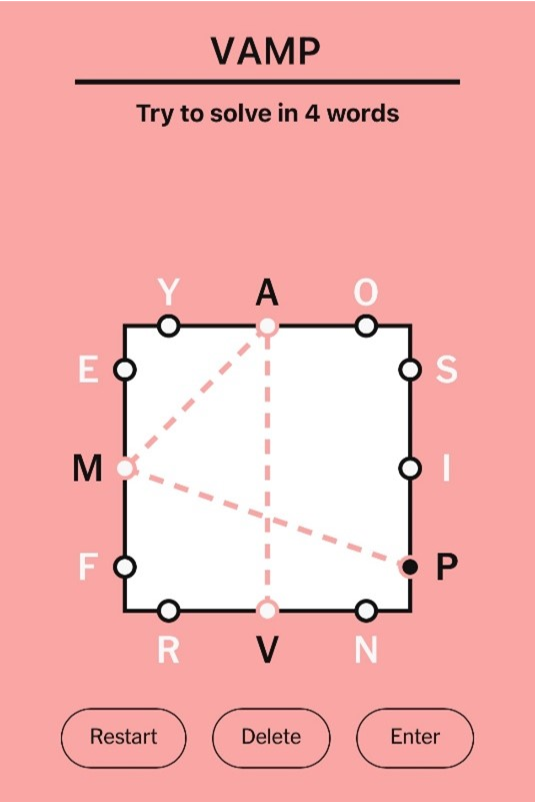
◼
Connect letters to spell words.
◼
Letters can be reused (e.g., ROSES in the puzzle above), but consecutive letters cannot be from the same side (e.g., VAMPS, because P and S are on the same side).
◼
Words must be at least 3 letters long and cannot be proper nouns or hyphenated..
◼
The last letter of a word becomes the first letter of the next word (e.g. VAMP - PERSON - NORM).
◼
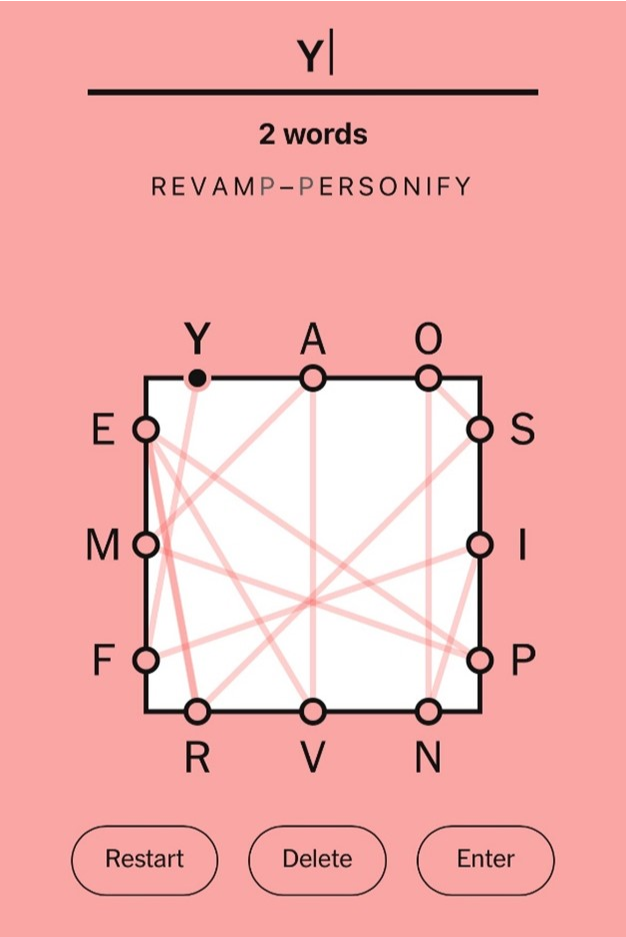
A solution to Letter Boxed is a string of one or more words that uses all of the letters in the puzzle (e.g., REVAMP - PERSONIFY is a 2-word solution).
2-Word Solutions
2-Word Solutions
Every Letter Boxed puzzle has at least one 2-word solution like REVAMP-PERSONIFY shown above. In my initial exploration of Letter Boxed, I challenged myself to write a Wolfram Language program that generated these 2-word solutions. This took a little tinkering, but I eventually came up with one: https://www.wolframcloud.com/obj/jeffw/LetterBoxed.
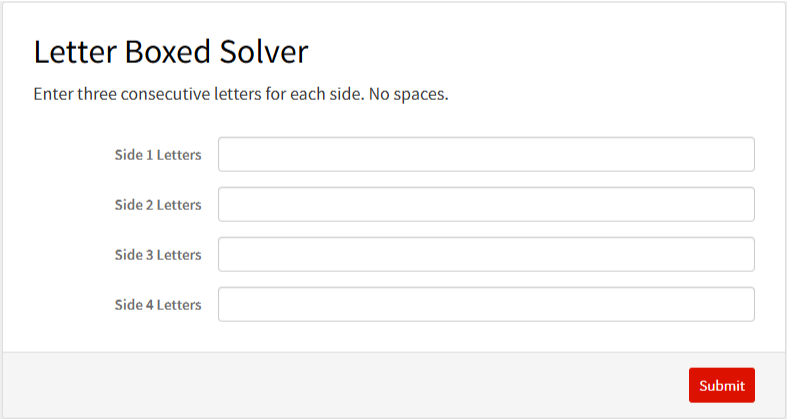
Any solver is only as good as the word list it is based on; my solver uses a 92,000+ word list built into Wolfram Language (available via the function DictionaryLookup). I have noticed that the Wolfram Language word list doesn’t contain some newer words (e.g., ROMCOM) or words borrowed from another language (e.g., KIBBITZ), but otherwise it does the job.
1-Word Solutions?
1-Word Solutions?
After playing the puzzle for a while, I came across a 2-word solution where one of the words used 11 of the 12 letters (the word CHRYSANTHEMUM, shown below).
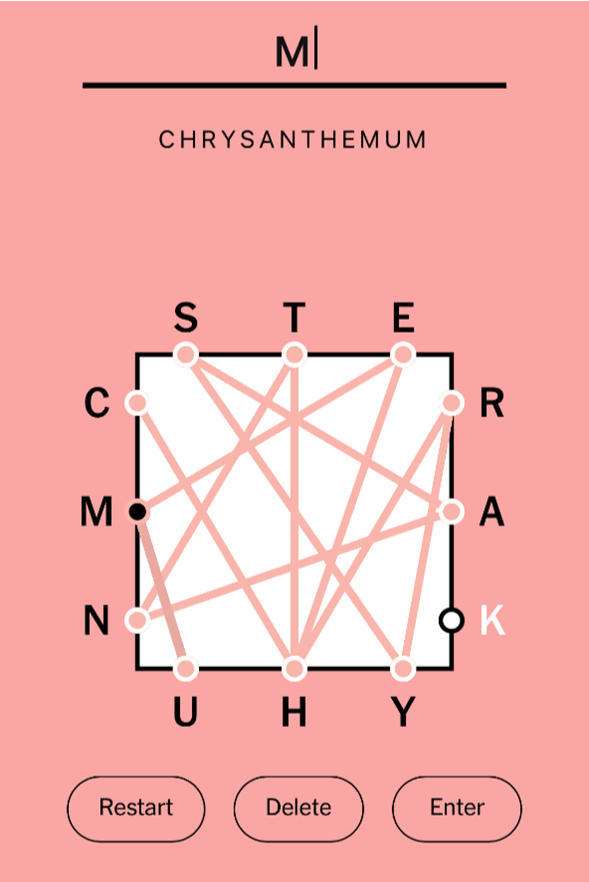
This made me wonder . . . are there any puzzles that have 1-word solutions? As it turns out, yes, there have been. There is a Reddit thread dedicated to Letter Boxed, and it features a post with the 1-word solution LEXICOGRAPHY. I discovered that these 1-word solutions have been dubbed “one-solves.”
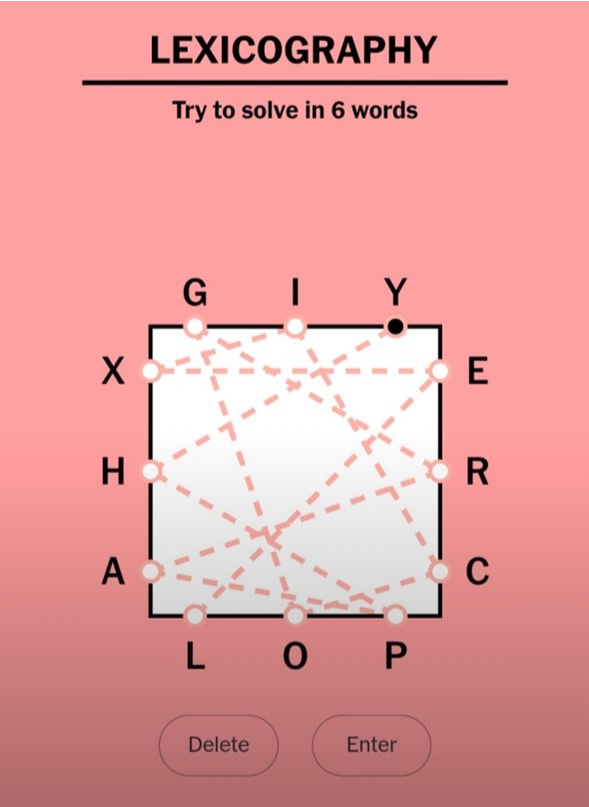
All of the One-Solves
All of the One-Solves
It was pretty simple to write code to come up with all of the words that have 12 distinct letters (the defining feature of a Letter Boxed puzzle). The list of one-solves (in DictionaryLookup) has 337 words on it. (See the end of this blog if you want to peruse the list.) I was not surprised to see that words with exactly 12 letters are not the most common. Intuitively, it makes sense that there are more words that repeat at least one of the 12 letters than words in which the 12 letters appear exactly one time. The table below shows the frequencies of words with each number of letters (up to the maximum of 23 in electroencephalographic).
How Many Possible Puzzles?
How Many Possible Puzzles?
Given any one-solve, how many different Letter Boxed puzzles could you make from it by rearranging the letters on the sides of the square? The expression 12! (i.e., 12 factorial, or 12 x 11 x 10 x 9 x 8 x 7 x 6 x 5 x 4 x 3 x 2 x 1) represents a very big number--479 million and change. That’s the number of ways to choose sets of 12 using 12 characters, so theoretically there are 479 million puzzles that can be made with 12 letters.
But some of those are eliminated by the requirement that consecutive letters cannot be on the same side of the square. And others are eliminated when you consider “duplicate puzzles.” Mixing up the letters on the side of the square produces a duplicate puzzle--e.g., PAT is the same as PTA, APT, ATP, TPA, and TAP. Two puzzles are also duplicates when the sides of the square are simply shuffled--e.g., AMB-IDE-XTR-OUS is the same as AMB-XTR-IDE-OUS.
I tried using my (basic) understanding of combinatorics to find a formula to calculate the number of possible puzzles for a 12-letter one-solve, but found that was over my head. (If any of you smart readers can send me the formula for calculating the number of possible puzzles in a 12-letter one-solve, I’d be most grateful.)
So . . . I moved on to the brute force method. My first attempt at counting the possible number of puzzles that can be made with 12 unique letters involved eliminating invalid and duplicate puzzles from the 479 million possible. I quickly abandoned this approach because the computational demands were too high--Mathematica (which I use to run Wolfram Language) balked, in other words. I had to come up with another approach, so I started exploring possible 3-letter combinations that could form a side of the square.
AMBIDEXTROUS is an example of a one-solve. Every letter in the word except the first and last has a letter that precedes and follows it. For instance, the letter M has the letters A and B as “companions.” This means that neither A nor B can be on the same side of the square as M. So MBX, for example, could not make up a side of the square (nor could BMX or other combinations of those 3 letters). The method I used to calculate the possible number of puzzles that exist for any word involved “throwing out” all 3-letter combinations that could NOT make up a side of the square, then finding all possible puzzles that could be made with the 3-letter combinations that remained. As it turns out, there are 5163 of them in all for any 12-letter word on the list--a pretty small number compared to 479 million. (You can check out my calculations at the end of this notebook.)
Do They All Yield a Valid Puzzle?
Do They All Yield a Valid Puzzle?
An immediate question that came to mind about the 337 one-solves on my list: are there any that do NOT yield a possible puzzle? It seems possible that in our longest one-solve electroencephalographic, for instance, the repetition of letters might not yield a puzzle. The answer is no--even the longest one-solve yields 639 possible puzzles.
If you think about the possibilities for a minute, the shortest possible word that would not yield a solution would consist of one letter interspersed with the others. For example, the nonsense word BACADAEAFAGAHAIAJKL (which has 19 characters) is the shortest possible “word” that would not yield a puzzle because the letter A cannot exist on one side of the square with any of the other 11 letters except K and L (and K and L cannot be on the same side in this “word”).
I hope this deep dive into one-solves has been interesting for you. Please send me your thoughts and comments!
All the One-Solves
All the One-Solves
Here are all of the one-solves (in Wolfram Language’s DictionaryLookup), grouped according to word length:
Find all possible 12+ character words with 12 distinct characters
Find all possible 12+ character words with 12 distinct characters
Analyze the one-solves
Analyze the one-solves
The code below returns the length of each one-solve and the number of unique 3-letter sides of a square that are possible for that word. These possible 3-letter sides are the fundamental building blocks of a puzzle for that word. The code eliminates duplicate sides such as PAT, PTA, and TAP.
Analyze a single one-solve
Analyze a single one-solve
CITE THIS NOTEBOOK
CITE THIS NOTEBOOK
Letter Boxed: the elusive 1-word solutions
by Jeff Weidenaar
Wolfram Community, STAFF PICKS, February 8, 2025
https://community.wolfram.com/groups/-/m/t/3387956
by Jeff Weidenaar
Wolfram Community, STAFF PICKS, February 8, 2025
https://community.wolfram.com/groups/-/m/t/3387956