Colaborators: Rodriguez Jimenez Octavio Alejandro & Adael Reyes Jimenez
Introduction
Introduction
In the design, planning, and optimization of cellular communication systems, one of the fundamental challenges is accurately predicting the signal strength received at a mobile receiver. Radio signal propagation is subject to a variety of phenomena that cause attenuation and random variations, collectively known as fading. While path loss models the average signal attenuation as a function of distance, the Log-Distance Shadowing or Log-Normal Fading Model is responsible for capturing the slow fluctuations of the signal around that average value, caused by the obstruction of buildings, mountains, and other environmental elements [4, 6].
Content
Content
The statistical basis of this model is the Lognormal Distribution. A random variable X follows a lognormal distribution if its natural logarithm, Y = ln(X), follows a normal distribution [2, 3]. This property is crucial in the context of wireless communications. When the received signal power (measured in linear units such as milliwatts) is modeled as a lognormal variable, its expression on a logarithmic scale (such as decibels, dB) is normally distributed [5]. This transformation greatly simplifies the statistical analysis, as it allows working with the well-known normal distribution.
In the real world, the signal isn’t perfect – there are always variations. Even if you’re 10 km from a tower, some days the signal is better than others. This is due to buildings, trees, weather... we call it ‘shadowing’ or shading.
This program allows you to experiment with cellular networks without having to install real antennas. It’s like a ‘flight simulator’ for telecommunications engineers, where you can make mistakes, learn, and find the best way to provide coverage for an entire region.
Conclusions
Conclusions
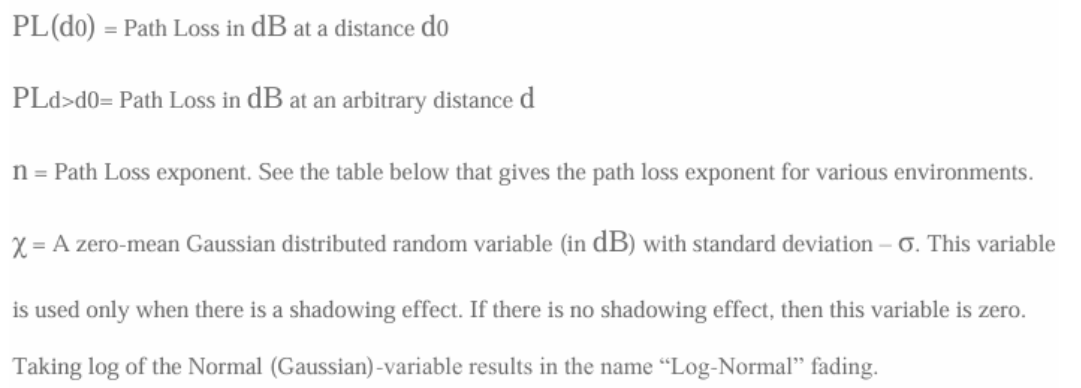
In short, we can conclude that cellular systems are a very extensive and complex phenomenon, since, as seen in these resources, there are different propagation models that consider various variables. In particular, the lognormal model is a model that simplifies several parameters, because we use the normal probability distribution and adapt it to a logarithmic scale so that we can graph in decibels.This formula considers the following parameters:With these parameters, we can calculate a probability regarding path loss in decibels (dB), and this helps us to plan our base stations and provide the best coverage in a specific area, such as free space, urban area cellular radio, shadowed urban cellular radio, obstructed in buildings, etc.This project will be key to simulating the log-normal model to understand the coverage efficiency of transmissions through antennas to communities within a radial area of a transmitter and to help make key decisions for connecting rural communities.

References
References
1. (S/f). Researchgate.net. Recuperado el 23 de noviembre de 2025, de https://www.researchgate.net/publication/340616951_Analysis_of_the_Geographical-Information_Impact_on_the_Performance_of_ABS-CRE_HetNets
2. Distribución logarítmica normal. (s/f). Academia-lab.com. Recuperado el 23 de noviembre de 2025, de https://academia-lab.com/enciclopedia/distribucion-logaritmica-normal/
3. Wikipedia contributors. (s/f). Distribución log-normal. Wikipedia, The Free Encyclopedia. https://es.wikipedia.org/w/index.php?title=Distribuci%C3%B3n_log-normal&oldid=169206076
4. Log distance path loss or log normal shadowing model. (s/f). Idc-online.com. Recuperado el 23 de noviembre de 2025, de https://www.idc-online.com/technical_references/pdfs/electronic_engineering/Log_Distance_Path_Loss_or_Log_Normal_Shadowing_Model.pdf
5. Wikipedia contributors. (s/f-a). Decibelio. Wikipedia, The Free Encyclopedia. https://es.wikipedia.org/w/index.php?title=Decibelio&oldid=170215072
6. (S/f-b). Studocu.com. Recuperado el 23 de noviembre de 2025, de https://www.studocu.com/es-mx/document/universidad-politecnica-de-pachuca/antenas-y-enlaces/capitulo-5-modelos-de-propagacion/50320976