By solving the Einstein evolution equations with Brill-Lindquist initial conditions, binary black hole merger occurs naturally on a spatial graph. However, this method demands substantial computational power, limiting its reproducibility and accessibility. This project aims to explore the potential of simulating binary black hole mergers using rewriting rules in Wolfram Models. The approach seeks to provide a more efficient method for studying the merger process, including the evolution of the metric, the generation of gravitational waves, and changes in the dimensional structure of spacetime.
Introduction
Introduction
Understanding black hole dynamics is crucial for probing the nature of space-time under strong gravity, and binary black hole mergers provide an exemplary laboratory for such studies. In the early dynamical states of a binary black hole system, where two black holes gradually spiral closer and orbit around their common center of mass, the system can be described analytically by solving Einstein’s equation. However, as the black holes begin to merge, their metrics superpose each other, causing significant distortions in the local space-time due to the extreme gravitational field. This merger produces a burst of gravitational waves that is so intense - its waveforms can be detected by the LIGO detectors. At this stage, Numerical Relativity is often employed to describe the dynamics involved. After the two black holes merge into one, their combined mass is greater than the sum of two black holes by the Second Law of Black Hole Thermodynamics.
Numerical Relativity typically involves decomposing four-dimensional space-time into a series of three-dimensional hypersurfaces at successive time steps, this is done by solving non-linear partial differential equations using numerical techniques such as Finite Differences and Adaptive Mesh Refinement (AMR). Simulating binary black hole merger has long been a challenge in this area due to the substantial computational expenses involved. Nevertheless, once a black hole merger simulation is constructed, the waveform prediction for the gravitational radiation emitted during the process can also be found.
One potential application of binary black hole simulation is identifying the source of gravitational waves. When LIGO receives relevant data, they reconstruct the waveforms of the gravitational radiation observed using burst analyses. Numerous combinations with different parameters are then carried out in numerical simulations for waveform predictions from different sources. Comparing each numerical prediction with the reconstructed data, researchers can identify the most likely sources of the detected gravitational waves.
This project aims to explore the potential of simulating binary black hole mergers using the Wolfram model as a cost-effective surrogate to traditional numerical black hole simulations. By leveraging the computational efficiency of the Wolfram model, this approach seeks to reduce the computational expenses associated with traditional methods, while still providing accurate and insightful simulations of black hole dynamics.
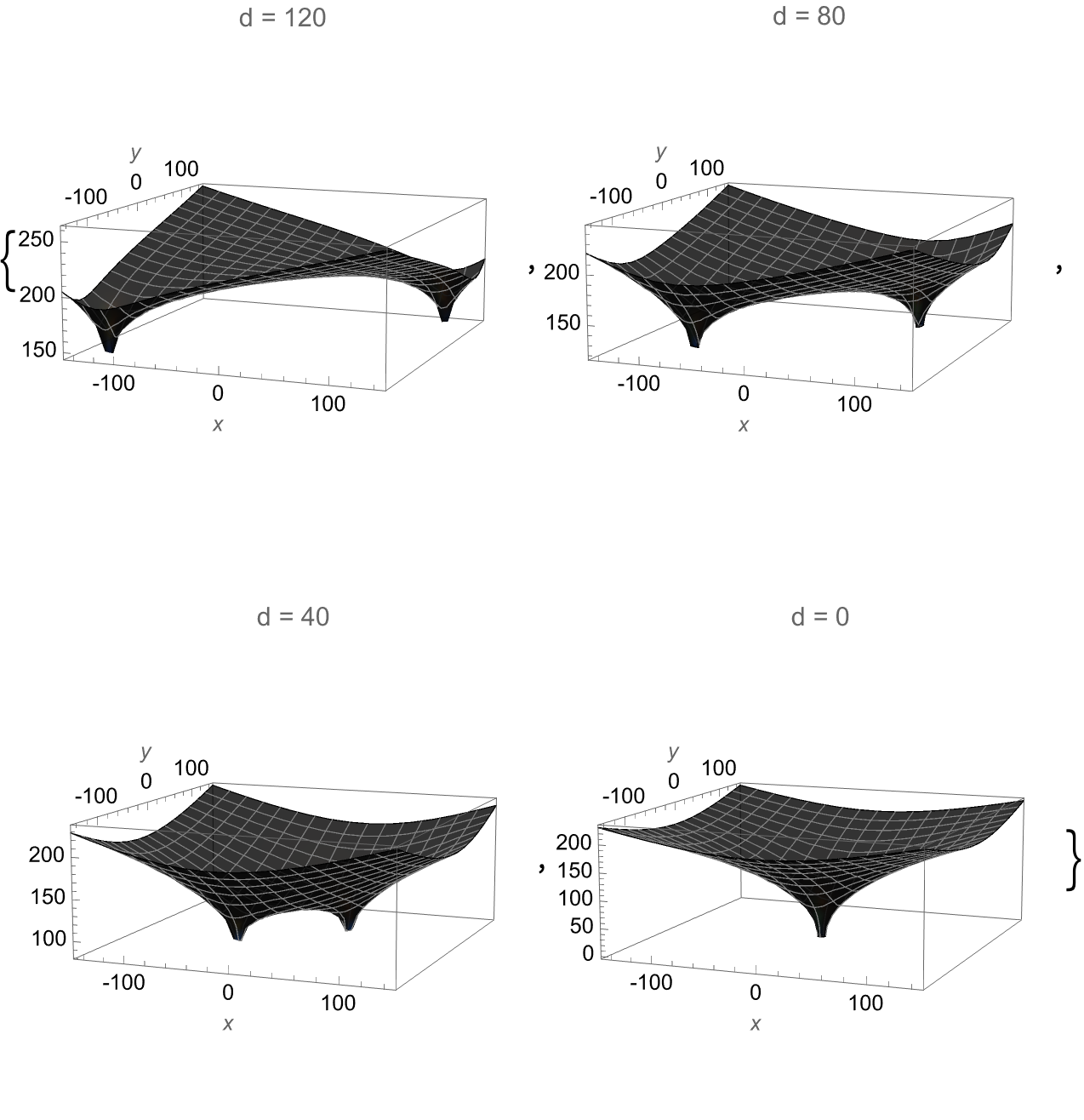
Visualization of the spatial curvatures of two black holes approaching each other:
In[]:=
flamm[x_][y_][d_]:=4Sqrt[4(Sqrt[(x-d)^2+(y-d)^2]-4)]+4Sqrt[4(Sqrt[(x+d)^2+(y+d)^2]-4)]plots=Table[Plot3D[flamm[x][y][d],{x,-150,150},{y,-150,150},PlotStyle->Directive[Black,Opacity[0.8],Specularity[White,30]],MeshStyle->{Gray},AxesLabel->Automatic,PlotRange->{{-150,150},{-150,150},All},BoxedTrue,Axes->True,PlotLabel->"d = "<>ToString[d],ViewPoint->{2,-5,1}],{d,120,0,-40}]
Out[]=
Methodology
Methodology
The Brill-Lindquist geometry describes a system of two initially stationary Schwarzschild black holes, characterized by a conformally flat spatial metric. This geometry serves as an initial data set for binary black hole simulations in General Relativity. In comparison to the relatively simpler single Schwarzschild geometry, the Brill-Lindquist initial data involves much more complex spatial structures, increasing challenges for the decomposition of spatial hypersurfaces and the solving of Einstein’s vacuum equations. Simulating the evolution of such a system is computationally intensive due to the need to solve highly nonlinear partial differential equations over a dynamic, three-dimensional space-time. Consequently, performing these simulations directly is generally impractical without the aid of supercomputers or high-performance computing clusters. Setting M = 1, =1, α = 1 = {0,0,0}, we obtain the simplified Brill-Lindquist metric:
z.
0
i
andβ
In[]:=
adm=ResourceFunction["ADMDecomposition"][{"BrillLindquist",1,1},t,{r,θ,ϕ},1,{0,0,0}];adm["SpacetimeMetricTensor"]["MatrixRepresentation"]//MatrixForm
Out[]//MatrixForm=

Constructing a Binary System
Constructing a Binary System
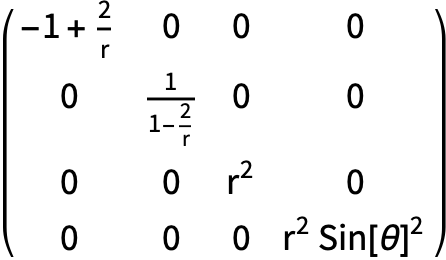
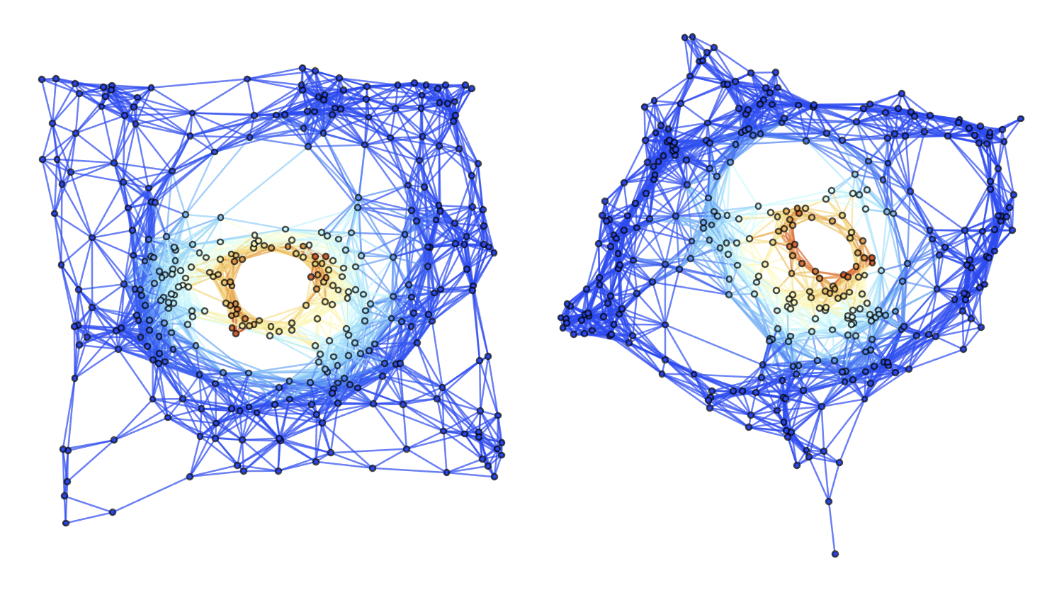
To avoid the complexities of directly using the Brill-Lindquist metric, we begin with two separate Schwarzschild metrics and analyze their individual hypersurfaces, with their extrinsic curvature visually represented by different colours. This approach simplifies the initial conditions and allows for a more manageable decomposition of the spacetime geometry.
The DiscreteHypersurfaceDecomposition function plays a crucial role in this process. Essentially, it foliates a Riemannian or pseudo-Riemannian manifold into a series of discrete submanifolds. These submanifolds are then represented as an undirected graph using adaptive hypergraph methods.
The DiscreteHypersurfaceDecomposition function plays a crucial role in this process. Essentially, it foliates a Riemannian or pseudo-Riemannian manifold into a series of discrete submanifolds. These submanifolds are then represented as an undirected graph using adaptive hypergraph methods.
In[]:=
metric=ResourceFunction["MetricTensor"][{"Schwarzschild",1},{t,r,θ,ϕ}];metric["MatrixRepresentation"]//MatrixForm
Out[]//MatrixForm=
In[]:=
decomposed1=ResourceFunction["DiscreteHypersurfaceDecomposition"][metric,{t,0,1},{r,0,5},{θ,-Pi,Pi},350,1.5];decomposed2=ResourceFunction["DiscreteHypersurfaceDecomposition"][metric,{t,0,1},{r,0,5},{θ,-Pi,Pi},350,1.5];
In[]:=
bh1=decomposed1["PolarGraphColored"];
In[]:=
bh2=decomposed2["PolarGraphColored"];
In[]:=
GraphicsRow[{bh1,bh2}]
Out[]=
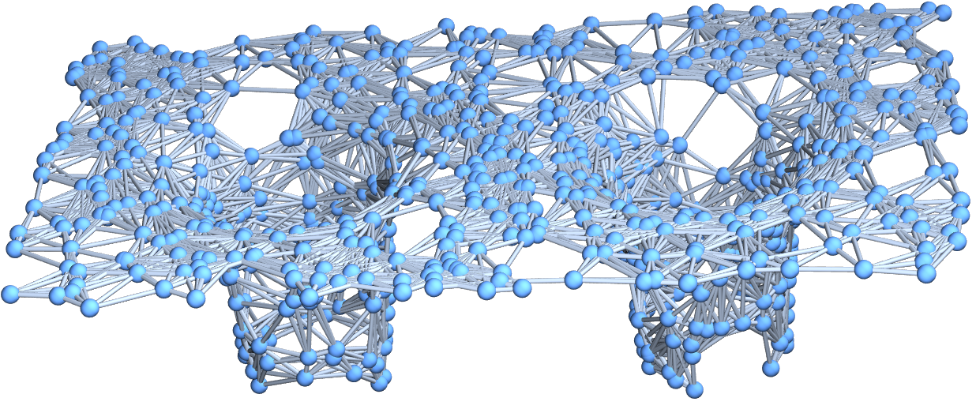
Assuming the two black holes are initially separately by a distance of 8 on the x direction, we first place them on the same graph by joining their edges on the same list:
In[]:=
edgelist1=EdgeList[bh1];edgelist2=EdgeList[bh2];addDistance={-8,0,0};shiftedEdgelist2=Map[UndirectedEdge[#1+addDistance,#2+addDistance]&@@#&,edgelist2];graphList1=EdgeList@bh1/.a_b_->{a,b};graphList2=EdgeList@shiftedEdgelist2/.a_b_->{a,b};
In[]:=
bhs=Flatten[Join[edgelist1,shiftedEdgelist2]];GraphPlot3D[bhs,VertexCoordinates->VertexList[bhs]]
Out[]=
Combined graph in 2D projection:
In[]:=
bhsGraph=GraphPlot[bhs,VertexCoordinates->Most/@VertexList[bhs]]
Out[]=
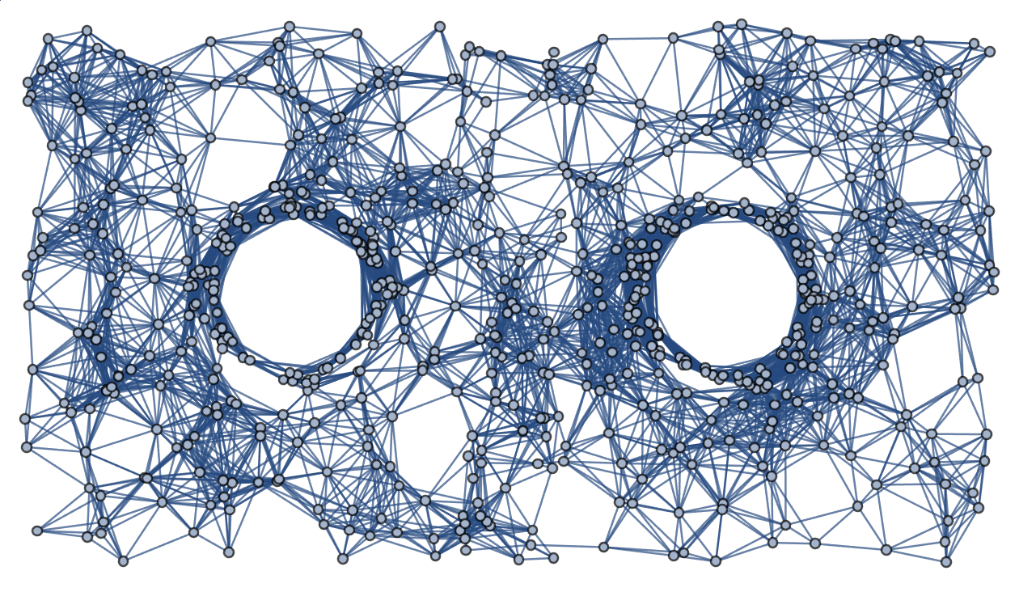
Although the two hypersurfaces currently reside on the same graph, they are two closed systems and do not yet have any interaction, we therefore introduce perturbations into the system by adding edges between them artificially.
To prevent edges crossing the event horizons, we select a chosen number of vertices randomly within the range [-6.5,-1.5] on the graph, then manually join those vertices with edges:
To prevent edges crossing the event horizons, we select a chosen number of vertices randomly within the range [-6.5,-1.5] on the graph, then manually join those vertices with edges:
Process of adding edges manually:
Highlighted positions of the event horizons on the rendered graph:
Now we have a system of two momentarily stationary Schwarzschild black holes with light interactions between them, approximating of the binary system. These initial conditions will serve as the foundation for subsequent computations in the project.
In order to simulate binary black hole merger, we need rules in Wolfram Model that evolves the merging process between them.
In order to simulate binary black hole merger, we need rules in Wolfram Model that evolves the merging process between them.
Combined graph in 2D projection with new edges added between:
Hunting for Rules
Hunting for Rules
To narrow down the range of selection, there are several criteria for our rules.
First, since we are working with graphs instead of hypergraphs, the rules must depend solely on binary relations. Second, the rules need to preserve the structure of a single black hole. Third, in order for two black holes to merge into one, the rules need to either expand their event horizons, or introduce a linear translation between them, while maintaining the general structure.
We start by looking for rules that preserve the Schwarzschild black hole structure and test them on a single black hole.
Display the 3D and 2D discrete hypersurfaces of a Schwarzschild black hole in polar coordinates, whereas the spatial coordinates of the earlier one depends on hypersurface embedding information:
Hausdorff dimension around the black hole hypersurface:
A positive correlation between the distance from origin and dimension is displayed on the plot above. It should be noted that the distance is not measured from the singularity, this is purely computed using the Cartesian coordinates. Distance = 2 is not the location of event horizon but the radius measured at the centre of the hole on the 3D spatial plane. Dimension is expected to approach 2D because there are no vertices within this spherical region.
Rules that Preserve the Black Hole Structure
Rules that Preserve the Black Hole Structure
Regardless of 3D or 2D representations, inspecting closely on the black hole graph, it can be seen that the hypersurface consists of numerous tiny hexagonal geometries. This suggests that the rules we need might exhibit similar topological structures and preserve the symmetry of the graph.
Alternatively, the rules we are looking for may also conserve the number of nodes and only update the edges. This ensures that there is no growth in the system during rule rewriting.
It is yet unclear which specific rules are needed and what they look like. To compare the graph before and after the update, we examine the Ricci curvature scalar and effective dimension (instead of Hausdorff dimension). An example is shown below.
Select a rule that exhibits polygonal topology:
It should be noted that after the rule rewriting, the new vertex points on the graph do not contain any spatial information and are only rendered randomly. This implies that the the general position of the event horizon will no longer be visually apparent. To determine whether the black hole remains on the graph after three steps of rule rewriting on the initial conditions, we compare the effective dimension and curvature of the graphs before and after the update.
The effective dimensions measured from graph centers seem to differ largely at short radius of measurement due to their difference in sizes, but they tend to exhibit similar trends over the long distance.
Select a chosen number of vertices on the un-updated graph that is closest to the event horizon, where curvature is expected to be large. Compute the curvature at these specific vertices both on the un-updated and updated graph, compare them accordingly. Repeat the same steps for vertices are are furthest from the event horizon, these points tend to be relatively flatter. From the plots below it can be observed that, while values of the curvatures fluctuate after the update, they generally maintain the same shape as before.
Selected vertices of curvature measurement highlighted on the graph (red, yellow):
Highlighting random geodesics on graphs before and after the update, it can be seen that the spatial structure does not change significantly with graph rewriting.
Now apply the sample rule to the binary system, select a vertex point near the event horizon for each black hole, check how the geodesics changes between them due to 3 steps of rule rewriting.
This rule is not a bad example as it conserves most of the black hole curvature, but the event horizons do not show any sign of approaching each other over time, it therefore will not lead to merging directly.
To speed up the process of looking for rules, we write a function that computes the mean squared errors between the updated and un-updated curvature, thereby filtering out those rules with large errors. The function was initially tested on 604 selected rules that preserve spatial structure well. Due to the computational expenses, the filtering process was operated on Cloud provided by Amazon Web Services (AWS). Setting an initial upper bound of 45 for mean squared errors, 109 rules were selected out of 604. The upper bound is yet to be reduced to 15 for the second filtering and further narrowing down, however, due to time constraints, we were unable to repeat the filtering by the end of the summer school.
To speed up the process of looking for rules, we write a function that computes the mean squared errors between the updated and un-updated curvature, thereby filtering out those rules with large errors. The function was initially tested on 604 selected rules that preserve spatial structure well. Due to the computational expenses, the filtering process was operated on Cloud provided by Amazon Web Services (AWS). Setting an initial upper bound of 45 for mean squared errors, 109 rules were selected out of 604. The upper bound is yet to be reduced to 15 for the second filtering and further narrowing down, however, due to time constraints, we were unable to repeat the filtering by the end of the summer school.
A selection of filtered rules on the initial binary system after three updates are presented below with geodesics (same start and end vertices) highlighted.
Compared with the un-updated graph, the first one ({{1,2},{1,3},{2,4}}{{2,1},{1,4},{3,1}}) appears to preserve the binary structure particularly well. We therefore keep updating the binary system graph with it and compare their curvature.
Despite the numerical differences, the general structure of the system is well maintained .
Despite the numerical differences, the general structure of the system is well maintained .
Rules that Introduce Movement
Rules that Introduce Movement
We have successfully identified several rules that conserve the structure of black holes. The next crucial step is to identify and test rules that introduce relative movement between them, which is essential for simulating the merging process.
As rule rewriting applies to the whole spatial graph, it is difficult to directly introduce a movement to specific targets. A more specialized approach is therefore required. One potential method involves using multiple rules: removing nodes and edges from one side of the graph while simultaneously updating the structure on the other side. This could create a differential effect, simulating movement towards a merger.
Another approach involves updating rules in specific regions of the graph. By focusing on particular areas, we can introduce directed movement towards each other, facilitating the merger process. These targeted updates could help in controlling the evolution of the black holes’ positions within the graph, ultimately leading to their merger.
Although time constraints have prevented the full exploration and implementation of these approaches, the search and testing of these mechanisms will continue.
Concluding Remarks
Concluding Remarks
This project introduces an innovative method for simulating binary black hole systems using discrete hypersurface decomposition. It identifies a set of potential rules that effectively preserve the structure of black holes. However, due to time constraints, the project could not fully explore the mechanisms driving the merging process. Nonetheless, the search and testing will continue in future research.
There are numerous aspects to investigate in the simulation of simplified binary systems, including variations in black hole mass, the distance of separation, and the insertion of a Minkowski plane between the black holes for potentially higher accuracy. Once the merging process is successfully replicated, the computation of the Weyl tensor will enable the prediction of gravitational waveforms.
This ongoing effort will include:
1. Further Rule Exploration: Investigating additional rules within the Wolfram model that can induce movement in black holes.
2. Localized Rule Application: Developing techniques to apply rules selectively to different regions of the graph.
3. Simulation and Analysis: Running extensive simulations to test the effectiveness of identified rules in facilitating black hole mergers.
Acknowledgments
Acknowledgments
I would like to extend my heartfelt gratitude to my mentors, Gianmarco Morbelli and Jon Lederman, for their invaluable support, guidance, and time throughout the past four weeks. I am deeply grateful to Xerxes Arsiwalla for all the insightful lectures and late-night discussions. My thanks also go to Eric Parfitt for his assistance in tackling several coding challenges, and to Fergus Noble for generously providing a list of candidate rules that conserve black hole structure. Finally, My would like to extend my special thanks to Stephen Wolfram for inspiring me and suggesting this project, which I have truly enjoyed every minute of working on.
References
References
1
.Wolfram S. (2020), “A Class of Models with the Potential to Represent Fundamental Physics,” https://www.wolframphysics.org/technical-introduction/
2
.Wolfram S. (2020), “Event Horizons, Singularities and Other Exotic Spacetime Phenomena,” https://www.wolframphysics.org/bulletins/2020/05/event-horizons-singularities-and-other-exotic-spacetime-phenomena/
3
.LIGO, et al. (2016), “Observing Gravitational-Wave Transient GW150914 with Minimal Assumptions,” The Physical Review, D 93, 122004, https://doi.org/10.1103/PhysRevD.93.122004
4
.Joan M. Centrella et al. (2010) “Binary Black Holes, Gravitational Waves, and Numerical Relativity,” Journal of Physics: Conference Series 78 (2007) 012010, https://doi.org/10.1103/RevModPhys.82.3069
6
.Gorard, J. (2023), “Computational General Relativity in the Wolfram Language using GRAVITAS I: Symbolic and Analytic Computation,” https://doi.org/10.48550/arXiv.2308.07508
7
.Gorard, J. (2024), “Computational General Relativity in the Wolfram Language using GRAVITAS II: ADM Formalism and Numerical Relativity,” https://doi.org/10.48550/arXiv.2401.14209
Cite This Notebook
Cite This Notebook