This essay questions whether our current scientific frameworks truly reach the fabric of the universe. Drawing on Donald Hoffman’s user interface theory and alternative quantum models like Barandes’ stochastic histories, it suggests that both perception and physics offer only partial, observer-bound views instead of capturing the foundations of the universe. Phenomenological reports of the “zeroth person perspective” — states of pure awareness devoid of self, time, or space — further undermine the physicalist paradigm by introducing consistent experiential data pointing to an undifferentiated ground beyond subject-object structure.
​
In search of a unifying framework that can accommodate these insights, the essay introduces Stephen Wolfram’s ruliad: a mathematical structure representing the totality of all possible computations. Within this framework, mind, matter (incl. physical laws) aren’t posited as fundamental truths but as localized coherence patterns emerging from the ruliad’s undifferentiated totality. Questions of free will, qualia, the emergence of subjectivity, and consciousness are situated in this framework, showcasing its power to provide a unifying language for important philosophical concepts. Last but not least, given the importance of the observer within this framework, a separation of the concept into two different types is proposed, clarifying the split between localized computational extraction and the global framing of an observer concerned with an explanation in the first place.
​
Prefer to listen to a presentation of the material instead? Here you go :) https://www.youtube.com/live/NT6cVcAYsqg
​

Part 1: The Search for a Framework Big Enough

The illusion of objective physical reality

The world you see in front of you is not actually there. That table, this screen? Just useful figments of your imagination. An interface that makes it easy for you to persist, aka survive, in this whatever-it-is reality you’re embedded in. Does that sound weird? Woo woo perhaps? But consider this.
​
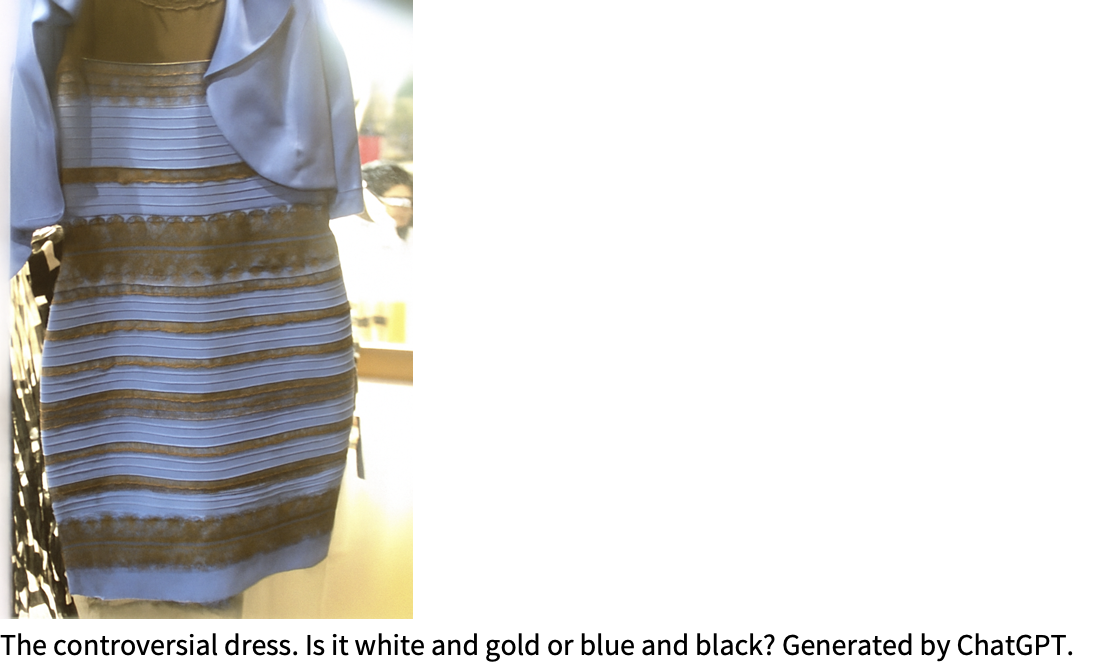
Clearly your senses deceive you. Why does a straight stick look bent in water? Why do dogs live in a world full of smells, some of them so subtle not even our most powerful machines can currently pick up on them? And why the heck is that dress both gold-white and blue-black (see picture)?!? Because….[follows long scientific explanation]… that’s why. Which should get us to two important conclusions: one, our sensations and perceptions are a neat construct for navigating this world but can most definitely lead us astray. They only ever capture a small part of the truth. And two, science can generalize these faulty impressions into a more consistent framework.
OK, great, then let’s do science. Let’s leave the philosophizing aside, all these worries about accurate perceptions and whatnot, and focus on science. Over time we should be able to explain everything that we see and measure, including exotic things like wonky movements of far away galaxies and funky quantum experiment outcomes. And yes, that dress which has baffled humanity for the last ten years. Even consciousness — the very essence of being alive — we will find a wonderful scientific explanation for it. We will find that underlying principle, the neural circuits and their functioning, the optimal algorithm, the perfect abstract math to embed it all in and even the last mysteries of human experience will be told not in mystical words but beautiful equations. That’s how it will go, that’s how we have been doing it and it’s worked fantastically.
​
Right? No.
​
Our neat scientific picture is falling apart. In little parts, here and there, nothing quite spectacular but all of it pointing in one unmistakable direction: reality is much much bigger than these physical phenomena we experience as embodied beings and measure as rigorous scientists. So, so much bigger. But then, what is it? What are we looking for instead? Let’s go over the data we have so far.

The user interface theory of perception

The human species, as all others, drives on self-preservation which is encapsulated in the evolutionary principle. Using known mathematical expressions for evolution and game theoretic approaches, Hoffman et al. [1] have tested how likely it is that we see objective reality (as in: that computer in front of you actually exists as “true objective reality”) versus us seeing a reality that is optimized for our survival fitness. The result? A smack zero percent chance for objective reality [2]. Zero. In no scenario does an organism who perceives a veridical version of reality have a better chance of survival than one that’s simply optimized for all “important data” helping it to survive. You don’t have to have perfect knowledge of geography for your survival, you just need to know if there is water and food in sufficient quantities. Said in Hoffman’s words: Fitness beats truth. Only every single time. Similarly, me typing on this computer being blissfully unaware of each and every electron chasing through its wires and the complicated logic gates it manipulates on its path, is most definitely the most efficient way to get this text out. No need for deeper understanding. Actually, any deeper understanding would just be penalizing as I’d be too occupied with switching logic gates instead of actually writing at two hundred strokes a minute. That’s also why this outcome has been called the “user interface theory of perception”. Because that’s what reality apparently is: a huge collection of very helpful icons.
​
But why stop at assuming we are optimized for seeing our world through a fitness-optimized “there is water!”-survival lens. What if “water” itself is also just a useful interface, a great illusion telling us in nicely summarized terms that some complicated information structure is actually very good for us?!? Yes, water can be described as hydrogen and oxygen atoms and chemical bonds, which in turn can be described by fundamental particles, which in turn are actually also not “real” but just handy properties of the geometries describing quantum systems. Said differently, it’s interfaces and useful summaries all the way down to our most fundamental theories. Ok, well then, one might say, perhaps our fundamental reality is not accessible to our eyes and noses but clearly we have identified the basic building blocks of reality: it’s Hilbert spaces and Poincaré groups and symmetries and everything is built up from there using some pretty reasonable assumptions. In other words, the world might not be “physical” in the what-I-touch-is-actually-like-that-on-a-fundamental-level sense, but surely, our abstract mathematical theories have captured objective reality. They are, in fact, describing the very fabric of the universe.
​
Except, it is not. Even if we were to fit gravity (aka the “big stuff”) somehow in the picture, which we currently don’t and it’s not looking like it will any time soon, there is still the annoying fact that alternative approaches to our foundational theories exist. And for them, quantum physics can look very different. Which very much throws a wrench into our “we know the fabric of the universe” confidence.

Alternative approaches to recovering quantum phenomena

Hoffman himself developed the “conscious agents” minimal model approach to reality [3]. Briefly, he assumes an abstract mathematical entity that models perception, decision, and action as transitions between structured state spaces as a kind of generalized input–output machine governed by a Markov kernel. And it’s these minimal agents which form the basis of reality and everything else, like physics or human experience, can be recovered from these fundamental building blocks. It should be noted that these agents are explicitly endowed with a minimal form of consciousness as Hoffman assumes qualia, that is the hard-to-grasp experience of the redness of red for example, to be irreducible and thus must be built into the foundation of reality. However, even despite this metaphysical addition, his approach offers a minimal version of a deeper reality which we can never see due to our user-interface experience. Which is great because we have to start somewhere and that’s as good of a start as any. Interestingly, he and his team have formally demonstrated that wave-like dynamics — including oscillation and interference — can arise from the composition of simple conscious agents. These structures hint at deep parallels with quantum behavior and suggest that what we call “physical waves” might emerge from informational transitions in a non-physical substrate. Some of his recent work [4] has proposed a promising formal mapping from the dynamics of these agent networks to the amplituhedron (a the geometric structure used to calculate scattering amplitudes in particle physics), though this connection remains speculative and under active development. Furthermore, Hoffman et al. show that, even if the underlying dynamics of conscious agents is time-symmetric, the projection of that dynamic, conditioned on a particular internal state, gives rise to an entropic arrow of time. This suggests that our experience of temporal flow is not a reflection of physical reality, but a perspectival artifact of bounded perception.
​
Coming from a very different angle, Barandes et al. have developed a stochastic take on quantum theory that sidesteps much of its traditional weirdness [5]. Instead of tracking wavefunctions evolving forward in time, they assign probabilities to entire spacetime histories. Meaning, the full configuration of the universe across space and time is being described, not just what’s happening now. This drops one of our most sacred assumptions: the Markov approximation, which says that each moment in time only depends on the one immediately before it. In Barandes’ world, what we see locally depends on how it fits into the total picture, a picture that could stretch all the way back to the formation of the universe. Schrödinger’s cat paradox? Not actually a paradox. The cat is always either dead or alive, but to be certain about it you’d have to know the entire history of the atoms making up the cat and box. Which we don’t, limited as we are. Still, the fact remains. In Barandes’ reformulation, there is no superposition, just different complete histories, and we don’t know which one we’re in. It’s a radically different ontology, but one that describes the same empirical results. One says: the foundation of our reality are wavefunctions, spooky actions, and branching worlds. The other says: it’s just configuration spaces, traced across all of time, and we simply are too limited to grasp it all.
​
You can imagine that quantum physicists aren’t too excited about having to deal with something as unwieldy as “the history of the universe”. But that doesn’t negate the broader point of this alternative formalism: reality doesn’t have to be built out of wavefunctions and quantum fields. It could just as well be modeled as a stochastic structure defined over configuration space with causality stretched across the full sweep of spacetime, not just moment to moment. Both frameworks describe the same empirical results, but they start from radically different pictures of what the world is made of. One leans into quantum weirdness: spooky action at a distance, cats that are both alive and dead, wavefunctions treated as ontologically real. The other simply says: no mystery, just probability distributions over the total history of the universe.
​
Then, what to believe? Here we have two mathematically rigorous theories: Hoffman presenting a formal path from agent networks to particle physics’ amplituhedron approach, and Barandes recovering most of standard quantum mechanic features with a decidedly not-quantum approach. And yet their very premises couldn’t be more different, between each other and in comparison to standard quantum theory. Said differently: at this point it is incredibly unlikely that standard quantum mechanics is the ultimate description of deeper reality, rather it is just one of the lenses through which we can look to explain the world. It’s just like that friend who insists on that dress being black and blue. True for them, but only due to some brain magic caveats which creates their truth. However, not truth in the fundamental sense. For that we need to step outside of our narrow field of science-as-is. To look for something “bigger” in which the different lenses on the quantum world, and dress colors, can seamlessly emerge without contradiction.

Phenomenological accounts of the Beyond

But here is the real kicker, this is not just a quibble between scientists wanting to find the best theory of reality by arguing about strange, abstract, 99.9%-of-humanity-couldn’t-care-less maths. No, even our pedestrian human experience actually holds a huge challenge to our contemporary notion of what the world is about. Since ancient times, people have reported that not is all as it seems. That perhaps there is no world, and no time, or space, not even an “I” doing the reporting. That there is a whole different way of existence, unusual but still very much true. It’s a theme that comes up in medieval Christian mysticism and is foundational to many Eastern philosophical traditions. But, being purely anecdotal and shrouded in incomprehensible words, it seemed more like a fancy flight of imagination than a serious data point. Until now. So, let’s do a quick detour into the strange world of human experience, specifically into the consciousness and qualia debate. While almost the entire scientific community is focused on explaining these phenomena from our usual physical-existence-as-fundamental perspective, this approach is highly challenged by systemized accounts of not-so-normal states of existence. In other words, we all might have been up in arms about the color of a dress, now imagine what happens with all of our science-ing and popular assumptions about the very fabric of humanity when we realize that there is a whole other level of existence we haven’t accounted for yet?!? Let’s dive in.
​
First off, we might be dealing with a case of bad data. More concretely, we’ve been ignoring phenomenological data — that is, first-person accounts of our lived experience — about what it actually feels like to be conscious not just as a single-line-of-thought human, but existence in its most primordial form. Though, as we will see, “feels like” is an entirely inadequate expression.
​
Let’s be honest: the consciousness debate has been stuck for a while now. On one side, we have the physicalists who insist that qualia, like the awe of watching a vibrant sun set or reflecting on the experience of the color red, are byproducts of physical systems we just haven’t fully explained yet. On the other side, there are non-physicalists who treat qualia as sacred, irreducible building blocks of the universe. Unexplainable in their ineffability, to be taken for very ground of reality from which our human experience originates. But what if both sides are missing something? What if the real issue is that we’ve all been stuck toggling between two perspectives, the third-person view of science and the first-person view of experience, while ignoring a third axis entirely? Enter the zeroth-person perspective.
​
This is a term popularized by philosopher Thomas Metzinger who, together with neuroscience collaborators, has been undertaking a humongous data gathering project [6] the extra-ordinary phenomenological experiences of deeply immersive meditation. Hundreds upon hundreds of survey results show, both quantitatively and qualitatively, that humans experience highly unusual states of being in the world on the regular. What’s even more impressive, these states exhibit a striking amount of regularity across age groups and cultures, and when compared to historical world literature, even across centuries. Everything is pointing to a shared, deeper reality that is generally accessible to humans.

Inside the zeroth person perspective

But what exactly is the zeroth person perspective? It’s an existence where all thought, language, emotions, even the body, and the very notion of a Self dissolve into a field of pure awareness and infinite potentiality. There, absolutely no distinction can be found. Not even seemingly basic distinctions like time and space or any type of object-subject differentiation. First person accounts of this “experience” — that is, a person saying “I had such and such an experience” — can be given after leaving the (often very fragile) zeroth person perspective. Here are a few of the hundreds reported alone in Metzinger’s book “The Elephant and the Blind” [6]:
​
​“I experience pure consciousness as a state of unboundedness and total ease and deep relaxation. There are no thoughts, no feelings, or any other sensations like weight or temperature. I just know I am. There is no notion of time or space, but my mind is fully awake and perfectly clear. It is a very simple and natural state.”
​​
​“Outside on the street there was a sound and in that moment it was clear to me that it is not a self that perceives the sound, but that there is awareness in/with the sound. There existed a perception that the sound appears in space with awareness and ‘recognizes itself’. Other perceptions, e.g., visual objects, bodily sensations, were also appearances of/with awareness without being tied to a perceiver or being perceived by a perceiver. Just an appearance of appearances. This experience/view has no mystical quality, but a quality of ‘ordinary suchness’. It simply is the way it is. One minute amazing and full of joy, but at the same time very simple.”
​​
​“It was as if everything disappeared, body, mind, space and time, but awareness itself was still present. There were no particular qualities that involved self-reflection, like emotion etc., until after the experience ended and I was again aware of my surroundings. This particular ‘pure presence’ involved the emptiness of all content except awareness itself. As if awareness is the only thing that exists, but I am that awareness and not separate from it.”
​​
Similar accounts can be found everywhere in the literature. Here is an especially poignant one by philosopher Jonathan Shear [6]:
​“Experience of the deepest level, that of pure consciousness awake to its own nature in and by itself, is generally held to be especially important. The defining characteristic of this experience is the complete absence of all sounds, tastes, thoughts, feelings, images, and anything else that one can ever imagine. Techniques for achieving this experience differ. [...] But they have in common the idea that it is possible for all empirical content to disappear, while one nevertheless remains awake. What then is the experience like? By all accounts it is not like anything. One can have it and remember it-one knows that one was not asleep. But one does not remember it as anything at all. It is just itself-unimaginable and indescribable.”
​​
These examples are firsthand accounts of what happens when the Self disappears, time collapses, and the whole machinery of mind goes quiet. These people weren’t spaced out, numb, or dreaming. Instead, they reported states of mind clearer than waking life where the usual boundaries between observer and world just weren’t there anymore. That’s why it is befittingly called the zeroth person perspective, as there is no Self left to take a perspective. The first-person perspective, aka the “I” that thinks and feels and watches, it is still there, but as a part of experience, not as its ineffable anchor. And so are qualia. There, but not the deepest layer of reality, not the metaphysical floor. Instead, pure awareness is. 
​
However, are we really exploring something beyond the known physicality of our world or is it all just a cool trick of a specific brain algorithm? Metzinger himself believes in the latter. He has proposed a compelling model of how the third and zeroth person perspective might be compatible: maybe the brain, when most of its normal activity powers down, runs a kind of loop — a recursive “expecting knowledge” algorithm — that watches for meaning but receives nothing. With nothing to model, the system reflects itself, like a camera pointed at its own feed. What would that feel like from the inside? Infinite openness. Total presence. The silent possibility of knowing, minus anything known. Though at this stage, it is just a hypothesis, it seems quite coherent and aligned with the data. However, there are a couple of immediate concerns, no matter how intriguing (and skeptical scientist friendly) this proposal might be. Let’s listen to another zeroth person experience report to help us dig deeper [6].
​
​“Rather cool and boundless like the universe. Within it no self, which formed like air bubbles in water only when the experience faded away. In this universe there was pure knowledge and perception without a center.”

Consequences of the existence of a zeroth person perspective

If a limited physical substrate is really what’s giving rise to such a timeless, spaceless reality of infinite knowledge, phenomenologically speaking, then a zeroth person perspective shouldn’t be able to access anything beyond its immediate sensory bubble, no matter how much people describe perceiving all of time and space. And that’s actually testable. We already have anecdotal cases of near-death experiences where clinically dead patients later report, with uncanny accuracy, events from the operating room that were later confirmed by medical staff. These accounts remain highly debated and controversial. But maybe they shouldn’t be. Just like Metzinger uncovered a large but under-researched body of data around the zeroth person perspective, we may be sitting on a surprisingly rich stockpile of credible, verifiable reports from flatlined brains that seem to perceive what they shouldn’t be able to. Sure, it’s a weird research proposal to write up. But honestly, if we care about making progress in the consciousness debate and science in general, we need to get serious about this kind of data.
​
But setting data aside for a moment, there’s also a deeper philosophical issue to contend with. Even if Metzinger’s explanation of loops running on empty holds up on first glance, it leaves us with a major epistemic blind spot. Because from the inside, there’s no way to tell the difference between a “simulation of infinity” and “infinity itself”. Phenomenologically, and even scientifically, there is probably no reliable way to distinguish between the two. It’s an epistemic boundary that cannot be resolved meaningfully, leaving us to wonder forever. Which is not something that humans are willing to do usually.
​
Put together, yes, the zeroth person perspective offers a fascinating new pool of data about “reality” that is majorly shifting our consciousness and fabric-of-the-universe debate. Yes, there might be a physical theory for it. However, anecdotal evidence is already casting significant doubt on it. Besides, it’s an extremely unsatisfying “explanation” as it can’t be contradicted from within the physicalist framework itself. A framework which itself is very much tied to the assumption of a physical world as objective reality….which probably exists with a zero percent chance. Thus, why not be brave and fully embrace these unusual phenomenological reports and follow them all the way to their possible and natural conclusion?!?

What the data is pointing to…

Summarizing everything until here, we are led to acknowledge that our current versions of reality-explanations are probably too narrow. Both promising alternatives to quantum foundations as well as human experience data suggest so. Stated more clearly:
1
.
The physical world we observe is most likely just a useful interface but not actually the literal truth of what the universe is about.
2
.
The Self observing this physical world, and asking all these questions about it, is also not fundamentally real. Rather, the subjective Self is another helpful interface — via highly sophisticated, almost entirely subconscious self-models — to navigate the information richness of whatever that deeper reality is like. But fundamentally, the deepest ground of existence is the zeroth person perspective.
3
.
And, no, that deeper ground is not simply the wavefunction (or quantum fields). Despite its mathematical elegance and predictive success, it is still only one of various valid lenses to look through. Yet many physicists now treat it as if it is the universe, the ontological substrate from which all else emerges. However, given all the new ways to recover patterns usually described by standard quantum mechanics, it might be time to step outside of the usual picture. Going beyond this narrow lens of a physicalist picture. Instead, a true understanding must reach beyond the physical, not by rejecting it but by situating it as one expression within a far more generative field.
If true, the overarching conclusion is sweeping. Whatever explanatory approach we pick going forward cannot simply explain physics, or empirical results in general, in an even better fashion. It also has to provide space for the emergence of subjectivity, for a Self that asks questions as much as its interface allows, while also being able to allow for its dissolution. An approach that has to unify mind, matter, and the undifferentiated infinite.
But….can’t our usual approach do it? Not quite. Let’s explore in more detail.

Can physicalism unify mind, matter, and the infinite?

Physicalist theories hope to be able to sketch out the entire transition from physics to human experience via science as we know it. That is:
1
.
Quantum theory, ideally unified with gravity, as the foundations of the universe.
2
.
From there, via scale separation techniques, we derive all of physical matter and its functionality and interactions (chemistry and biology). The emergence of matter-stuff.
3
.
In the scheme of neuroscience, this gets us to neurons and their chemical and electrical signaling, which if modeled appropriately on the population level, should recover known human thinking and perception patterns. By identifying brain regions and their algorithms, we will be able to explain how visual perception works, how we allocate attention, how emotions arise, how we create meaning, eventually an entire Self etc. Even consciousness and the experience of qualia should be explainable. In short, all of the mind-stuff.
In this physicalist vision, a successful theory of everything would begin with the unified dynamics of spacetime and wavefunctions and from there, derive all emergent structures, including human experience. Neurons would fire in recognizable patterns, cognitive algorithms would play out in biological hardware, and eventually, consciousness, perception, and meaning would be captured within a complete scientific account of mind.
​
But serious doubts remain. Not only is physical reality itself most likely an evolved interface rather than an objective ground but the physicalist project runs into an even deeper challenge: the undifferentiated nature of the zeroth-person perspective. Modeling undifferentiated awareness — something that exists prior to time, structure, and Self — inevitably leads to unfalsifiable claims within a framework that assumes separation from the outset. How are we going to model structurelessness with a framework that deeply depends on clearly separated structure?! Thus, even if we were to identify a brain algorithm that reliably induces the zeroth-person perspective and inject it into people, we could never quite tell whether the algorithm causes the experience, or simply loosens a stranglehold that was keeping us from something far bigger. In a theory with no building blocks for non-building blocks, some questions will always remain unanswered. I don’t know about you, but that sounds rather unsatisfying….

Supportive summary #1

Before moving on, let’s recapitulate the arguments so far. Briefly, the first part of this essay built the case for why we might need a different foundation for how to explore the fabric of the universe.
​
Starting from Hoffman’s game theoretic results, we saw that there is a zero percent likelihood that evolution has allowed us to see objective reality. We thus confront the possibility that what we take to be physical reality — tables, photons, even space and time — are not objective truths but evolved icons optimized for survival.
​
Physics, too, isn’t spared: both Hoffman’s model of conscious agents and Barandes’ reformulation of quantum theory suggest that wavefunctions and observers might not be fundamental, but may represent only one way of how to describe empirical results. We thus have competing lenses for describing physical patterns on the quantum level, all which assume different building blocks of the universe.
​
Last but not least, phenomenological data of deep meditative states, which reliably reports a human existence outside of time, structure, and identity, adds an important new dimension to our explorations. Not only does it offer compelling human-level perspective on what was previously a purely mathematical conclusion (namely, that the world is not what it seems to be), but it also challenges most mainstream theories of consciousness. As such, it both opens up and constrains the search for a new approach to understanding the fabric of the universe in important ways.
​
All of it converges on three conclusions: our physical world is likely an interface, the Self a regulatory construct, and our most fundamental theories of reality like standard quantum theory just a lens. Together, they point to us currently describing “surface level” phenomena.
​
Still, couldn’t a version of physicalism still provide the language to unify mind, matter, and the undifferentiated infinite, one might ask? Unlikely. Though our physicalist approaches have made amazing progress on both mind-stuff and matter-stuff, i.e. all that is nicely differentiated, it fundamentally lacks the conceptual tools to account for something that precedes differentiation itself.
​
Luckily, there is another framework in town which has all the tools we need.

Part 2: Rewriting Reality -- the Ruliad as a new Foundation for Mind, Matter, and the Infinite

About the Ruliad

The idea of a computational universe originated in the 1980s when Stephen Wolfram began exploring cellular automata, simple grid-like systems with black and white cells updated according to ultra-basic rule [7]. What he found was astonishing: some of these ultra-minimal rules produced rich, unpredictable, almost lifelike behavior. Meaningful patterns. Dynamics that looked organic, despite being built from nothing but binary logic. As it turns out, getting complexity out doesn’t require putting complexity in. ​​
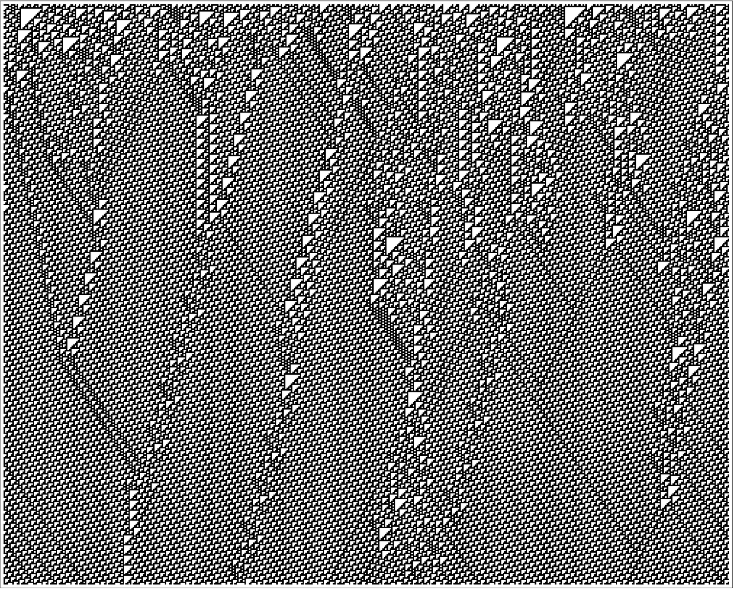
​​From this insight emerged what was later called the Principle of Computational Equivalence (PCE). In short, once a system crosses a certain threshold of complexity, it becomes computationally universal. Meaning, it can emulate any other such system, including a Turing machine. This flattens the traditional computational hierarchy. There’s no meaningful “more powerful” once universality is reached. Complexity is everywhere and simplicity can get us there. That’s what he found. Even something as simple as Rule 110 as shown in the picture above. But then… even the most elaborate laws of physics might just be one face of a far simpler computational system, hiding in plain sight.​To explore that, Wolfram turned to graph rewriting systems, a more flexible generalization of cellular automata. There, connections, not just states, could change while not being locked to a grid. When certain rewriting rules were applied to these graphs, the resulting causal structures began to resemble the relativistic fabric of spacetime, including localized reference frames and indications of Lorentz invariance. Causal relationships formed light cones. Graph distances mirrored relativistic intervals. Even quantum phenomena like superposition and entanglement began to surface as natural consequences of how these computational histories branched and merged.​But what if one took all of this to its ultimate limit? What if we didn’t pick just one rule to generate our universe? What if we included all possible rules, applied in all possible ways, to all possible initial conditions? That totality is what Wolfram calls the Ruliad, the maximally entangled limit of all computation [8]. It’s not a system we can simulate. It’s the space of all possible computations, stitched together into one vast structure. ​​
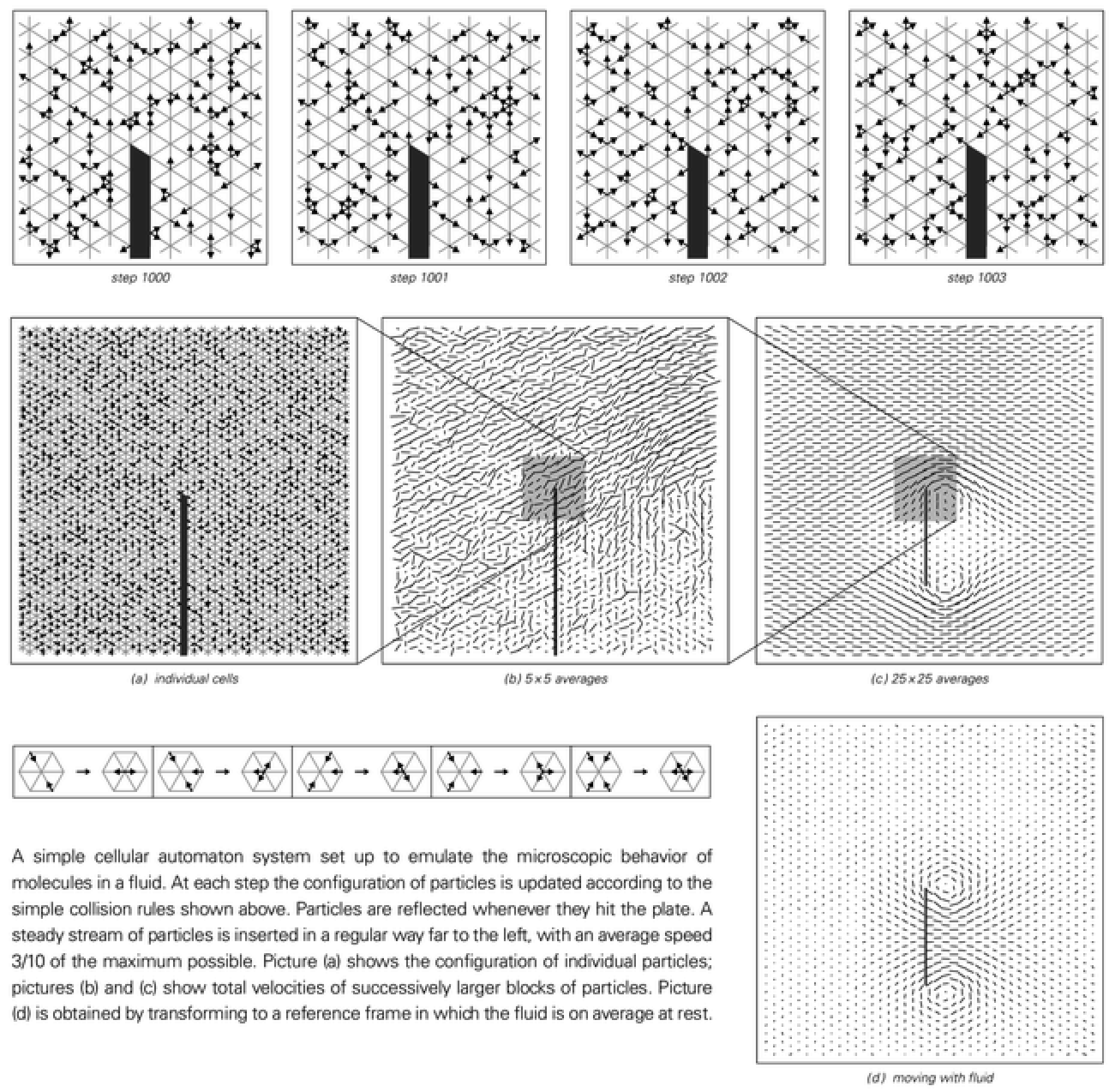
And it’s way more than just a fancy possibility. Since even the most simple rules can give rise to complex behavior, most of the ruliad is operationally meaningful. If complexity required complexity, then only a few stretches of the ruliad would have created actual worlds, with most of it being noise otherwise. But thanks to the PCE, computational universality is shockingly common. Even simple rules, once past a certain threshold, behave as richly as any other, meaning that vast regions of the ruliad are capable of producing structured realities. Like our physical one.​But here is another thing about simple rules producing complexity: you don’t know what the next step looks like until you run it. There is no formula or a neat trick to predict the next step, to jump ahead. Rather, it can only be known by computing it. No shortcut. No compression. That’s computational irreducibility. There might be pockets of repeatable elements that can be predicted, which makes them “computationally reducible”. But the vast majority of the ruliad, or the output of even the simplest cellular automata, is computationally irreducible. Which of course doesn’t bode well for resource-constraint observers like us humans. We can only ever interact with this complexity in some limited way, for example by sampling it via coarse-graining like averaging things together to make them manageable. Kind of like how complicated microscopic molecule movements can lead to simplified flow diagrams when averaged out (see picture below [7]).​​
​We are a bit like these eddies forming around the barrier of the last picture (d): oblivious to the deeper dynamics but, in turn, blessed with a stable and easily graspable world. Wolfram et al has shown that many vexing phenomena, like the second law of thermodynamics, are at their core a result of our computationally bounded existence meeting a computationally irreducible universe. ​Strictly speaking, the ruliad is more than just a universe. It is the totality from which any and every type of universe can emerge. It is all computations ever possible already computed. Eternal and unmoving in its absolute completeness. A computational monism: everything that exists — from matter to mind to everything else— is ultimately the unfolding of computation-as-undifferentiated-substance. There are no two substances, no divide between the physical and the mental, the objective and the subjective. Just one fabric: computation. And only when we zoom in, as small bounded entities like us human observers might do, does this undifferentiated totality look like the separable structure of states and update rules. It’s a picture we give it in the absence of being able to grasp it all.

The Ruliad as an optimal approach to unify mind, matter, and the infinite

But let’s return to the big question from earlier: can the ruliad approach constructively accommodate the above conclusions, addressing all three of them meaningfully.
1
.
“The physical world is simply a useful interface.” Stephen Wolfram holds his own version of the interface theory of perception, which he calls “observer theory”. In his view, we don’t experience the raw structure of reality, the ruliad, but only a sampled slice of it. Not only sampled, but also coarse-grained, abstracted, or equivalenced. Said differently, the vast complexity of the ruliad can never be captured by computationally bounded entities like human observers, and as such, we only ever perceive a highly filtered version of this ultimate reality. Thus, what we call space, time, and even physical laws are not fundamental truths but stable patterns we’re able to extract with our limited capabilities. In this framing, perception isn’t a window into reality, but a compression, an interface adapted not for truth but for computability.
2
.
“The Self is a construct, emergent from something far more infinite.” Here, the ruliad as the totality of all possible computations in its vast, monolithic abstract nature offers the undifferentiated ground being sampled via computationally bounded observers, leading to differentiated Selves. How exactly that happens remains to be shown but I will sketch a possible pathway further down.
3
.
“The physical world needs to be situated within something far more generative.” By its nature of being the maximally entangled limit of all possible computations, the ruliad offers a view from everywhere, not just a view from physical space. Wolfram et al have made significant process in showing how the main characteristics of general relativity and quantum mechanics can be recovered through discrete and deterministic rule rewriting systems [9]. Though currently mostly a qualitative connection, mathematical formalization [10] is currently underway to rigorously connect this digital universe to the continuity approaches we have so far used to explore physics and other scientific disciplines. Furthermore, initial results also show applicability in a variety of other disciplines like biology, chemistry, and mathematics.
​
It is therefore possible to recover science-as-is without it being restricted to assumptions of physicality. Additionally, it is uniquely structured to also accommodate mind-stuff as well as the undifferentiated infinity. To include all three of them in one mathematical framework is truly unprecedented. And it has to answer one very, and age-old, question: How do we get something from everything?

When the sea begins to fold

An honest caveat

First though, let’s be honest with ourselves and properly situate this discussion by acknowledging that the entire concept of the ruliad and its differentiated version as computational rules operating on states is something that we as entities steeped in computational thinking come up with. But it doesn’t mean it is the ultimate truth. In the middle ages, people believed ultimate reality to be book-like as that was the cutting edge knowledge invention of the time. We currently think of everything as computation as that is our most cutting edge and successful technology to find and name the patterns we encounter. The questions will only ever be as good as the abilities of the question-asker, and that question-asker is constantly evolving.
​
Nonetheless, despite all of these computational ideas perhaps being more representational than veridical, we can still compare the quality of our questions and answers by the explanatory power they offer. Which, as mentioned, has been outstanding and ever-accelerating in the last few decades. As such, we already have made humongous leaps as humans. We have gone far beyond the world of our senses and are now exploring the space of all possibilities through ever-more abstract tools. However, the fact remains: though we might attempt the structure of our existence “from the ruliad up”, in the end, there is only us — the coherent eddies, perhaps — asking these questions while simultaneously laying the foundations for our own answers.
​
Maybe, probably then, the ruliad isn’t the ultimate ground of reality. We can’t know for sure. But it might get us closer than other frameworks, especially because of its ability to capture the zeroth person perspective. Not only structurally, but also qualitatively, it seems to align very well with witness accounts, like this one [6] describing a sense of a “self-updating process”:
​
​“In a moment in which all self-feeling had dissolved and I was walking in the forest (i.e., not a sitting meditation, not a specific walking meditation).
Everything was a big ... self-updating process. Timeless, almost dimension-less, in a way, empty, and yet every particle of “my experience” was somehow connected with every other particle, a wholeness. With no point of identity to which I could have referred.”​
​
Words are only ever poor approximations of such an experience. And any scientific framework will be too. But that’s ok. We have to start somewhere. Ideally somewhere, where the newest questions an imagined being like us can ask can be answered. Even if never ever fully true.

The emergence of the Self asking the questions

Pesky qualia … finally asking the right questions

Being the hallmark feature of the specialness of our subjective experience as a separate Self -- qualia -- the discussion surrounding it has probably been the one thing that has thwarted the full acceptance of the physicalist program by consciousness researchers. It just seems too unlikely that the ineffable experience of something to “feel like anything” can be captured by a cold, mathematical algorithm, even if executed on wet and warm hardware. That is, even if we were to find the equations of consciousness and their instantiation in specific neural circuitry in the brain, which we are making slow progress on, science will never be able to explain what it actually feels like to live through them. So the argument goes.
​
So far this has been a stalemate, with both sides agreeing to disagree. The philosophers saying that qualia is unexplainable irreducible, thus making up the very ground of existence. And the scientists calling BS, saying it all comes down to the right algorithms run in a specific way in the correct substrate. For them, qualia is just an emergent phenomena of all that biological computation. But what if it didn’t have to be a stalemate? The two aspects to tease apart to get to a resolution are the following: what counts as an explanation and what does it mean to have an experience.
​
On the former, many philosophers mistake scientific algorithms as purely rational explanations. Meaning, that whenever scientists say they can explain the algorithm behind the experience of red that it would be the descriptive explanation which could somehow infer the experience of it. That’s of course wrong. What is meant is that, knowing all we know about the color experience of red and the physical substrate, we would then instantiate it in a human brain that has never experienced red and thus, almost “telepathically”, transfer this experience over into the naive subject. Would they then have an “experience of red”, of the qualia of red? Absolutely. Total knowledge does not only come in the form of words, it needs to recapitulate all dimensions of what is supposed to be reproduced and that includes biological instantiation. Thus, a full physicalist explanation of the qualia of red would always entail it being executed in a brain. Show don’t tell, as they say. Which explains the confusion around “full explanations” between philosophers and scientists. However, is reproducing the qualia of red via algorithms-in-the-brain-instantiation really a full explanation or are we simply looking at a correlation...?!? The jury’s out on that one.
​
The second issue is a bit trickier: what exactly is an “experience”? Even if a color-blind person were suddenly able to perceive red and its qualia via neural implants, why should any of it feel like anything at all? Why should a biological computation come with vibes? We know that emotions, for example, are a “biological summary” of a brain computation showing a too great discrepancy. Happiness? Exceeding expectations. Anger? Violating expectations. And in both cases, the body is flooded with chemicals which trigger the characteristic physiological changes, like increased heart rate. None of which we perceive directly, they are largely inaccessible to us. But we do get the summary of them, and then we say we “feel angry”. Same with the experience of red. Any type of feeling or qualia seems to simply be neural circuits firing and subconscious body signals reverberating without us being able to resolve them meaningfully.
​
“But still”, most qualia-obsessed philosophers would argue, “why would an algorithmic biological response feel like anything”? In other words, why have a full-blown, ineffable experience when a simple summary algorithm, as is the emotion of anger, could also just be neutral?! Why feel angry?! The physicalist answer is usually something like: “because that’s just how it is, that’s how we perceive biological summaries.” [11] Which, on first glance, seems like a very unsatisfying answer. But perhaps it only feels unsatisfying because we’re asking the question in the wrong frame.
​
Let’s return to the data. What do we know? In the zeroth-person perspective, there is no “feeling.” No anger, no joy, no red, no Self. Feelings, emotions, qualia, vibes ... they only emerge once the Self-loop comes online, once the eddies rise from the calm sea of infinity. Zooming in on that experience, we realize that we often toggle between being in an emotion and neutrally observing it. Just like enjoying the redness of a sunset, aka being fully immersed in it, and then wondering why it feels like anything at all, aka taking the view from above. Philosophers often reify the immersion while scientists feel like they are done if they can explain the view from above. That’s where the entire disagreement comes from. But both of them miss the important part: the transition into any type of subjective differentiated experience in the first place. That’s where qualia come into being. Not in the toggle later on.
​
But that transition we know. It’s coherence forming bounded eddies in the undifferentiated infinity as described by the ruliad. And thus, any time we experience -- and wonder about the experience -- of the redness of red, looking for a proper algorithm to describe it all, we have to admit that we are the very calculation running and we can’t step outside of it. Us and the way we build our experiences are not some separate entity we can isolate in a lab and explore like a cell culture. We are the very exploration exploring. We are like an eddy trying to discover itself in its fullness, from the view above, but that’s impossible. Because there is no view from above. All there is is the ruliad (or an equivalent monism), and any coherence eddy “broadening its horizon” to capture itself in the act of being said eddy would have to deconstruct its own boundedness until it, inevitably, finds itself in the totality. Only there it could become fully known. But also there, it doesn’t exist as graspable, separate entity to be examined. All the questions about qualia it might have ever had cease to exist right in the moment it could have finally put its finger on them.
​
Said differently, the question of transitioning from zeroth to first person perspective, and thus the question of qualia, is fundamentally about a process of coherence which can’t capture itself in its entirety. That’s the crux. It’s not a biological summary of conveniently tagged bodily changes, a view from above in that sense, nor is it the ineffable and unexplainable ground of existence. Rather, it is a process trying to catch itself in the act of processing, and never quite succeeding.
​
This is a powerful reframe of the qualia debate, a whole new access point to resolve the decades-old stalemate. Take the example of the emotion of anger. Of course we can describe it algorithmically as “violated expectations” and list off all the released chemicals and physiologically changes. We can then instantiate it in a test subject by artificially replicating these details. We can even teach them to label the ensuing experience as anger. But as soon as the awareness and label of such a feeling becomes known to mind, the experience itself becomes a point of inquiry, and that’s where we step into a-process-not-catching-itself-fully territory. That doesn’t make it unexplainable or completely inaccessible by theoretic means, as some like to claim [12]. But having a theoretical description also doesn’t make it entirely pin-down-able, as others might hope. And it for sure doesn’t support any line of argument simply explaining qualia away, as heralded by others again [13]. Rather, it all points us to a new and highly intriguing point of exploration: the transition from zeroth to first person perspective. The birthplace of that which we call “experience”. That’s where we all should gather to discuss qualia.
​
Yet, still, why does a process trying to catch itself feel like anything in the end? Feeling for sure is a biological summary, but why not come in neutral? That we don’t know yet. But we might be able to because now we can finally ask a better question, one that can resolve the old tensions. That is the power of this unifying framework.
The Ruliad Program

Similar to how the physicalist program attempts to explain the nature of reality, we can now also sketch out the Ruliad Program:
1
.
The foundation is the ruliad. That totality is reflected in people’s zeroth person accounts, which most remarkably is not called an “experience” except for lack of better words. It’s a substance monism where the substance is the totality of all possible computations applied in all possible ways to all possible (abstract) initial conditions. As such, it is the ontology and the fabric of the universe.
2
.
Eddies of coherence can form because everything possibly imaginable is contained in the totality of all things. These eddies can be seen as a form of boundedness and persistence in the ruliad. Most notably, they have a “sense” of dynamics (the local rules present in their part of rulial space), seemingly setting them apart from the immovable totality. Therefore, everything separate emerging from the ruliad is always a process.
3
.
The way this persistent boundedness moves through rulial space can meaningfully include further rules that coarse-grain the complexity of the ruliad into ever more restricted but highly persistent eddies. Eventually even leading to eddies asking themselves the question of “what is experience?” while constantly folding and sampling rulial space to be able to ask this question in the first place. Thus, the very act of human perception is a folding of the totality in these coherent ways, leading to the emergence of a physical world (matter-stuff) and time and a Self (mind-stuff) as co-foldings. It’s patterns describing patterns. And as such never entirely separate from each other, never entirely objective since there is no “outside” description possible.
Thus, the Ruliad program offers a compelling approach to work within the constraints stated earlier. The biggest challenge is, of course, recovering known knowledge via its current tools, like graph rewriting and cellular automata approaches. First efforts are successfully underway, making it a promising alternative to standard scientific approaches.

Supportive summary #2

In this second part, I introduced the ruliad framework by Stephen Wolfram as a new framework most optimally suited for unifying explanatory approaches to mind, matter, and the undifferentiated infinity (as we had identified as a goal in part 1).
​
Postulating the emergence of something from the everything via a tensioned coherence, we have an effective framework for capturing the move from the zeroth to first perspective to first and third person one. Concrete phenomenological accounts of this transition also offer us insights into what type of equivalencing happens within these coherences in order to arrive at an experience of a separate Self. This includes sense data, time, space, emotions and feelings, and even qualia.
​
Explaining qualia — why anything should “feel like” anything in the first place — has been a contentious debate among scientists and philosophers. The former simply “explaining it away” by stopping at identifying its neural mechanism, while the latter often assuming it to be simply unexplainable. The ruliad framework gives us a new and more helpful approach to the discussion. We can show that the qualia question simply arises from a process (the Self) being unable to fully model itself. If it could, it would have dissolved back into the totality, the ruliad, where no qualia can be found in the first place. Thus, it is in the transition from zeroth to first person perspective that the qualia debate should unfold, which might resolve the current stalemate.
​
Last but not least, similarly to the Physicalist Program, we can sketch out the explanatory tower of the Ruliad Framework. It assumes the ruliad as the fabric of the universe from which everything else emerges as coherence modes.

Part 3: Connecting the Ruliad Framework to Existing Questions

In this last part of the post, let’s explore further conclusions and insights we can draw from the ruliad approach.

A Short Philosophical View on the Ruliad

A Computational Monism

Philosophically speaking, the ruliad can be considered a computational monism. A single substance from which matter-stuff and mind-stuff can be derived, occurring concurrently. This is very similar to Spinoza’s God [14]. Spinoza described God as a single, infinite substance expressing itself through infinite modes — an eternal, self-caused totality, within which everything that exists must already reside. He argued that we, as finite minds, perceive only a sliver of this fullness, grasping just two of its infinite attributes: thought and extension. In a strikingly modern echo, Wolfram’s Ruliad describes a total structure containing all possible rules applied in all possible ways — a timeless, logically complete whole from which every pattern, law, and perception emerges. Like Spinoza’s God, the Ruliad is not something we look at directly, but something we live through. We are not outside of it; we are local projections within it, carving out coherent paths through a space too vast to fully comprehend. What Spinoza intuited philosophically, Wolfram articulates computationally: that what we experience as reality is not the whole, but a bounded, observer-relative slice of something far more complete.
​
What Spinoza called “thought” and “extension” weren’t two kinds of substance, but two ways of slicing the same underlying reality, two attributes of a single, infinite structure that expresses itself in infinite forms, very much pushing back against Descartes dualism of mind-stuff and matter-stuff. Wolfram’s Ruliad does something strikingly similar. What we call physics — matter-stuff — is just one projection of the ruliad: a stable pattern in causal space that our coarse-grained filters latch onto. What we call mind — the experience of time, identity, coherence — is another projection, emerging from the way we move through the Ruliad as bounded observers. Spinoza called it a “mode” in which an infinite substance, aka God, expresses itself, thus making humans finite expressions of an infinite God. Making us part of God, not something separate from God. Which translates effortlessly to the Wolfram framework. The ruliad is all there is. We can never look at it from an external vantage point. Rather, we are part of it, sampling it in our very own and special way.

On Free Will

But, do we have free will on how we sample it? After all, the ruliad is a static totality of all rules unfolding in all possible, but ultimately deterministic, ways. Aren’t we going to run into Laplace’s dreaded Demon, the outside entity who can foresee the entire future by simply following all these deterministic rules, effectively robbing us of our free will?! The answer is a firm “no”, as Wolfram has already argued [7]. And it all comes back to the unavoidable computational irreducibility of most of the ruliad. Any computationally bounded entity, even if less bounded than us but still not the entirety of the ruliad, can’t simply jump ahead in a calculation, predict the next output of a rule. The universe is incompressible in that way. That means, even if the Demon perfectly knew the initial conditions of a system and the underlying rules driving it, it’d still only ever discover the future as it unfolds. No shortcuts. Which, ok, basically tells us that Laplace’s Demon loses its teeth. We are all on equal footing here. But is “not being able to know the future” the same as “having free will”? For Wolfram, yes, because as that future in its intense complexity unfolds, any observer will just shake their head and claim that there is no rhyme or reason to it all. None whatsoever. Thus, though the brain itself might actually run on deterministic rules, the complex outcomes will look so far removed from any type of regularity that we can’t help but attribute this apparent randomness to some special quality like “freedom”. In other words, it’s a felt freedom. We will probably never figure out the rules, and even if we did we still wouldn’t be able to say what comes next. In that way, failure to predict (due to computational irreducibility) is tightly coupled to an apparent free will.
​
But here’s the twist. Our conscious experience of free will doesn’t arise from confronting that chaos. Our minds don’t live in the irreducible substrate and its consequences. We live in pockets of reducibility. We slice the world into trees, tables, sunsets, chocolate milk, equivalencing the insane complexity of the ruliad in nicely manageable impressions. We are a tiny islands of clarity floating atop an unfathomable sea, or so we believe. And it’s from this very, very abstracted coherence that we ask the question of free will. So, the felt experience of “I could’ve chosen otherwise” doesn’t come from the unknowability of deep rulial space but from the fuzziness of our constructed equivalence class. We are free not because the ruliad is irreducible, and thus unpredictable, but because we don’t know which of its many paths we are actually on. And how they go together. We feel rather confident about our simplified, malleable, surface-level-narratives existence as the question asker. It’s the blissful ignorance of a highly equivalenced existence, like that one our conscious mind occupies, which affords us a felt sense of freedom.
​
Thus, yes, free will is a structural consequence of how bounded observers equivalence the ruliad into a navigable world. We are both unable to predict what comes next (due to irreducibility) as well as blissfully unaware of the many threads running underneath our single-threaded conscious experience (due to equivalencing). However, I would argue that it is the latter which affords us the felt sense of freedom. The impossibility of prediction makes us epistemically free: neither us nor any outside observer can fully determine what comes next for us. But felt freedom implies more than unpredictability. It also contains a sense of agency, the felt certainty of “I could have chosen differently”. Agency, however, is a construct of the narrative-bound, highly equivalenced observer. It is part of our island of apparent clarity. Exactly there where we first situated the question of free will. And thus, in the end, it’s the equivalencing that gives us free will, at least phenomenologically.
​
It’s not in facing the irreducible chaos that we locate free will, but in reveling in our apparent clarity and its path-ignorance that we become phenomenologically free.

On subjectivity and consciousness

Just a small teaser to dive into the implications of the user interface theory of perception and the zeroth person perspective when investigated systematically through a framework like Wolfram’s computational universe.
​
We immediately see that what we call subjective experience and all of its content is an emergent phenomena. It is thus algorithmically explainable in its dynamics and underlying drivers. Though its lived experience will forever fall into the “a process trying to catch itself” territory, knowing the drivers, we can probably instantiate this magical aspect of being alive. Thus, there is no point in reifying subjective experience per se. Rather, we should dissect the clearly algorithmic parts from the “only experience” ones. For example, we can distinguish the algorithm triggering the emotion of anger from our reflections about it feeling like something. This might sound like the very premise of the Hard Problem of Consciousness posited by Chalmers [15] -- how and why physical processes give rise to felt experience -- but only when we forget that we are not starting at physical processes. Our starting point is the ruliad and its eddies of coherence. There, “experience” or qualia have a computational description instead of being fundamentally inexplicable as Chalmers had suggested.
​
And to return once more to the discussion of consciousness, we can now point to a crucial new access point for the entire discussion. Currently, consciousness doesn’t have any agree-upon definition. For medical staff, consciousness equates to a person being awake and able to grasp their reality. Most cognitive scientist seem to use anything happening above a certain “threshold of reportability” as a target variable for consciousness, meaning, if I can talk about it or remember it then it was “in my consciousness”. And for philosophers of mind, consciousness often comes down to reflexive subjectivity, to reflections on “what it’s like” or ones own beliefs and intentions, etc. No wonder then that everybody is so confused.
​
But the ruliad approach also offers hope to bring order into the consciousness chaos. For one, it tells us that subjective experience -- from pure sense perception to abstract thoughts to then reflecting on those thoughts -- is just an ever-increasing tower of ever-new equivalencing algorithms sampling a unified totality. Thus, all these different attempts to grasp first-person (subjective) consciousness can be situated somewhere on this tower. That gets us order. A sequence of an emergent progression of subjectivity. But does that really give us “consciousness”?
​
The greatest point of friction are possibly people entering the zeroth person perspective. Are they not conscious despite reporting a clarity of existence unbeknownst to typical conscious, first-person experience? Should we expand the definition of consciousness to include the zeroth person perspective? Is the ruliad itself then consciousness? But that can’t be right given that is reported to not really be like anything. So then, should we restrict the definition of consciousness to some specific coherence algorithms sampling the ruliad? We can do that. However, then any question of consciousness should always carry the label consciousness-as-ours.
​
But then what about the consequences tied to the concept of consciousness? Questions of morality, care, and compassion are usually tied to whether we label something as conscious or not. We pamper a dog but swat a fly. We fight to save premature babies while eating sentient, intelligent animals. We design AI systems to mimic human reasoning yet debate whether it matters if they “feel” anything at all. The answer to all of these dilemmas hinges on our definition of consciousness. It’s an important and pressing matter. But if we are only trying to explain consciousness-as-ours, aren’t we automatically precluding these other species from an honest answer? Is that who we want to be as modern humans?!

New perspectives on observer theory

Non-human observers

What makes up an observer, as in, can we identify the aspects of the eddy/process having an experience it wants explanations for?
​
That is difficult to answer right now except for a few general pointers. Stephen Wolfram himself has identified computational boundedness, which limits the ability to “fully comprehend” and predict the complexity/irreducibility of rulial space, as well as a certain sense of persistence as hallmark features of observers. I would argue that both of them derive from the deeper need of tensioned coherence in a space of totality but for all practical purposes, especially for easier understanding, boundedness and persistence are more well defined.
​
But then, is an electron or any other elementary particle an observer? Is an ant one? A thermostat? A tree? I think that the answer depends on what we want to achieve with the concept of an observer. It depends on why the question-asker wants to ask the question in the first place. It’s the usefulness of the observer that shapes the answer.
​
For example, we only worry about electrons being observers because of the quirks introduced by the measurement postulate in standard quantum mechanics. But if that framework is reformulated with fewer ad hoc assumptions, would we still entertain the idea of “quantum observers” at all? Interestingly, Barandes’ stochastic approach already eliminates the need for quantum observers or a dedicated measurement postulate altogether. Everything is determined — the full configuration space trajectory exists — but we, as computationally bounded human observers, simply don’t have access to all of it. Whatever measurement outcome we read off an apparatus isn’t the result of some atom inside it collapsing a wavefunction or “observing” anything. It’s just the point at which we, the external observers, choose to read out what was always already there. So no, perhaps we don’t need an observer definition to include subatomic particles. But we for sure need an experimenter to put a stake into the ruliad to ask the question in the first place.
​
And how about a tree or an ant, why do we care if they are observers? For two aspects, I wager. One, if they are observers with a relevant “being in the world”-consciousness, we could wonder what type of world they see and what insights that might hold for our scientific theories. As such, their status as observers would be an epistemically fascinating one and worthy of fine-grained classification since it might point to us to scientific hypotheses that hadn’t been on our human radar.
​
Two, we might want to explore them as conscious observers of the universe because they might have the ability for joy and suffering and goal pursuits. Which would make them moral entities to be taken into account. The question of wondering about non-human observers has then turned into a moral one.
​
What might be first tentative answer for that? Well, taking the zeroth person perspective seriously we should recognize that there is no difference between the tree and us, we are all made of the same stuff, all fundamentally undifferentiated awareness. We also know that on the level of the zeroth person perspective there is no suffering as suffering and wondering requires differentiation and incomplete information. Should we then ignore this moral question? Absolutely not. Because we, the question asker, are not actually residing in the total understanding of the everythingness. Rather, as beings of a more coarse-grained level of existence who need guidance on all aspects of their imagined life, we should probably adopt the stance of extending full moral consideration to our brethren in rulial space. Because that’s what we would like others to do unto us. That consideration doesn’t imply to naively project our type of suffering or joy onto them. Rather, it should be a consideration of brotherhood in a stewardship sense. To take care of them as much as we do of ourselves, in all of our imperfection.
​
But can we ever know what type of observers non-humans might be? Might they also have Selves and a first person perspective and feelings and goals? It’s impossible to answer for now while we don’t even have any good models for humans. If we truly want to make progress on non-human observer characteristics, we first have to find more general answers of how our own cognition processes work. Attempts toward that have been made, outlining some shared characteristics underlying cognitive models in humans relevant to observer status [16] , like having an internal memory, an interaction with the environment, and updating our decision making processes accordingly. But how does memory work? How is it encoded and what might be the equivalent of that in a tree? What even counts as Self versus environment when some individuals, especially in the neurodiverse population, do not necessarily report such a clear distinction? And which information processing algorithms are important for our human existence besides pure survival homeostasis? For example, some people see the world as a fuzzy field of deeply connected possibilities while others perceive it as an almost static certainty. These different cognitive styles then inform the patterns we deem important to explain and the style of theories we develop to explain them. What are we perhaps not seeing or asking because only one cognitive style gets to ask the questions? There is so much we don’t yet know about human sense-making even though we couldn’t be closer to the source of information, it’s quite staggering. So, yeah, understanding trees and ants will be possible but we are not anywhere near to it at this point. And thus their status as observer remains undefined. And it will continue doing so in direct proportion to us not yet having identified the algorithms driving a consciousness-as-ours. But when we do, when we can model the tower of human subjectivity arising from the ruliad, we also know about many of the questions we haven’t asked yet. And it’s probably there where we will find trees, and ants, and who knows what.

The two types of observers relevant to the framework

Nonetheless, the ruliad framework needs an observer, ideally a well-defined one. In its totality, where everything is possible, there are no theories to validate and no questions to ask. It is only the world as we see it -- our human world as it arises through our specific ways of equivalencing -- that we want to explain. It’s us that gives differentiated structure to the ruliad in the first place. We are the origin story of physics, mathematics, economy. We are the reason for why there are things to explain in the first place.
​
Which is why we need to be aware that the concept of an observer carries two intertwined but separate meanings in the Wolfram framework.
​
For one, an observer is a stake in the ground of the totality. It extracts something definite from the undifferentiatedness. That’s why we wonder about electrons as observers when trying to recover quantum physics in this computational universe. We need them to limit the space of possibilities, separate it out into something useful, manageable. To carve out a definite, limited existence in infinite rulial space. We can then go and examine this tiny little slither, and there, within the happenings of nicely delineated causal graphs, we find the quantum weirdness of superposition and probability. The electron-as-observer is our cookie cutter stancing out a definite shape from the forever-dough of the ruliad.
​
Actually, most of the recovery of known sciences from within this framework relies on the observer being an entity that provides a space of coalescence, something that stances out a meaningful something from the everything. That picks out a special type of graph from the infinity of possible graphs, and a beginning and end node, conveniently ignorant of all the paths it could have traveled in-between these nodes (aka equivalencing them). A Type One observer in that sense is a well-defined, computationally bounded version of sampling. One that restricts, slices, stances, and equivalences in all the right ways so that we end up recovering quantum weirdness or the second law of thermodynamics or economic theories.
​
This is our first important definition of an observer in the framework: a computational boundedness cutting up and equivalencing rulial space, singling it out for third person examinations and scientific discovery, showing that most of our observed patterns come down to the discrepancy between this boundedness and the totality it tries to wrangle.
​
But we know that there is no view-from-above. No true third-person scientific discovery. There is only the ruliad, and our questions as well as Selves arising as eddies within it. And that is our second definition of the observer: the question asker, the one whose eddies predetermines the world to be described in the first place, and the one who is computationally bounded and persistent because that’s how it ensures to stay coherent in each calculation step. That’s what sets us apart from Type One observers. Our sense-making of the world is not just about equivalenced perceptions but, to a very large degree, also about keeping ourselves within our computational boundedness and provide an (illusion of ) persistence. These are not outside, pre-given entities. These are consequences of eddies believing themselves separate from the totality. And to keep up the charade, they need to account for it first. They need to spend significant resources to ensure they don’t overstretch their computational resources as well as string together their equivalencing in just the right way to create persistence. That’s how Selves get built, after all. The very Self asking the questions.
​
Type One observers then inherit their boundedness and persistence from the (human) Type Two observer. That’s why we can simply postulate it for them. They also inherit their reason for existence from the human: Type Two creates the world to be explained and it uses Type One to effectively capture the patterns that were discovered in this special world. The baker and the cookie cutter. Indeed, two very different types of observers.
​
Last but not least, let’s take a quick look at computational boundedness. Turns out, as far as Type Two observers go, it comes in at least three different flavors. Flavors of boundedness. And they drive the creation of Observer Two’s world.
​
One, predictive physical boundedness: human cognition is most likely a predictive and error-correcting process acting on priors/beliefs. These priors might be valenced constructs [17] which greatly reduce the space of possibilities we tend to explore. Most sense data, and with it the perception of a physical world including our own physical body map, will be dominated by this boundedness, or better: arise as a consequence of it.
​
Two, affective boundedness: navigating this world of priors is not only done by pure physical survival weighting but also due to affective weighting of all information. Any type of decision making, learning, attribution of meaning, etc will be a volition gradient through a valence map of priors and thus sample rulial possibility space in a highly specific way.
​
And three, reflexive boundedness: the Self-model is a higher-order equivalencing loop which ties together all lower levels of boundedness into a, usually, single-threaded “I”. It is the ultimate obscuring or equivalencing of the complexity of the ruliad. The experience of time possibly emerges here.
​
Having all three of them act together, plus potentially more, might give us a starting point to wonder how we create the universe we want to explain in the first place. And better understand how non-humans come up with their own universes.

Possible next steps

Though long, this has been only a slight sketch of the explanatory power of the ruliad. Things that ideally should be investigated in more depth:
◼
  • Parsing apart the various uses of “observer” more in detail. In most cases, like in the case of en electron or a bacterium or thermostat, it is used to describe the computational boundedness and persistence of our(!) object of investigation. It might be useful to call these “limited entities” instead of observers. They are patterns we human-like observers need to make sense of the world but perhaps not more than that. But then, can we really draw a clear boundary?
  • ◼
  • Is an “observer” then an eddy in the ruliad who has some form of conscious awareness, some type of equivalencing that goes beyond purely being an explanatory pattern? But what about a person in a zeroth person perspective, are they not an observer anymore as soon as they are fully immersed in the totality? What about humans who struggle to form a single thread of consciousness, who rather experience deep fragmentation like we see in neurodivergent individuals? What about babies or people in hyperfocus who are not running any self-awareness loop but are simply effectively functioning given their environment and tasks? Are they still observers? What importance would it hold to call them that? Should we separate that out from the concept?
  • ◼
  • A deep dive on the three, proposed types of boundedness for human observers.
  • ◼
  • Translating existing results from neuroscience and philosophy on the patterns of human behavior into computational patterns, aka computational neurophenomenology, in order to explore first concrete connections between human experience (Type Two observers) and the Wolfram framework.
  • ◼
  • Building toy models to highlight the confusion around “a process trying to describe its own process” in the qualia debate. Generally: offering a deeper understanding of how structure becomes felt would be incredibly valuable for the philosophical discourse as well as inform scientific explorations.
  • ◼
  • Exploring a possible isomorphism between Hoffman’s agent network (when stripped of its metaphysical add-on of consciousness) to the ruliad framework in order to take advantage of the existing mathematical results and proposed ties to fundamental particle physics. For example, one might treat his agents as purely as mathematical objects—6-tuples of state spaces and transition functions— which then reduce to generalized input–output machines embedded in a network. Each agent applies a function from a percept space to an action space and can pass outputs to others through a directed interaction graph. With appropriate definitions of symbolic state, looping, and memory, such a system can, in principle, simulate a Turing machine and thus achieve computational universality. But that remains to be shown in practice.
  • Acknowledgments

    Many thanks go to my mentor Zsombor Méder who helped in uncountable ways from providing literature, being a patient sounding board, fantastic psychological support, and creating a wonderful atmosphere of discovery. Thanks also to my fellow group-E members for their valuable input, especially to Elly who was not only a great roommate but also a champion in anything Wolfram notebooks. I really appreciate Xerxes for organizing these interesting physics lectures and helping out with all of my science questions. And Sam for explaining his paper to me. Thanks to Stephanie for all the organizational support. And to Stephen for his huge amount of work I could build on, not to mention for dedicating so much time and company resources to the absolutely amazing program that is WSS!

    References

    1
    .
    Hoffman, D. D., Singh, M., & Prakash, C. (2015). The interface theory of perception. Psychonomic Bulletin & Review, 22(6), 1480–1506.
    2
    .
    Prakash C, Fields C, Hoffman DD, Prentner R, Singh M. Fact, Fiction, and Fitness. Entropy (Basel). 2020 Apr 30;22(5):514. doi: 10.3390/e22050514.
    3
    .
    Hoffman, D. D., & Prakash, C. (2014). Objects of consciousness. Frontiers in Psychology, 5, 577.
    4
    .
    Hoffman, D. D., Prakash, C., & Singh, M. (2020). Fusions of conscious agents. Entropy, 22(1), 16.
    5
    .
    Barandes, J.A. (2023). The Stochastic–Quantum Theorem. arXiv:2309.03085
    6
    .
    Metzinger, T. (2023). The Elephant and the Blind: The Consciousness Puzzle and the Nature of Reality. Ditzingen: Reclam Verlag.
    7
    .
    Wolfram, Stephen. A New Kind of Science. Wolfram Media, Inc., 2002. ISBN: 978-1579550080.
    8
    .
    Wolfram, Stephen. “What Is the Ruliad?.” Writings by Stephen Wolfram, 2021.
    9
    .
    Wolfram, S. (2020). A Class of Models with the Potential to Represent Fundamental Physics. Wolfram Physics Project.
    10
    .
    Arsiwalla, X.D., Gorard, J. Pregeometric Spaces from Wolfram Model Rewriting Systems as Homotopy Types. Int J Theor Phys 63, 83 (2024). https://doi.org/10.1007/s10773-024-05576-0
    11
    .
    Churchland, Patricia S. Brain-Wise: Studies in Neurophilosophy. MIT Press, 2002
    12
    .
    Bitbol, Michel. “Is Consciousness Primary?” NeuroQuantology, vol. 8, no. 4, 2010, pp. 498–502
    13
    .
    Dennett, Daniel C. Consciousness Explained. Little, Brown and Co., 1991.
    14
    .
    Spinoza, B. (1677). Ethics.
    15
    .
    Chalmers, David J. The Conscious Mind: In Search of a Fundamental Theory. Oxford University Press, 1996.
    16
    .
    Elshatlawy, H., Rickles, D., Arsiwalla, X. D., & Blum, A. (2025, April 22). Towards a Generalized Theory of Observers.
    17
    .
    Kelly, G. A. (1955). The Psychology of Personal Constructs.

    Cite This Notebook

    “The Ruliad as an Optimal Framework for Unifying Mind, Matter, and the Infinite”
    by Damaris Kroeber
    Wolfram Community, July 10, 2025
    https://community.wolfram.com/groups/-/m/t/3497773