This project explores the SYK model through the hypergraphs in the Wolfram's model framework. The SYK model's remarkable solvability in the large N limit unveils features like reparameterization invariance and analytic solutions in the strong coupling limit. Considering the out of time-ordered 4pt function (OTOC) as the diagnostic of quantum chaotic, the SYK model shows an exponentially decreasing OTOC, characterized by a Lyapunov exponent saturating the chaos bound. The later might have some implications for quantum gravity. Keeping this in mind, the project endeavors to express these ideas in the language of Wolfram hypergraphs, incorporating solvability, large N limits, and quantum chaos into a novel framework. Challenges encompass discerning between classical and quantum systems, measuring the Lyapunov exponent, defining particles, and perturbing initial conditions.
Contents
Contents
◼
The SYK model
◼
Importance of 4pt functions
◼
Back to the SYK mode
◼
SYK model and Wolfram hypergraphs
◼
Simply following to trajectory in a causal graph fails to work
◼
Towards SYK
◼
Appendix
1. The SYK model
1. The SYK model
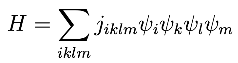
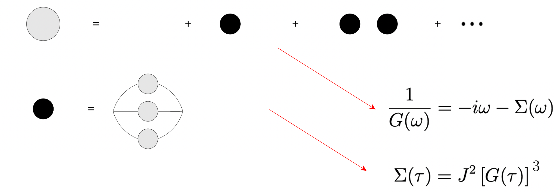
The SYK model consists a quantum mechanical model of N Majorana fermions interacting with random interactions. The model is non-local in space in the sense that the interaction is all-to-all. This model should be actually considered as a (0 + 1)-dimensional quantum mechanical system with the following Hamiltonian The coupling constant are taken randomly from a Gaussian distribution with zero mean and a width of order where is the only dimension-full quantity in the theory.One important property of the model is its solvability in the large limit . It turns out that in this limit, the disorder-averaging (shown by dashed line in the following figure), lead to only melonic diagrams contribute to the full 2pt function of the model: Therefore, the Schwinger-Dyson equations associate with the 2pt function and self-energy take the following simple form: More specifically, in the strong coupling limit, i.e. the term drops from the first equation above; equations take even a simpler form: There are two important points with the above equations: 1. They are invariant under ; this is called “reparameterization invariance”, or the conformal symmetry 2. One can find analytic solutions to the above equations; the model is solvable in this limit.Calculating higher point functions is more complicated. However, the presence of reparameterization invariance in the strong coupling limit simplifies it significantly. It turns out that fpt functions contributing at large N limit are just the ladder-melonic diagrams: The above diagram can be easily expressed by a recursive relation Then the whole thing to do is to calculate the kernel K. In the conformal limit it can be done analytically. Eventually, the 4pt function is found to be given as a sum over hypergeometric functions.
j
iklm
J/
3/2
N
J
N
N≫1

G
Σ
βJ≫1
-iω

τf(τ)



2. Importance of 4pt functions
2. Importance of 4pt functions
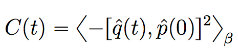
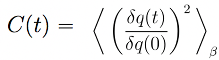
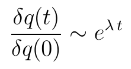
Recent studies in the context of quantum chaos have revealed that in thermal systems with a large N, quantum chaotic behavior can be diagnosed by exponential growth of "squared - commutator" of two simple operator : Here is called the Lyapunov exponent . This can be intuitively understood in analogy with the measure of classical chaos . The squared - commutator is very reminiscent of the Poisson bracket in classical mechanics . Let us takeThen replacing the commutator with the Poisson bracket in the classical limit, we arrive atOn the other hand, in the classical system, the divergence of the quantity in the brackets is referred to as the sign of chaotic behaviorThis then suggests that exponential growth of the squared - commutator in a quantum system might be a sign of quantum chaotic behavior . However, C (t) itself can be written in terms of the 4 pt function of the two operators W and V . For the unitary operatorsThe fpt function appeared above is different from time ordered correlators we deal with in conventional quantum field theory . Here, the operators are not time ordered . For this reason, this is called "out of time - ordered correlator" (OTOC) . In summary, in a quantum chaotic system, the exponential decrease of OTOC can be a sign of quantum chaotic behavior in the system .


3. Back to the SYK mode
3. Back to the SYK mode
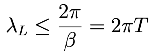
Interestingly, OTOC can be calculated analytically in the SYK model . The associated Lyapunov exponent of the model is found to be asIs there any physical point hidden in the value?Indeed, yes! It is well - known that value of Lyapunov exponent in thermal system with a large N is bounded from above : This is referred to as the chaos bound . There are two important points regarding the bound: 1. AdS black holes saturate the bound . 2. SYK model saturates the bound . One immediate conclusion could be that the SYK model is a model of quantum gravity! Among other things, the latter conclusion together with the solvability of the model at large N and strong coupling limit provide strong motivation to study the SYK model .

4. SYK model and Wolfram hypergraphs
4. SYK model and Wolfram hypergraphs
The goal of this project is to realize similar ideas (solvability, large N limit, quantum chaos, etc) in the language of hypergraphs in the Wolfram' s model . Let' s first review the challenges we face : 1. How to distinguish between classical and quantum systems? 2. Let' s focus on the classical case; how to measure the Lyapunov exponent a . How to define a particle? b . How to perturb the initial condition of the particle?3. Back to quantum mechanics, and SYK model, a . how to read a correlation function? b . How to read OTOC?
5. Ideas to explore chaos in Wolfram model
5. Ideas to explore chaos in Wolfram model
6. Feynman Hypergraphs
6. Feynman Hypergraphs
Keywords
Keywords
◼
SYK
◼
Hypergraph
◼
Chaos
◼
Lyapunov exponent
Acknowledgment
Acknowledgment
We would like to express our gratitude to Jon Lederman for mentoring this project and providing valuable insights and suggestions. We would also like to thank Xerxes D. Arsiwalla for providing valuable feedback. Additionally, our thanks go to the Wolfram Winter School for making this endeavor possible.
References
References
◼
[1] Wolfram, S. (2020). A class of models with the potential to represent fundamental physics. Complex Systems, 29(2), 107-536. doi:10.25088/complexsystems.29.1.2
◼
[2] Maldacena, Juan, and Douglas Stanford. “Remarks on the sachdev-ye-kitaev model.” Physical Review D 94.10 (2016): 106002.
◼
[3]Brouwer, Andries; Haemers, Willem H. (2011), Spectra of Graphs (PDF), Springer
CITE THIS NOTEBOOK
CITE THIS NOTEBOOK
SYK model from Wolfram hypergraphs
by Ali Davody
Wolfram Community, STAFF PICKS, January 12, 2024
https://community.wolfram.com/groups/-/m/t/3101616
by Ali Davody
Wolfram Community, STAFF PICKS, January 12, 2024
https://community.wolfram.com/groups/-/m/t/3101616