Find the First and Second parts here:
1st: Consistent Force Field: alkylbenzenes, alkanes, alkenes. Energy, geometry optimization, vibrations.
2nd: Consistent Force Field: alkylbenzenes, alkanes, alkenes. Conformational analysis of molecular rotors
1st: Consistent Force Field: alkylbenzenes, alkanes, alkenes. Energy, geometry optimization, vibrations.
2nd: Consistent Force Field: alkylbenzenes, alkanes, alkenes. Conformational analysis of molecular rotors
Table of Contents
Table of Contents
Introduction
In an earlier installment we introduced the ConsistenForceField paclet and demonstrated the basic uses of many of the functions. In the previous installment we introduced the method of conformation space mapping with the ConsistentForceField paclet functions and studied the conformational dynamics of a simple molecular rotor n-butane making use of symmetry distortion coordinates and conformational space groups. In this post we’ll extend the analysis to molecules containing two rotors, or molecular gears.
Getting started
Getting started
First, install the ConsistenForceField paclet, and then load it.
In[]:=
PacletInstall["RobertNachbar/ConsistentForceField",UpdatePacletSitesTrue]
In[]:=
Needs["RobertNachbar`ConsistentForceField`"]
Two Rotors (Molecular Gears)
2-Fold Rotors: Diphenylmethane
2-Fold Rotors: Diphenylmethane
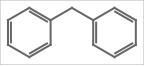
Diphenyl methane might offer the opportunity for gearing since the phenyl rings are rigid and in close proximity. Di-, tri-, and tetraphenylmethane have been studied extensively, both theoretically and experimentally [
0
, 0
, 0
to cite but a very few].In[]:=
(dpm=Molecule["C(c1ccccc1)c2ccccc2"])//MoleculePlot3D
Out[]=

Instead of using a simple torsion angle to characterize the rotation of each phenyl group, we’ll use the symmetry distortion coordinate.
Compute the pairs of torsion angles for each ring:
In[]:=
{,}=CFFTorsion[dpm,{{8,1,2,3},{8,1,2,7}}]
ω
1,1
ω
1,2
Out[]=
,
In[]:=
{,}=CFFTorsion[dpm,{{2,1,8,13},{2,1,8,9}}]
ω
2,1
ω
2,2
Out[]=
,
Recall the rotational coordinates from above.
ϕ
1
ω
1,1
ω
1,2
ϕ
2
ω
2,1
ω
2,2
Manually compute and from the :
ϕ
1
ϕ
2
ω
i,j
In[]:=
(+-Quantity[180,"AngularDegrees"])2
ω
1,1
ω
1,2
Out[]=
In[]:=
(+-Quantity[180,"AngularDegrees"])2
ω
2,1
ω
2,2
Out[]=
However, it’s more convenient to use the symmetry coordinate function of :
CFFTwoFoldTorsion
Compute and from the directly from the molecule’s atom coordinates:
ϕ
1
ϕ
2
In[]:=
CFFTwoFoldTorsion[dpm,{8,1,2,{3,7}}]
Out[]=
In[]:=
CFFTwoFoldTorsion[dpm,{2,1,8,{13,9}}]
Out[]=
For the curious, the symmetry distortion coordinates for diphenylmethane are
S
1
ϕ
1
ϕ
2
2
S
2
ϕ
1
ϕ
2
2
S
3
ω
1,1
ω
1,2
ω
2,1
ω
2,2
S
4
ω
2,1
ω
2,2
ω
2,1
ω
2,2
S
1
S
2
S
3
S
4
In[]:=
(-+-+Quantity[360,"AngularDegrees"])2
ω
1,1
ω
1,2
ω
2,1
ω
2,2
Out[]=
In[]:=
(--+)2
ω
2,1
ω
2,2
ω
2,1
ω
2,2
Out[]=
As can be seen, they are small and we can ignore them for the sake of simplicity.
Stationary structures
Stationary structures
gauche,gauche
gauche,gauche
The gauche,gauche conformation is automatically generated by .
Molecule
In[]:=
dpmGaucheGauche=Molecule["C(c1ccccc1)c2ccccc2"]//CFFOptimizeGeometry
Out[]=
Molecule

In[]:=
ResourceFunction["PointGroupSymbol"][dpmGaucheGauche]
Out[]=
C
2v
In[]:=
MoleculePlot3D[dpmGaucheGauche]
Out[]=

In[]:=
CFFEnergy[dpmGaucheGauche]
Out[]=
In[]:=
CFFTwoFoldTorsion[dpmGaucheGauche,{{8,1,2,{7,3}},{2,1,8,{9,13}}}]
Out[]=
,
In[]:=
Select[CFFNormalModes[dpmGaucheGauche,"FrequenciesOnly"->True]["Frequencies"],Im[#]>Quantity[0,"Wavenumbers"]&]
Out[]=
{}
The gauche,gauche conformation is a minimum.
syn,gauche
syn,gauche
We can generate the syn,gauche conformation from the gauche,gauche conformation by rotating one of the phenyl rings by 90°. However, as shown below, the phenyl rings are slightly puckered in the gauche,gauche conformation
In[]:=
MoleculePlot[dpmGaucheGauche,AtomLabels->"AtomIndex"]
Out[]=
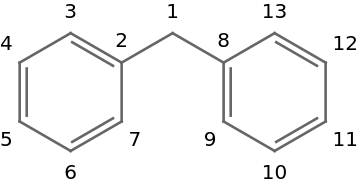
Compute the intra-ring dihedral angles:
In[]:=
Quantity[180,"AngularDegrees"]-CFFTorsion[dpmGaucheGauche,{{2,3,7,4},{2,7,3,6},{8,9,13,12},{8,13,9,10}}]//Mod[#,Quantity[360,"AngularDegrees"],Quantity[-180,"AngularDegrees"]]&
Out[]=
,,,
This means that rotating one of the rings by 90° will give a structure of symmetry, not the desired . Therefore, we need to do an initial constrained optimization to obtain a geometry with the desired symmetry, followed by an unconstrained optimization.
C
1
C
s
In[]:=
dpmSynGauche=MoleculeModify[dpmGaucheGauche,{"SetTorsionAngle",{8,1,2,3}->0}]//CFFOptimizeGeometry[#,"Constraints"->{{"Torsion",{8,1,2,3},0,200}}]&//CFFOptimizeGeometry[#,"Constraints"->None,Method->"FindRoot"]&
Out[]=
Molecule
In[]:=
ResourceFunction["PointGroupSymbol"][dpmSynGauche]
Out[]=
C
s
In[]:=
MoleculePlot3D[dpmSynGauche]
Out[]=

In[]:=
CFFEnergy[dpmSynGauche]
Out[]=
In[]:=
CFFTwoFoldTorsion[dpmSynGauche,{{8,1,2,{3,7}},{2,1,8,{9,13}}}]
Out[]=
,
In[]:=
Select[CFFNormalModes[dpmSynGauche,"FrequenciesOnly"->True]["Frequencies"],Im[#]>Quantity[0,"Wavenumbers"]&]
Out[]=
The syn,gauche conformation is a transition state.
syn,syn
syn,syn
The syn,syn conformation can be generated from the syn,gauche conformation by rotating the gauche ring by 90°. That ring is still puckered, so again the optimization is carried out in two steps.
In[]:=
Quantity[180,"AngularDegrees"]-CFFTorsion[dpmSynGauche,{{8,9,13,12},{8,13,9,10}}]//Mod[#,Quantity[360,"AngularDegrees"],Quantity[-180,"AngularDegrees"]]&
Out[]=
,
In[]:=
dpmSynSyn=MoleculeModify[dpmSynGauche,{"SetTorsionAngle",{2,1,8,9}->0}]//CFFOptimizeGeometry[#,"Constraints"->{{"Torsion",{8,1,2,3},0,200},{"Torsion",{2,1,8,9},0,200}}]&//CFFOptimizeGeometry[#,"Constraints"->None,Method->"FindRoot"]&
Out[]=
Molecule
In[]:=
ResourceFunction["PointGroupSymbol"][dpmSynSyn]
The syn,syn conformation is a double partial maximum (a hill top).
summary
summary
The table below summarizes the above findings.
Stationary structures conformation map
Stationary structures conformation map
full conformation map
full conformation map
As was done for n-butane, the itineraries are used to make a set of paths for the conformation map, making use of the symmetry of the space.
The legend function is defined in the initialization section at the end of the notebook. Putting it all together:
As one phenyl ring executes a rotation of 180°, sometimes called a “flip”, the other phenyl ring rotates slightly out of the way and then “falls” back to it original orientation. The barrier to rotation is 1.12 kcal/mol, fairly low, especially compared to the energy of the “hill-top” syn,syn conformations. The potential energy surface has serpentine valleys running vertically and horizontally between rows of hill-tops.
3-Fold Rotors: Di-t-butylmethane
3-Fold Rotors: Di-t-butylmethane
With more blades on the propellers or teeth on the gears there will be less space between the blades for the other rotor to slip by without correlated disrotation.
Propane, of course, has two 3-fold rotors, but the methyl groups are too small to engage as gears. Larger 3-fold rotors can be realized by replacing the six methyl hydrogen atoms with methyl groups, giving di-t-butylmethane.
There are now three torsion angles for each rotor from which we can construct rotational symmetry coordinates.
The three-fold rotational coordinates given above are recalled here.
Stationary structures
Stationary structures
Di-t-butylmethane has four stationary structures. We’ll quickly compute them here using the same techniques employed for n-butane and diphenylmethane, and omit all the comments for brevity.
gauche,gauche
gauche,gauche
The gauche,gauche conformation is a minimum.
anti,anti
anti,anti
The anti,anti conformation is a transition state.
syn,anti
syn,anti
The syn,anti conformation is a transition state.
syn,syn
syn,syn
To construct the syn,syn conformation, the central C—C—C angle needs to be opened up to allow room for the two methyl groups.
The syn,syn conformation is a double partial maximum (a hill top)
Stationary structures conformation map
Stationary structures conformation map
The conformation space of di-t-butylmethane is the same as for diphenylmethane except for having three periods in 360° instead of two.
Now, generate a list of symbols representing the stationary structures for the conformation map. We’ll use the same transformations as for diphenylmethane, replacing the 2-fold translation by a 3-fold translation.
Unconstrained conformational reaction paths
Unconstrained conformational reaction paths
Di-t-butylmethane has two conformational transition states, and thus two different pathways. We’ll quickly compute the reaction paths here using the same techniques employed for n-butane and diphenylmethane, and omit all the comments for the steps for brevity.
from anti,anti
from anti,anti
This pathway, while short, is quite different from what we’ve seen for diphenylmethane. Both t-butyl groups rotate in a disrotatory fashion and arrive at orientations different from those at the beginning of the pathway.
The negative direction does not need to be explored because the transition state conformation has higher symmetry than the perturbed conformation.
from syn,anti
from syn,anti
The negative direction does not need to be explored because the transition state conformation has higher symmetry than the perturbed conformation.
conformational energy profile
conformational energy profile
The energy profiles along the conformational reaction coordinate for the gauche,gauche ⇌ anti,anti ⇌ gauche,gauche process and the gauche,gauche ⇌ syn,anti ⇌ gauche,gauche are shown below.
Full conformation map
Full conformation map
As was done for diphenylmethane, the itineraries are used to make a set of paths for the conformation map, making use of the symmetry of the space.
The legend function is defined in the initialization section at the end of the notebook.
Putting it all together:
3-Fold Rotors: Bis(9-triptycyl)methane
3-Fold Rotors: Bis(9-triptycyl)methane
Triptycene is a rigid molecule containing three benzene rings on a bicyclo[2.2.2]octatriene framework and has 3-fold rotational symmetry.
We can build bis(9-triptycyl)methane by replacing the methyl groups of propane with triptycyl groups.
The three views below (top, side, bottom), with the central methylene colored yellow for reference, show the spectacular interleaving of the “blades” or “gear-teeth” of the triptycyl groups.
Stationary structures
Stationary structures
gauche,gauche
gauche,gauche
The gauche,gauche conformation is an energy minimum.
Stationary structures conformation map
Stationary structures conformation map
Now, generate a list of symbols representing the stationary structures for the conformation map. We’ll use the same transformations as for di-t-butylmethane, except expanded appropriately to six dimensions (see the Initialization section at the end of the notebook).
And here are the conformations mapped into the space:
Unconstrained conformational reaction paths
Unconstrained conformational reaction paths
conformational energy profile
conformational energy profile
The conformational energy profiles for these two processes couldn’t be more different. The correlated disrotation pathway has a negligible barrier so the molecular gearing is essentially unhindered. The conrotation pathway passes over a very high energy barrier which is surmountable only at high temperatures.
Full conformation map
Full conformation map
We need to do a little more work for the conformational reaction paths than for di-t-butylmethane. First, we’ll remove the energy and then use the 6-dimensional transformations to generate all the symmetry-related path points and gather them into a single list.
So, just how does the molecule accomplish the feat of gear-slippage? Examination of one unit cell of the map, shown below, suggests that it happens stepwise. Starting at the minimum located at (150°, 150°) and moving north-westerly the two 9-triptycyl groups begin to move in a gearing fashion. Before the molecule reaches the gearing transition state, the first 9-triptycyl group reverses the direction of its rotation and slips a second phenyl ring into the groove of the second 9-triptycyl group and thus reaches the top of the energy barrier at the gear-slippage transition state at (180°, 180°). The first 9-triptycyl group continues rotating in the reverse direction and slides the first phenyl ring out of the groove as the molecule descends down the far side of the energy barrier. Finally, the first 9-triptycyl reverses the direction of its rotation a second time and the two rotors continue in a gearing fashion to the enanteomeric conformation at (210°, 210°).
Back Matter
References
References
1
.Mislow, K., Gust, D., Finocchiaro, P., & Boettcher, R. J. (1974). Stereochemical correspondence among molecular propellers. In Stereochemistry I: In Memory of van’t Hoff (pp. 1-28). Springer Berlin Heidelberg. https://link.springer.com/chapter/10.1007/3-540-06648-9_7
2
.Nourse, J. G., & Mislow, K. (1975). Dynamic stereochemistry of tetraarylmethanes and cognate systems. Role of the permutation subgroup lattice. Journal of the American Chemical Society, 97(16), 4571-4578. https://doi.org/10.1021/ja00849a019
3
.Barnes, J. C., Paton, J. D., Damewood Jr, J. R., & Mislow, K. (1981). Crystal and molecular structure of diphenylmethane. The Journal of Organic Chemistry, 46(24), 4975-4979. https://doi.org/10.1021/jo00337a031
4
.Buergi, H. B., Hounshell, W. D., Nachbar Jr, R. B., & Mislow, K. (1983). Conformational dynamics of propane, di-tert-butylmethane, and bis (9-triptycyl) methane. An analysis of the symmetry of two threefold rotors on a rigid frame in terms of nonrigid molecular structure and energy hypersurfaces. Journal of the American Chemical Society, 105(6), 1427-1438. https://doi.org/10.1021/ja00344a004
5
.Guenzi, A., Johnson, C. A., Cozzi, F., & Mislow, K. (1983). Dynamic gearing and residual stereoisomerism in labeled bis (9-triptycyl) methane and related molecules. Synthesis and stereochemistry of bis (2, 3-dimethyl-9-triptycyl) methane, bis (2, 3-dimethyl-9-triptycyl) carbinol, and bis (1, 4-dimethyl-9-triptycyl) methane. Journal of the American Chemical Society, 105(6), 1438-1448. https://doi.org/10.1021/ja00344a005
6
.Hahn, T., Shmueli, U., & Arthur, J. W. (Eds.). (1983). International tables for crystallography (Vol. A). Dordrecht: Reidel.
7
.Z-matrix (chemistry), Wikipedia. accessed 10 June 2024 https://en.wikipedia.org/wiki/Z-matrix_(chemistry)
Initialization
Initialization
conformation map legends
conformation map legends
CITE THIS NOTEBOOK
CITE THIS NOTEBOOK
Consistent Force Field: alkylbenzenes, alkanes, alkenes. Conformational analysis of molecular gears
by Robert Nachbar
Wolfram Community, STAFF PICKS, June 11, 2024
https://community.wolfram.com/groups/-/m/t/3191986
by Robert Nachbar
Wolfram Community, STAFF PICKS, June 11, 2024
https://community.wolfram.com/groups/-/m/t/3191986