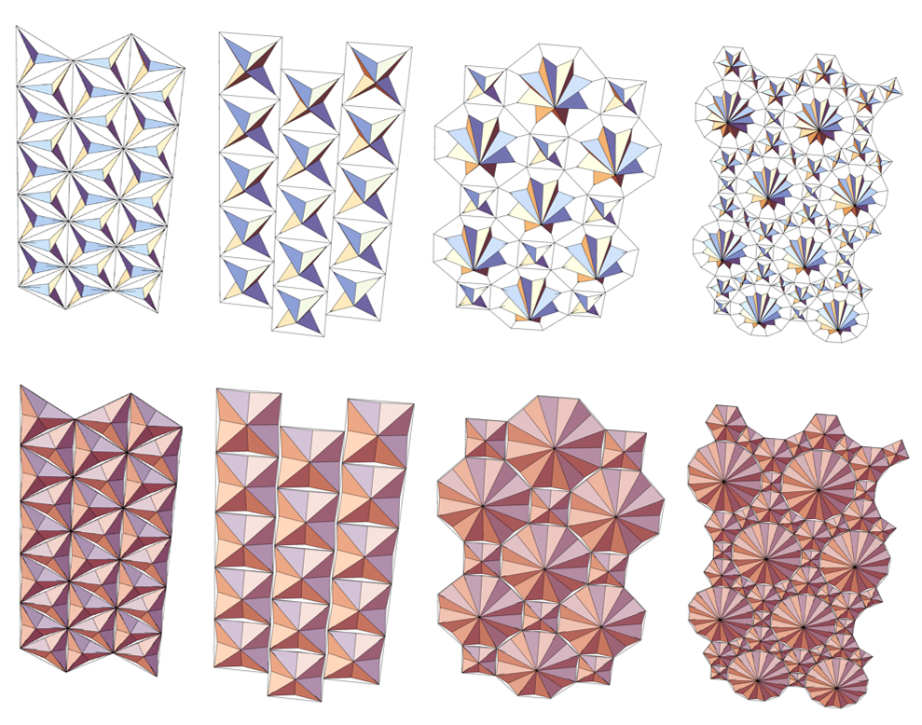
Partially closed (left) and partially open (right) configurations of origami solar facades with different textures.
ABSTRACT (original article): This work studies the mechanics of novel origami solar modules with tensegrity architecture for integration in the dynamic solar facades of energy - efficient buildings.The analyzed modules are deployed by adjusting the rest lengths of cables attached to given nodes, so as to form a tensegrity origami.Their stiffness is tuned by adjusting the pretension of the actuation cables, when the deployment motion is locked.The insertion of solar thermal or photovoltaic panels into the rigid elements of the module makes it possible to form positive - energy solar systems.The work studies the kinematics and the mechanics of the investigated structures through analytic and numerical methods.Two folding motions are examined : to open and close the modules and to track sun rays.The rapid prototyping of a physical mock - up permits an experimental validation of the force–displacement response in a given configuration of the sun - tracking motion.A procedure for the computation of the fundamental vibration modes and vibration frequencies of a quadrangular solar module is also given, and the expected response of the system under wind loading is outlined. CITATION (original article): Fraternali, F., de Castro Motta, J., Germano, G., Babilio, E., Amendola, A. Mechanical response of tensegrity-origami solar modules, Applications in Engineering Science 2024, 17, 100174, https://doi.org/10.1016/j.apples.2023.100174
Introduction
Introduction
The paper “Mechanical response of tensegrity-origami solar modules” (DOI: j.apples.2023.100174) analyzes the dynamics of folding systems designed to cover building facades by assembling basic modules. The projection of a single module in its flat, i.e., unfolded, configuration on the plane parallel to the building facade has a generic polygonal shape, which we denote as the ‘base polygon’. Since p is the number of sides of the base polygon, it consists of p isosceles triangles, each of which has the base coinciding with one side of the base polygon and the height connecting the midpoint of the bases with the center of the polygon. Because such a triangle is designed to be folded along the height, we call it a ‘macro-triangle’, with its two right triangles showing only rigid motions. The present notebook, actually an appendix to the Supplementary Text of the main paper, to which we refer the reader for further details, shows how some basic Mathematica commands can be used to generate origami solar facades with different textures.
Video of solar module mock-up
Video of solar module mock-up
Frontal and 3D view of the primary and secondary folding motions of the solar module mock-up.
Out[]=
Design principles of tensegrity-origami modules
Design principles of tensegrity-origami modules
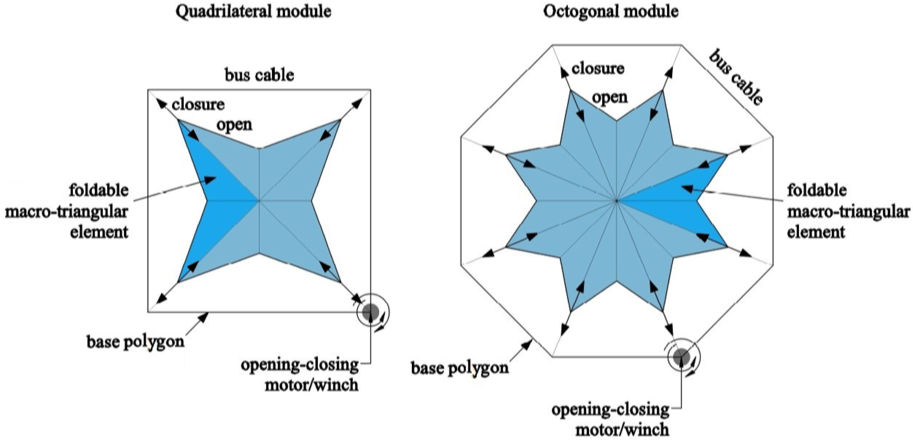
Frontal views of quadrilateral and octagonal versions of the solar eye module, with illustration of the primary folding motion.
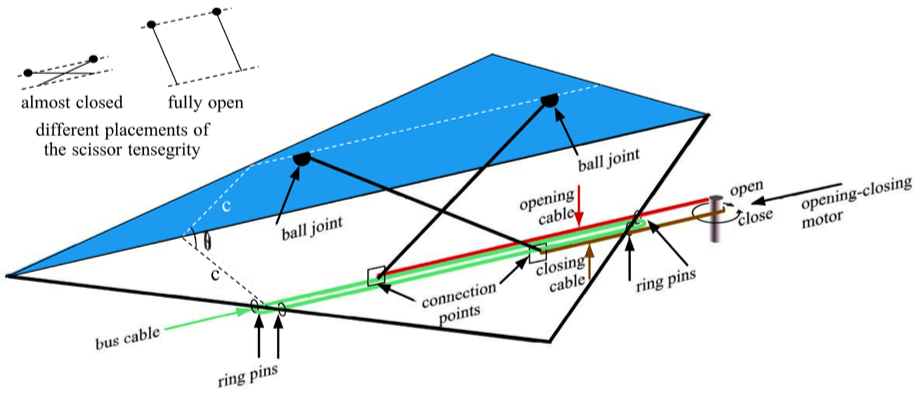
Illustration of the secondary folding motion of a micro-triangle.
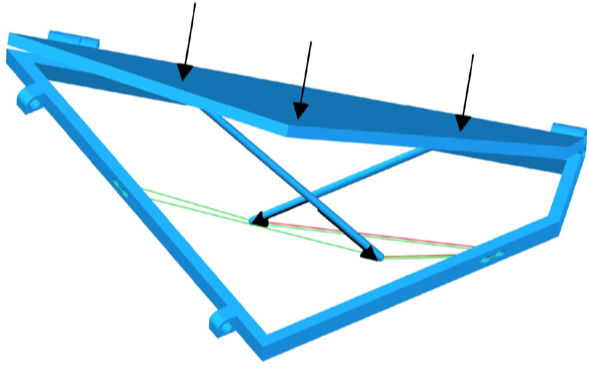
Deformation of the base cable of the scissor tensegrity under the action of external forces.
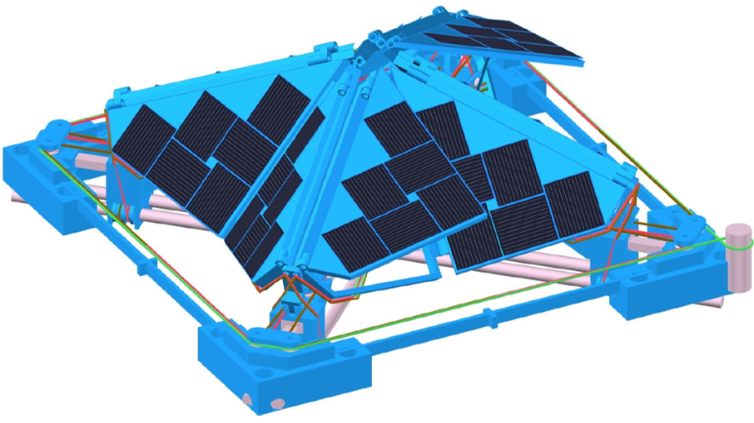
Illustrative isometric view of the quadrilateral module.
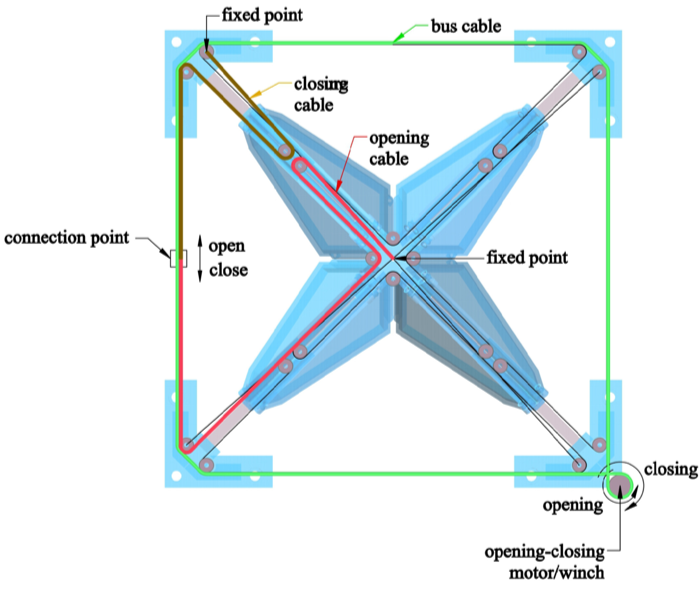
Opening–closing mechanism of the primary folding motion of a quadrilateral module obtained by changing the rest length of the activation cables.
3D view of the fabricated mock-up of a quadrilateral module. (b–f) Frames extracted from videos of the opening and closing mechanisms of the primary (b–c) and the secondary (d–f) folding motions (see Movies S1–S3 of Supplementary Materials).
The macro-triangle
The macro-triangle
Fig. 1: Reference configuration of the compound element F.
Assembly method
Assembly method
With the aim of emphasizing the possibility of building very different facades, a feature that can be exploited in both architecture and civil engineering, we show a repertoire of possible assemblages of basic modules to build complex arrangements.
Mathematical preliminaries
Mathematical preliminaries
Triangular textures
Triangular textures
Three arrangements based on F with α=2π/3 are shown here.
Arrow triangular pattern
Arrow triangular pattern
Hexagonal triangular pattern #1
Hexagonal triangular pattern #1
It can be seen that the hexagonal triangular pattern #1 can be easily transformed into the arrow pattern by appropriately translating the horizontal strips of equilateral triangles. These two examples highlight the ability of assembled modules to produce very different-looking facade covers, simply by taking advantage of the translation of the modules during their placement in the assembly phase, without changing their basic kinematic properties.
Hexagonal triangular pattern #2
Hexagonal triangular pattern #2
A further example of the design philosophy shown above is reported here, where a rigid rotation of the base module in hexagonal triangular patterns #1 produces a facade cover that can be perceived as having a different overall appearance from the previous one, without having changed the characteristics of the base module.
Square textures
Square textures
Two arrangements based on F with α=π/2 are shown here.
Square brickwork pattern
Square brickwork pattern
Here, a rigid translation of half module in the square pattern produce a different overall facade cover appearance.
Honeycomb textures
Honeycomb textures
Composite triangular and hexagonal textures
Composite triangular and hexagonal textures
Composite square and octagonal textures
Composite square and octagonal textures
Composite textures employing squares, hexagons and dodecagons
Composite textures employing squares, hexagons and dodecagons
Conclusions
Conclusions
In this contribution, a series of basic polygon assemblies shows the ability of an origami-based system to be used as a folding skin for building facades. In particular, it can be recognized that even patterns constructed using the same basic module can produce a very different appearance by simply exploiting rigid motion in the module placement and assembly phase.
CITE THIS NOTEBOOK
CITE THIS NOTEBOOK
Origami solar modules with tensegrity architecture for solar façades of energy-efficient buildings
by Fernando Fraternali, Julia de Castro Motta, Giovanni Germano, Enrico Babilio, Ada Amendola
Wolfram Community, STAFF PICKS, January 26, 2024
https://community.wolfram.com/groups/-/m/t/3110653
by Fernando Fraternali, Julia de Castro Motta, Giovanni Germano, Enrico Babilio, Ada Amendola
Wolfram Community, STAFF PICKS, January 26, 2024
https://community.wolfram.com/groups/-/m/t/3110653