Chapter 4 - The Square of Judgments and Fixedpoints
In[]:=
CloudGet["ArTensorLogic.wl"]
In the previous chapter we studied Aristotelian deduction rules and their realization on AEIO tensors. The fixed point construction was introduced as the closure of a tensor under repeated rule application. In this chapter we add a second structural component: the square of judgments. Our aim is to understand how the square interacts with the fixed point behavior and how this interaction leads to a paraconsistent reading of Aristotle's World.
4.1 The Square of Judgments
4.1 The Square of Judgments
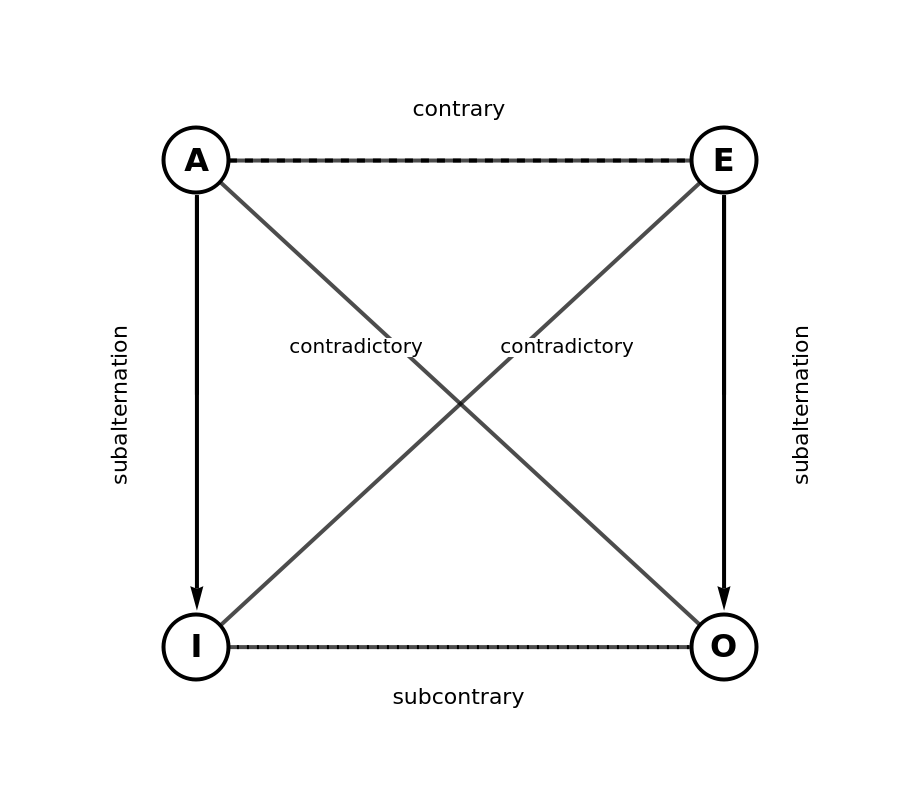
We work with the four judgment forms A, E, I, and O as before. In Aristotle's World these forms are connected by structural relations. The square of judgments is a diagram that records these relations for one pair of subject and predicate, (S,P).
The relations are:
- A(S,P) and I(S,P) stand in a subalternation relation.
- E(S,P) and O(S,P) stand in a subalternation relation.
- A(S,P) and E(S,P) stand in a contrary relation.
- I(S,P) and O(S,P) stand in a subcontrary relation.
- A(S,P) and O(S,P) stand in a contradictory opposition.
- E(S,P) and I(S,P) stand in a contradictory opposition.
- E(S,P) and O(S,P) stand in a subalternation relation.
- A(S,P) and E(S,P) stand in a contrary relation.
- I(S,P) and O(S,P) stand in a subcontrary relation.
- A(S,P) and O(S,P) stand in a contradictory opposition.
- E(S,P) and I(S,P) stand in a contradictory opposition.
Example 4.1.1: A Schematic Square Diagram
Example 4.1.1: A Schematic Square Diagram
This example is schematic pseudo-code for a graphics cell that draws the square of judgments. It is not essential for the tensor logic itself, but it helps to keep the structure in mind.
Out[]=
4.2 The Square Inside the Tensor
4.2 The Square Inside the Tensor
In the tensor representation used by ArTensorLogic.wl, the four judgment forms are organized into four judgment sections. For a tensor t, the call matJ[t, "A"] returns the matrix corresponding to the A-section, and similarly for "E", "I", and "O".
In[]:=
t0=createArTensor[3];t1=addJudgment[t0,{1,"A",2}];t2=addJudgment[t1,{1,"I",2}];displayArTensor[t2]
Out[]=
A |

E |
I |
O |
In this small example, the tensor t2 contains both an A-entry and an I-entry at the same row and column indices. In traditional terminology, this corresponds to the subalternation relation between A(S,P) and I(S,P) for one fixed pair S,P. In the tensor, this relation becomes visible as the simultaneous occupation of positions in the A- and I-sections.
More generally, whenever we speak of A(S,P), E(S,P), I(S,P), and O(S,P) for one pair (S,P), we can think of the row and column indices as encoding this pair. The four judgment sections then record which combinations of forms are present at that tensor position.
4.3 Ten Aristotelian Basic Inferences
4.3 Ten Aristotelian Basic Inferences
In addition to the square of judgments, Aristotelian logic is characterized by canonical syllogistic inferences. Aristotle presents a small collection of basic syllogisms from which further inferences can be derived. In this chapter we focus on ten such syllogistic patterns as abstract deduction schemes between AEIO judgments.
The following list gives ten well known Aristotelian syllogisms in AEIO notation. The letters S, P, and M are schematic subject, predicate, and middle terms:
1. I-Conversion: I(S,P) => I(P,S)
2. E-Conversion: E(S,P) => E(P,S)
3. A-Subalternation: A(S,P) => I(S,P)
4. E-Subalternation: E(S,P) => O(S,P)
5. Barbara: A(M,P), A(S,M) => A(S,P)
6. Celarent: E(M,P), A(S,M) => E(S,P)
7. Darii: A(M,P), I(S,M) => I(S,P)
8. Ferio: E(M,P), I(S,M) => O(S,P)
9. Baroco: A(P,M), O(S,M) => O(S,P)
10. Bocardo: O(M,P), A(M,S) => O(S,P)
2. E-Conversion: E(S,P) => E(P,S)
3. A-Subalternation: A(S,P) => I(S,P)
4. E-Subalternation: E(S,P) => O(S,P)
5. Barbara: A(M,P), A(S,M) => A(S,P)
6. Celarent: E(M,P), A(S,M) => E(S,P)
7. Darii: A(M,P), I(S,M) => I(S,P)
8. Ferio: E(M,P), I(S,M) => O(S,P)
9. Baroco: A(P,M), O(S,M) => O(S,P)
10. Bocardo: O(M,P), A(M,S) => O(S,P)
◼
In Aristotle's World, when the premises 1-10 are given, the conclusions 1-10 follow by necessity.
Each item on this list can be read as a pattern of movement in the AEIO space. Starting from a configuration of premises of types A, E, I, and O, and using the middle term M as a connector, we are led to a conclusion of a specific AEIO form about S and P. The fixed point construction on tensors can be seen as the cumulative effect of closing a configuration under such syllogistic patterns.
4.4 Fixed Points as Syllogistic Closure
4.4 Fixed Points as Syllogistic Closure
The function fixedPointTensorAEIO[t] turns an initial tensor t into a closed tensor under Aristotelian deduction rules. Conceptually, this means that all consequences that can be generated by the relevant syllogistic patterns, such as the ten basic inferences listed above, are already present in the resulting tensor.
From a practical point of view, the process can be summarized as follows:
1. Start from an initial tensor t0 representing a finite list of AEIO judgments.
2. Apply local deduction behavior that reflects the Aristotelian rules (including the canonical syllogisms).
3. Repeat this proce ss until the tensor no longer changes.
4. The resulting tensor t* is a fixed point of the deduction behavior and can be regarded as syllogistically closed.
1. Start from an initial tensor t0 representing a finite list of AEIO judgments.
2. Apply local deduction behavior that reflects the Aristotelian rules (including the canonical syllogisms).
3. Repeat this proce ss until the tensor no longer changes.
4. The resulting tensor t* is a fixed point of the deduction behavior and can be regarded as syllogistically closed.
Example 4.4.1: Closing a Tensor under FixedPointTensorAEIO
Example 4.4.1: Closing a Tensor under FixedPointTensorAEIO
We illustrate the idea with a small example. We begin with a set of judgments in pset-form and translate it into a tensor. Then we apply the fixed point construction and finally translate back to a list of judgments.
In[]:=
pset0={{1,"A",2},{2,"E",3}};t0=psetToTensor[pset0,3];t1=fixedPointTensorAEIO[t0];displayArTensor[t1]
Out[]=
A |
E |
I |
O |
This computation can be read as follows. The initial list pset0 describes some AEIO judgments at selected tensor positions. The tensor t0 encodes this information in a tensorial form. The call fixedPointTensorAEIO[t0] then performs the closure under Aristotelian deduction rules, yielding a tensor t1 in which all relevant consequences are present.
To compare the initial and the closed configuration in list form, we can use tensorToPset and tensorToMinimalPset.
In[]:=
tensorToPset[t1]tensorToMinimalPset[t1]
Out[]=
{{1,A,2},{1,E,3},{1,I,2},{1,O,3},{2,E,3},{2,I,1},{2,O,3},{3,E,1},{3,E,2},{3,O,1},{3,O,2}}
Out[]=
{{2,E,3},{1,A,2}}
The list produced by tensorToMinimalPset[t1] can be viewed as a compressed representation of the fixed point configuration. It has been closed under the Aristotelian rules encoded in fixedPointTensorAEIO, including those patterns that correspond to the ten basic syllogisms described earlier. n this way, the interaction between the square of judgments and the fixed point construction leads to a paraconsistent behavior. Inconsistent AEIO configurations do not immediately explode into complete triviality. They are contained and structured by the tensor representation and by the Aristotelian deduction rules implemented in ArTensorLogic.wl.
We illustrate the idea with a small interactive example. The slider n controls the number of terms. For each value of n, the Aristotelian tensor has shape <n,4,n>, where the middle component records the four judgment sections A, E, I, and O. The second slider keeps only the first k judgments from a fixed initial list. In this way we can watch how the fixed point grows step by step as more judgments are admitted into the initial configuration.
Out[]=


This computation can be read dynamically. The slider for k changes the initial AEIO configuration by admitting more or fewer judgments from the fixed list. The slider for n changes the number of available terms and therefore the shape of the Aristotelian tensor <n,4,n>. For each setting, fixedPointTensorAEIO produces the syllogistic closure of the resulting initial tensor.
4.5 The Twenty-four Aristotelian Syllogisms
4.5 The Twenty-four Aristotelian Syllogisms
In traditional presentations of Aristotelian logic, the core of the syllogistic calculus is often summarized as the twenty-four ‘perfect’ syllogisms in the first, second, third, and fourth figures. In Aristotle’s World, these syllogisms are not added as a separate proof calculus on top of the tensor representation. Instead, they appear as special instances of the deduction behavior already encoded in the AEIO tensor and in the function fixedPointTensorAEIO.
Conceptually, each of the twenty-four syllogisms can be seen as a pattern of movement in AEIO space. A configuration of premises about a subject S, a predicate P, and a middle term M is inserted into the tensor at the corresponding positions. The fixed point construction then propagates information through the A-, E-, I-, and O-sections until all relevant consequences are present. A familiar syllogistic conclusion appears exactly when the corresponding tensor position is occupied in the closed tensor.
The code below implements this idea for the full list of twenty-four syllogisms. For each syllogistic figure, we construct an initial list of AEIO judgments for the premises, translate this list into an Aristotelian tensor of shape <n,4,n>, and apply fixedPointTensorAEIO. The result is a closed tensor in which we can test whether the expected conclusion is present at the appropriate tensor position.
4.5.1 Proof Construction
4.5.1 Proof Construction
4.5.1.1 Standard Order of Judgments for Judgment and Figure Generation
4.5.1.1 Standard Order of Judgments for Judgment and Figure Generation
In[]:=
stdLetter[j_]:=Switch[j,1,"A",2,"E",3,"I",4,"O"];stdJ[j_,t1_,t2_]:={t1,stdLetter[j],t2};
4.5.1.2 Syllogistic Figure Configuration
4.5.1.2 Syllogistic Figure Configuration
getSyllScheme[fig_,u_,v_,w_]:=Switch[fig,1,{stdJ[u,1,2],stdJ[v,2,3],stdJ[w,1,3]},2,{stdJ[u,1,2],stdJ[v,3,2],stdJ[w,1,3]},3,{stdJ[u,2,1],stdJ[v,2,3],stdJ[w,1,3]},4,{stdJ[u,2,1],stdJ[v,3,2],stdJ[w,1,3]}];
4.5.1.3 Valid Figure Condition
4.5.1.3 Valid Figure Condition
Glashoff’s standard enumeration ranges over all 256 combinatorial syllogistic rules determined by the four figures and the four judgment forms A, E, I, and O. The proof vector selects exactly those indices for which the target conclusion W is derivable from the premises U and V in the intended interpretation. In particular, the twenty-four traditional syllogisms form a distinguished subfamily of these 256 rules, and the so-called ‘perfect’ syllogisms constitute a proper subset of this family.
When we say that the Aristotelian tensor proves ‘the twenty-four syllogisms’, this should therefore be read as follows: the tensor closure agrees with Glashoff’s proof vector on which of the 256 combinatorial labels are valid syllogistic rules. The perfect syllogisms appear among these twenty-four as especially simple cases, but they do not exhaust the full set of tensor-confirmed syllogistic inferences.
4.5.2 Proof Execution
4.5.2 Proof Execution
The proof execution checks, if each of the 256 constallations is a valid inference.
The following button executes the proof and tests all 256 syllogistic constalations. It computes the tensor-based proof vector, compares the result with Glashoff’s standard proof vector, and displays whether the two coincide.
In this way the tensor formalism serves as a uniform proof environment for the syllogistic calculus. The same closure mechanism that realizes the ten basic inferences from Section 4.3 also verifies the twenty-four canonical syllogisms. No additional proof rules are needed. The classical list of syllogisms thus appears as a derived consequence of the AEIO structure, the square of judgments, and the fixed point behavior of Aristotelian tensors.
At the same time, the tensor representation does more than reproduce the standard twenty-four syllogisms. Because inconsistent AEIO configurations are contained rather than exploded into triviality, the fixed point tensor can encode syllogistic structure even in the presence of tension between A, E, I, and O. The twenty-four syllogisms are therefore best viewed as a classical fragment inside a richer paraconsistent dynamics of Aristotelian tensors.
We have reached the end of the tutorial on the syntax of Aristotle’s logic. Finally, a few words on the role of the tensor under the semantic dimension.
4.6 Semantic Outlook
4.6 Semantic Outlook
The ten syllogistic deduction rules compute necessary consequences from given premises. One question remains: wherein is the necessity of this system of ten rules (or of any equivalent system) grounded? This question has two complementary answers.
The philosophical answer is that the necessity derives from the formal structure of the predicates we actually employ while navigating the ocean of our cognition. Aristotle described this in great detail, and I reconstructed his description in my paper. For us moderns, however, the philosophical answer alone is no longer entirely satisfactory. We also have mathematics as a pillar of scientific knowlege. And in mathematics necessity is tied to conditions or axioms that are, or must be, satisfied.
The question therefore becomes: what are the mathematical conditions under which the Aristotelian rules are satisfied? In contemporary logic this leads into the field of \emph{formal semantics}. On this level we have found the desired conditions once we know what mathematical objects correspond to AEIO-closures, and what mathematical objects behave according to the ten basic rules.
The answer developed in my paper is that AEIO-closures correspond to abstract spaces called domains. The Aristotelian predicates themselves correspond to basic elements of these spaces, namely to neighbourhoods in such domains. The algebraic behaviour of AEIO-tensors reflects the way in which neighbourhoods can be combined and transformed inside a domain.
The Tensor in ArTensorLogic.wl defines basic algebraic operations for the continuous, stepwise construction and modification of domains. In this sense, the fixed point construction on AEIO-tensors has a direct semantic counterpart in the closure behaviour of neighbourhoods in a domain.