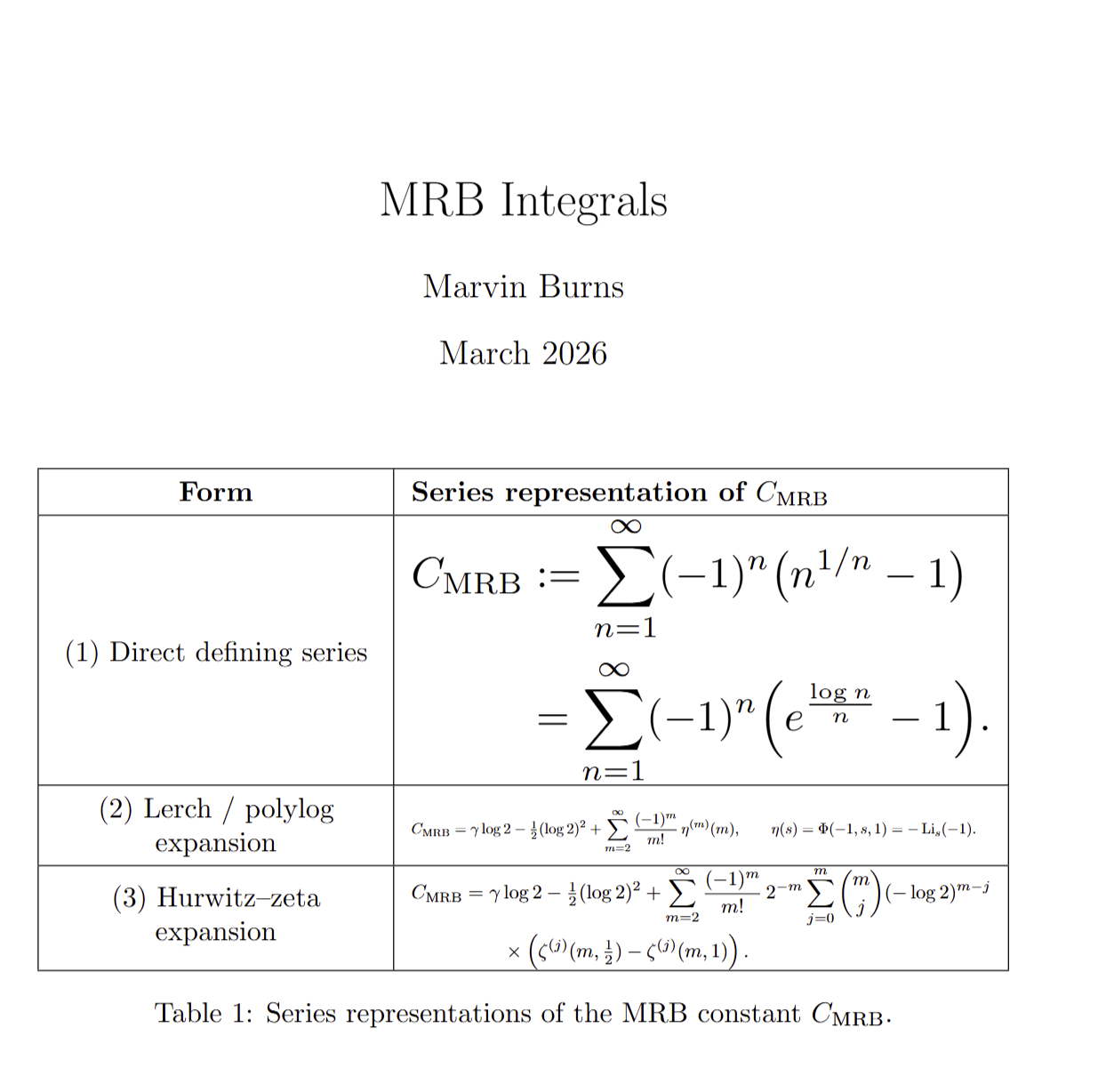
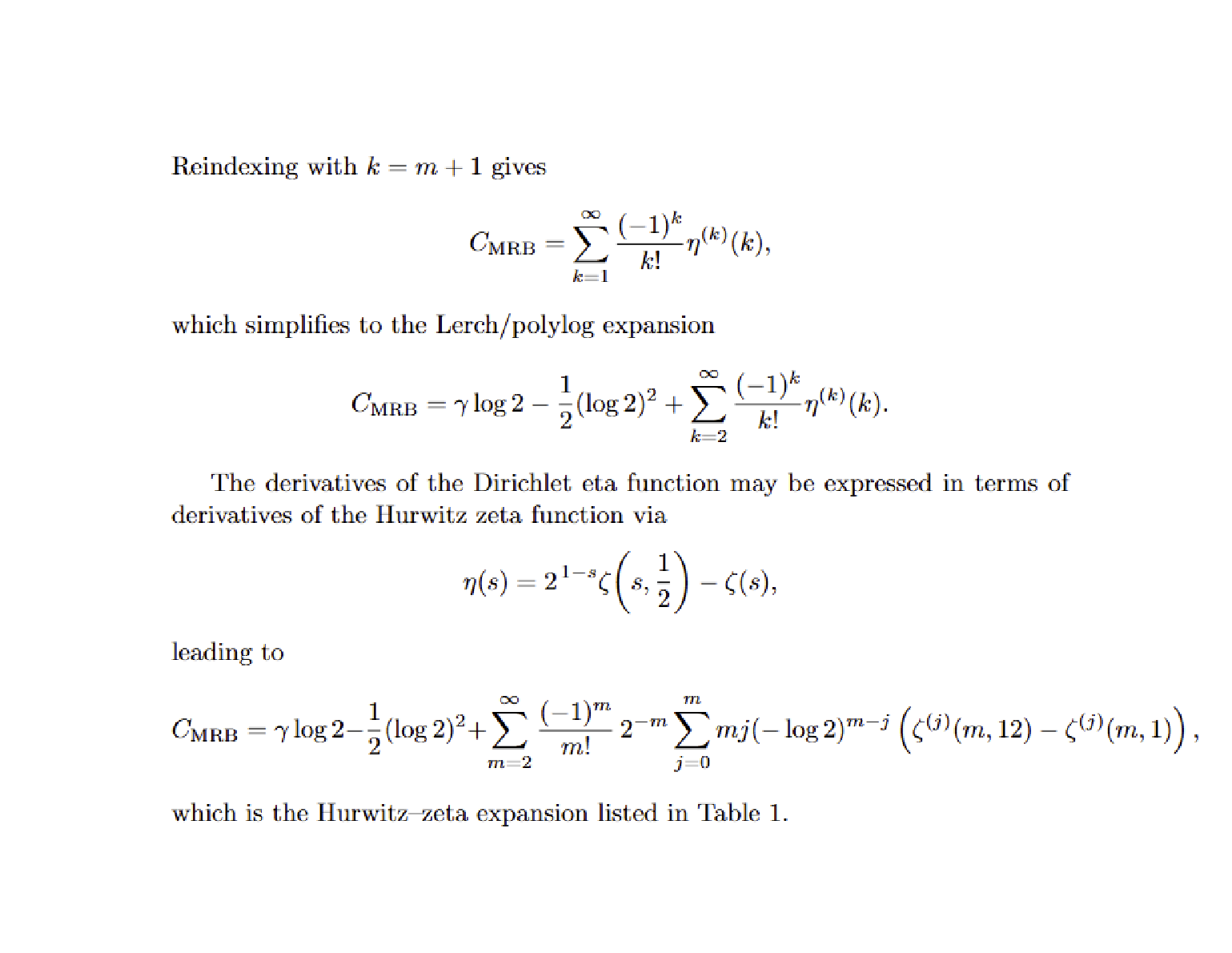
I asked GPT to give an integral form for the MRB constant from its table 1 and got the following.
I asked GPT to give an integral form for the MRB constant from its table 1 and got the following.
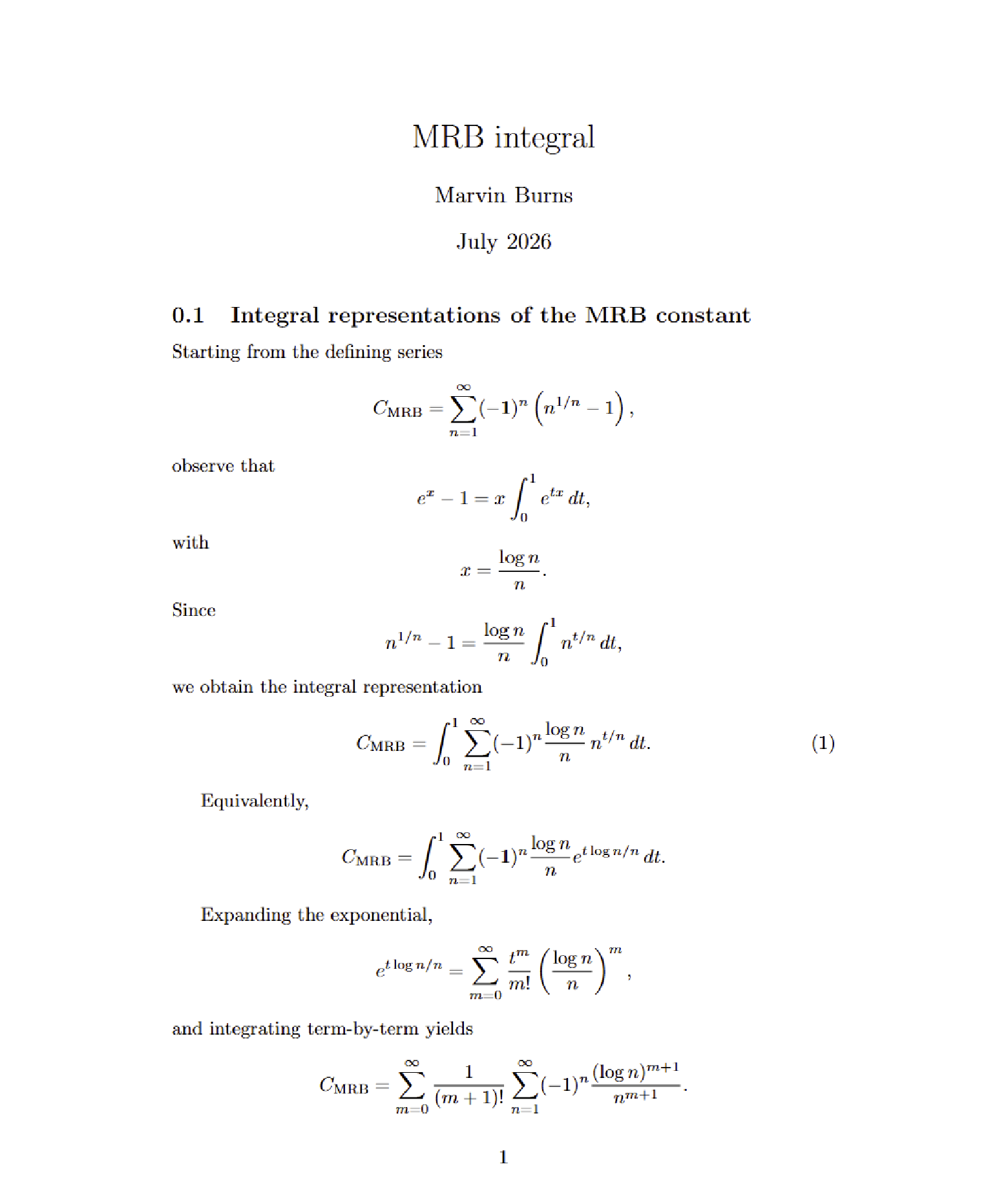
CMRB=log(n)expt
1
∫
0
∞
∑
n=1
n
(-1)
tlog(n)
n
n
∞
∑
n=1
n
(-1)
tlog(n)
n
n
∞
∑
n=1
n
(-1)
-1+
t
n
n
Write a notebook to justify reversing the int and sum.


Rigorous Abel-Regularized Derivation for an Integral Form of the MRB Constant
Rigorous Abel-Regularized Derivation for an Integral Form of the MRB Constant
Goal
Goal
We want a rigorous version of the formal derivation starting from :(-1).The issue is that the manipulations
C
MRB
∞
∑
n1
n
(-1)
1/n
n
◼
exchanging the sum over
◼
expanding
◼
and reversing the order of the resulting sums,
are not justified directly at because absolute convergence fails.
x1
Abel regularization
Abel regularization
Introduce an Abel parameter with and define Then the MRB constant is recovered, in the Abel sense, by C(x),provided this limit exists.
x
0≤x<1
C(x):(-1).
∞
∑
n1
n
(-1)
1/n
n
n
x
C
MRB
lim
x
-
1
Step 1: Integral identity for each term
Step 1: Integral identity for each term
Use -1us.With , -1-1ss.Hence
u
e
1
∫
0
su
e
u
logn
n
1/n
n
(logn)/n
e
logn
n
1
∫
0
slogn/n
e
logn
n
1
∫
0
s/n
n
C(x)s.
∞
∑
n1
n
(-1)
n
x
logn
n
1
∫
0
s/n
n
Step 2: Why sum and integral may be interchanged for 0≤x<1
Step 2: Why sum and integral may be interchanged for
0≤x<1
For , ≤.Also, since the function attains its maximum at , ≤.Therefore ≤x.Because x<∞ (|x|<1),we get ds<∞.So Tonelli/Fubini applies, giving
0≤s≤1
s/n
n
slogn/n
e
logn/n
e
1/n
n
y↦
logy
y
1/e
ye
1/n
n
(logn)/n
e
1/e
e
n
(-1)
n
x
logn
n
s/n
n
1/e
e
n
|
logn
n
∞
∑
n1
n
|
logn
n
∞
∑
n1
1
∫
0
n
(-1)
n
x
logn
n
s/n
n
C(x)s.
1
∫
0
∞
∑
n1
n
(-1)
n
x
logn
n
s/n
n
Step 3: Expand the exponential
Step 3: Expand the exponential
Since ,we obtain formally .
s/n
n
slogn/n
e
∞
∑
m0
m
s
m!
m
logn
n
n
(-1)
n
x
logn
n
s/n
n
∞
∑
m0
n
(-1)
n
x
m
s
m!
m+1
(logn)
m+1
n
Step 4: Why the order of summation may be reversed for 0≤x<1
Step 4: Why the order of summation may be reversed for
0≤x<1
For fixed , ≤≤,so ≤x.Summing over gives an absolutely convergent majorant. Hence we may interchange the sums and the integral: Now integrate term by term: s.Thus Equivalently, after reindexing ,
n
∞
∑
m0
m
s
m!
m
logn
n
s/n
n
1/n
n
1/e
e
∞
∑
m0
n
(-1)
n
x
m
s
m!
m+1
(logn)
m+1
n
1/e
e
n
|
logn
n
n
C(x)s.
1
∫
0
∞
∑
m0
∞
∑
n1
n
(-1)
n
x
m
s
m!
m+1
(logn)
m+1
n
1
∫
0
m
s
1
m+1
C(x).
∞
∑
m0
1
(m+1)!
∞
∑
n1
n
(-1)
n
x
m+1
(logn)
m+1
n
km+1
C(x).
∞
∑
k1
1
k!
∞
∑
n1
n
(-1)
n
x
k
(logn)
k
n
Step 5: Abel limit
Step 5: Abel limit
So the correct statement is:
Clean final integral representation
Clean final integral representation
Remarks
Remarks
◼
Without the factor
◼
The bound
◼
This is an instance of Abel regularization: establish identities for
Related documentation
Related documentation
Mathematica confirms that this transformation gives over 200 correct digits :