MRB Summand and Mathematica's HarmonicNumber
With PROVISO
MRB Summand and Mathematica's HarmonicNumber
With PROVISO
With PROVISO
Expected output
Expected output
In[]:=
"First 10 HarmonicNumber values:"{1,(3/2),(11/6),(25/12),(137/60),(49/20),(363/140),(761/280),(7129/2520),(7381/2520)}"""HarmonicNumber[n] equals Sum[1/k]?"{True,True,True,True,True,True,True,True,True,True}"""MRB summand phi[x] = x^(1/x)-1""""Harmonic-number generating function:"SeriesData[z,0,{1,3/2,11/6,25/12,137/60,49/20,363/140,761/280,7129/2520,7381/2520},1,11,1]"""Written directly with HarmonicNumber:"z+(3z^2/2)+(11z^3/6)+(25z^4/12)+(137z^5/60)+(49z^6/20)+(363z^7/140)+(761z^8/280)+(7129z^9/2520)+(7381z^10/2520)"""Do the coefficients equal HarmonicNumber[n]?"{True,True,True,True,True,True,True,True,True,True}"""MRB-Harmonic identity:"True"""MRB expansion from original formula:"1-z-z^2-(z^3/2)+(z^4/6)+(3z^5/4)+(131z^6/120)+(9z^7/8)+(1087z^8/1260)+(271z^9/720)-(2291z^10/10080)"""MRB expansion from HarmonicNumber:"1-z-z^2-(z^3/2)+(z^4/6)+(3z^5/4)+(131z^6/120)+(9z^7/8)+(1087z^8/1260)+(271z^9/720)-(2291z^10/10080)"""Exactly equal through order "10"? "True"""Exact closed-form identity for x > 0:"True"""Direct MRB term versus harmonic-GF continuation:""""PROVISO:""Sum[HarmonicNumber[n] z^n, {n, 1, Infinity}]""converges only for |z| < 1.""For MRB integer terms use the analytic continuation""-Log[1-z]/(1-z), not the divergent raw power series."
Out[]=
First 10 HarmonicNumber values:
Out[]=
1,,,,,,,,,
3
2
11
6
25
12
137
60
49
20
363
140
761
280
7129
2520
7381
2520
Out[]=
Out[]=
HarmonicNumber[n] equals Sum[1/k]?
Out[]=
{True,True,True,True,True,True,True,True,True,True}
Out[]=
Out[]=
MRB summand phi[x] = x^(1/x)-1
Out[]=
Out[]=
Harmonic-number generating function:
Out[]=
z++++++++++
3
2
z
2
11
3
z
6
25
4
z
12
137
5
z
60
49
6
z
20
363
7
z
140
761
8
z
280
7129
9
z
2520
7381
10
z
2520
11
O[z]
Out[]=
Out[]=
Written directly with HarmonicNumber:
Out[]=
z+++++++++
3
2
z
2
11
3
z
6
25
4
z
12
137
5
z
60
49
6
z
20
363
7
z
140
761
8
z
280
7129
9
z
2520
7381
10
z
2520
Out[]=
Out[]=
Do the coefficients equal HarmonicNumber[n]?
Out[]=
{True,True,True,True,True,True,True,True,True,True}
Out[]=
Out[]=
MRB-Harmonic identity:
Out[]=
True
Out[]=
Out[]=
MRB expansion from original formula:
Out[]=
1-z--++++++-
2
z
3
z
2
4
z
6
3
5
z
4
131
6
z
120
9
7
z
8
1087
8
z
1260
271
9
z
720
2291
10
z
10080
Out[]=
Out[]=
MRB expansion from HarmonicNumber:
Out[]=
1-z--++++++-
2
z
3
z
2
4
z
6
3
5
z
4
131
6
z
120
9
7
z
8
1087
8
z
1260
271
9
z
720
2291
10
z
10080
Out[]=
Out[]=
10? Exactly equal through order True
Out[]=
Out[]=
Exact closed-form identity for x > 0:
Out[]=
True
Out[]=
Out[]=
Direct MRB term versus harmonic-GF continuation:
Out[]=
Out[]=
PROVISO:
Out[]=
Sum[HarmonicNumber[n] z^n, {n, 1, Infinity}]
Out[]=
converges only for |z| < 1.
Out[]=
For MRB integer terms use the analytic continuation
Conclusion
Conclusion
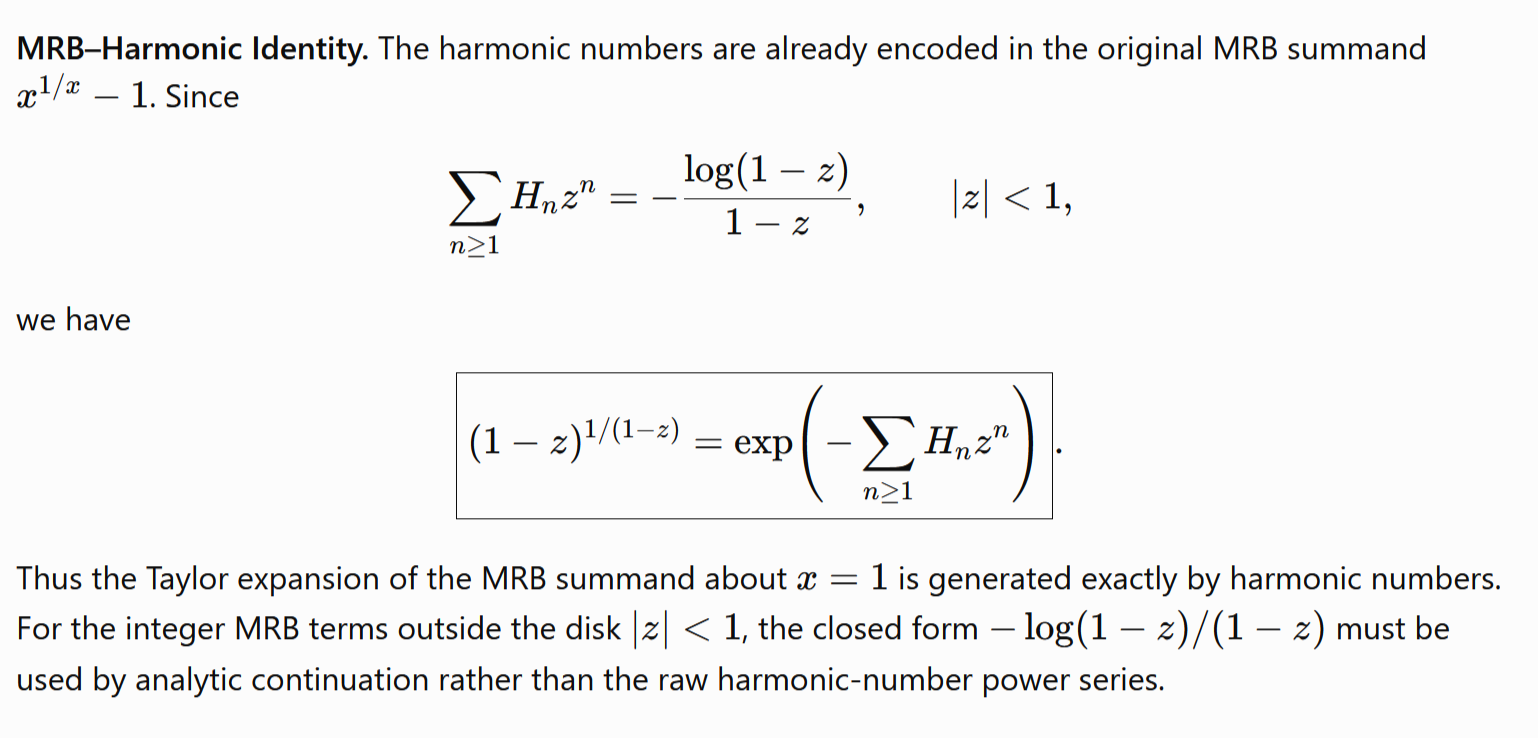
We did not insert harmonic numbers into the MRB problem . They were already hidden inside the original expression x^(1/x).
By shifting the point x = 1 to z = 0, the exponent of the MRB summand turns into the standard generating function for the harmonic numbers .
By shifting the point x = 1 to z = 0, the exponent of the MRB summand turns into the standard generating function for the harmonic numbers .
Related documentation
Related documentation
Acknowledgement
Acknowledgement
This was found while searching for a closed for using GPT . The author checked and understood the code . He personally accepts all responsibility for all statements made in the notebook .