MRB Irrationality Trifoliated Relation
MRB Irrationality Trifoliated Relation
Core infographic
Core infographic

Reading the infographic
Reading the infographic
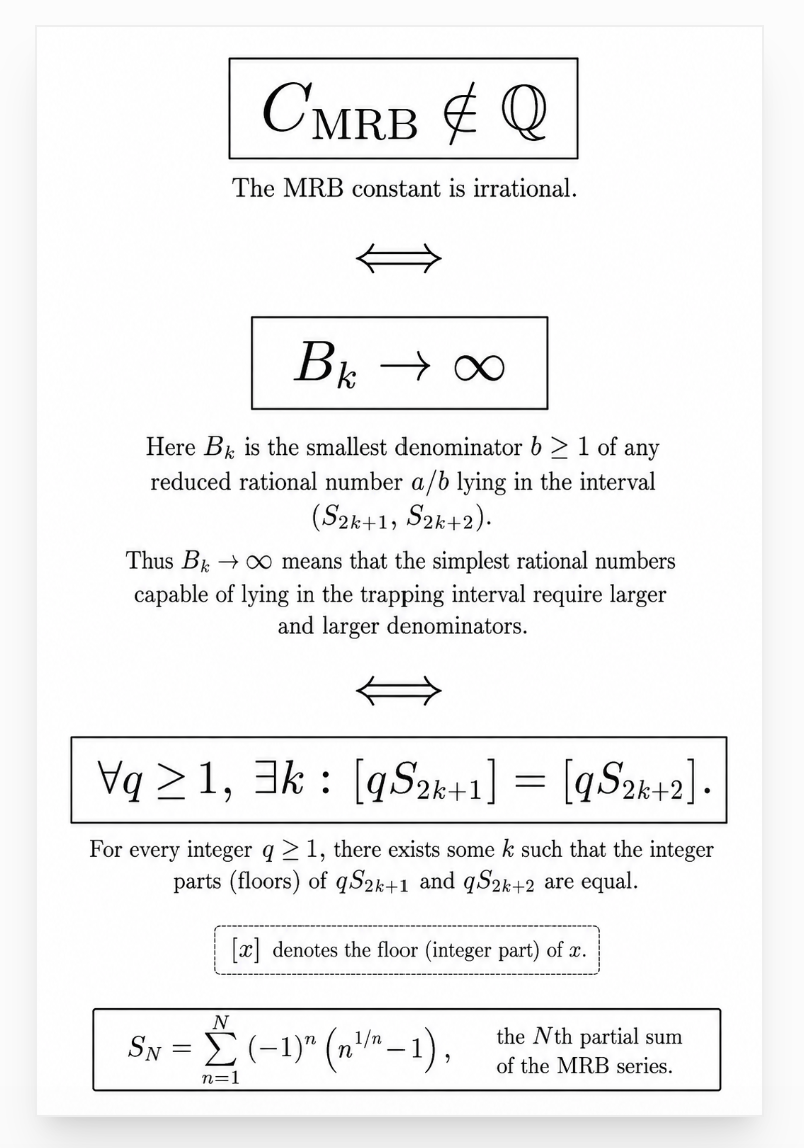
The infographic summarizes a proposed equivalence connecting the irrationality of the MRB constant to a denominator-growth condition for rationals trapped between consecutive partial sums.
It presents three statements:
1. ∉Q2. ∞3. where is the th partial sum of the MRB series.
C
MRB
B
k
∀q≥1, ∃k: ⌊q⌋⌊q⌋
S
2k+1
S
2k+2
Definitions
Definitions
MRB partial sums
MRB partial sums
Define These alternating partial sums form nested trapping intervals which are intended to squeeze toward the MRB constant.
The denominator parameter
The denominator parameter
For each , let $B_k$ denote the smallest denominator for which there exists a reduced rational number So $B_k$ measures how simple the simplest rational inside the th trapping interval can be.
◼
small $B_k$ means a simple rational lies in the interval
◼
large $B_k$ means every rational in the interval needs a more complicated denominator
Thus the statement means the trapping intervals eventually avoid all rationals with bounded denominator.
Floor formulation
Floor formulation
The infographic also gives the equivalent condition This says that for every fixed integer scaling factor , some trapping interval is so short that the two scaled endpoints fall in the same unit interval.
That is exactly what prevents a rational with denominator from lying strictly between them.
Why the equivalence is plausible
Why the equivalence is plausible
A reduced rational number with denominator has the form Such a rational lies in an interval $(x,y)$ exactly when there is an integer such that Multiplying by gives So if , then there is no integer strictly between and , hence no rational with denominator in the interval.
Applied to the floor condition says that denominator is excluded from the th trapping interval.
If this happens for every fixed once is chosen appropriately, then the smallest admissible denominator must tend to infinity.
Connection to irrationality
Connection to irrationality
If a real number is rational, say in lowest terms, then every sufficiently small interval containing also contains a rational with denominator —namely itself.
So if the trapping intervals shrink to a limit and yet eventually contain no rational of any fixed denominator, that behavior is consistent with the limit being irrational.
The infographic encapsulates this idea as
Wolfram Language exploration
Wolfram Language exploration
Define the partial sums
Define the partial sums
In[]:=
mrbPartialSum[n_Integer?Positive]:=Sum[(-1)^j(j^(1/j)-1),{j,1,n}]
First few partial sums
First few partial sums
In[]:=
Table[{n,N[mrbPartialSum[n],30]},{n,1,12}]
Out[]=
{{1,0},{2,0.414213562373095048801688724210},{3,-0.0280360079343133335199495865704},{4,0.386177554438781715281739137639},{5,0.00644789297756688289167567342327},{6,0.354454047574844550265911987326},{7,0.0339847998187207584565846558261},{8,0.330824354469730424390338773619},{9,0.0543063474604887647059401230358},{10,0.313231759254655975129894229432},{11,0.0696565313422852400501025175221},{12,0.299732036920256493713108013639}}
Consecutive trapping intervals
Consecutive trapping intervals
In[]:=
Table[{k,N[mrbPartialSum[2k+1],20],N[mrbPartialSum[2k+2],20]},{k,0,8}]
Out[]=
{{0,0,0.41421356237309504880},{1,-0.028036007934313333520,0.38617755443878171528},{2,0.0064478929775668828917,0.35445404757484455027},{3,0.033984799818720758457,0.33082435446973042439},{4,0.054306347460488764706,0.31323175925465597513},{5,0.069656531342285240050,0.29973203692025649371},{6,0.081617993359488297054,0.28906002077789960746},{7,0.091199962508263363034,0.28040707751098442975},{8,0.099055002885438708212,0.27324225598510023772}}
Interval widths
Interval widths
In[]:=
Table[{k,N[mrbPartialSum[2k+2]-mrbPartialSum[2k+1],30]},{k,0,12}]
Out[]=
{{0,0.414213562373095048801688724210},{1,0.414213562373095048801688724210},{2,0.348006154597277667374236313903},{3,0.296839554651009665933754117792},{4,0.258925411794167210423954106396},{5,0.230075505577971253663005496117},{6,0.207442027418411310407469876169},{7,0.189207115002721066717499970560},{8,0.174187253099661529512332325896},{9,0.161586349641542281808721224246},{10,0.150851300358278785424559796237},{11,0.141586440632163424460829365197},{12,0.133501376458707753420573350481}}
Since the width is exactly the positive term added at the even step.
Search for the smallest denominator in a trapping interval
Search for the smallest denominator in a trapping interval
In[]:=
clearDenominatorSearch[k_Integer?NonNegative,maxDen_Integer?Positive]:=Module[{left,right},left=N[mrbPartialSum[2k+1],50];right=N[mrbPartialSum[2k+2],50];SelectFirst[Range[maxDen],Function[q,AnyTrue[Range[Ceiling[qleft],Floor[qright]],CoprimeQ[#,q]&&left<#/q<right&]],Missing["NotFound"]]]
Floor test for a fixed denominator
Floor test for a fixed denominator
Visualize the trapping intervals and candidate rationals
Visualize the trapping intervals and candidate rationals
Remarks
Remarks
◼
The image is an excellent high-level summary of the denominator-exclusion viewpoint.
Related documentation
Related documentation
Useful symbols: