A sum for
A sum for
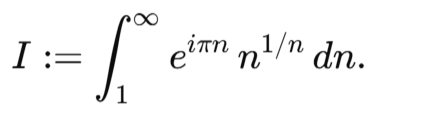
This notebook explores the relationship between a truncated sum and an integral involving Meijer G-functions. Here's a summary of the content:
Derivation of REGI:
Derivation of :
REG
I
◼
The notebook starts with a truncation of a sum to a finite number of terms, specifically 5 terms.
◼
The expression involves the differentiation of a power of a complex expression and evaluates the limit as ε approaches zero from above.
◼
The result includes Meijer G-functions, which are special functions that generalize many classical functions.
Meijer G-function Scheme:
Meijer G-function Scheme:
◼
A function is defined using the function.
f[n]
◼
The notebook demonstrates that the sum of from 1 to is very close to an integral involving the exponential
·f[n]
1-n
(I/π)
k
Deriving REGI :
Deriving :
REG
I
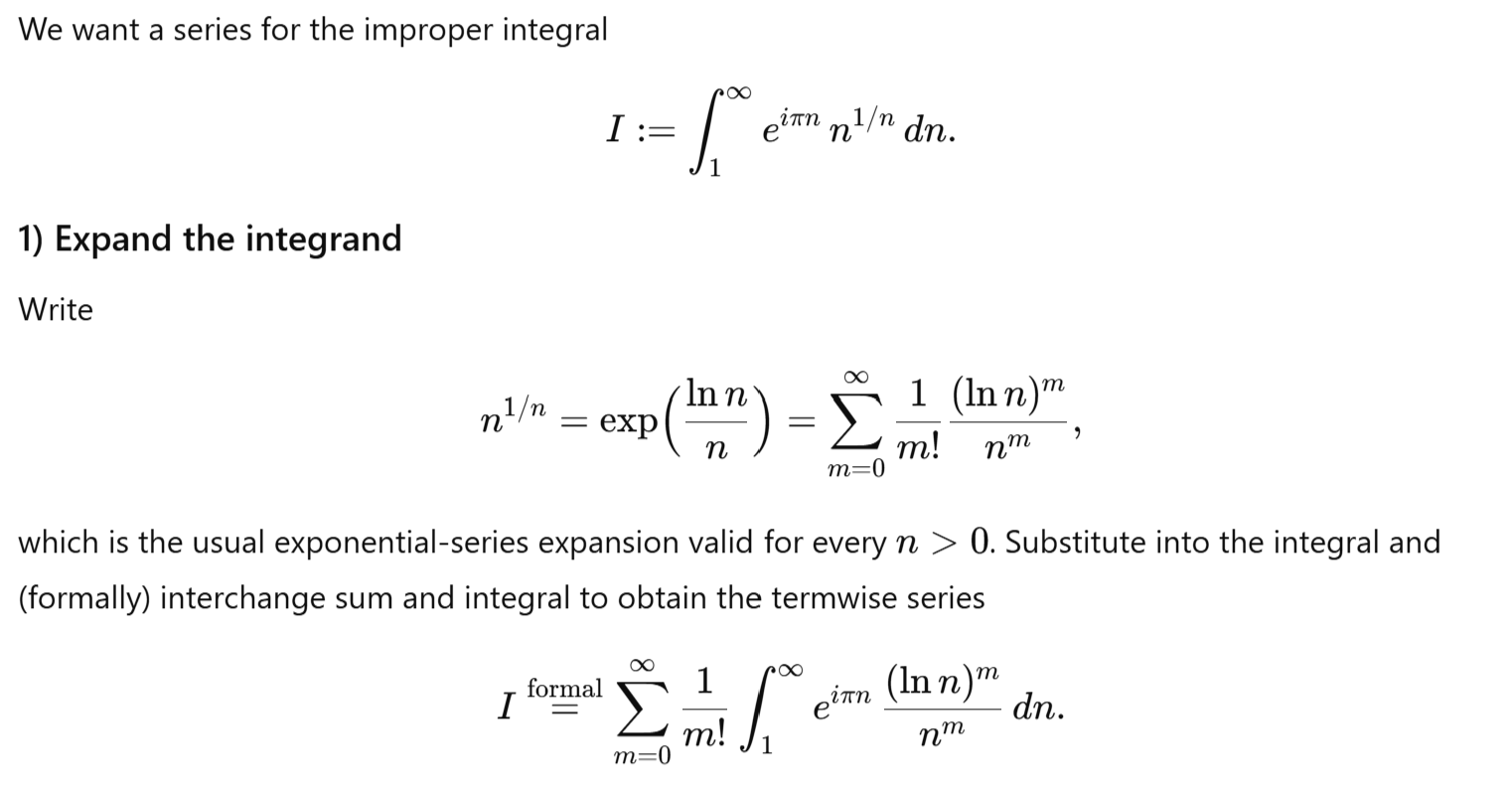
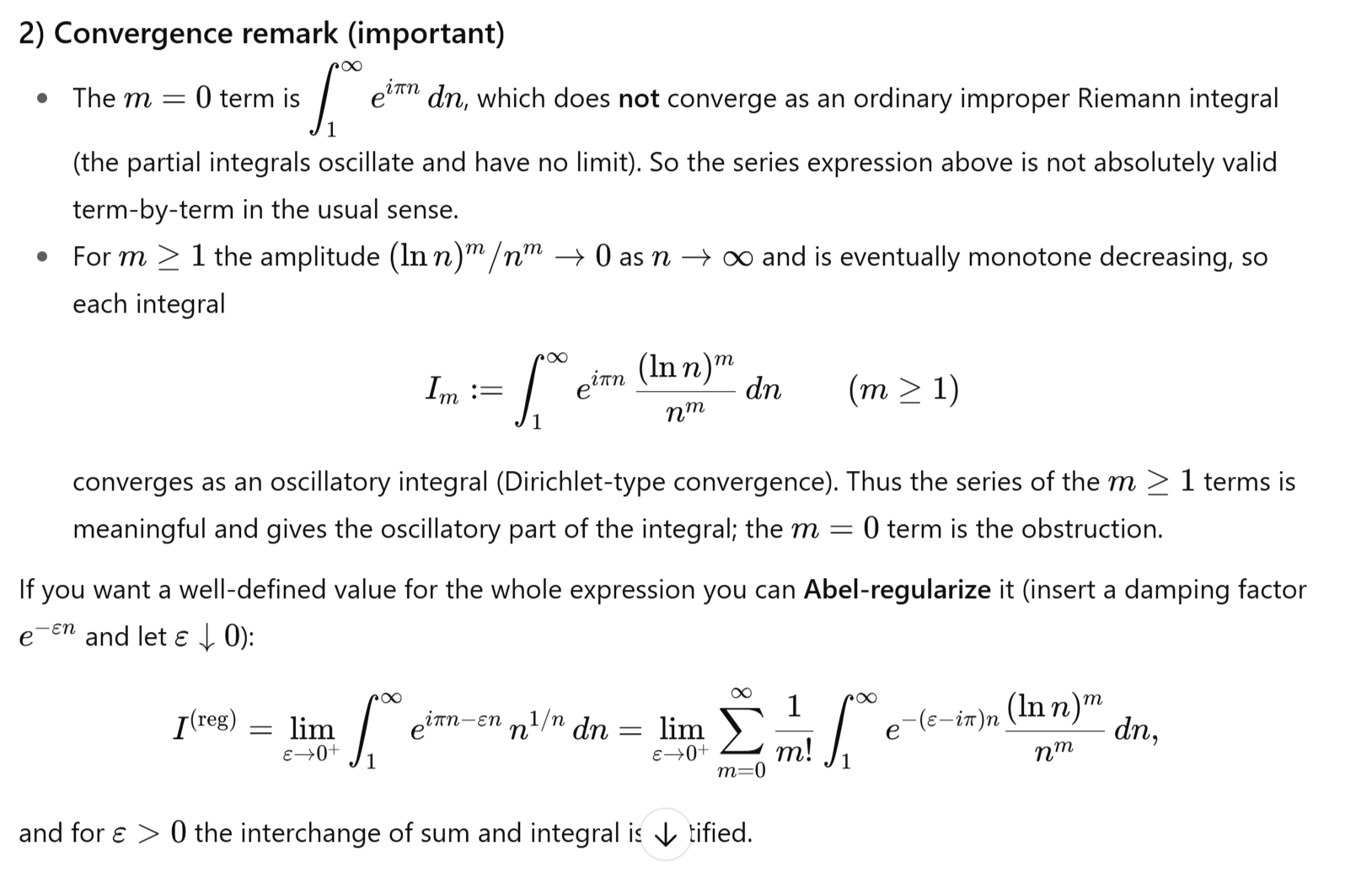
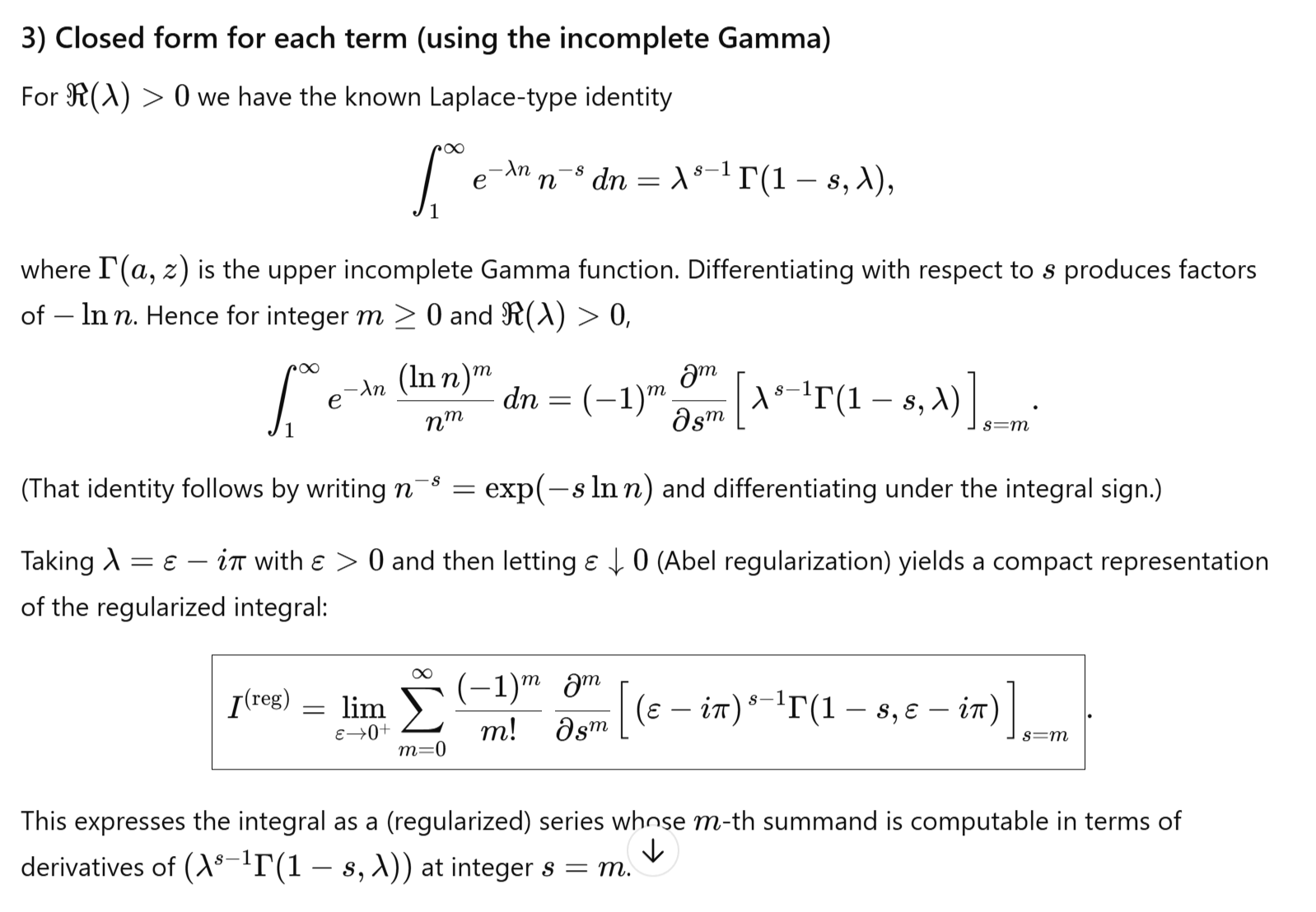

Likewise,
Likewise,

An example of each identity:
An example of each identity:
In[]:=
mValue=200;(*Choosealargevalueofmforapproximation*)integralApprox=NIntegrate[(-1)^nn^(1/n),{n,1,mValueI}]
Out[]=
0.070776-0.365691
In[]:=
epsilon=10^-15;(*Asmallpositivevalueforε*)maxTerms=7;(*Numberoftermsintheseriesforapproximation*)N[seriesApprox=Sum[(-1)^m/m!D[(epsilon-IPi)^(s-1)Gamma[1-s,epsilon-IPi],{s,m}]/.s->m,{m,0,maxTerms}],20]
Out[]=
0.07077603908225251372-0.36569050489028995872
In[]:=
{N[integralApprox-seriesApprox,20]}
Out[]=
{2.29268×+1.63615×}
-10
10
-9
10
In[]:=
(*Truncatesumtoafinitenumberofterms*)ε=10^-15;truncatedSum=Sum[((-1)^m/m!)D[ExpIntegralE[s,-π+ε],{s,m}]/.s->m,{m,0,7}(*Exampletruncation*)];(*Numericalevaluation*)N[truncatedSum,20]
Out[]=
0.07077603908225251372-0.36569050489028995872
In[]:=
mValue=200;(*Choosealargevalueofmforapproximation*)integralApprox=NIntegrate[(-1)^nn^(1/n),{n,1,mValueI}]
Out[]=
0.070776-0.365691
In[]:=
N[truncatedSum-integralApprox,20]
Out[]=
-2.29268×-1.63615×
-10
10
-9
10
They produce the following MeijerG pattern , so we have the following scheme for REGI :
They produce the following MeijerG pattern , so we have the following scheme for :
REG
I
In[]:=
f[n_]:=MeijerG[{{},Table[1,{n+1}]},{{-n+1}~Join~Table[0,{n+1}],{}},-I*Pi]
The Sum of ((I/Pi)^(1 - n))*f[n] from 1 to k is very close to Integrate[Exp[Pi x I] (Log[x]/x)^k/k!, {x, 1, Infinity I}]
In[]:=
Quiet[Table[(NSum[((I/Pi)^(1-n))*f[n],{n,1,k},WorkingPrecision->30]-NIntegrate[Exp[PixI](x^(1/x)-1),{x,1,InfinityI},WorkingPrecision->30]),{k,1,10}]]
Out[]=
{-0.013151136322896915896042479590+0.0006897875186108090326933142385,-0.001421490286282695298646021364-0.000513233401500500881066494278,-0.000108221962203470358710102501-0.000083550210242336386452936677,-6.251948266013391446019917×-8.004174116225517844085244×,-2.81606776161310097239036×-5.72402915924135466272069×,-9.736326531881161579814×-3.3230120282628222458083×,-2.29276081718949396455×-1.636148835337933825178×,-1.022898261731585400×-7.0222569313145840589×,2.4936746448809275×-2.677645031830936432×,1.731466464610742×-9.1996602892119102×}
-6
10
-6
10
-7
10
-7
10
-9
10
-8
10
-10
10
-9
10
-12
10
-11
10
-13
10
-12
10
-14
10
-14
10
Does the k’th term of the Sum of ((I/Pi)^(1 - n))*f[n] equal Integrate[Exp[Pi x I] (Log[x]/x)^k/k!, {x, 1, Infinity I}]?
More precision follows.