I need more antioxidants in my diet. Many of us do. To that end, I’m drinking a cup of green tea, infused with spearmint and lemongrass, as I write this.
Why do we need antioxidants? Because electrons don’t like living the single life.
Without a partner, electrons can be unstable and highly reactive. A molecule with unpaired electrons can become a free radical. In the body, it is usually an oxygen molecule that has lost an electron. It steals electrons from a nearby molecule to stabilize itself. This chain reaction of electron theft from one molecule to the next can damage the body’s cells. Free radicals have been linked to heart disease, eye damage and some cancers. Antioxidants can neutralize these free radicals and stop the chain reaction by donating one of their own electrons, while remaining stable in the process.
Antioxidants come in many bright and beautiful foods: the anthocyanins of blueberries, the flavonoids of dark chocolate, the resveratrol of red grapes, and the catechins of green tea. I decided to take a closer look at the nutrient antioxidants using the Wolfram Language.
Vitamins
Vitamins
Several vitamins are considered antioxidants because they help neutralize free radicals: vitamin C (ascorbic acid), vitamin E (tocopherol) and vitamin A (retinol).
Vitamin C
Vitamin C
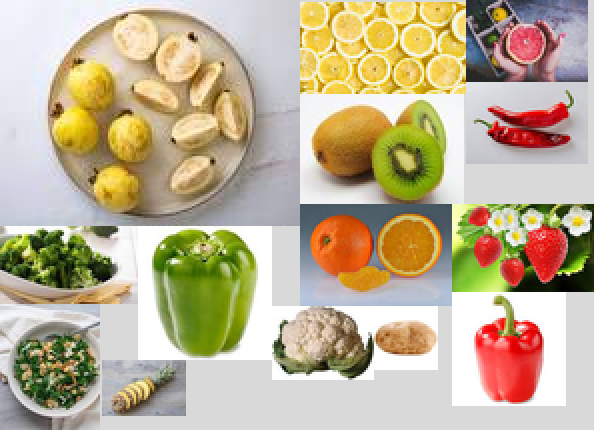
I imagine that vitamin C would win the popularity contest for best-known antioxidant. Vitamin C supplements abound on store shelves, but the best sources are found in colorful fruits and vegetables. I used WebImageSearch and ImageCollage to visualize these foods weighted by their vitamin C content. A couple of images stood out. Judging by the green pepper’s image size, its vitamin C content is surprisingly high. I have not tried guava yet, but it also is clearly a rich source of vitamin C:
In[]:=
vitaminCStrings={"oranges","strawberries","kiwifruit","grapefruit","guava","pineapple","lemons","broccoli","potatoes","chili peppers","green peppers","red peppers","kale","cauliflower"};vitaminCImages=WebImageSearch[#,1]&/@vitaminCStrings//Flatten;vitaminCFoods=Interpreter["Food"][{"oranges","strawberries","kiwifruit","grapefruit","guava","pineapple","lemons","broccoli","potatoes","chili peppers","green peppers","red peppers","kale","cauliflower"}];vitaminCValues=QuantityMagnitudeEntityValue#,&/@vitaminCFoods;vitaminCImagesValues=Thread[vitaminCValues->vitaminCImages];ImageCollage[vitaminCImagesValues,Background->LightGray]
Out[]=
Nutrient data in the Wolfram Language provides the recommended daily value for vitamin C:
In[]:=
UnitConvertEntityValue,"DailyValue","Milligrams/Day"
Out[]=
Vitamin E
Vitamin E
Vegetable oils are a major source of the next antioxidant: vitamin E. When I retrieved the top 20 oils in vitamin E content, the result was a mix of hazelnut, sunflower, safflower, canola, peanut and cod liver oils. The list also included babassu oil, which was new to me. It’s a tropical oil extracted from the seeds of the babassu palm and has traits similar to coconut oil, so it’s used in hair and skin care products.
In[]:=
vitaminEOils=EntityValueEntityClass@@Entity["Food",{EntityProperty["Food","FoodTypeGroup"]->ContainsExactly[{Entity["FoodTypeGroup","Oils"]}],EntityProperty["Food","AddedFoodTypes"]->ContainsExactly[{}]}],,"EntityAssociation"//DeleteMissing;vitaminEOils//ReverseSort//Take[#,UpTo@20]&
Out[]=
,,,,,,,,,,,,,,,,,,,
Vitamin A
Vitamin A
The two dietary sources of vitamin A are animals (dairy, eggs, fish and organ meats) and carotenoids, such as beta-carotene, which the body converts into vitamin A. Milk often is fortified with Vitamin A, but colorful vegetables provide even more:
In[]:=
vitaminAFoods=Interpreter["Food"][{"milk","red bell peppers","kale","collard greens","sweet potatoes","spinach","butternut squash","carrots"}];AssociationThreadvitaminAFoods,EntityValue#,&/@vitaminAFoods//N//
Out[]=

Liver is very high in vitamin A content. Exercise caution if feeding liver or liver-based foods (like pâté) to children, due to the risk of vitamin A toxicity.
In[]:=
liverFoods=Interpreter["Food"][{"pork liver","beef liver","chicken liver"}];AssociationThreadliverFoods,EntityValue#,&/@liverFoods//N
Out[]=
,,
Minerals
Minerals
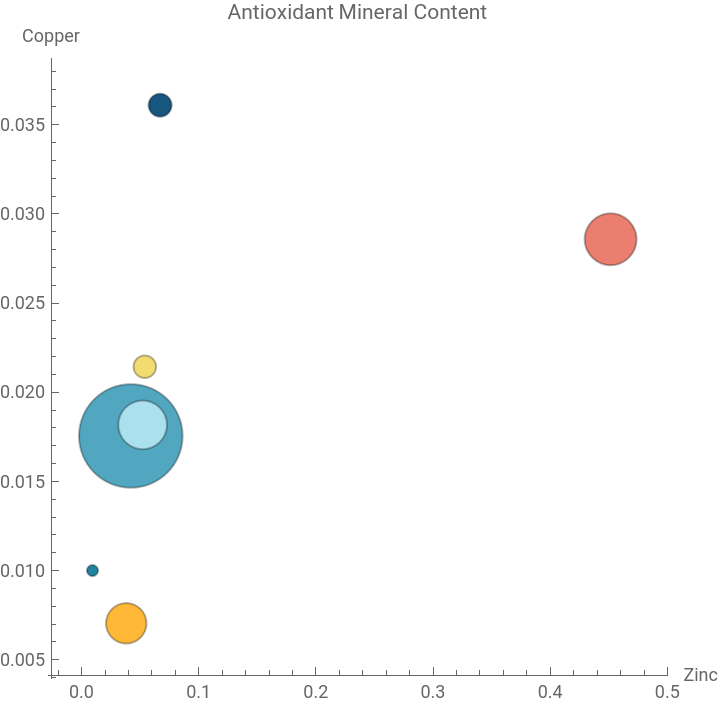
Where to go for your dose of the antioxidant minerals copper, zinc and selenium? Nuts, seeds and oysters are a few of the best sources.
I discovered that a bubble chart is a great way to visualize a trio of nutrients. Zinc and copper amounts are represented by the axes, and the size of the bubble represents selenium content. Hovering over the big blue bubble shows that Brazil nuts are uniquely high in selenium:
In[]:=
mineralFoods=Interpreter["Food"][{"oyster","crab","cashews","sunflower seeds","Brazil nuts","chocolate","cocoa"}];mineralStrings={"oyster","crab","cashews","sunflower seeds","Brazil nuts","chocolate","cocoa"};mineralProperties=,,;mineralValues=QuantityMagnitude[EntityValue[#,mineralProperties]&/@mineralFoods];labeledMineralData=MapThread[Callout[#1,#2]&,{mineralValues,mineralStrings}];BubbleChart[labeledMineralData,Frame->False,Axes->True,AxesLabel->{"Zinc","Copper"},ChartStyle->24,PlotLabel->"Antioxidant Mineral Content"]
Out[]=
Carotenoids
Carotenoids
The carotenoids beta-carotene, lycopene and lutein are among the best-known antioxidants, particularly for reducing the risk of macular degeneration. Foods high in carotenoids include red, orange, yellow and some green leafy vegetables.
Beta-carotene
Beta-carotene
Beta-carotene is a precursor to vitamin A. Beta-carotene also is a provitamin, which is a specific type of precursor when the body converts a substance to a vitamin. Vegetables provide more beta-carotene than fruits overall, which is not surprising with powerhouse sources like carrots, sweet potatoes and leafy greens in their camp:
Lycopene
Lycopene
Tomatoes are famous for their lycopene content, particularly when they are processed, such as sauces and pastes:
Watermelon also provides lycopene, giving this summertime favorite its red color:
Watermelon is a source of glutathione. Glutathione is called the “master antioxidant” because it exists in every cell of the human body and is a powerful line of defense against inflammation and cell damage:
It’s impressive that watermelon can do all these things while being composed of 92% water, which makes it a good source of hydration too:
Lutein
Lutein
Lutein and zeaxanthin accumulate in the retina and are vital to eye health. As with many antioxidants, green and leafy vegetables are a good source:
Phytosterols
Phytosterols
Phytosterols (also called plant sterols) are plant-derived compounds that are structurally similar to cholesterol in animals. They compete with dietary cholesterol for absorption in the digestive tract, which can help reduce cholesterol levels. I examined three groups — nuts and seeds, beans and lentils, oils — to see which provided the most phytosterols. I will be adding sunflower seeds to my shopping list!
CITE THIS NOTEBOOK
CITE THIS NOTEBOOK
Antioxidants: colorful foods to tame free radicals
by Gay Wilson
Wolfram Community, STAFF PICKS, June 10, 2024
https://community.wolfram.com/groups/-/m/t/3189461
by Gay Wilson
Wolfram Community, STAFF PICKS, June 10, 2024
https://community.wolfram.com/groups/-/m/t/3189461