Yesterday, my lab and I were watching The Prisoner “Arrival” (1967) in Wegmans Theater. We noticed some ‘flangy’ sound and I was curious about why that might be the case, given our excellent Atmos sound system.
Andrew had just done some reconfiguration of the HDMI audio from the PC and we were watching via Plex streaming from my house. This suggests that there are many potential sources of this distortion, not limited to -
■
DVD mastering
■
Transcoding / Ripping the DVD to mkv
■
Plex re-encoding / transmission
■
PC decoding / HDMI encoding
■
Theater’s sound system
It seems to make the most sense to start at the source of this chain. In my limited experience, I’ve noticed that mid-era DVD mastering could get very sloppy with a lack of attention to detail with respect to color, frame rates and especially audio.
Did this with prerelease 14.3
In[]:=
$Version
Out[]=
14.3.0 for Mac OS X ARM (64-bit) (July 14, 2025)
The Source
The Source
The Prisoner’s exterior scenes were shot in Portmeirion (Wales) and interiors at MGM - British Studios (Borehamwood) between Sept 1966–Jan 1968 by cinematographer Brendan J . Stafford, a BBC-educated DP. Given the studio resources of BBC / ITC at the time, it is very likely the episodes were shot on 35mm Arri BLs. Sound of that era was single channel, e.g., monaural.
I have access to two sets of DVDs - one first edition set from A&E, and another BluRay remastered set. I only have the original set on-hand — The set the mkv was ripped from is in storage. A quick dump of the first edition DVD suggests a bit of a mess, 29.97 FPS, stereo 48kHz.
λ mediainfo /Volumes/THE_PRISONER1
General
Complete name : /Volumes/THE_PRISONER1/VIDEO_TS/VIDEO_TS.BUP
Format : DVD Video
Format profile : Menu
File size : 14.0 KiB
Overall bit rate mode : Variable
Frame rate : 29.970 FPS
FileExtension_Invalid : ifo
Video
ID : 224 (0xE0)
Format : MPEG Video
Format version : Version 2
Bit rate mode : Variable
Width : 720 pixels
Height : 480 pixels
Display aspect ratio : 4:3
Frame rate : 29.970 (29970/1000) FPS
Standard : NTSC
Compression mode : Lossy
Audio
Format : AC-3
Format/Info : Audio Coding 3
Channel(s) : 2 channels
Sampling rate : 48.0 kHz
Compression mode : Lossy
General
Complete name : /Volumes/THE_PRISONER1/VIDEO_TS/VIDEO_TS.BUP
Format : DVD Video
Format profile : Menu
File size : 14.0 KiB
Overall bit rate mode : Variable
Frame rate : 29.970 FPS
FileExtension_Invalid : ifo
Video
ID : 224 (0xE0)
Format : MPEG Video
Format version : Version 2
Bit rate mode : Variable
Width : 720 pixels
Height : 480 pixels
Display aspect ratio : 4:3
Frame rate : 29.970 (29970/1000) FPS
Standard : NTSC
Compression mode : Lossy
Audio
Format : AC-3
Format/Info : Audio Coding 3
Channel(s) : 2 channels
Sampling rate : 48.0 kHz
Compression mode : Lossy
The BluRay rips from the newer set, which we watched in Wegmans, look a little better, frame rate wise, but the audio is still stereo -
Path Danger!
In[]:=
loc="/Volumes/Plex/TV Shows/The Prisoner (1967)/The Prisoner\ S01E01\ Arrival.mkv";loc="~/Downloads/The Prisoner\ S01E01\ Arrival.mkv";
In[]:=
Information[arrival=Video[loc]]
Out[]=

Understandable, maybe the audio is just duplicated into both channels. But, given the distortion, maybe it isn’t.
The question is, what do those stereo audio channels look like?
The question is, what do those stereo audio channels look like?
Investigation
Investigation
Let’s have a look -
In[]:=
AudioPlot[arrival]
Out[]=
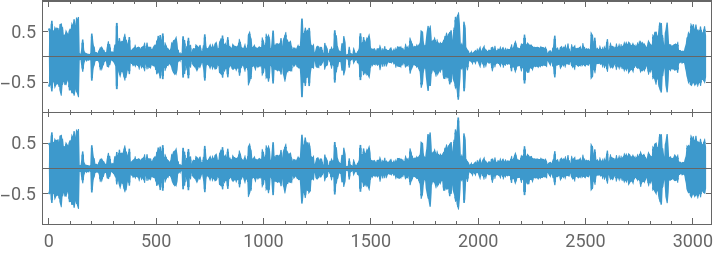
And sure enough, they look similar, but not the exact same!
Let’s extract the two channels and do a little math to compare them -
In[]:=
AudioPlot[diff=Subtract@@AudioChannelSeparate[Audio[arrival]]]
Out[]=

And whaddaya know - there’s a bunch of differences there. Let’s see if we can figure out where they are and listen to the original sound.
We’ll select the time intervals (in seconds) where the differences are considered ‘loud’ by the MMa audio processing algorithms, and the duration of the sound is two seconds or longer.
In[]:=
segs=Select[AudioIntervals[diff,"Loud"],Abs[Subtract@@#]>=2&];
In[]:=
VideoTrim[arrival,segs]
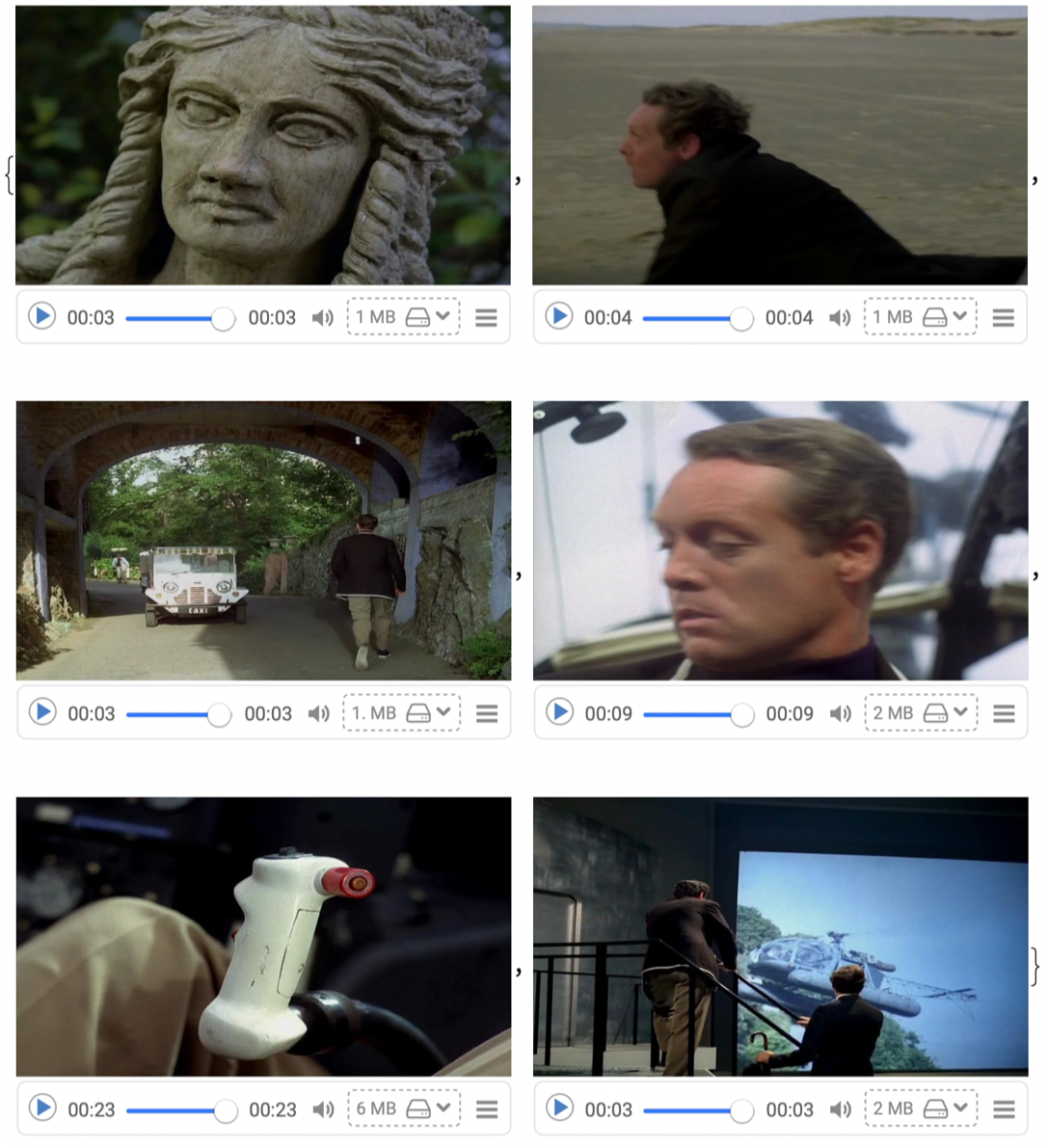
Based on the action in the scenes where the flanging is the worst there is a telltale finding —
It appears that the sound on the DVDs has bits of sweetening added by someone somewhere, before they were mastered. More specifically, there are audio pans when the taxi turns the corner, and lots of panning of the helicopter. These certainly weren’t in the original sound recording or broadcast mix, since broadcast and televisions of the time had no way of decoding or reproducing them.
It appears that the sound on the DVDs has bits of sweetening added by someone somewhere, before they were mastered. More specifically, there are audio pans when the taxi turns the corner, and lots of panning of the helicopter. These certainly weren’t in the original sound recording or broadcast mix, since broadcast and televisions of the time had no way of decoding or reproducing them.
It appears that, at some point in the production processes, someone messed with the monaural signal to try to make it ‘better’, resulting instead in making parts of the sound corrupt and annoying when playing back!
Phasing / Flanging
Phasing / Flanging
When you hear something that sounds a bit like a jet flying overhead in a scene where there are no jets, there’s a chance that the two audio tracks might be slightly out of phase with each other, and that phase-offset is changing over time.
We can quickly examine an example here.
Temporal Evidence
Temporal Evidence
The Haas effect, sometimes called the precedence effect, is frequently used in ‘stereoizing’ monophonic sound. It is essentially a channel delay from 5-35ms (especially in speech, which was Haas’ original research domain) that makes the sound more ‘full’ or ‘voluminous’. Any more delay and the sound takes on an ‘echo’ effect.
It’s important to consider that, unless the sound engineers are working with the known-original monaural track, the delay may be ‘baked in’ to the source they then choose to ‘stereoize’. Adding effects to a audio or video track that already has effects can create a chaotic experience, and, more frequently, certain sorts of perceptual or other artifacts.
From 19:30 to 20:45 there’s significant flangy sounds when Rover appears –
Note embedded in original notebook if necessary.
In[]:=
messy=VideoTrimarrival,,
In[]:=
messy=
Out[]=
Let’s have a look at any inter- or intra- channel delays in the stereo channels. First, let’s get the sampling rate so we know how many samples of delay we should be looking for -
In[]:=
fs=Information[messy,"SampleRate"][1]
Out[]=
In[]:=
minLagMs=5;(*ms*)maxLagMs=35;minLagSamples=QuantityMagnitude@Round[minLagMs/1000*fs];maxLagSamples=QuantityMagnitude@Round[maxLagMs/1000*fs]
So - we’re looking at around ~1500 samples, give or take. We can start by correlating the two channels to see if there might be some common stereoizing applied -
NB - Wolfram’s ListCorrelate tool doesn’t respect the Audio datatypes at this point, so we’ll just extract the two channels and operate on the raw data.
Luckily, this shows a strong peak at the origin, e.g., no offset, but then we see some other correlation peaks as we travel forward in samples / time. So, let’s find the peaks, sort them, grab the 2nd highest peak -
Note the fun-filled use of Quantities, since the units we extracted above are in samples/sec. That means now we can get a look at where the peak offset might be and —
so it’s very plausible that some sort of ‘light’ Haas processing was done.
Evidence in the frequency domain
Evidence in the frequency domain
Sweeping, flanging sounds are reflected in frequency domain ‘combs’ that get closer or further apart over time. We can use a spectrogram to look at the full section above -
It’s pretty fascinating, the center section is where Rover (the large ‘attack balloon’) is becoming ready to attack and there is a lot of audio sound effect things happening there to get the ‘roar’ (at about 20 seconds) and the ‘attack’ (at about 30sec).
All of that manipulation reflects itself in a ‘flat’ spectrum from about 5 seconds to 45 seconds. There is relatively uniform processes on the spectral content, then it goes back to more variable flatness where the jet sound is. Especially after 60 sec, it looks like it takes a ‘jump’ and, indeed, this is where you can hear the artifact.
Afterward, if you listen closely, you can hear what sounds like a jet flying away, this is the modulated comb filtering you would typically see in the Spectrogram. You can sort of see it in the higher frequencies above, let’s isolate it to the last 15 seconds -
And - surely enough - there are those converging ‘comb’ lines toward the end!
Conclusion
Conclusion
So, we weren’t hallucinating, there were distortions, and artifacts, and, given the rips they very likely originated from the movie files themselves and not the setup of our Atmos system (but see below).
Whether the original DVD masters have the poor sound, or the difference is the result of the ripping workflow will have to wait for a trip to my storage unit.
Postscript
Postscript
I chatted with a few friends in the sound universe -
I' ve done a few remixes of old mono movies, most recently [Redacted]. One does tend to take existing mono tracks and use for "stereoizing" or panning . If you do that, you have to move it off sync to the original track to avoid phasing. If you watch the remix of [Redacted] you will note that movie has more damn car drive bys than any other movie in history. I cursed [Famous Director Guy's] name many times while alone in my studio. My guess is that in the long history of remixing and mastering for The Prisoner, tracks were added on top of tracks causing phasing. This would make sense of the fact you hear it more in action scenes, since they’d have more stereoizing. I bet if you listened to only one speaker in your theater, the phasing might go away. Or the track on track was mixed together. Who knows. Lots of bad sound mastering going on.
And
In 1987, when our PBS TV station transitioned from mono to stereo, they inserted an Orban mono-to-stereo synthesizer so that folks at home could see the red light go on, implying the content was stereo. Suddenly, TV bought Tektronics scopes to see the Lissajous display like it was something new. “Look at that Magic”. We had a rather large oscilloscope next to our Neve 8014 console upstairs in the radio, as did most recording studios.
One of my favorite super nerd things when teaching stereovision and binaural sound in Perception classes is that stereo means solid (from Greek) and not '2' . Audio marketing in the 50s and 60s got us thinking that stereo = 2. In lectures, I call that Stereo™ (Remember Quad™ which was also stereo. Strictly speaking, even Atmos™ is stereo, but Atmos means 'vapor' or' steam' which is even more wonderfully confusing .)
A colleague friend of mine wrote a great paper called "On paradoxical monocular stereopsis" which, at first sounds way too nerdy, but also wrong . But when you think "Seeing solid 3D things with only one eye" it makes more sense. (People with one working eye don't see the world as flat, of course, and, in art school I remember being taught to look at printed and drawn images with one eye, monocularly. This was because, when you look with two eyes, the visual information your brain gets is ‘this is flat with a picture of a solid thing on it’. When you look at it monocularly, your brain isn’t sure so it tends to make it look more deep, more solid! Try it. Look at a landscape image and close one eye . Give it a minute.
And finally my contribution to the ‘folks sitting around telling tales of time past’, there was a guy that ran a record store in LA that I used to visit a lot . He had a single, big-assed Voice of the Theater in there that he played music on. He used to complain that "stereo is a gimmick". I thought he was a nut at first, then I learned a more and more about perceptual systems and it started to make sense . Especially with respect to reconstituted fake stereo .
A colleague friend of mine wrote a great paper called "On paradoxical monocular stereopsis" which, at first sounds way too nerdy, but also wrong . But when you think "Seeing solid 3D things with only one eye" it makes more sense. (People with one working eye don't see the world as flat, of course, and, in art school I remember being taught to look at printed and drawn images with one eye, monocularly. This was because, when you look with two eyes, the visual information your brain gets is ‘this is flat with a picture of a solid thing on it’. When you look at it monocularly, your brain isn’t sure so it tends to make it look more deep, more solid! Try it. Look at a landscape image and close one eye . Give it a minute.
And finally my contribution to the ‘folks sitting around telling tales of time past’, there was a guy that ran a record store in LA that I used to visit a lot . He had a single, big-assed Voice of the Theater in there that he played music on. He used to complain that "stereo is a gimmick". I thought he was a nut at first, then I learned a more and more about perceptual systems and it started to make sense . Especially with respect to reconstituted fake stereo .
References
References
Haas, H . (1972). The influence of a single echo on the audibility of speech. J . Audio Eng . Soc ., 20, 145–159. (English translation of Haas’ 1949 Doctoral Thesis).
Koenderink, J . J ., van Doorn, A . J ., & Kappers, A . M . L . (1994). On So–Called Paradoxical Monocular Stereoscopy. Perception, 23(5), 583–594. https://doi.org/10.1068/p230583
The Prisoner. (2025). In Wikipedia . https://en.wikipedia.org/w/index.php?title=The_Prisoner&oldid=1300637113
Acknowledgements
Acknowledgements
Thank you to Aidan Montag, Andrew Sevigny, Gary Rydstrom, Dave Sluberski, Craig Good, Paul Abbott.
CITE THIS NOTEBOOK
CITE THIS NOTEBOOK
An adventure in two channels: investigating stereo artifacts in The Prisoner episode
by Flip Phillips
Wolfram Community, STAFF PICKS, July 31, 2025
https://community.wolfram.com/groups/-/m/t/3522727
by Flip Phillips
Wolfram Community, STAFF PICKS, July 31, 2025
https://community.wolfram.com/groups/-/m/t/3522727