In 2006, Noam Elkies found an elliptic curve of rank at least 28. Today in 2024, Elkies&Klagsbrun announced an elliptic curve of rank at least 29. Here it is:
y^2+xy==x^3-27006183241630922218434652145297453784768054621836357954737385x+55258058551342376475736699591118191821521067032535079608372404779149413277716173425636721497
With it, they included a list of 29 independent points:
In[]:=
independent={2891195474228537189458255536634,1159930748096124706459835910727318679593425283},{3402542165322127811451484642234,1661508223164691055862657623730465560755290883},{4298760026558467240422107564794,4313142249890236204790986787384907722927474563},{3728756667770947009884455714554,2530180219584734091116528693531660545660397443},{5991744132052078230511185130234,10418901628842034362301273055728300669218858883},{3236493534632768520540227223034,1324626796262167243658687198416201825373745283},{78226686134991174232380689386234,690394210062759896503429654125516779999512554883},{11492605643548859374635605140234,35536316911450952155461624238308456029618940883},{-5143303362384229804906088118566,7622356511107986864120352355674305680222368483},{443985655575065435281568435002,6584468124388858623214803939643557365635620355},{-979565018904269680752629749766,8987348422104537684966706438714038633832170883},{5184894285212178249566461261834,7390536788003150201273204464695859875505480483},{-4469171023687146502067179612166,9310658892841458934133221137392081403414455683},{3606405835110925482450522970234,2183644666981703632482662193390480040127898883},{16151744576785317732688993162234,61908882092472338946519909276455831463747210883},{3573684355943766387962362869754,2094467155115749424853047283659077805560259203},{-759376049938858166436491644166,8679171135458197195914024161800061810952119683},{-5328058719935886182106003119366,6920588147379497633202935557367499676224350083},{5380268474895377355583039694554,8105660240030025092450118297303424395856037443},{17069233487425098088940203248484,67583677272795299213867443505411893525786510633},{5215432542403430758248050783794,7501515746204716855921710958364078294243814643},{2838942178046024039763692432122,1212346280964590308944175800544505700108208003},,,{2558229016839511149831260080762,1706598395830079994387505244133382709649637123},{2361253942905600810977556672634,2157503396243552448798851089310708763298766083},{2678312077644931683114439906234,1462722361020796436741527433473386115047618883},{3379397084927230910084852603902,1608494167359575995485655188349208450365853755},{3632407730870998917912491355514,2255654937037700801978158381185619053396712963},{2428778263277521959543043930234,1998325023610603606161737305486867803334410883};
243146882395382015946366404808154
81
811625272160726332199288136187427505366582108107
729
A key feature of elliptic curves is that if two rational points are on the curve, then a line through both points will intersect the curve at a third rational point. One minimum check we can do is that no three points are on a line.
In[]:=
ResourceFunction["FindExtraordinaryLines"][independent]
Out[]=
{}
For a line tangent to a curve at a rational point, the tangency counts as two points, and the line intersects a new rational point. We could then take a tangency of that new point, an so on. A given rational point generates a set of points. If that exercise was done on all of the independent points, there would be no overlap between the 29 sets.
So what does this curve with huge values look like? Humans aren’t skilled at visualizing 30-digit numbers, so it kind of looks like a line. With Log, we can see something else:
In[]:=
p=Sort[#+5328058719935886182106003119366+1&/@SortBy[independent,Last]];Graphics[Point[Log/@Drop[p,1]]]
Out[]=
For a simpler elliptic curve, consider . We plot a stretched version of this curve below over a grid of circles. For the white circles, the curve goes through that point. If you look at the points labeled 3, 2 and -5, you’ll see they make a line. Similarly, points 2, 4 and -6 are on a line. In fact, for any triple of values that sum to zero, those three points are on a straight line.
-20x.+5+16y.+y.-x.-==0
3
x.
2
x.
2
y.
3
y.
In[]:=
p17set={{0,4},{3,-3},{-3,5},{1,-5},{-2,0},{-1,-3},{-1,-1},{-3,-5},{0,0},{3,5},{1,1},{1,3},{2,0},{-1,5},{3,-5},{-3,3},{0,-4}};p17=#/{1,Sqrt[3]}&/@p17set;p17not=#/{1,Sqrt[3]}&/@Complement[Select[Tuples[{Range[-3,3],Range[-5,5]}],EvenQ[Total[#]]&],p17set];GraphicsEdgeForm[Black],Table[{Style[Text[n-9,p17[[n]]],30],Circle[p17[[n]],1/Sqrt[3]]},{n,1,17}],LightGray,Disk[#,1/Sqrt[3]]&/@p17not,Opacity[.4],ContourPlot-20x.+5+16y.-3x.-3==0,{x.,-3.5,3.5},y.,-3.5,3.5[[1]]
3
x.
3
y.+3
2
x.
2
y.
3
3
y.
Out[]=
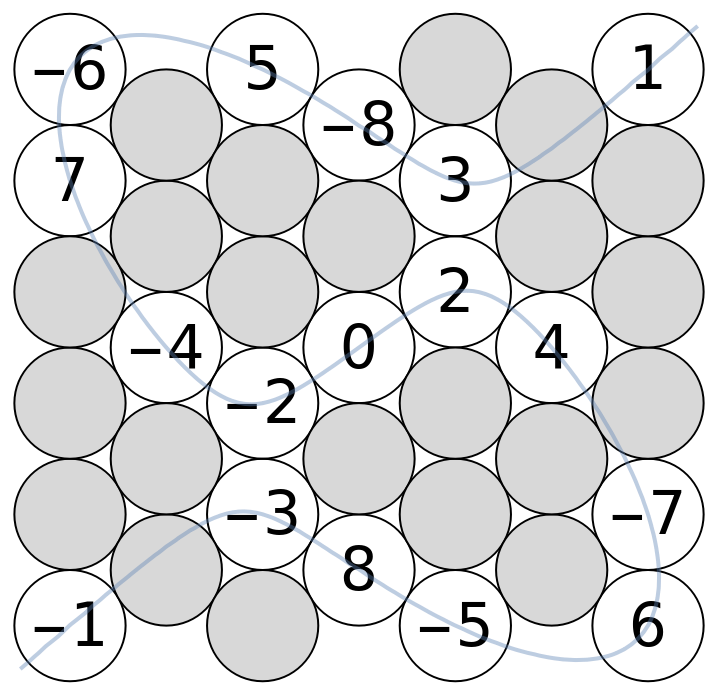
Suppose you had this curve and just the rational point for 1. The tangent line for 1 intersects at point -2. The tangent line for -2 intersects at point 4. The tangent line for 4 intersects at point -8. A line through points 1 and -8 gives point 7. A line through points 1 and 4 gives point -5.
We get a triangle of six points. The zero-sum triplets can be extended, but they won’t be nicely contained in a disk. Point 9 would be on the curve between -2 and -4. Point 10 would be left of -3. Point 11 would be between 0 and -2. From the
Out[]=
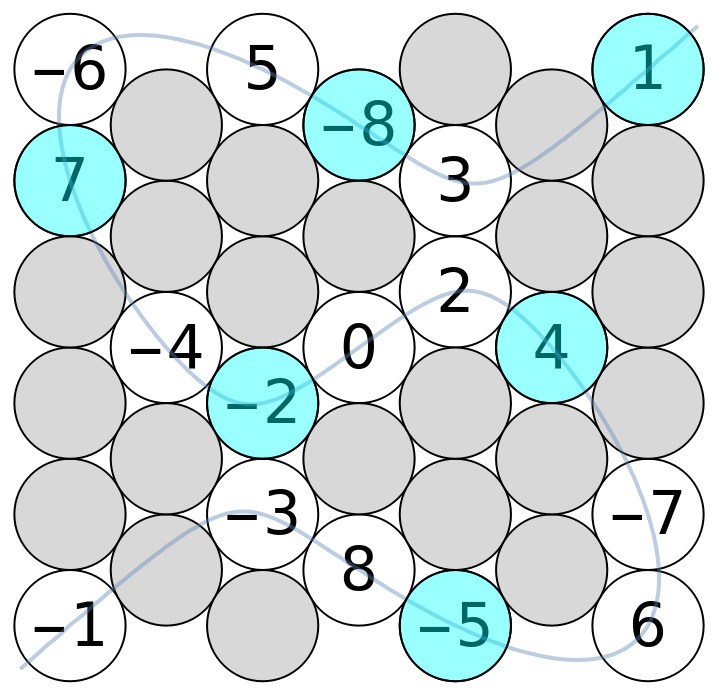
The points off the nice grid we could generate are as follows:
In[]:=
have={1,4,-5,-2,7,-8};Complement[Join[-(Total/@Subsets[have,{2}]),-2have],have]
Out[]=
{-14,-11,10,13,16}
If we repeat this a few times, it appears that we can’t generate the other nice points from 1 alone.
In[]:=
have={1,4,-5,-2,7,-8,-14,-11,10,13,16};Complement[Join[-(Total/@Subsets[have,{2}]),-2have],have]
Out[]=
{-32,-29,-26,-23,-20,-17,19,22,25,28}
In[]:=
have={1,4,-5,-2,7,-8,-14,-11,10,13,16,-32,-29,-26,-23,-20,-17,19,22,25,28};Complement[Join[-(Total/@Subsets[have,{2}]),-2have],have]
Out[]=
{-56,-53,-50,-47,-44,-41,-38,-35,31,34,37,40,43,46,49,52,55,58,61,64}
At this point it becomes clear that point 1 only generates points corresponding to modulus 3 equals 1. If we started with point 2, we would have generated the points corresponding with modulus equals 2.
Anyway, congratulations to Elkies and Klagsbrun on their record-setting discovery.
CITE THIS NOTEBOOK
CITE THIS NOTEBOOK
New record in elliptic curves by Elkies-Klagsbrun: rank 29 (and now 30)
by Ed Pegg
Wolfram Community, STAFF PICKS, August 30, 2024
https://community.wolfram.com/groups/-/m/t/3261317
by Ed Pegg
Wolfram Community, STAFF PICKS, August 30, 2024
https://community.wolfram.com/groups/-/m/t/3261317