This is part of live presentation series called Mathematical Games in which we explore a variety of games and puzzles using Wolfram Language. In this episode, we explore knots and crossing numbers.
demonstrations.wolfram.com
demonstrations.wolfram.com
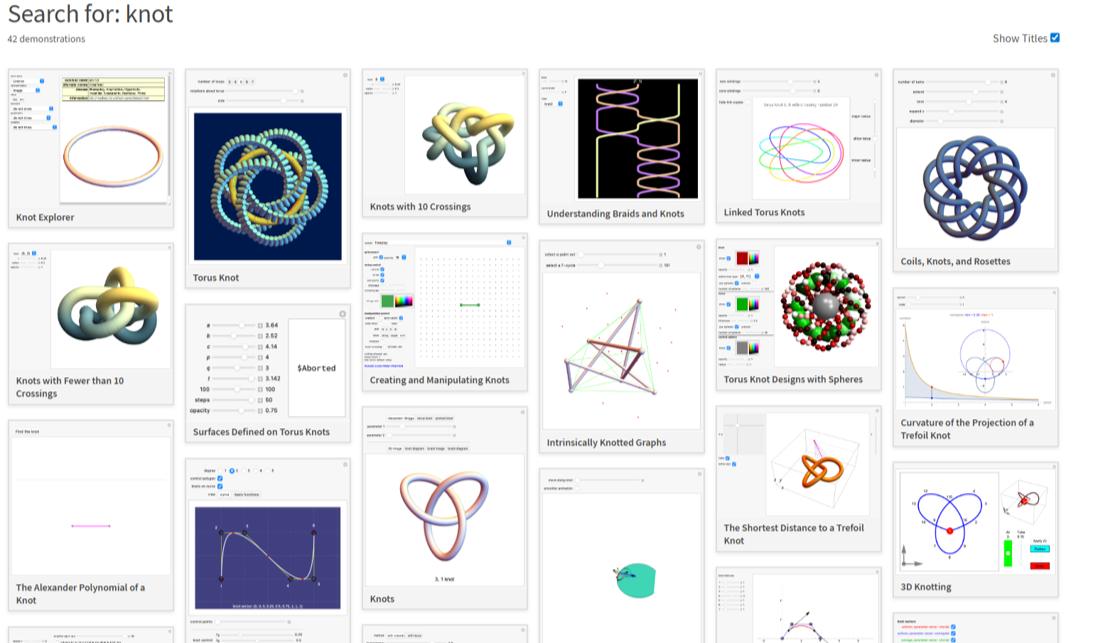
Many Demonstrations use knots
Gardner used knots many times in his columns.
Martin Gardner: Unexpected Hanging and Mathematical Magic Show
Martin Gardner: Unexpected Hanging and Mathematical Magic Show
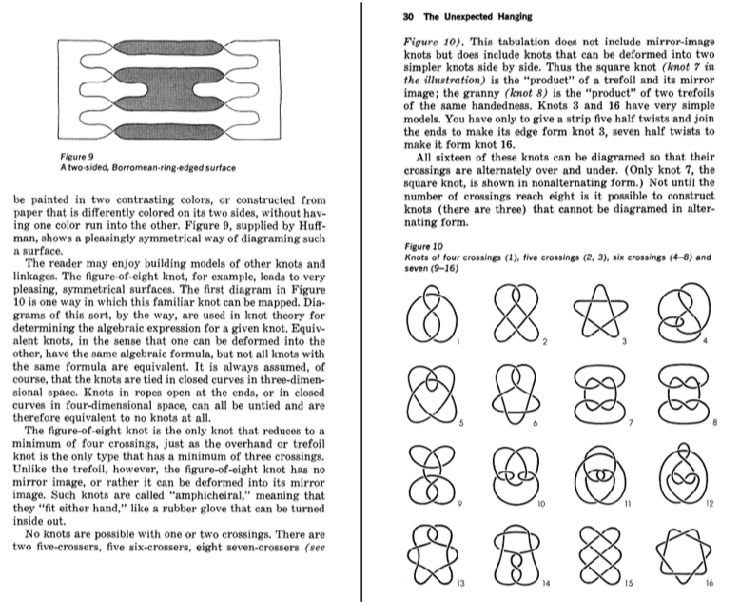
Alternating knot: over and under alternate.
The square knot (7) is shown in nonalternating form. Puzzle: find the alternating form.
With 8 crossings there are 3 non-alternating knots.
The square knot (7) is shown in nonalternating form. Puzzle: find the alternating form.
With 8 crossings there are 3 non-alternating knots.
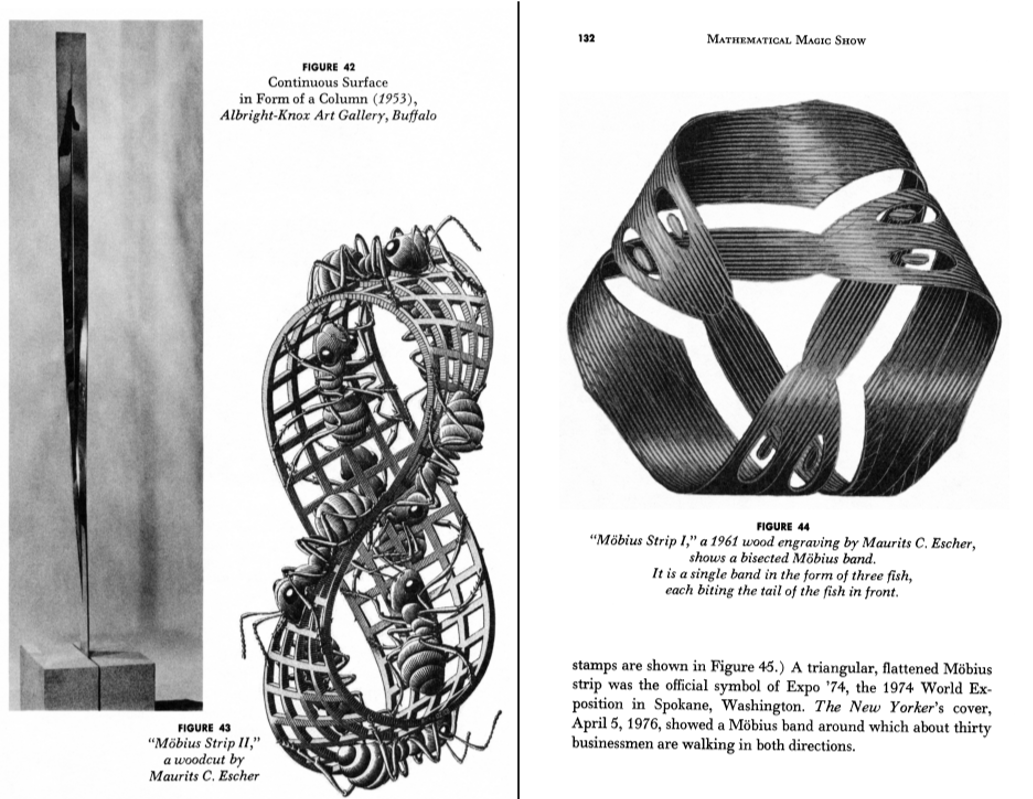
For a Mobius strip with 3 twists, cutting the band in half produces a knot.
Last Recreations
Last Recreations
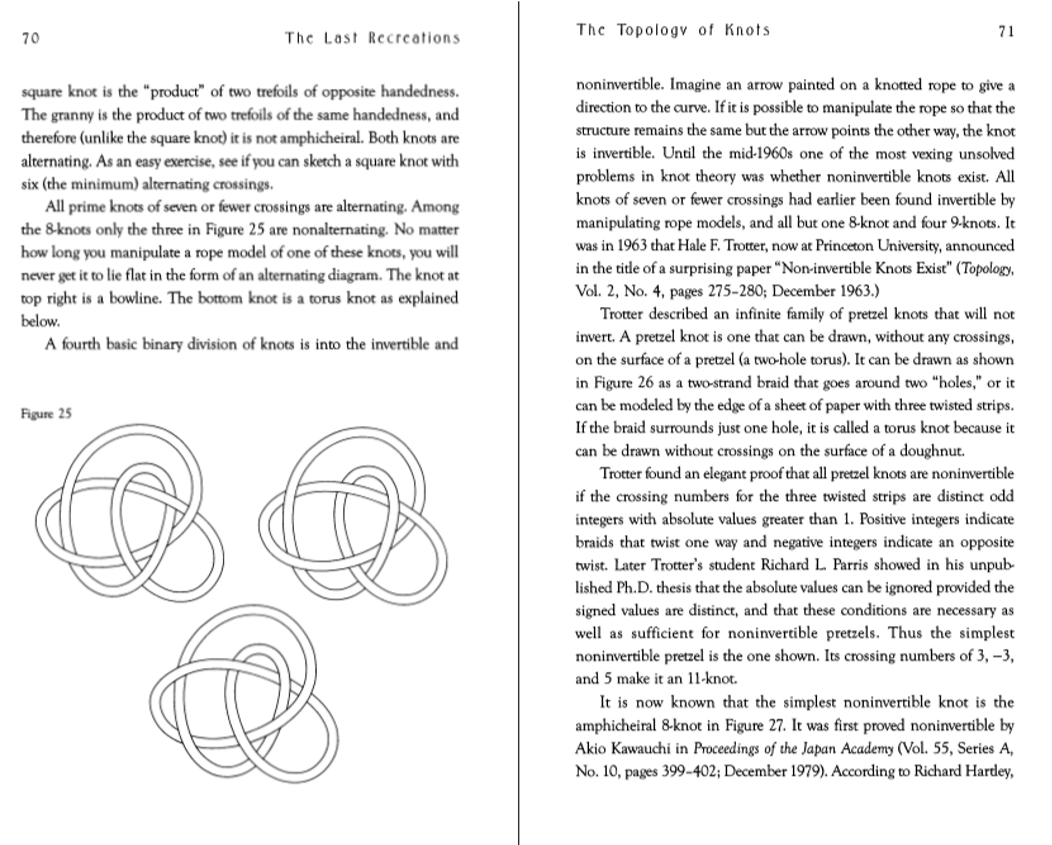
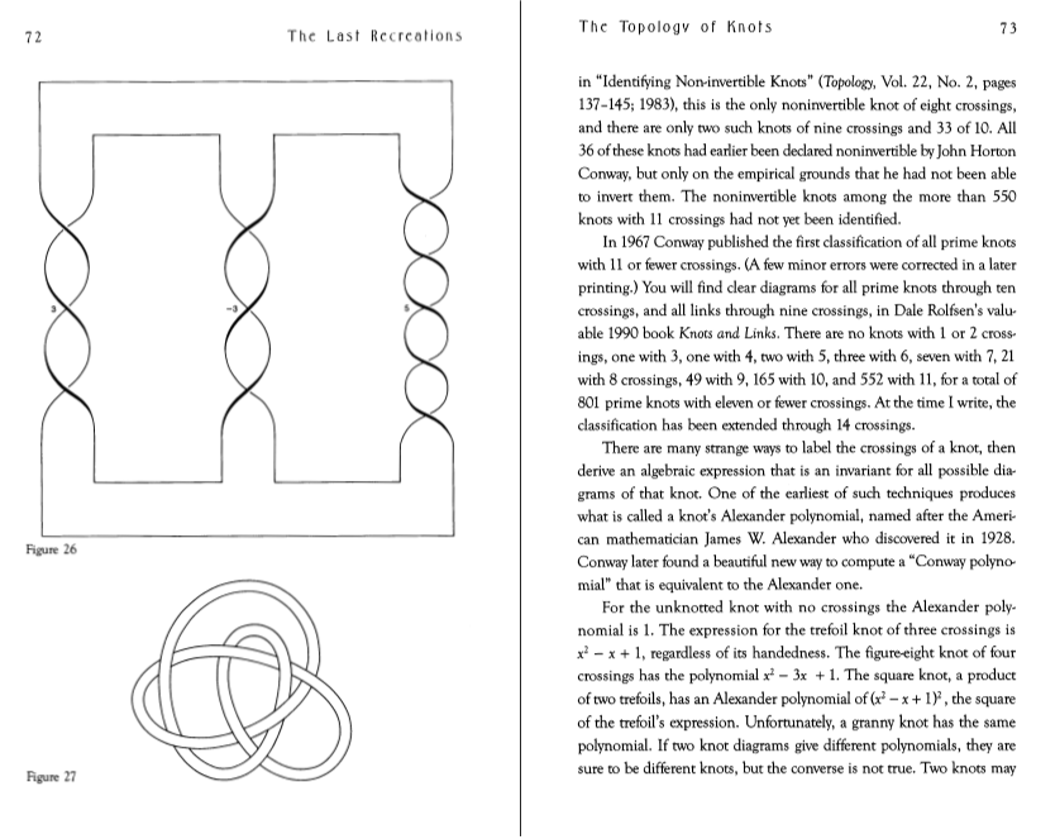
The three non-alternating knots.
Attach an arrow to a knot. If you can get the same knot figure with the arrow reversed, the knot is invertible.
Attach an arrow to a knot. If you can get the same knot figure with the arrow reversed, the knot is invertible.
The unique 8-crossing non-invertible knot in on the next page.
The Second Book
The Second Book
Disentanglement puzzles frequently involve knots or topology.
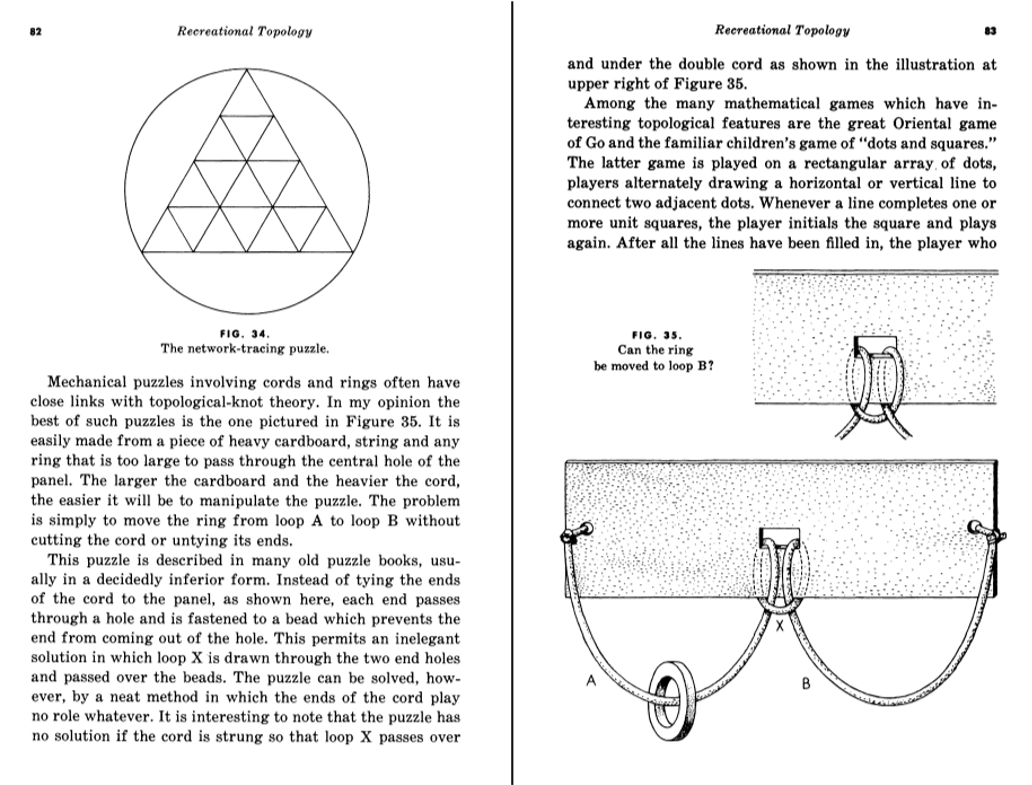
The Baguenaudier (time-waster in French) is related to Gray codes.
The Gray codes arrange the integers so that only one binary bit changes per step.
The Gray codes arrange the integers so that only one binary bit changes per step.
The number of steps needed for disentanglement steadily increases.
Time Travel -- The Császár Polyhedron
Time Travel -- The Császár Polyhedron
Conway-Gordon: all sets of 7 points in 3D standard position (no 4 coplanar) always define at least one knot.
It’s possible for there to be exactly one knot. The vertices of the Csaszar polyhedron make only one knot. Here it is:
Morphing the Császár Polyhedron
Morphing the Császár Polyhedron
Four versions of the Császár polyhedron are shown. You can study the transition between these versions. In each of the four, the triangles shared by adjacent tetrahedra form a Möbius band. Each Möbius band contains all seven vertices of the Császár polyhedron, but only 14 of its edges. The edges of the Möbius graph form three Hamiltonian cycles, which are exactly loops, if the faces of the polyhedron do not intersect one another. If the faces intersect one another and the edges do not intersect one another, then one of the Hamiltonian cycles might not form a loop.
Császár Polyhedron to Thomas Kirkman’s Schoolgirl Problem
Császár Polyhedron to Thomas Kirkman’s Schoolgirl Problem
The Császár Polyhedron leads to the Room square.
Fifteen young ladies in a school walk out three abreast for seven days in succession: it is required to arrange them daily, so that no two shall walk twice abreast.
The below grid was used by Cayley to solve the Kirkman Schoolgirl’s problem.
The Room square is named after Thomas Room, even though Cayley created it earlier.
The Room square is named after Thomas Room, even though Cayley created it earlier.
A set of 28 double-8 dominoes without blanks or doubles.
abc d35 e17 f28 g46 gives the first day.
abc d35 e17 f28 g46 gives the first day.
If a graph is made of the connection between the 7 points and 7 lines of the Fano plane, you’ll get the Heawood graph.
The Heawood Graph on the Szilassi Polyhedron, which is the dual of the Császár Polyhedron:
The Heawood graph has crossing number 3.
Knotted Doughnuts
Knotted Doughnuts
Crossing Number Graphs
Crossing Number Graphs
What is the simplest way to present a graph? For a planar graph, a planar form often works best.
For non-planar graphs, it can be trickier. The Petersen graph has crossing number 2.
Pal Turan Brick Factory Problem
Pal Turan Brick Factory Problem
Wikipedia: During World War II, Hungarian mathematician Pál Turán was forced to work in a brick factory, pushing wagon loads of bricks from kilns to storage sites. The factory had tracks from each kiln to each storage site, and the wagons were harder to push at the points where tracks crossed each other. Turán was inspired by this situation to ask how the factory might be redesigned to minimize the number of crossings between these tracks.
With both knots and graphs, it’s desirable to minimize crossings.
Crossing Number Graphs
Crossing Number Graphs
The smallest possible graph requiring a given number of crossings is known as a crossing number graph, or CNG:
Most of these graphs were “found” by myself and Geoff Exoo in 2009. But many of these graphs are among the most famous
graphs in graph theory. Geoff suspected that many of these famous graphs had the extra property, so we went and proved it.
Most of these graphs were “found” by myself and Geoff Exoo in 2009. But many of these graphs are among the most famous
graphs in graph theory. Geoff suspected that many of these famous graphs had the extra property, so we went and proved it.
Images of the Small Knots
Images of the Small Knots
Polynomials of the Small Knots
Polynomials of the Small Knots
The Alexander Incidence matrix can be used to make the Alexander Polynomial. For the matrix, first make the directional knot diagram with intersections and regions numbered. Then, for each intersection, arrange for both arrows to point up. Use the label diagram for crossings to match regions with values. If a region doesn’t border a crossing, it gets a value of 0. Then, remove columns corresponding to adjacent regions and find the determinant.
Dropping regions 5&6, we can complete the matrix and then calculate the polynomial.
The Alexander Polynomial, BLM/Ho Polynomial, Bracket Polynomial, Conway Polynomial and Jones Polynomial for various knots.
Interactive Alexander Polynomial
Interactive Alexander Polynomial
This Demonstration computes the Alexander polynomial of an interactively drawn knot and attempts to find knots with the same invariant in the database. When drawing a knot, Alt+Click adds or removes locators and the corresponding line segment or inserts or removes a locator on an existing line segment. Clicking a double point toggles the double point.
More Conway Polynomials
More Conway Polynomials
The Conway polynomial is the simplest of the polynomials.
Gauss Code
Gauss Code
Draw a closed curve that crosses itself. Follow the curve and label every other intersection with 1, 2, 3, 4, ... eventually, you’ll label all of the intersections. If you then look at the between values, you’ll get a permutation.
Draw a closed loop that crosses itself several times. Draw an arrow on the loop, then follow it, labeling every other intersection with 1, 2, 3, …, until the arrow is reached. Following these steps, every intersection will be labeled once, a fact noticed by Gauss. With additional steps, the Gauss code of the loop can be written, allowing reconstruction of the original diagram.
For orders 3, 4, 5, …, there are 3, 5, 16, 44, 180, … distinct graphs that come from the permutations. For orders 5, 6, and 7, there are 2, 36, and 571 permutations that cannot be drawn as self-intersecting loops due to nonplanarity. Some permutations may have parity issues that will prevent a Gauss code loop representation.
Intrinsically Knotted Graphs
Intrinsically Knotted Graphs
A look at Braid Diagrams
A look at Braid Diagrams
Knots can be presented as braids that have top/bottom wrapping. The number of braids is the Braid Index.
Knot True/False
Knot True/False
Alternating : crossings alternate over and under along the knot.
Amphichiral : the knot is equivalent to its mirror image.
Chiral : the knot is not equivalent to its mirror image.
Composite : the knot can be decomposed into a connected sum of simpler knots.
Hyperbolic : the knot’s complement admits a complete hyperbolic geometry.
Invertible : the knot is equivalent to itself when its orientation is reversed.
Prime : the knot cannot be decomposed into simpler knots by connected sum.
Satellite : the knot contains a nontrivial companion knot in a solid torus structure.
Torus : the knot can be drawn on the surface of a standard torus without crossings.
Amphichiral : the knot is equivalent to its mirror image.
Chiral : the knot is not equivalent to its mirror image.
Composite : the knot can be decomposed into a connected sum of simpler knots.
Hyperbolic : the knot’s complement admits a complete hyperbolic geometry.
Invertible : the knot is equivalent to itself when its orientation is reversed.
Prime : the knot cannot be decomposed into simpler knots by connected sum.
Satellite : the knot contains a nontrivial companion knot in a solid torus structure.
Torus : the knot can be drawn on the surface of a standard torus without crossings.
I am Knot a Number
I am Knot a Number
ArfInvariant : takes value 0 or 1, a mod 2 concordance invariant of the knot.
BraidIndex : the minimum number of strands needed to represent the knot as a closed braid.
BridgeIndex : the minimum number of “bridges” in any projection of the knot.
DegreeThreeVassiliev : the third-order finite type invariant for the knot.
DegreeTwoVassiliev : the second-order finite type invariant for the knot.
Determinant : absolute value of the Alexander polynomial evaluated at –1.
Genus : the minimal genus of any orientable surface bounded by the knot.
NakanishiIndex : the minimal number of generators of the knot’s Alexander module.
OzsvathSzaboTau : integer invariant from Heegaard Floer homology giving a lower bound on slice genus.
Signature : algebraic count of positive minus negative eigenvalues of a Seifert matrix.
SmoothFourGenus : minimal genus of a smoothly embedded surface in the 4-ball bounded by the knot.
StickNumber : minimum number of straight segments needed to construct the knot.
TopologicalFourGenus : minimal genus of a locally flat surface in the 4-ball bounded by the knot.
UnknottingNumber : the fewest crossing changes required to transform the knot into the unknot.
BraidIndex : the minimum number of strands needed to represent the knot as a closed braid.
BridgeIndex : the minimum number of “bridges” in any projection of the knot.
DegreeThreeVassiliev : the third-order finite type invariant for the knot.
DegreeTwoVassiliev : the second-order finite type invariant for the knot.
Determinant : absolute value of the Alexander polynomial evaluated at –1.
Genus : the minimal genus of any orientable surface bounded by the knot.
NakanishiIndex : the minimal number of generators of the knot’s Alexander module.
OzsvathSzaboTau : integer invariant from Heegaard Floer homology giving a lower bound on slice genus.
Signature : algebraic count of positive minus negative eigenvalues of a Seifert matrix.
SmoothFourGenus : minimal genus of a smoothly embedded surface in the 4-ball bounded by the knot.
StickNumber : minimum number of straight segments needed to construct the knot.
TopologicalFourGenus : minimal genus of a locally flat surface in the 4-ball bounded by the knot.
UnknottingNumber : the fewest crossing changes required to transform the knot into the unknot.
Brittenham, M. and Hermiller, S. “Unknotting Number is not Additive under Connected Sum”, Sep 2025, https://arxiv.org/abs/2506.24088 .
Two Bridge Knots
Two Bridge Knots
In a knot drawing, a line over a gap indicates an over-crossing and under-crossing. A bridge is a segment in a knot drawing with one or more over-crossings.
Both of these are the trefoil knot.
The figure 8 knot
Of the 1,701,936 knots with up to sixteen crossings, only 5,546 are 2-bridge knots.
The Other Knot Properties
The Other Knot Properties
ConwayString : notation encoding a knot by sequences of tangles in Conway’s scheme.
DowkerNotation : encodes a knot diagram by pairing crossing labels along the knot.
ColoringNumberSet : set of integers n for which the knot admits a nontrivial n-coloring.
BraidWord : sequence of braid group generators whose closure yields the knot.
ThurstonBennequin : integer invariant from contact geometry measuring twisting relative to framing.
AlexanderBriggsList : early catalog indexing knots by crossing number and order (e.g. 3₁, 4₁).
SeifertMatrix : integer matrix derived from a Seifert surface encoding linking information.
DowkerList : ordered list of even integers representing crossings in Dowker’s system.
BraidWordNotation : explicit symbolic form of the braid word using σᵢ generators and exponents.
DowkerNotation : encodes a knot diagram by pairing crossing labels along the knot.
ColoringNumberSet : set of integers n for which the knot admits a nontrivial n-coloring.
BraidWord : sequence of braid group generators whose closure yields the knot.
ThurstonBennequin : integer invariant from contact geometry measuring twisting relative to framing.
AlexanderBriggsList : early catalog indexing knots by crossing number and order (e.g. 3₁, 4₁).
SeifertMatrix : integer matrix derived from a Seifert surface encoding linking information.
DowkerList : ordered list of even integers representing crossings in Dowker’s system.
BraidWordNotation : explicit symbolic form of the braid word using σᵢ generators and exponents.
Pentomino 5
Pentomino 5
George Sicherman solved the problem of placing the pentominoes in a 12×12 grid so that each row and column contained five pentomino cells, no pentominoes were adjacent, (except at corners) and all pentominoes were connected by corners into a single group.
For 3² + 4² = 5² 9/16/25 or 16/9/25
For 3² + 4² = 5² 9/16/25 or 16/9/25
Did you know the Pythagoras figure could be 56 identical triangles?
September 27, 2025 OR 27 September 2025
September 27, 2025 OR 27 September 2025
Next Saturday, September 27, has an amazing property.
It’s a square number either way.
month/day/year order 9272025 = 3045².
day/month/year order 27092025 = 5205²
day/month/year order 27092025 = 5205²
Prince Rupert’s Cube
Prince Rupert’s Cube
The Hudson Bay Company 1670 - August 2025
and the Noperthedron
The Hudson Bay Company 1670 - August 2025
and the Noperthedron
and the Noperthedron
Rupert was the governor of the Hudson Bay Company, founded in 1670.
It was the longest running company in North America -- until August 2025!
It just got liquidated this month.
It was the longest running company in North America -- until August 2025!
It just got liquidated this month.
A convex polyhedron without Rupert’s property (Jakob Steininger, Sergey Yurkevich)
A three-dimensional convex body is said to have Rupert’s property if its copy can be passed through a straight hole inside that body. In this work we construct a polyhedron which is provably not Rupert, thus we disprove a conjecture from 2017. We also find a polyhedron that is Rupert but not locally Rupert.
The Noperthedron
The Noperthedron
Other resources (other than MathWorld)
Other resources (other than MathWorld)
knotinfo.org -- Lots of look-up tables.
Unsolved
Unsolved
Many items on Knots and Crossing numbers are unsolved.
Slice–Ribbon Conjecture - Is every slice knot also ribbon?
Concordance Group - What is the structure of the knot concordance group in dimension 4?
Crossing Number - Can we effectively determine the minimal crossing number of a knot?
Unknot Recognition Complexity - Is there a polynomial-time algorithm to recognize the unknot?
Jones Polynomial Detection - Does the Jones polynomial detect the unknot?
Khovanov Homology Power - Does Khovanov homology detect genus, fiberedness, or all knots?
Volume Conjecture - Do colored Jones polynomials determine hyperbolic volume?
Character Varieties - How fully do SL2(C) representations encode knot complements?
Knotted Surfaces in 4D - How can knotted surfaces in S^4 be classified?
Mutation Problem - Can mutants always be distinguished by advanced invariants?
Bridge and Braid Indices - How hard is it to compute them, and what are the sharp bounds?
Knot Floer Homology Questions - Does Heegaard Floer theory detect fibered knots and more?
Harary–Hill (complete graphs) — Is cr(K_n) = Z(n) for all n?
Zarankiewicz (complete bipartite) — Is cr(K_{m,n}) = ⌊m/2⌋⌊(m−1)/2⌋⌊n/2⌋⌊(n−1)/2⌋ for all m,n?
What are the larger Crossing Number Graphs?
What are the Quartic Crossing Number Graphs?
Concordance Group - What is the structure of the knot concordance group in dimension 4?
Crossing Number - Can we effectively determine the minimal crossing number of a knot?
Unknot Recognition Complexity - Is there a polynomial-time algorithm to recognize the unknot?
Jones Polynomial Detection - Does the Jones polynomial detect the unknot?
Khovanov Homology Power - Does Khovanov homology detect genus, fiberedness, or all knots?
Volume Conjecture - Do colored Jones polynomials determine hyperbolic volume?
Character Varieties - How fully do SL2(C) representations encode knot complements?
Knotted Surfaces in 4D - How can knotted surfaces in S^4 be classified?
Mutation Problem - Can mutants always be distinguished by advanced invariants?
Bridge and Braid Indices - How hard is it to compute them, and what are the sharp bounds?
Knot Floer Homology Questions - Does Heegaard Floer theory detect fibered knots and more?
Harary–Hill (complete graphs) — Is cr(K_n) = Z(n) for all n?
Zarankiewicz (complete bipartite) — Is cr(K_{m,n}) = ⌊m/2⌋⌊(m−1)/2⌋⌊n/2⌋⌊(n−1)/2⌋ for all m,n?
What are the larger Crossing Number Graphs?
What are the Quartic Crossing Number Graphs?
CITE THIS NOTEBOOK
CITE THIS NOTEBOOK
Mathematical Games: knots and crossing numbers
by Ed Pegg
Wolfram Community, STAFF PICKS, September 18, 2025
https://community.wolfram.com/groups/-/m/t/3547082
by Ed Pegg
Wolfram Community, STAFF PICKS, September 18, 2025
https://community.wolfram.com/groups/-/m/t/3547082