Introduction and Motivation
Introduction and Motivation
The Pólya urn model, introduced by George Pólya and F. Eggenberger (1923), is a classic stochastic process modeling positive reinforcement, contagion, and path-dependent dynamics. Unlike sampling with replacement (which produces independent and identically distributed trials) or sampling without replacement (which depletes the pool), the Pólya scheme adds a ball of the drawn color back into the urn.
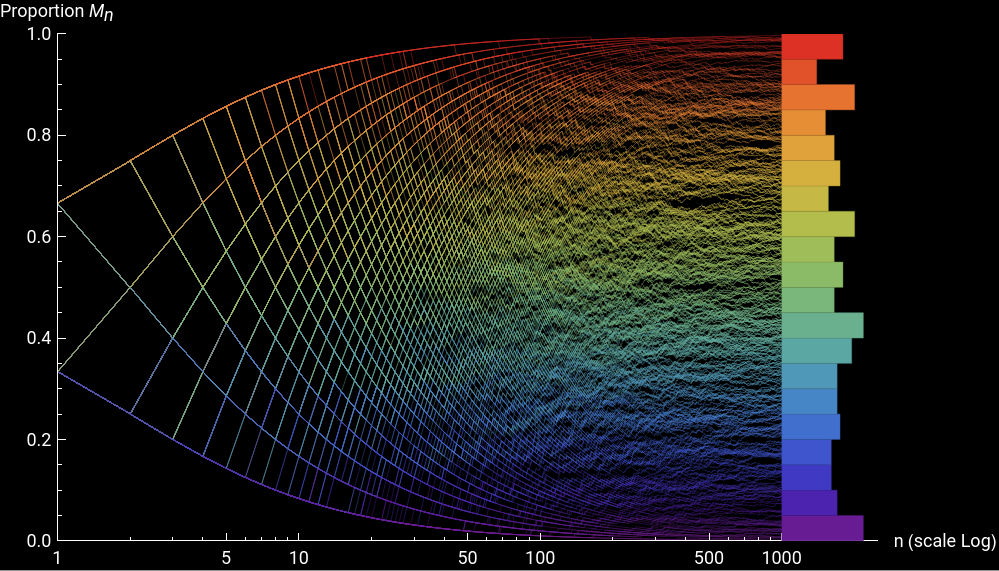
This feedback mechanism makes subsequent draws dependent on the entire past history. Despite this reinforcement, the sequence of relative proportions constitutes a bounded discrete-time martingale. Consequently, Doob's Forward Convergence Theorem applies, guaranteeing almost sure convergence to a limiting random variable whose distribution turns out to be continuous Uniform(0, 1).
1. Model Formulation and Setup
1. Model Formulation and Setup
At time , the urn contains 1 black ball and 1 white ball. At each discrete time step , one ball is drawn uniformly at random, inspected, and returned together with an additional ball of the same color. Let be the indicator that the drawn ball is black (1) or white (0):
n=0
n>=1
X
n
X
n
1 | ifdrawnballisblack |
0 | ifdrawnballiswhite |
The total number of black balls added to the urn by step is denoted by :
n
B
n
B
n
n
∑
i=1
X
i
B
0
At the end of period , the urn holds balls in total, exactly +1 of which are black. The proportion of black balls at time is defined by:
n
n+2
B
n
n
M
n
B
n
n+2
2. Martingale Property
2. Martingale Property
Let =={∅,Ω} and define the natural filtration as =σ(,,…,) for .
ℱ
0
ℱ
n
X
1
X
2
X
n
n>=1
Integrability and Adaptability: Since , we have almost surely for every . Thus, . Furthermore, is a measurable function of , making it strictly -adapted.
0<=<=n
B
n
0<<1
M
n
n>=0
[]<∞
M
n
M
n
B
n
ℱ
n
Notice that =+. Given the history up to time , the probability of drawing a black ball at step is precisely the current proportion of black balls:
B
n+1
B
n
X
n+1
n
n+1
(1)+1
X
n+1
ℱ
n
M
n
B
n
n+2
Now computing the conditional expectation of :
M
n+1
[]+1(+1+[])+1++1+1+1
M
n+1
ℱ
n
B
n+1
n+3
ℱ
n
1
n+3
B
n
X
n+1
ℱ
n
1
n+3
B
n
B
n
n+2
B
n
n+3
n+3
n+2
B
n
n+2
M
n
Hence, is a martingale.
(,)
M
n
ℱ
n
3. Probability of k Black Followed by j White Draws
3. Probability of Black Followed by White Draws
k
j
Let and be positive integers. Consider the specific event . By the conditional probabilities:
k>=1
j>=1
A==1,…,=1,=0,…,=0
X
1
X
k
X
k+1
X
k+j
(A)××⋯××××⋯×
1
2
2
3
k
k+1
1
k+2
2
k+3
j
k+j+1
Factoring the terms in the numerator and denominator:
(A)
k!j!
(k+j+1)!
1
(k+j+1)
k+j |
k |
4. Distribution of Bn and Limiting Law
4. Distribution of and Limiting Law
B
n
Any arbitrary binary sequence containing exactly black balls and white balls produces the same numerator product and denominator product . Consequently, every path with black balls has equal probability:
k
n-k
k!(n-k)!
(n+1)!
k
(,…,),with=k
X
1
x
1
X
n
x
n
k!(n-k)!
(n+1)!
n
∑
i=1
x
i
Since there are such disjoint sequences:
n |
k |
(k)
B
n
n |
k |
k!(n-k)!
(n+1)!
n!
k!(n-k)!
k!(n-k)!
(n+1)!
1
n+1
for every integer . Therefore, is uniformly distributed on {0, 1, ..., n}.
0<=k<=n
B
n
Because is a martingale uniformly bounded in [0, 1], Doob's Martingale Convergence Theorem implies that converges almost surely to a random variable . For any fixed in (0, 1), the cumulative distribution function is:
M
n
M
n
M
∞
x
F
n
M
n
B
n
⌊x(n+2)-1⌋+1
n+1
Taking the limit as :
n->∞
lim
n∞
F
n
lim
n∞
x(n+2)
n+1
Since on [0, 1], the sequence converges in distribution to a standard continuous uniform random variable:
F(x)=x
M
n
Simulation
Simulation
Out[]=
CITE THIS NOTEBOOK
CITE THIS NOTEBOOK
Pólya's urn: Martingales and limiting distribution
by Diego Ramos
Wolfram Community, STAFF PICKS, October 2, 2026
https://community.wolfram.com/t/28231
by Diego Ramos
Wolfram Community, STAFF PICKS, October 2, 2026
https://community.wolfram.com/t/28231