A recent preprint by Aabir Fauzan, titled “ζ(5) Is Irrational,” https://doi.org/10.5281/zenodo.22826418 claims to prove that ζ(5) is irrational—a result that would settle a longstanding open problem if correct. This article examines the proposed argument, focusing on its use of Hankel determinants, and presents Wolfram Language computations that illustrate the strikingly accurate approximations produced by the construction.
The Basel Problem
The Basel Problem
Add the reciprocals of the square numbers:
1+++++⋯=1.644934067...
1
2
2
1
2
3
1
2
4
1
2
5
It is not hard to show that this series converges. What number does it converges to? After Pietro Mengoli posed the problem in 1644, mathematicians like Jacob and Johann Bernoulli, Leibniz, de Moivre, and Stirling tried to solve it. It became known as the Basel problem, after the Swiss city associated with the Bernoulli family. In 1735, a 28 years old Euler found the answer:
1++++⋯=
1
2
2
1
2
3
1
2
4
2
π
6
Euler’s route to the answer looked at sin(x)/x, whose nonzero zeros occur at ±π, ±2π, ±3π, ... , and treated it like an infinite polynomial factored by its roots:
sin(x)
x
∞
∏
n=1
2
x
2
n
2
π
2
x
6
Expanding the product, the coefficient of x^2 is -(1/π^2)(1 + 1/2^2 + 1/3^2 + ...). But the Taylor series of sin(x)/x says that the same coefficient is -1/6. Matching them gives π^2/6 almost at once. Euler went on to solve higher powers.
In[]:=
Table[Zeta[2n],{n,1,10}]
Out[]=
,,,,,,,,,
2
π
6
4
π
90
6
π
945
8
π
9450
10
π
93555
691
12
π
638512875
2
14
π
18243225
3617
16
π
325641566250
43867
18
π
38979295480125
174611
20
π
1531329465290625
In 1859, Bernhard Riemann introduced the notation for the function and carried it into the complex plane. See Riemann Zeta Function at MathWorld. The odd powers remained a mystery for centuries.
ζ(s)
Apéry's Surprise
Apéry's Surprise
In 1978, Roger Apéry astonished an audience of number theorists by announcing that is irrational. His formulas were so unexpected that the result was initially met with some disbelief. It survived the scrutiny, and is now commonly called Apéry's constant.
ζ(3)
ζ(3)
1++++⋯=ζ(3)=1.202056903...
1
3
2
1
3
3
1
3
4
Apéry built rational approximations to ζ(3) that were simultaneously very accurate and arithmetically well controlled. If ζ(3) were a fraction, his estimates would eventually turn the tiny approximation error into a nonzero integer with absolute value less than 1. The full proof shows that the denominators and the errors behave exactly as required. Apéry did it using binomial sums and recurrence relations.
For more detail: Apéry's Constant (MathWorld) and Apéry's theorem (Wikipedia). Irrationality is known; whether Apéry's constant is transcendental is still unknown.
What is a Hankel matrix?
What is a Hankel matrix?
A Hankel matrix is constant along each anti-diagonal. Starting from moments m0, m1, m2, ..., a 3 by 3 example is:
m 0 | m 1 | m 2 |
m 1 | m 2 | m 3 |
m 2 | m 3 | m 4 |
In[]:=
HankelMatrix[5]
Out[]=
{{1,2,3,4,5},{2,3,4,5,0},{3,4,5,0,0},{4,5,0,0,0},{5,0,0,0,0}}
In[]:=
ArrayPlot[HankelMatrix[20],ImageSize->Small]
Out[]=
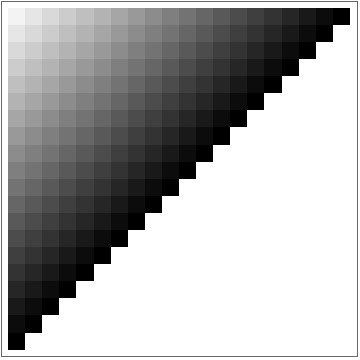
Fauzan’s construction uses Hankel determinants built from a specially chosen moment sequence. In the code below, hankelMatrix[n] defaults to dimension 37 n, matching the family used in the proof.
In[]:=
d[m_]:=Product[t+j^2,{j,m}];moment[n_,e_,x_:x]:=Module[{k=40n,p,q},p=d[3n]^6t^e;q=PolynomialQuotient[p,d[k],t];Together[Total[MapIndexed[#1(-1)^(First[#2]-1)BernoulliB[2First[#2]](2First[#2]+1)(2First[#2]+2)(2First[#2]+3)/24&,CoefficientList[q,t]]]+Sum[(p/.t->-j^2)2j^2/((-1)^(j-1)(k-j)!(k+j)!)(j^4(x-HarmonicNumber[j,5])-1/4+1/(2j)),{j,3n+1,k}]]];hankelMatrix[n_,s_:Automatic,x_:x]:=Module[{h=Replace[s,Automatic->37n],m},m=moment[n,#,x]&/@Range[0,2h-2];HankelMatrix[Take[m,h],Take[m,-h]]];
A small numerical experiment
A small numerical experiment
For a quick experiment, keep n = 1 but use an 11 by 11 matrix rather than the full 37 by 37 matrix. The determinant is a polynomial in x. We look for values of x for which the determinant is zero; at those values the matrix is singular. One of the roots is extraordinarily close to ζ(5). The last number displayed below is the numerical value of ζ(5) itself.
In[]:=
Append[Sort[x/.#&/@NSolve[Det[hankelMatrix[1,11]]==0,100]],N[Zeta[5],100]]
Out[]=
{1.036927755143369926331365486457034168057080919501912811544377717229235627735124171839302923586682512,1.036927755143369926331365486457034168057080919501912811974194260157167723825844521487924277191118669,1.036927755143369926331365486457034168057080919501912811974192677903803589786281484560043106557133336}
Now keep n = 1 and vary only the matrix dimension from 11 through 19. These smaller matrices make the phenomenon easy to explore, but they do not test the proof’s full asymptotic family, whose dimension is 37 n. There is also an important numerical disclosure: the code uses the known value Zeta[5] to choose, among all determinant roots, the one closest to ζ(5). So this is an illustration of the construction, not an independent numerical discovery of the constant.
In[]:=
Grid[Table[{k,N[(SortBy[x/.#&/@NSolve[Det[hankelMatrix[1,k]]==0,200],Abs[#-Zeta[5]]&][[1]]-Zeta[5])]},{k,11,19}],Frame->All]
Out[]=
11 | 1.58225× -60 10 |
12 | 3.83854× -65 10 |
13 | 3.23035× -69 10 |
14 | 5.91818× -73 10 |
15 | 1.9207× -76 10 |
16 | 9.81462× -80 10 |
17 | 7.31323× -83 10 |
18 | 7.52777× -86 10 |
19 | 1.02812× -88 10 |
The saved errors decrease from about 1.58*^-60 at dimension 11 to about 1.03*^-88 at dimension 19. That is impressive, but extremely good approximations by themselves do not prove irrationality.
Where the irrationality proof needs more
Where the irrationality proof needs more
The missing bridge is arithmetic. The preprint constructs integer-coefficient polynomials Q_n of degree 37 n whose values at ζ(5) are strictly positive and shrink very rapidly. If ζ(5) = a/b were rational, then b^(37 n) Q_n(a/b) would be a nonzero integer. The decay estimate eventually makes its absolute value smaller than 1, which is impossible for a nonzero integer. Thus positivity (or another proof of nonvanishing), coefficient integrality, and sufficiently fast decay are the crucial extra ingredients. The small matrices above let us see the determinant phenomenon, but they do not verify those asymptotic estimates.
So, at the very least, the construction gives a remarkably sharp numerical window onto the Hankel determinants that appear in the claimed proof of ζ(5) irrationality.
References
References
Background links: Basel problem / ζ(2) • Riemann zeta function • Apéry's constant • Hankel matrix • Bernoulli numbers
Aabir Fauzan, “ζ(5) is irrational,” preprint, 17 September 2026. Zenodo DOI: 10.5281/zenodo.22826419.
Dan Romik’s Lean project, https://github.com/danromik/zeta5-irrationality, follows Fauzan’s preprint closely. Its README notes that the final verification includes an additional axiom giving the needed prime-number-theorem statement for Chebyshev’s theta function, so that assumption should be kept in view when describing the formalization.
The separate mo271 project, https://github.com/mo271/Zeta5, reports a complete Lean proof whose final theorem depends only on Lean/Mathlib’s standard logical axioms. It is not a line-by-line transcription of the preprint: the project explicitly describes several modifications to the normalization and valuation estimates.
Because the result is very recent, it is useful to distinguish the original preprint, the independent formalization projects, and later peer review. This notebook is a public-facing computational companion to the Hankel-matrix idea, not an independent proof.
CITE THIS NOTEBOOK
CITE THIS NOTEBOOK
Basel, Hankel, and a recent proof of ζ(5) irrationality
by Ed Pegg
Wolfram Community, STAFF PICKS, October 7, 2026
https://community.wolfram.com/t/28282