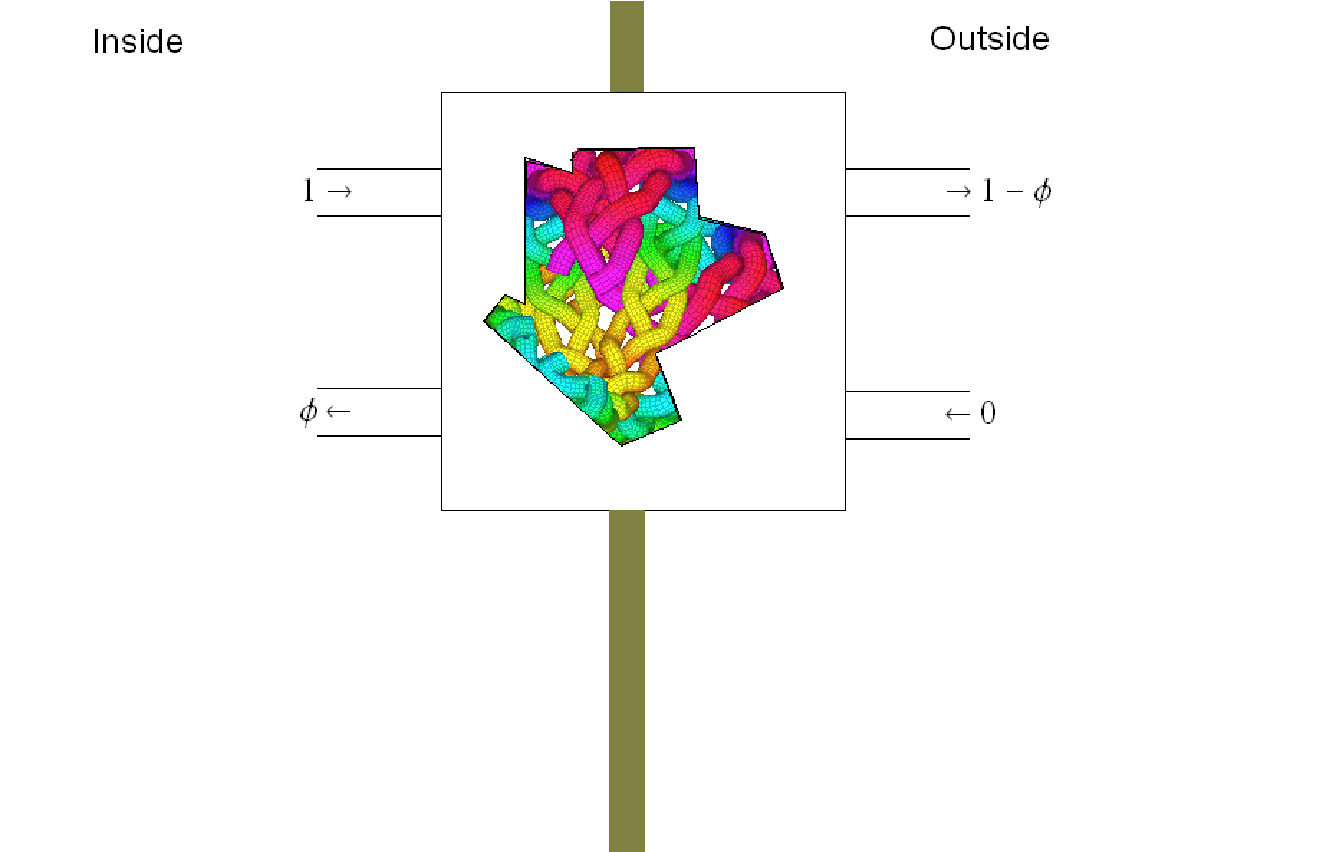
The gray bar represents an insulating wall. On the left we have a heater and a thermostat keeping the inside temperature a nice warm 1, but the air is stale and stuffy. On the right, outside, the air is nice and fresh, but freezing cold. 0 in fact. Bridging inside to outside is heat-exchanger, a box containing two separate but tangled tubes, one for intake, and one for exhaust. The outbound air saves energy by transferring some of its heat to the inbound air, managing to reach a temperature of Φ, while lowering the exhaust air temperature to 1 - Φ. (At least one of the tubes contains a (very energy efficient) fan. The tubes are the only connection between inside and outside.)
How warm can we make Φ? You might intuit that, for sufficiently long, tangled tubes, we might
approach Φ = ½. Is there any way, without additional energy, to get Φ > ½? (Neglect thermal expansion and mechanical compression.)
Solution: Schematically,
How warm can we make Φ? You might intuit that, for sufficiently long, tangled tubes, we might
approach Φ = ½. Is there any way, without additional energy, to get Φ > ½? (Neglect thermal expansion and mechanical compression.)
Solution: Schematically,
In[]:=
Grid[{{1,"→",1-ϕ},{ϕ,"←",0}}]
Out[]=
1 | → | 1-ϕ |
ϕ | ← | 0 |
We could call ϕ the “efficiency”. Presumably, if we scaled all the temperatures by A,
In[]:=
%/.{x_,y_,z_}{A*x,y,A*z}
Out[]=
A | → | A(1-ϕ) |
Aϕ | ← | 0 |
Similarly, if we add B to all the temperatures, the behavior will be
In[]:=
%/.{x_,y_,z_}{B+x,y,B+z}
Out[]=
A+B | → | B+A(1-ϕ) |
B+Aϕ | ← | B |
This isn’t much different from converting Eccentrigrade to Fair-n-hot. A and B can be anything, including C and D. Now suppose we replace the original box with two of these devices plugged together!
In[]:=
Row[{%," : ",%/.AC/.BD}]
Out[]=
A+B | → | B+A(1-ϕ) |
B+Aϕ | ← | B |
C+D | → | D+C(1-ϕ) |
D+Cϕ | ← | D |
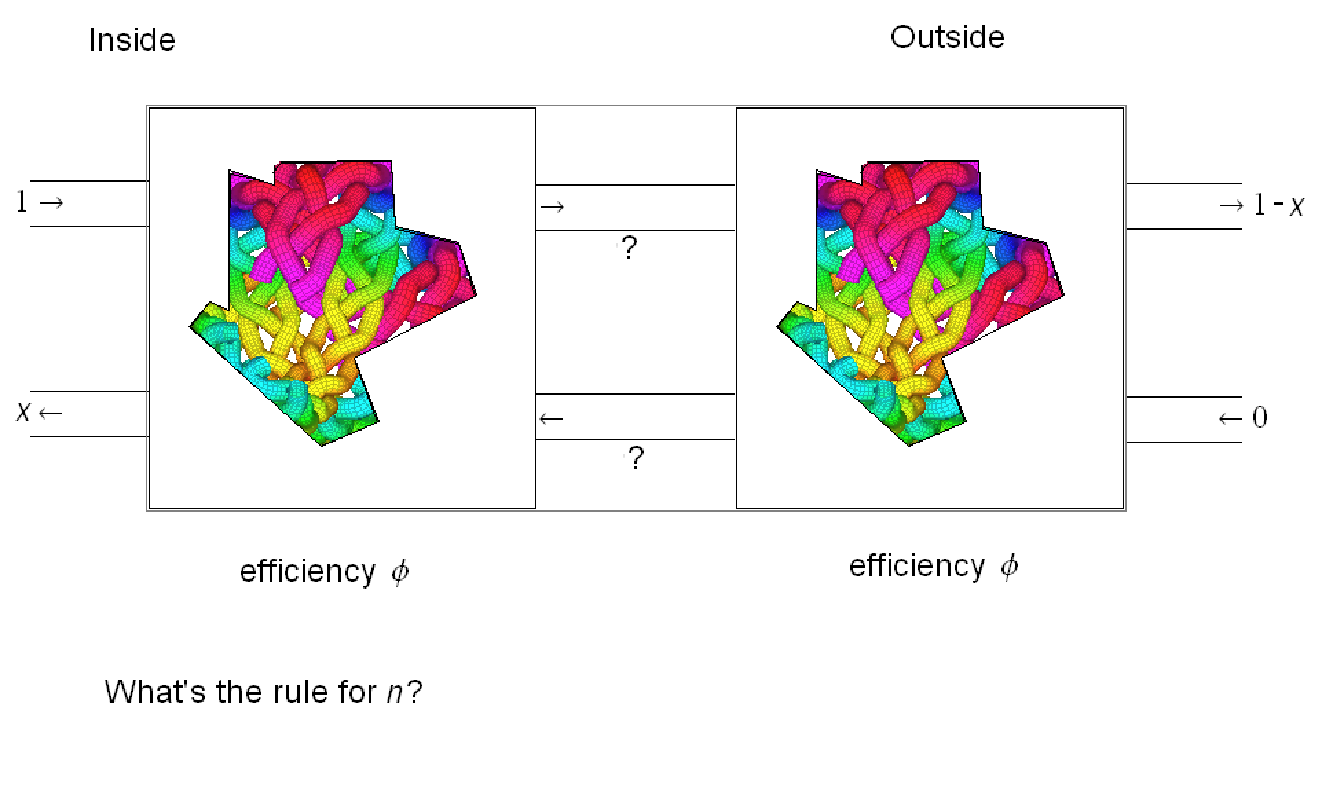
In order to match up with our original conditions,
In[]:=
{A+B->1,B+A*(1-ϕ)->C+D,B->D+C*ϕ,D->0}
Out[]=
{A+B1,B+A(1-ϕ)C+D,BD+Cϕ,D0}
Check:
In[]:=
%%//.%
Out[]=
1 | → | C |
Aϕ+Cϕ | ← | Cϕ |
C | → | C(1-ϕ) |
Cϕ | ← | 0 |
Yep, they match. Turn these substitution rules into equations:
In[]:=
%%/.RuleEqual
Out[]=
{A+B1,B+A(1-ϕ)C+D,BD+Cϕ,D0}
Solve them:
In[]:=
Solve[%]
Out[]=
A,B,C,D0,{B1-A,C1-A,D0,ϕ1}
1
1+ϕ
ϕ
1+ϕ
1
1+ϕ
The second solution says that if ϕ was already 100%, then connecting two boxes is a no-op. But we’re not allowed to play with ϕ, so we must use the first solution:
In[]:=
Simplify[%%%%%/.%[[1]]]
Out[]=
1 | → | 1 1+ϕ |
2ϕ 1+ϕ | ← | ϕ 1+ϕ |
1 1+ϕ | → | 1-ϕ 1+ϕ |
ϕ 1+ϕ | ← | 0 |
The combined efficiency is 2ϕ/(1+ϕ). The original question was could we beat ϕ = 50%. Suppose we could reach 40%.
In[]:=
%/.ϕ2/5
Out[]=
1 | → | 5 7 |
4 7 | ← | 2 7 |
5 7 | → | 3 7 |
2 7 | ← | 0 |
4/7 > 1/2, quod erat desiderandum. What if we strung together four boxes?
In[]:=
Simplify[%%/.ϕ2*ϕ/(1+ϕ)]
Out[]=
1 | → | 1+ϕ 1+3ϕ |
4ϕ 1+3ϕ | ← | 2ϕ 1+3ϕ |
1+ϕ 1+3ϕ | → | 1-ϕ 1+3ϕ |
2ϕ 1+3ϕ | ← | 0 |
From this you should have no trouble guessing (and proving) the formula for n boxes. But wait a minute. What’s the difference between two boxes and one long box? None. There was no reason to imagine a limit of ϕ = 50% in the first place!
CITE THIS NOTEBOOK
CITE THIS NOTEBOOK
Counterflow: Maximizing Heat Transfer Efficiency in an Air Exchange System
by Bill Gosper
Wolfram Community, STAFF PICKS, June 26, 2023
https://community.wolfram.com/groups/-/m/t/2944415
by Bill Gosper
Wolfram Community, STAFF PICKS, June 26, 2023
https://community.wolfram.com/groups/-/m/t/2944415