Cylindrical Anamorphosis of Parametric Surfaces
Cylindrical Anamorphosis of Parametric Surfaces


Mirror anamorphosis is a distorted projection that a viewer sees as a normal undeformed image when reflected[1].
This Demonstration deals with the artist's process: given a realistic 3D surface, make a new surface of the deformed, anamorphic image as reflected in the cylindrical mirror. The surfaces used are parametric surfaces defined by the built-in Mathematica function ParametricPlot3D.
The technique of 3D cylindrical anamorphosis is used by many graphic artists[2].
Details
Details
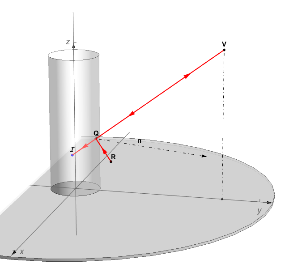
In this Demonstration, the mirror is a circular right cylinder with radius parallel to the axis. The viewer's eye is at at a distance and a height .
1
z
V
y
v
z
v
A point of the object is reflected by the mirror toward the observer's eye. The light path forms equal angles with the normal vector , perpendicular to the cylinder at , the intersection with the cylinder of the view line between the viewpoint and the image point .
n
Q
V
ℐ
The viewer perceives the anamorphic point as the point . The artist makes the anamorphic point from the reflected point . Both and are in the same horizontal plane and at the same distance from .
R
ℐ
R
ℐ
R
ℐ
Q
References
References
[1] J. Britton. "Cylindrical Mirror Anamorphoses." Department of Mathematics, Camosun College, Victoria, BC, Canada. britton.disted.camosun.bc.ca/anamorphic/cylmirror.html.
External Links
External Links
Permanent Citation
Permanent Citation
Erik Mahieu
"Cylindrical Anamorphosis of Parametric Surfaces"
http://demonstrations.wolfram.com/CylindricalAnamorphosisOfParametricSurfaces/
Wolfram Demonstrations Project
Published: June 27, 2017