,
,
,
,
,
,
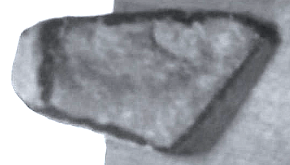
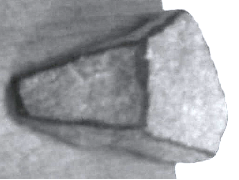
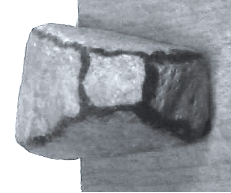
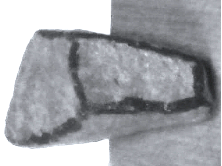
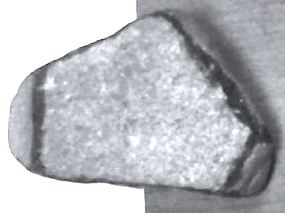
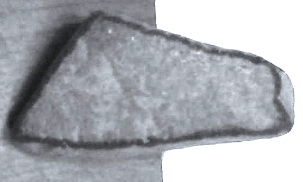
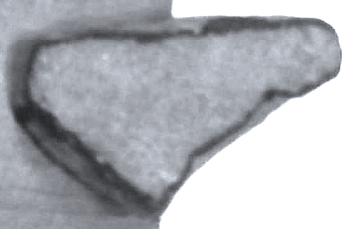
I found this 7 faced stone with 15 edges - a considerably augmented pentagonal prism. In the list above, its third and fifth members are the top and bottom of the prism. I’ve heard it said that some American Indian tribes engaged in a search for geometric stones with their children. My personal collection contains stones with up to 13 faces and 27 edges.
I found this 7 faced stone with 15 edges - a considerably augmented pentagonal prism. In the list above, its third and fifth members are the top and bottom of the prism. I’ve heard it said that some American Indian tribes engaged in a search for geometric stones with their children. My personal collection contains stones with up to 13 faces and 27 edges.
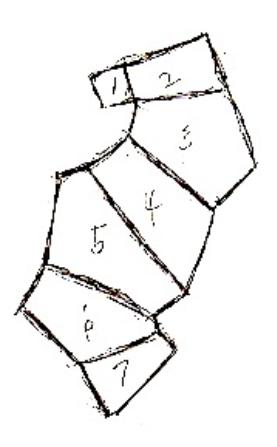
The traced layout below folds inward to make a 3D copy of the stone. Next to it an ideal pentagonal prism displays the 1:1 geometry necessary to compare a 15 tone equal tempered scale with the edges of the stone. From his 1969 book Utopia or Oblivion, R. Buckminster Fuller exemplified our perceptual need for closer identities with the cartoon caption, “Scientists blind-probing with instruments”. Today the visual representation of data is tremendous. The use of auditory display has not formed a solid foundation and is still used primarily for signaling within ear shot. Ding! The elevator arrives. The use of Harmonics seems futile at times, except for those who hear or take the time to hear better.

Set Lowest Volume for Listening
Set Lowest Volume for Listening
1. The 15 Tone Equal Tempered Scale (idealPentaPrism) is established per step of equal temperament.
as
15
2
In[]:=
F[0]:=200(*200-400hzoctave*)F[1]:=209.45882456412534F[n_]:=F[n-1]*1.0472941228206267179`/;n>1idealPentaPrism=Table[F[i],{i,0,15}]//Round
Out[]=
{200,209,219,230,241,252,264,276,289,303,317,332,348,365,382,400}
In[]:=
(*This15ToneScaleisbasedupontheedgesofthestone,whosefreqencieswereoctavereducedtofitthe200-400HZoctave.*)edgesOctave={200,208,212,232,239,240,244,264,275,288,298,328,333,338,388,400};{audEdgesStone=Sound[{Play[Sin[200*2Pit],{t,0,1}],Play[Sin[208*2Pit],{t,0,1}],Play[Sin[212*2Pit],{t,0,1}],Play[Sin[232*2Pit],{t,0,1}],Play[Sin[239*2Pit],{t,0,1}],Play[Sin[241*2Pit],{t,0,1}],Play[Sin[246*2Pit],{t,0,1}],Play[Sin[264*2Pit],{t,0,1}],Play[Sin[274*2Pit],{t,0,1}],Play[Sin[288*2Pit],{t,0,1}],Play[Sin[299*2Pit],{t,0,1}],Play[Sin[328*2Pit],{t,0,1}],Play[Sin[335*2Pit],{t,0,1}],Play[Sin[341*2Pit],{t,0,1}],Play[Sin[388*2Pit],{t,0,1}],Play[Sin[400*2Pit],{t,0,1}]}],(*This15tonescaleisequaltempered.*){200,209,219,230,241,252,264,276,289,303,317,332,348,365,382,400};audEdgesET=Sound[{Play[Sin[200*2Pit],{t,0,1}],Play[Sin[209*2Pit],{t,0,1}],Play[Sin[219*2Pit],{t,0,1}],Play[Sin[230*2Pit],{t,0,1}],Play[Sin[241*2Pit],{t,0,1}],Play[Sin[252*2Pit],{t,0,1}],Play[Sin[264*2Pit],{t,0,1}],Play[Sin[276*2Pit],{t,0,1}],Play[Sin[289*2Pit],{t,0,1}],Play[Sin[303*2Pit],{t,0,1}],Play[Sin[317*2Pit],{t,0,1}],Play[Sin[332*2Pit],{t,0,1}],Play[Sin[348*2Pit],{t,0,1}],Play[Sin[365*2Pit],{t,0,1}],Play[Sin[382*2Pit],{t,0,1}],Play[Sin[400*2Pit],{t,0,1}]}],Audio[audEdgesET]+Audio[audEdgesStone],BarChart[edgesOctave,ImageSize->Small],BarChart[idealPentaPrism,ImageSize->Small]}
Stone Scale Equal Tempered Prism Scale Combined Stone Scale Prism ET ScaleThe difference between the equal tempered scale and the stone’s scale becomes recognizable only when combined in the Audio file. The faster the beats heard, the more that the stone scale diverges from the ideal prism per edge of equal temperament. The last pitch we hear only completes the octave and therefore no beats are heard.
<< ONLY SINE TONES ARE USED HERE. TURN THE VOLUME TO THE LOWEST SETTING AND BRING IT UP FROM THERE. >>
<< ONLY SINE TONES ARE USED HERE. TURN THE VOLUME TO THE LOWEST SETTING AND BRING IT UP FROM THERE. >>
2. (edges15) is a sorted list of the stone’s 15 edges after averaging. For brevity the averaging calculation is not shown here.
In[]:=
edges15=Sort[{114.24,105.78,101.88,116.48,268.83,167.24,279.11,233.55,187.25,340.61,264.15,483.16,82.41,388.25,288.94}]//Round
Out[]=
{82,102,106,114,116,167,187,234,264,269,279,289,341,388,483}
3. (baseStringLength) takes the total of the stone’s 15 edges as a base string length as 1/1. Although the longest member of the 15 edges could have been used as 1/1, that is not the case here. Now each edge fits within an established 1/1 string length. This 1/1 relationship is key to demonstrate correspondences between measurement data and a sounding string. The relationship of parts to one another and to the whole is the essence of Harmonics.
In[]:=
baseStringLength=Total[edges15]
Out[]=
3421
Face 1
Face 1
In the following code section the Coordinates Tool, with its hand to trackpad interface, is used to measure the perimeters for each of the seven faces. This section is repeated for each face.
I. (face1Coord) are Coordinates Tool measurements in Cartesian coordinates for the perimeter.
In[]:=
face1Coord={{8.953125`,16.39062500000003`},{10.51171875`,128.92578125000003`},{131.015625`,121.10937500000003`},{124.9375`,16.52734375000003`},{8.953125`,16.39062500000003`}};
II. (parts1) shows perimeter lengths, counterclockwise from left side of each face. There are 15 edges and the faces also share 15 edges. This is where their measurements did not always line up. Averaging seemed to set the model right and otherwise the errors introduced are not critical for this application. (averageParts1) shows the averages for shared edges. These are used to reconcile string length with frequency. Total[averageParts1] is the perimeter measurement per face. These are used to determine 7 durations with one duration per face for the chords that follow.
In[]:=
parts1=ArcLength[Line[{face1Coord[[#]]},{face1Coord[[#]]}]]&/@{{1,2},{2,3},{3,4},{4,5}}(*parts1arenotused,butshownheretoshowmeasurementerrorsbeforeaveraging*)
Out[]=
{112.546,120.757,104.759,115.984}
In[]:=
averageParts1={114,106,102,116};(*largestedgediscrepancyinsecondpositionwithface5firstposition*)
In[]:=
Total[averageParts1]
Out[]=
438
III. This section finds the durations for the 7 chords. (facePerimeters) lists the perimeter of each face. Durations are based on the lengths of perimeters. (durationStringLen) is the 1/1 ratio string length, obtained as the total of the 7 perimeters. (dur1) the ratio of perimeter to durationStrngLen is expanded by 5 octaves. The double ratio ((+,-)n2) can be used effectively to expand or compress lists of data while maintaining octave relationships. Any interval can be set as 1/1 to constrain data within its bounds.
III. This section finds the durations for the 7 chords. (facePerimeters) lists the perimeter of each face. Durations are based on the lengths of perimeters. (durationStringLen) is the 1/1 ratio string length, obtained as the total of the 7 perimeters. (dur1) the ratio of perimeter to durationStrngLen is expanded by 5 octaves. The double ratio () can be used effectively to expand or compress lists of data while maintaining octave relationships. Any interval can be set as 1/1 to constrain data within its bounds.
(+,-)n
2
In[]:=
facePerimeters={438,817,1158,1202,1328,1078,822};durationStringLen=Total[facePerimeters]dur1=N[facePerimeters[[#]]/durationStringLen*32]&/@{1,2,3,4,5,6,7}
Out[]=
6843
Out[]=
{2.04822,3.82055,5.41517,5.62093,6.21014,5.04106,3.84393}
IV. String Length and Frequency are inversely proportional. (string1Edges) shows the ratio of the 1/1 base string length to the 4 edges of (face1). (freq1Edges) establishes a frequency for each edge. To keep the resulting chord within a reasonable range a very low frequency 16.35 HZ is used as a multiplier. The 7 faces contain two chords with five tones and five chords with four tones. note: For brevity, the 10 three tone chord vertices of the pentagonal prism are not applied here.
In[]:=
string1Edges=baseStringLength/averageParts1
Out[]=
,,,
3421
114
3421
106
3421
102
3421
116
In[]:=
freq1Edges=Round[string1Edges*16.35]
Out[]=
{491,528,548,482}
In[]:=
{491,528,548,482}
Out[]=
{491,528,548,482}
V. (audFace1) is the Sound file for ( face1), a chord based upon its stone face. (audFace1Oct ) is a scale based upon the stone face. (audFace1ET) uses the nearest equal tempered tone in relation to the stone face. When the two audio files are mixed together, we can hear by the beats, how far the augmented prism diverges from the norm of an ideal prism. !! SET YOUR VOLUME BELOW ONE-HALF !!
{{audFace1=Sound[Play[Sin[491*2Pit]+Sin[528*2Pit]+Sin[548*2Pit]+Sin[482*2Pit],{t,0,2.05(*dur1*)}]]},audFace1Oct=Sound[{Play[Sin[244*2Pit],{t,0,1.2}],Play[Sin[275*2Pit],{t,0,1.6}],Play[Sin[240*2Pit],{t,0,1}],Play[Sin[263*2Pit],{t,0,1.4}]}],audFace1ET=Sound[{Play[Sin[241*2Pit],{t,0,1.2}],Play[Sin[276*2Pit],{t,0,1.6}],Play[Sin[241*2Pit],{t,0,1}],Play[Sin[264*2Pit],{t,0,1.4}]}];audCombiScale1=Audio[audFace1ET]+Audio[audFace1Oct]};
Stone Chord Stone Scale Stone Scale + ET Stone Scale
The edges of each face produce a Stone Chord. A chords duration is a scale of face perimeters, from shortest to longest. With the Stone Scale, the perimeter is walked through counterclockwise starting on the left side of each face. Then, while listening to the Stone Scale it’s possible to see and hear that longer edges are pitched higher than shorter ones. Scalar edge durations are set in an arithmetic series (1 - 1.8 seconds), to imply a rhythm. In the combination Stone and Et Stone Scale, the faster the beats heard, the more the stone scale diverges from an ideal prism per edge.
In[]:=
face1=
,
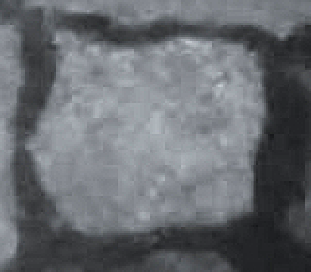
;

Face 2
Face 2
In[]:=
face2Coord={{13.7890625`,72.43359375`},{8.91796875`,171.32421875`},{267.52`,186.91`},{293.43359375`,17.90234375`},{13.7890625`,72.43359375`}};
In[]:=
parts2=ArcLength[Line[{face2Coord[[#]]},{face2Coord[[#]]}]]&/@{{1,2},{2,3},{3,4},{4,5}}
Out[]=
{99.0105,259.071,170.983,284.912}
In[]:=
averageParts2={102,269,167,279};
Face 3
Face 3
Face 4
Face 4
Face 5
Face 5
Face 6
Face 6
Face 7
Face 7
To review: A chords duration is a scale of face perimeters, from short to long. The faster the beats heard the more that a stone scale diverges from an ideal prism per edge. With the scales, longer edges are pitched lower than shorter ones. This scaling also applies to individual edge durations.
Epilogue
Epilogue
CITE THIS NOTEBOOK
CITE THIS NOTEBOOK
Seven faces: An harmonics application with audio display
by Drew Lesso
Wolfram Community, STAFF PICKS, March 10, 2025
https://community.wolfram.com/groups/-/m/t/3413532
by Drew Lesso
Wolfram Community, STAFF PICKS, March 10, 2025
https://community.wolfram.com/groups/-/m/t/3413532