A complex microscopic dynamic, e.g., with strong correlations, usually drag the system into out-of-equilibrium states. In this cases, the Boltzmann-Gibbs (BG) statistical mechanics fails and some sort of extension of the entropy measures are needed. In 1988, Tsallis proposed nonextensive statistical mechanics based on the concept of a nonadditive entropy. In this short computational essay, we shall explore it in the Wolfram Mathematica, using the resource function TsallisEntropy.
Tsallis Entropy
Tsallis Entropy
The Boltzmann-Gibbs entropy, which is a logarithmic measure of the lack of information, is defined as =-kln where is the number of possible microscopic configurations/states and is the Boltzmann constant (which is set to one in the information theory). For a quantum system, it reduces to the von Neumann entropy. In 1988 Tsallis [1] showed that raising probabilities associated with an event by a power (called the entropic index) leads to a non-extensive generalization of the BG entropy function:
S
BG
W
∑
i=1
p
i
p
i
Wϵ
k
qϵ
In[]:=
Out[]=
S
q
k1-
w
∑
i
q
p
i
-1+q
where is a conventional positive constant. Note =.
k
S
1
S
BG
When rare events (i.e., close to 0) are privileged while privileges common events (i.e., close to 1).
q<1
p
q>1
p
Tsallis entropy is concave for q > 0, and convex for q < 0. Plot k vs :
S
q
p
In[]:=
Sq[p_]:=Table[{p,1-p},q,1],{q,values={-1,-0.5,-.1,0,0.1,1,3,10}};Plot[Evaluate@Sq[p],{p,0,1},PlotRange{0,2},FrameLabel{"p","/k"},FrameTrue,PlotLabelsvalues]
S
q
Out[]=
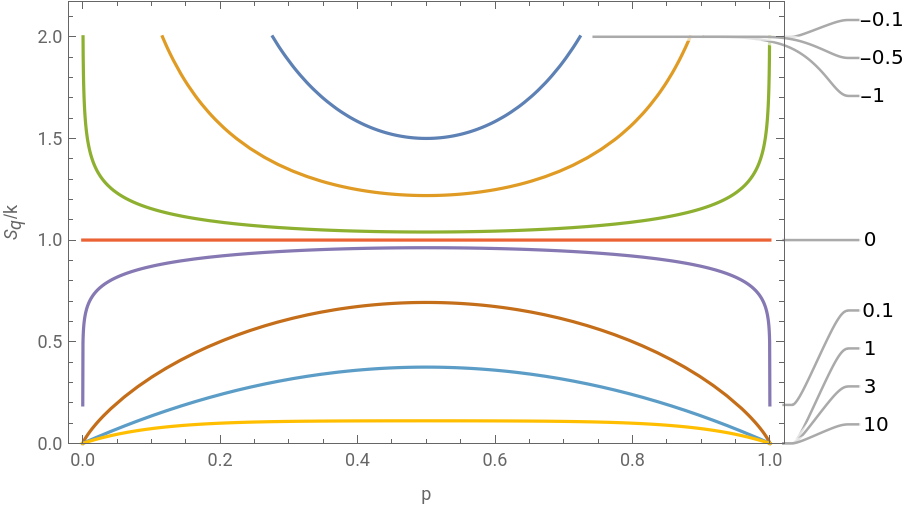
The BG entropy function is recovered for .
q1
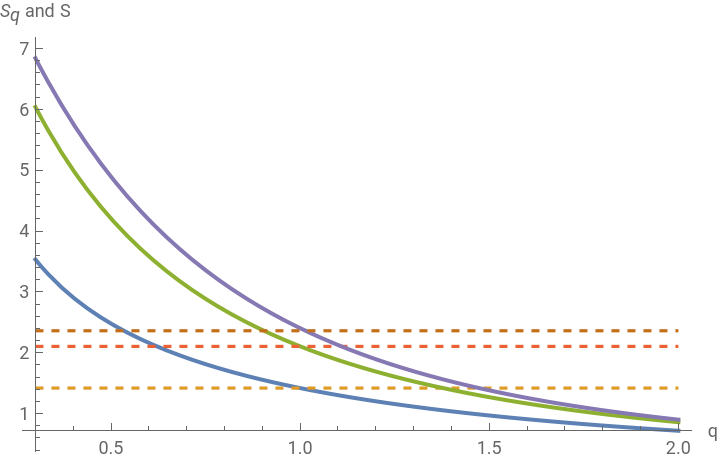
Compare the Tsallis entropy with the BG entropy for different discrete sets of probabilities:
In[]:=
p=Table[PDF[NormalDistribution[0,σ],x],{σ,1,3},{x,-6,6}];BGEntropy[p_]:=-p.Log[p];PlotEvaluate[#,q],BGEntropy[#]&/@p,{q,0.3,2},
Out[]=


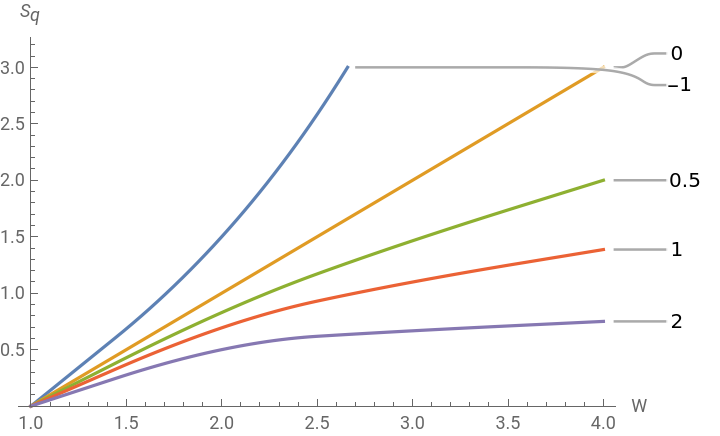
Plot the value of the Tsallis entropy at its extremum (equiprobability) for and typical values of :
k=1
q
In[]:=
ListPlotTableTable,{x,1,W},q,1,{q,{-1,0,0.5,1,2}},{W,1,4},JoinedTrue,AxesOrigin{1,0},PlotRange{0,3},PlotLabels{-1,0,0.5,1,2},InterpolationOrder2,AxesLabel{"W",""}
1
W
S
q
Out[]=
Some interesting properties of Sq
Some interesting properties of
S
q
Show non-additivity (A,B)=(A)+(B)+(1-q)(A)(B) for two independent systems A and B with discrete sets of probability:
S
q
S
q
S
q
S
q
S
q
In[]:=
q=2;p1={0.2,0.3,0.5};p2={0.1,0.6,0.3};[Flatten@Outer[Times,p1,p2],q,1]==[p1,q,1]+[p2,q,1]+(1-q)[p1,q,1]*[p2,q,1]
Out[]=
True
Show non-additivity (A,B)=(A)+(B) with for two independent systems and with continuous probability distributions:
S
q
S
q
S
q
q=1
A
B
In[]:=
1=NormalDistribution[0,2];2=NormalDistribution[1/3,1];[ProductDistribution[1,2],1]==[1,1]+[2,1]
Out[]=
True
Application of Sq
Application of
S
q
Several applications of Tsallis entropy and Tsallis statistics in general have been reported. For instance, by imposing the extensivity of , with being the density matrix of a block of spinsof the ground state of quantum spin chains in the neighborhood of a quantum phase transition, it is possible to find the value of a λ-dependent entropic index denoted , (where λ characterizes the strength of a transverse magnetic field along the z direction) for which with the so-called central charge. The corresponding value =, confirms that its universal behavior is strictly related to the universal role played by the central charge in conformal field theory, as it was confirmed numerically the agreement of the value of for which is extensive in critical quantum Ising and XY models ( and ) and critical isotropic XX models ( and ). For this and only this value of , the non-additive entropy is thermodynamically extensive (i.e., proportional to in the large limit, as required by the Legendre structure of thermodynamics), whereas the additive is not. [2]
S
q
p
L
p
L
L
q
ent
-c/6(-1/)=1
q
ent
q
ent
c
q
ent
9+
-32
c
c
q
S
q
λ=1
c=1/2
λ<1
c=1
q
S
q
N
N
S
BG
Other examples of physical systems described by non-extensive statistical mechanics [3] are but not limited to anomalous diffusion of cold atoms in dissipative optical lattices [4], anomalous diffusion in granular matter [5], experimental high energy physics [6], observational high energy physics in cosmic rays [7].
An interesting technological application was the development of an automatic micro-calcification detection method using a type II fuzzy index. The thresholding was performed using the Tsallis entropy characterized by , which depends on the non-extensiveness of the mammogram. The results suggest that the proposed Tsallis entropy approach outperforms the two-dimensional non-fuzzy approach and the conventional Shannon entropy partition approach whereas upon introduction of the Tsallis entropy, the results surge to 96.55% True positives with 0.4 False positives [8].
q
Tsallis q-algebra
Tsallis q-algebra
Non-extensive statistical mechanics uses constructions based on a special algebra sometimes referred to as q-algebra, which depends on parameter q. Particularly, q-analysis relies on the generalization of the logarithm function and its inverse the exponential function.
By defining the deformation of the logarithm function x=(-1)(1-q),
ln
q
1-q
x
Define the generalized function q-logarithm:
In[]:=
lnq[x_,q_]:=-1/;x>0
1-q
x
q-1
Plot the q-logarithm for several values of q:
In[]:=
ClearAll[q];Plot[Evaluate@Table[lnq[x,q],{q,values={-1,-0.5,0.5,1.1,2}}],{x,0,2},PlotRange{-2,3},FrameLabel{"x","(x)"},FrameTrue,PlotLabelsvalues]
ln
q
Out[]=
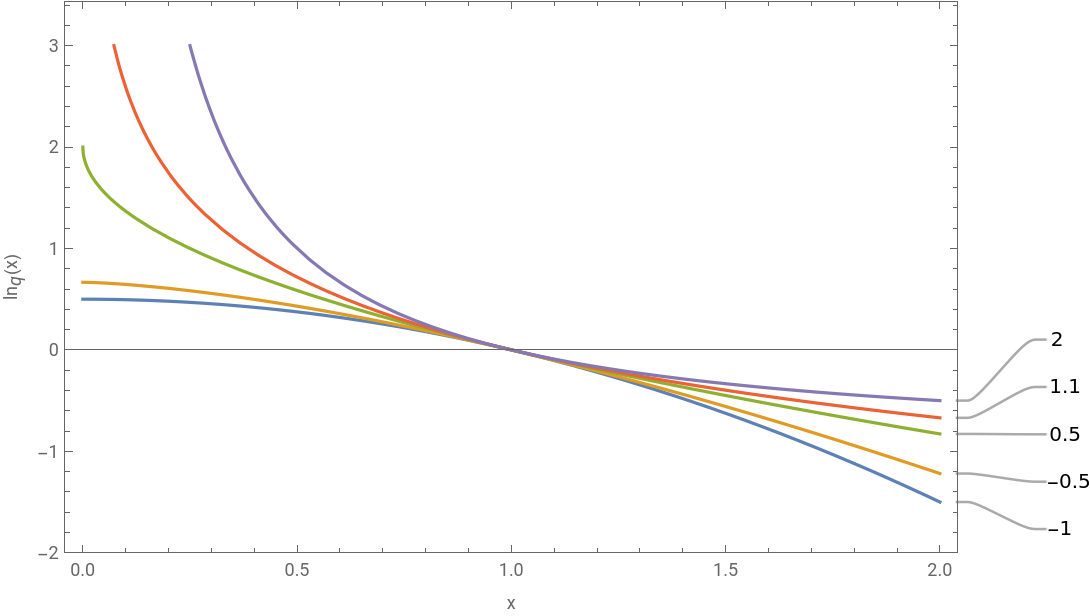
that recovers the logarithm function for
q=1∀x>0
Define the generalized q-exponential:
Plot the q-exponential for several values of q:
Define the q-multiplication function (a.k.a q-sum):
Define the q-multiplication function (a.k.a q-product):
Define the generalized q-sum function:
Examine the regular sum operation, q-sum, and generalized q-sum:
and Nivanen et al. [10] identified additional deformed operators, recovering the distributivity. In later works, the q-multiplication and the q-addition were identified as belonging to two different classes, and further operators were defined. All this together lead to mathematical developments like spiral generalizations of the trigonometric and hyperbolic functions through the extension of Euler’s formula to the complex domain [11], representations of the Dirac delta function [12–14], two parameter extensions for the logarithm and exponential and their related algebras [15, 16], among others. Other deformed mathematical structures had been introduced, particularly the Kaniadakis formalism [17–20], from which some of the developments within the nonextensive context have been inspired and generalizations of Laplace and Fourier transforms. Let’s take a brief look into the latter.
We can observe that for positive values of q, the solution is now a function with damped oscillations; and for negative values function has amplified oscillations.
Plot the q-Fourier transform of the sinc function:
q-Gaussian
q-Gaussian
A q-Central Limit Theorem consistent with non-extensive statistical mechanics was reported by Umarov et al. [21] where the authors showed that in the framework of q-algebra, the corresponding q-generalization of the central limit theorem becomes possible and relatively simple by allowing the random variables that are being summed to be strongly correlated in some special manner.
Define the q-Gaussian function:
Define the q-Gaussian normalizing constant:
Plot the value of the q-Gaussian function for typical values of q:
Compute the q-Gaussian for q = 1:
One of the most impressive applications of q-exponentials is the fourteen-decades verification that the distributions of hadronic transverse momenta emerging after high-energy collisions can be explained by a q-exponential distribution [25]. In the 1960s, Rolf Hagedorn and others suggested that the distributions could be explained in terms of BG statistics. This was successful for collisions of not-too-large transverse momenta, but started failing when modern accelerators enabled collisions at higher center-of-mass energies. In 2000, the description was improved by replacing the BG factor in Hagedorn theory by the q-exponential, resulting in successful calculation and later focusing on experiments done at RHIC/Brookhaven (STAR, PHENIX Collaborations) and LHC/CERN (ALICE, CMS, ATLAS, LHCb Collaborations)
References
References
1
.Tsallis, C. Possible generalization of Boltzmann-Gibbs statistics. J Stat Phys 52, 479–487 (1988). https://doi.org/10.1007/BF01016429
2
.Caruso, F., Tsallis, C. Nonadditive entropy reconciles the area law in quantum systems with classical thermodynamics. Phys. Rev. E 78, 021102 (2008). http://dx.doi.org/10.1103/PhysRevE.78.021102
4
. E. Lutz and F. Renzonni, Nature Physics 9, 615 (2013).
5
. G. Combe, V. Richefeu, M. Stasiak and A. P. F. Atman, Phys. Rev. Lett. 115, 238301 (2015).
6
. C.-Y. Wong and G. Wilk, Phys. Rev. D 87, 114007 (2013).
7
.G. C. Yalcin and C. Beck, Sci. Rep. 8, 1764 (2018).
8
. Mohanalin, Beenamol, Prem Kumar Kalra, Nirmal Kumar. A novel automatic microcalcification detection technique using Tsallis entropy & a type II fuzzy index. Computers & Mathematics with Applications,
60, 8, 2426-2432 (2010). https://doi.org/10.1016/j.camwa.2010.08.038.
60, 8, 2426-2432 (2010). https://doi.org/10.1016/j.camwa.2010.08.038.
9
.Tsallis, C. Nonextensive physics: a possible connection between generalized statistical mechanics and quantum groups. Phys. Lett A 195, 5–6 (1994). https://doi.org/10.1016/0375-9601(94)90037-X
10
.L. Nivanen, A. Le Méhauté and Q. A. Wang, Rep. Math. Phys. 52, 437 (2003).
11
.E. P. Borges, J. Phys. A: Math. Gen. 31, 5281 (1998).
12
. E. K. Lenzi, E. P. Borges and R. S. Mendes, J. Phys. A: Math. Gen. 32, 8551 (1999).
13
.M. Jauregui and C. Tsallis, J. Math. Phys. 51, 063304 (2010).
14
.G. Sicuro and C. Tsallis, Phys. Lett. A 381, 2583 (2017).
15
.V. Schwämmle and C. Tsallis, J. Math. Phys. 48, 113301 (2007).
16
.P. G. S. Cardoso, E. P. Borges, T. C. P. Lobão and S. T. R. Pinho, J. Math. Phys. 49, 093509 (2008).
17
.G. Kaniadakis, Physica A 296, 405 (2001).
18
.G. Kaniadakis, Phys. Rev. E 66, 056125 (2002).
19
.G. Kaniadakis and A. M. Scarfone, Physica A 305, 69 (2002).
20
.G. Kaniadakis, M. Lissia and A. M. Scarfone, Physica A 340, 41 (2004).
21
.Umarov, S ., Tsallis, C ., & Steinberg, S . (2008) . On a q-Central Limit Theorem Consistent with Nonextensive Statistical Mechanics . Milan Journal of Mathematics, 76 (1), 307–328. https://doi.org/10.1007/s00032-008-0087-y
22
.Sau Fa, K., Mendes, R. S., Pedreira, P. R. B., & Lenzi, E. K. (2001). q-Gaussian trial function and Bose–Einstein condensation. Physica A: Statistical Mechanics and Its Applications, 295(1–2), 242–245. https://doi.org/10.1016/s0378-4371(01)00081-4
23
. Douglas, P.; Bergamini, S.; Renzoni, F. (2006). “Tunable Tsallis Distributions in Dissipative Optical Lattices”. Physical Review Letters. 96 (11): 110601. https://doi.org/10.1103/PhysRevLett.96.110601
24
.L. Borland, The pricing of stock options, in Nonextensive Entropy – Interdisciplinary Applications, eds. M. Gell-Mann and C. Tsallis (Oxford University Press, New York, 2004)
25
.Tsallis, C. Beyond Boltzmann–Gibbs–Shannon in Physics and Elsewhere. Entropy 2019, 21, 696. https://doi.org/10.3390/e21070696