In our laboratory we are engaged in numerical modeling of processes in quantum dots, using Wolfram Mathematica. In particular, we study optical and light phenomena to quantum dots, such as: interband absorption, photoluminescence, intraband absorption, nonlinear absorption, harmonic generations in quantum dots and much more. In this paper, we will show how to calculate harmonic generations, using a spherical “InAs” QD as an example. The nonlinear optical properties (second and third harmonic generations) in quantum dot were numerically studied. The energy spectra and wave functions of the particle in the considered system were calculated with the finite element numerical method. Quantum transitions are considered in the electron sub-band. The second and third harmonic generation coefficients were determined.
Introduction
Introduction
Harmonic generation plays a key role in high-tech fields such as quantum optics and nanotechnology. This exciting phenomenon, arising from nonlinear interactions between signals, allows for the creation of new frequencies that enrich the emission spectrum of quantum dots—functional nanoparticles known for their unique optical properties. These properties make quantum dots indispensable in advanced optical devices such as lasers, LEDs, and highly sensitive sensors.
Harmonic generation in quantum dots opens up numerous possibilities for enhancing or developing new technologies. For example, quantum dots are used to achieve various colors in ultra-high-resolution displays, in medical diagnostic systems, and in photo-catalysts for solar energy conversion. The nonlinear optical effects that arise during harmonic generation also contribute to the development of novel methods for controlling and manipulating light at the nanoscale.
Studying these effects and implementing them in modern systems helps to gain a deeper understanding of the behavior of quantum materials and adapt technologies to meet desired specifications. In this article, we will explore the fundamental principles of harmonic generation in quantum dots, their applications in various fields of optics, and their impact on cutting-edge technologies.
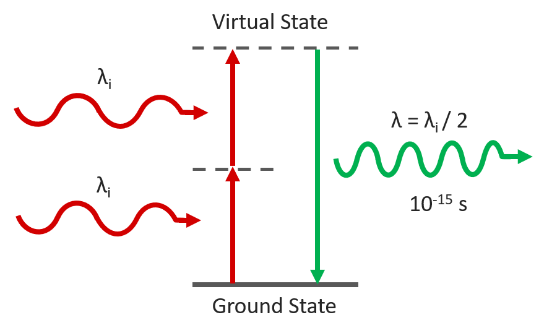
Fig. 1. Second Harmonic Generation (SHG) process
Quantum Dot model
Quantum Dot model
The geometry of semiconductor quantum dots (QDs) plays a crucial role in their optical and electronic properties. Different shapes of QDs allow them to demonstrate unique characteristics that can be utilized in various applications. Here are some of the main geometries of semiconductor QDs:
◼
1. The most common shape, frequently used in research and applications. Spherical QDs have isotropic properties, meaning their optical and electronic characteristics do not vary with direction.
◼
2. Nanorods and Nanowires: These quantum dots have elongated structures, resulting in anisotropic properties. Nanorods (or nanowires) can be useful in lasers and polarized optics due to their directional properties.
◼
3. Nanoplates: These have a plate-like or disc shape and display highly directional optical properties. Nanoplates are used in light emission and energy conversion studies.
◼
4. Quantum Rings: These structures enable control over quantum effects, such as the Aharonov-Bohm effect. Quantum rings have unique optical properties that can be useful in spintronics and quantum information.
◼
5. Heterostructure Quantum Dots: Core-shell structures consist of a quantum dot surrounded by different materials. This helps improve stability and increase quantum emission efficiency.
◼
6. Quantum Wells and Wires: They allow for control over energy levels by confining electron movement in one or two directions. Quantum wells and wires are used in the creation of highly efficient photo-detectors and solar cells.
These different geometries enable quantum dots to exhibit a wide range of properties, which can be tailored for various scientific and technological applications, from displays and LEDs to medical sensors and quantum computing.
QD geometry. In this paper, we focus on spherical QDs and their optical properties.
QD geometry. In this paper, we focus on spherical QDs and their optical properties.
Spherica QD geometry function call has the following form:
In[]:=
ClearAll[sphericalQD];sphericalQD[r_] := Region @ ImplicitRegion[++ <= r, {x, y, z}];
2
x
2
y
2
z
Spherica QD with r = 1:
In[]:=
sphericalQD[1]

Energy Spectrum and Wave Function
Energy Spectrum and Wave Function
Having obtained the geometry of the QD, it is then necessary to calculate the energy and wave functions by solving the Schrödinger equation:

where is particle effective mass in QD, , , , - particle confining potential in QD has the following form
*
m
ℏ is Plank constant
ψ - particle wave function
E - particle energy in QD
U
conf
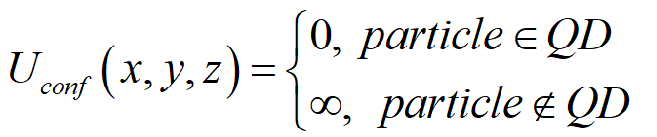
After this we give the numerical values of the constants in the Schrödinger equation (all energy values in eV, all dimension values in nm).
In[]:=
ℏ = 1.05456*; (* Plank constant *) m0 = 9.109*;(* Free electron mass *)μ = 0.023 * m0; (* Electron effective mass in QD *)ev = 1.602*; (* electron-volt *)nm = ; (* nanometr *)
-34
10
-31
10
-19
10
-9
10
Now we can numerically calculate (with FEM) the energy and wave functions of the particle in the studied QD (Dirichlet boundary conditions are used) for radial (x, y) and axial directions
In[]:=
ClearAll[eigensystem];eigensystem[r_, type_] := Quiet IfSameQ[type, "Radial"], Transpose @ NDEigensystem -**(D[ψ[x, y],{x, 2}] + D[ψ[x, y], {y, 2}]), DirichletCondition[ψ[x, y] 0, True], ψ[x, y], x, , , y, , , 5, Method {"PDEDiscretization" {"FiniteElement", {"MeshOptions" {"MaxCellMeasure" 0.1, AccuracyGoal 2}}}, "Eigensystem" {"Arnoldi", "MaxIterations" 10000, "Shift" -3}} , Transpose @ NDEigensystem -**(D[ψ[z],{z, 2}]), DirichletCondition[ψ[z] 0, True], ψ[z], z, , , 5, Method {"PDEDiscretization" {"FiniteElement", {"MeshOptions" {"MaxCellMeasure" 0.1, AccuracyGoal 2}}}, "Eigensystem" {"Arnoldi", "MaxIterations" 10000, "Shift" -3}} ;
1
ev
2
ℏ
2*μ*
2
nm
-r
2
r
2
-r
2
r
2
1
ev
2
ℏ
2*μ*
2
nm
-r
2
r
2
First 5 {energy, wave function} “Axial” pairs for spherical QD with 10 nm radius
In[]:=
eigensystem[10,"Axial"]
Out[]=
0.163513,InterpolatingFunction[z],0.654051,InterpolatingFunction[z],1.47161,InterpolatingFunction[z],2.6162,InterpolatingFunction[z],4.08782,InterpolatingFunction[z]


Harmonic Generations
Harmonic Generations
After receiving the numerical data, we can move on to studying some optical properties of the system. So now we are interested only in the generation of the second harmonics (SHG) for three-levels system (Fig. 2). Based on a number of articles, we can conclude that the second harmonic generation coefficient has the following form and depends only from axial wave function

where, , , , istheelectricconstant, , is matrix elements of transitions, is the energy difference between two transition levels.
ω is the frequency of incident light
e is the electron charge
σ is population of levels
ϵ
0
Γ is system Linewidth
M
ij
E
fi
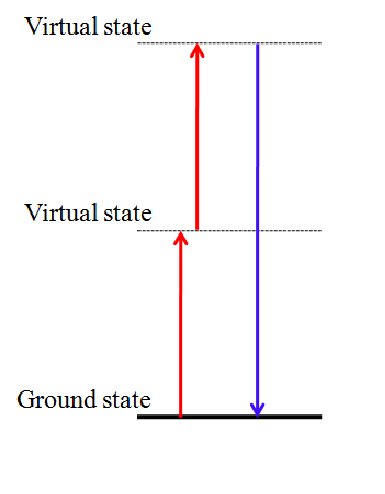
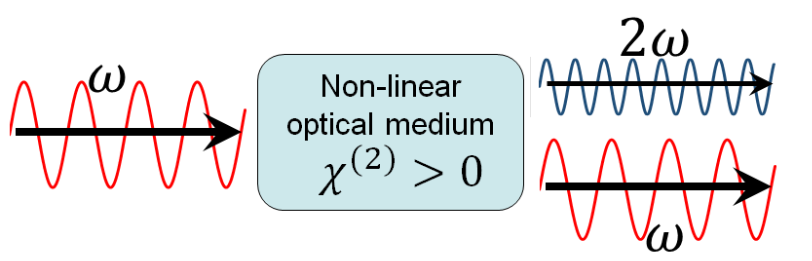
Fig. 2. Energy level scheme of SHG process (left) and harmonics generations (right)
Numerical values of the constants in the equation (all energy values in meV, all dimension values in nm).
Matrix elements calculation for three different transitions based on Monte-Carlo integration method.
SHG coefficient calculation:
CITE THIS NOTEBOOK
CITE THIS NOTEBOOK
Second harmonic generation in quantum dots
by Khachik Khachatryan
Wolfram Community, STAFF PICKS, February 4, 2025
https://community.wolfram.com/groups/-/m/t/3381702
by Khachik Khachatryan
Wolfram Community, STAFF PICKS, February 4, 2025
https://community.wolfram.com/groups/-/m/t/3381702