H1N1 refers to a subtype of the influenza A virus, known to cause respiratory infections in humans and animals . This subtype includes various strains of flu viruses, including seasonal flu strains and those responsible for influenza pandemics . Here are some key points about H1N1 :
Origin and History
Origin and History
◼
The H1N1 subtype has been responsible for several influenza pandemics, with the most notable being the 1918 influenza pandemic, often referred to as the “Spanish flu,” which caused widespread morbidity and mortality worldwide.
◼
Another significant outbreak of H1N1 was the 2009 swine flu pandemic. This particular strain, officially named A(H1N1)pdm09, emerged in Mexico and the United States in early 2009 and quickly spread globally, leading the World Health Organization (WHO) to declare it the first flu pandemic of the 21st century.
Characteristics
Characteristics
◼
Influenza A viruses, including H1N1, are categorized based on two proteins found on the surface of the virus: hemagglutinin (H) and neuraminidase (N). There are multiple subtypes of these proteins, which is why flu viruses are named accordingly (e.g., H1N1).
◼
The virus can mutate rapidly, leading to new strains that may vary in their contagiousness and severity of illness they cause.
Transmission and Symptoms
Transmission and Symptoms
◼
H1N1 is transmitted from person to person through respiratory droplets when an infected person coughs or sneezes. It can also be spread by touching surfaces contaminated with the virus and then touching the mouth or nose.
◼
Symptoms of H1N1 infection are similar to seasonal flu and can include fever, cough, sore throat, body aches, headache, chills, and fatigue. Severe cases can lead to pneumonia, respiratory failure, and can be fatal, especially in high-risk groups such as the elderly, young children, pregnant women, and people with chronic health conditions.
Prevention and Treatment
Prevention and Treatment
◼
Annual vaccination is the most effective way to prevent flu, including strains of H1N1. The flu vaccine is updated yearly to cover the most common circulating strains.
◼
Antiviral medications can be used to treat H1N1 influenza, especially in severe cases or high-risk patients. These drugs are most effective when started within the first 48 hours of symptom onset.
Ro
R
o
The basic reproduction number, , of H1N1 or any infectious disease, represents the average number of people to whom a single infected person will transmit the virus in a fully susceptible population . For H1N1, the
has varied across different outbreaks and studies, reflecting differences in population immunity, virus strain, and public health interventions . During the 2009 H1N1 pandemic, estimates of the
varied widely, with many studies suggesting a range between 1.2 and 1.6, although some estimates placed it slightly higher or lower . This range indicates that each infected person would, on average, infect about 1.2 to 1.6 other people in a population without immunity or interventions in place .
R
o
R
0
R
o
varied widely, with many studies suggesting a range between 1.2 and 1.6, although some estimates placed it slightly higher or lower . This range indicates that each infected person would, on average, infect about 1.2 to 1.6 other people in a population without immunity or interventions in place .
Mortality/Morbidity
Mortality/Morbidity
H1N1 influenza (swine flu) tends to cause high morbidity but low mortality rates (1 % - 4 %) .
Given information :
Given information :
The estimated CFR in the Greek population was 17.5 deaths per 100, 000 symptomatic cases .
To calculate the Case Fatality Rate (CFR) with specific numbers, let' s assume you are given :
◼
Number of deaths from H1N1 : 175
◼
Number of confirmed symptomatic cases of H1N1 : 100, 000
Using the formula : Plugging in the numbers : %
CFR100
Number of deaths from the disease
Number of confirmed symptomatic cases of the disease
CFR1000.0175
175
100,000
The mean duration of symptoms for H1N1 influenza, based on historical data and clinical observations, typically ranges from about one week to two weeks for most individuals .
The rate of recovery (γ) can be calculated using the formula :
γ=
1-CFR
D
In[]:=
CFR=0.0175/100
Out[]=
0.000175
Mean duration of symptoms
In[]:=
d=7;
In[]:=
γ1=(1-CFR)/d
Out[]=
0.142832
Simple SIR Model
Simple SIR Model
In[]:=
Clear["Global`*"]
In[]:=
betaSoln=First@Solve,β
ℜ
0
β
γ
Out[]=
{βγ}
ℜ
0
In[]:=
params=<|->1.6,β->β,γ->0.142832,->10334095,I0->1|>/.betaSoln
ℜ
0
Out[]=
1.6,βγ,γ0.142832,10334095,I01
ℜ
0
ℜ
0
In[]:=
paramsN=Normal@(params//.params)
Out[]=
{1.6,β0.228531,γ0.142832,10334095,I01}
ℜ
0
Infection Rate
β=0.228531;
Recovery rate
γ=0.142832;
In[]:=
n=10334095;
FoI
λ[t_]=βi[t]/n;
In[]:=
tmax=300;
In[]:=
sireqns={s'[t]==-λ[t]*s[t],i'[t]==λ[t]*s[t]-γ*i[t],r'[t]==γ*i[t],s[0]==n-20,i[0]==20,r[0]==0};[t]+ℐ[t]+R[t]n;
Solve the system
sol1=NDSolve[sireqns,{s,i,r},{t,0,tmax}];(*Plotthesolutions*)fig1=Plot[Evaluate[{s[t],i[t],r[t]}/.sol1],{t,0,tmax},PlotLegends->{"Susceptible","Infected","Recovered"},AxesLabel->{"Time","Population"},AxesLabel->{"Time","Population"},PlotStyle->{Blue,Red,Green}]
Out[]=
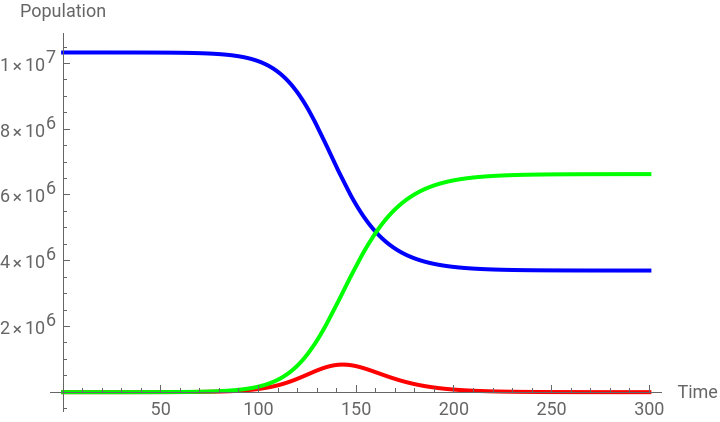


SIR Model with Death and Births
SIR Model with Death and Births
Letthebirthratebe,,anddeathrate.consequently,
b>0
μ>0
bμ
Let the new born babies are quite healthy but susceptible .
In[]:=
Clear["Global`*"]
In[]:=
betaSoln=First@Solve,β
ℜ
0
β
γ+μ
Out[]=
{β(γ+μ)}
ℜ
0
In[]:=
params=<|1.6,ββ,γ0.142832,μ->0.04,10334095,I01|>/.betaSoln
ℜ
0
Out[]=
1.6,β(γ+μ),γ0.142832,μ0.04,10334095,I01
ℜ
0
ℜ
0
In[]:=
paramsN=Normal@(params//.params)
Out[]=
{1.6,β0.292531,γ0.142832,μ0.04,10334095,I01}
ℜ
0
Infection Rate
β=0.292531;
Recovery rate
γ=0.142832;
Death rate
μ=0.04;
In[]:=
n=10334095;
FoI
λ[t_]=βi[t]/n;
In[]:=
tmax=300;
In[]:=
b=μ;
In[]:=
sireqns2={s'[t]==-λ[t]*s[t]-μ*s[t]+b*n,i'[t]==λ[t]*s[t]-γ*i[t]-μ*i[t],r'[t]==γ*i[t]-μ*r[t],s[0]==n-1,i[0]==1,r[0]==0};
Solve the system
sol2=NDSolve[sireqns2,{s,i,r,d},{t,0,tmax},MaxStepSize->0.1];(*Plotthesolutions*)fig2=Plot[Evaluate[{s[t],i[t],r[t],d[t]}/.sol2],{t,0,tmax},PlotLegends->{"Susceptible","Infected","Recovered","Dead"},AxesLabel->{"Time","Population"},AxesLabel->{"Time","Population"},PlotStyle->{Blue,Red,Green,Black},PlotRange->All]
Out[]=
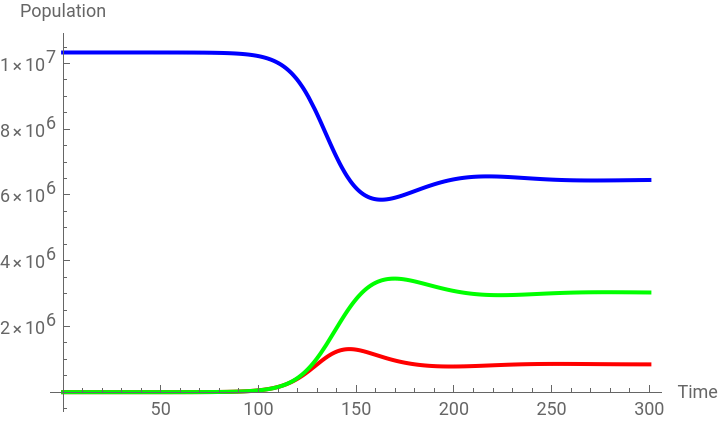

Treatment
Treatment
The initial and best step in management should be to prevent swine flu . Specifically, with the prevention of swine flu in swine, prevention of transmission of swine flu from swine - to - humans, and prevention of human - to - human spread .
◼
Antiviral Medications: These are the cornerstone of specific treatment for H1N1 influenza. Antiviral drugs such as oseltamivir (Tamiflu), zanamivir (Relenza), and sometimes peramivir (Rapivab) can be effective if started within the first 48 hours after symptom onset. They can reduce the severity and duration of symptoms, and are particularly recommended for hospitalized patients, those at high risk of flu-related complications, and in some cases, as prophylaxis to prevent illness in people exposed to the virus.
◼
Preventive Measures: In addition to treating the symptoms and using antiviral medications, preventive measures play a crucial role in managing H1N1 influenza. This includes:
◼
Vaccination: The seasonal flu vaccine often includes protection against the H1N1 virus and is the best way to prevent the illness.
◼
Practicing good hygiene: Regular handwashing, using alcohol-based hand sanitizers, avoiding close contact with sick individuals, and covering the mouth and nose with a tissue or the elbow when coughing or sneezing can help prevent the spread of the virus.
◼
Hospitalization: In severe cases, especially among high-risk individuals, hospitalization may be necessary. Treatment in a hospital might include antiviral therapy, intravenous fluids, and respiratory support, such as supplemental oxygen or mechanical ventilation, for patients with severe respiratory distress.
Vaccination
Vaccination
Direct Immunity with vaccination
Direct Immunity with vaccination
Infection Rate
Recovery rate
Death rate
FoI
Vaccination coverage
Days
Solve the system
A separate compartment for vaccination
A separate compartment for vaccination
Define the system of differential equations
Solve the system
Leaky vaccine with coverage of 60 %
Leaky vaccine with coverage of 60 %
Infection Rate
Recovery rate
FoI
Vaccination coverage
The reduction in the force of infection
Days
Define the system of differential equations
Solve the system
As we can see, a 60 % coverage is not sufficient to prevent an epidemic if the vaccine is not perfectly effective .
Leaky vaccine with coverage up to 70 %
Leaky vaccine with coverage up to 70 %
Infection Rate
Recovery rate
FoI
Vaccination coverage
The reduction in the force of infection
Days
Define the system of differential equations
Solve the system
References
References
1
.H1N1 Influenza A infection https://www.ncbi.nlm.nih.gov/pmc/articles/PMC2765289/
2
.Estimation of the reproduction number of influenza A(H1N1)pdm09 in South Korea using heterogeneous models https://bmcinfectdis.biomedcentral.com/articles/10.1186/s12879-021-06121-8
3
.H1N1 Influenza (Swine Flu) https://emedicine.medscape.com/article/1807048-overview?form=fpf#showall
4
.Estimating the Disease Burden of 2009 Pandemic Influenza A(H1N1) from Surveillance and Household Surveys in Greece https://www.ncbi.nlm.nih.gov/pmc/articles/PMC3111416/#pone.0020593-Pebody1
6
.Tolerability of 2 doses of pandemic influenza vaccine (Focetria®) and of a prior dose of seasonal 2009-2010 influenza vaccination in the Netherlands https://www.ncbi.nlm.nih.gov/pmc/articles/PMC4962940/
7
.H1N1 Influenza (Swine Flu) Treatment & Management https://emedicine.medscape.com/article/1807048-treatment?form=fpf
8
.Πόσο αποτελεσματικό είναι το φετινό αντιγριπικό εμβόλιο; https://www.onmed.gr/ygeia-eidhseis/story/374073/poso-apotelesmatiko-einai-to-fetino-antigripiko-emvolio
CITE THIS NOTEBOOK
CITE THIS NOTEBOOK
An Analysis of H1N1 Influenza
by Athanasios Paraskevopoulos
Wolfram Community, STAFF PICKS, February 3, 2024
https://community.wolfram.com/groups/-/m/t/3115319
by Athanasios Paraskevopoulos
Wolfram Community, STAFF PICKS, February 3, 2024
https://community.wolfram.com/groups/-/m/t/3115319