Gauge multiplets to lightcone strings
Sourav Raha
University of Florida
Sourav Raha
University of Florida
Abstract: In this project, we use hypergraphs to represent the color lines of a quantum system that has adjoint matter. We derive the replacement rules corresponding to the action of a quartic Hamiltonian. We discuss the supersymmetric extension of this formalism and how it is related to lightcone quantized strings.
Introduction
Introduction
The simplest non-trivial operation in quantum mechanics is the commutator: It is the cornerstone of Heisenberg’s uncertainty principle. It also comes in handy for constructing the eigenvalues of the quantum harmonic oscillator where the ladder operators satisfyIn the operator formalism, the matrix elements of any quantum operator can be written as If the ground state is normalized, computing such elements is equivalent to repeated applications of the commutator relation of the ladder operators. This can push all the annihilation operators to the right of all the creation operators. This is referred to as normal ordering in literature.
-
A
B
B
A
[a,]1
a
<0|…aa……aa……|0>
a
a
a
a
Normal ordering
Normal ordering
We might use string substitution systems to implement normal ordering. For example, we show how a an expression like
can be normal ordered
aaaa
a
a
a
a
can be normal ordered
Out[]=
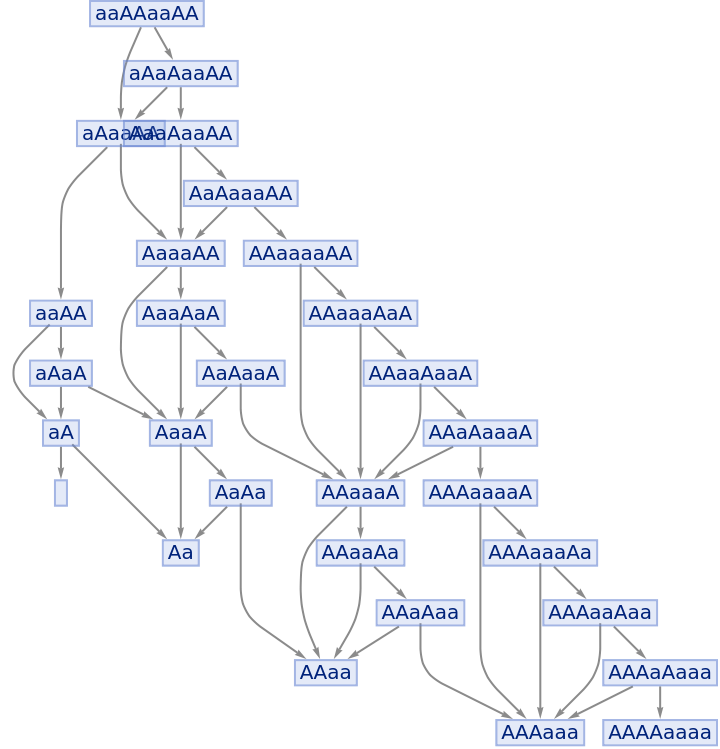
One can see that the normal ordering produces 4 distinct terms in the end: including an empty (vacuum) state. One question could be: how to obtain operator subsequences that simplify to the vacuum? The following multiway system shows how this can be achieved:
In[]:=
Out[]=
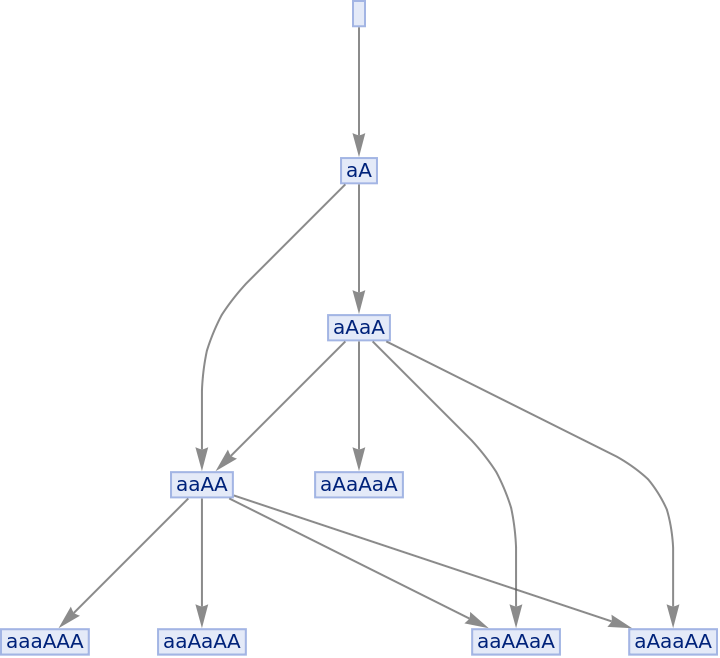
The leftmost sequences would correspond to the norms of the oscillator eigenstates.
StringJoin@@@Tuples[{"A","B"},2]ToLowerCase/@%Outer[StringJoin,%,%%]
Out[]=
{AA,AB,BA,BB}
Out[]=
{aa,ab,ba,bb}
Out[]=
{{aaAA,aaAB,aaBA,aaBB},{abAA,abAB,abBA,abBB},{baAA,baAB,baBA,baBB},{bbAA,bbAB,bbBA,bbBB}}
Adjoint multiplets
Adjoint multiplets
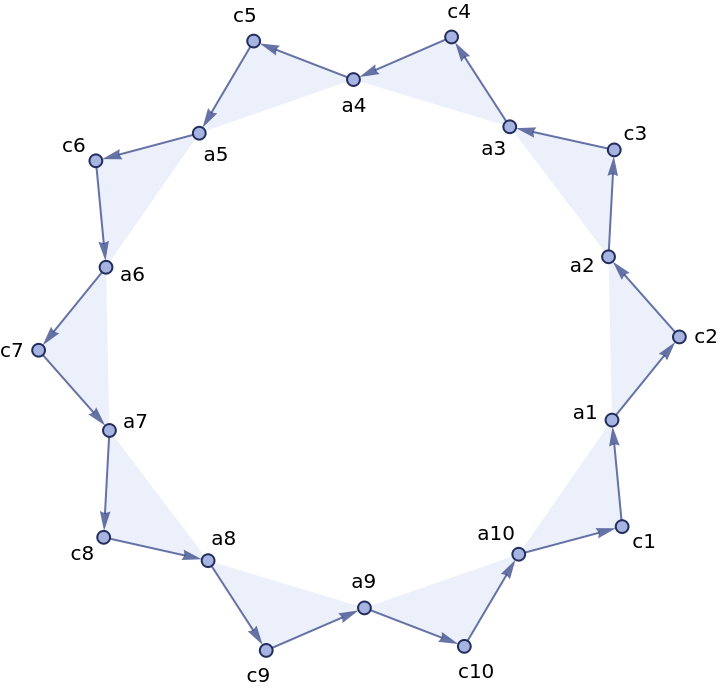
However, one could ask: how to deal with situations where the particle is a multiplet of some internal degree of freedom? String substitution systems do not have the power to capture such extra degrees of freedom. For example, we might have adjoint multiplets where are ‘color’ indices and take values from . In that case, we leverage the power of hypergraphs. The hypergraphs represent the state of a system, with each expression representing a color line and the atoms representing the operators that share a particular color index (i.e. the color index is contracted between the two operators). Here we represent an initial state that represents a single trace state of particles
,
μ
a
ν
ρ
a
σ
μ
δ
σ
ρ
δ
ν
μ,ν
1…N
10
tr|0>
10
a
In[]:=
<<SetReplace`
ToExpression["A"<>ToString[#]]&/@Range[10];ToExpression["c"<>ToString[#]]&/@Range[10];init=Join[{RotateRight[%%]},{%},{%%}]//TransposeHypergraphPlot[init,VertexLabelsAutomatic]
Out[]=
{{a10,c1,a1},{a1,c2,a2},{a2,c3,a3},{a3,c4,a4},{a4,c5,a5},{a5,c6,a6},{a6,c7,a7},{a7,c8,a8},{a8,c9,a9},{a9,c10,a10}}
Out[]=
The simplest non-trivial Hamiltonian is the one with a quartic interaction:
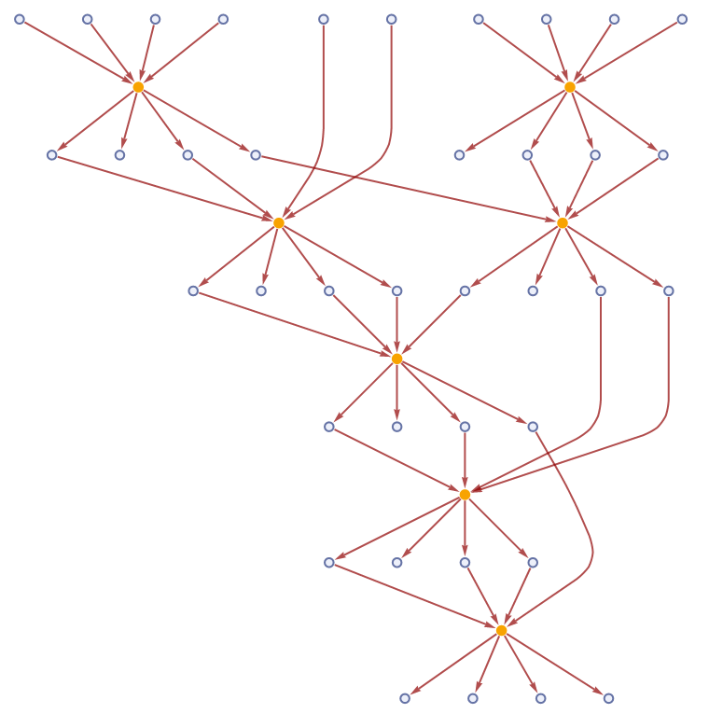
This term annihilates two quanta followed by creation of two quanta. The application of this Hamiltonian does not change the total number of particles. All it does is to identify certain color indices. Its action has been implemented using the following set of rules:
traa
a
a
This term annihilates two quanta followed by creation of two quanta. The application of this Hamiltonian does not change the total number of particles. All it does is to identify certain color indices. Its action has been implemented using the following set of rules:
In[]:=
evo=ResourceFunction["WolframModel"][<|"PatternRules"{{{c1__,a1_},{a1_,c2__},{c3__,a2_},{a2_,c4__}}Module[{w,b1,no,b2,ea,s},{{c1,a1,w,b1},{c3,a2,s,a1,c2},{b1,no,b2},{b2,ea,a2,c4}}](*,{{c1__,a1_},{a1_,c2__},{c3__,a2_},{a2_,c4__}}Module[{s,b1,b2,ea,w,no},{{c1,a1,s,a2,c4},{b2,ea,a1,c2},{c3,a2,w,b1},{b1,no,b2}}]*)}|>,init,50]evo["ExpressionsEventsGraph"]evo["EventsStatesPlotsList"]
Out[]=
WolframModelEvolutionObject


Out[]=
Connection to string bits
Connection to string bits
Future prospects
Future prospects
1
.Extend the amplitude calculation developed here to include fermionic excitations. This would require dealing with Grassmann numbers and their anti-commuting properties.
Keywords
Keywords
◼
String bits
Acknowledgment
Acknowledgment
Mentor: Tobias Canavesi
References
References
◼
Bergman, O., & Thorn, C. B. (January 01, 1995). String bit models for superstring. Physical Review. D, Particles and Fields, 52, 10, 5980.
https://journals.aps.org/prd/abstract/10.1103/PhysRevD.52.5980
https://journals.aps.org/prd/abstract/10.1103/PhysRevD.52.5980