The latest update of the Dietary Guidelines for Americans (DGA), published by the U.S. Department of Health and Human Services (HHS) and U.S. Department of Agriculture (USDA), has prompted questions and debates, particularly on the subject of fats.
Like previous DGA reports, the 2026 report advises that no more than 10% of total calories come from saturated fat. So what’s different this time? The new guidelines are more permissive about butter, full-fat dairy (such as whole milk), red meat and beef tallow in our diets. There is less emphasis on polyunsaturated fats from plant-based foods and fatty fish.
It seems a good time to step back and look at the science of fat.
Of the macro-nutrients in our foods—fat, protein and carbohydrates—fat is the highest source of calories, at 9 calories per gram. With such a high caloric price tag, why include fat in our diet at all?
Fat provides our energy, protects our organs, supports cell growth, controls cholesterol and blood pressure, and helps our bodies absorb important nutrients, according to research scientists at the Department of Nutrition at Harvard's T.H. Chan School of Public Health.
Fatty acids molecular structure
Fatty acids molecular structure
Structurally, fatty acids are long hydrocarbon chains with a carboxylic acid at one end. Monounsaturated fatty acids (MUFAs) have one carbon-carbon double bond. Saturated fatty acids have no carbon-carbon double bonds because the molecules are fully saturated with hydrogen atoms.
Oleic acid and and palmitic acid are good examples. Oleic acid is monounsaturated (one double bond), and palmitic acid is saturated (no double bonds). Oleic acid is abundant in olive oil and canola oil, while palmitic acid is found in animal fats and palm oil.
In[]:=
MoleculePlot/@,
Out[]=
,
Polyunsaturated fatty acids (PUFAs) have two or more carbon-carbon double bonds. Depending upon their molecular structure, some PUFAs can be omega-3 fatty acids or omega-6 fatty acids.
Found in plant-based oils, linoleic acid is an omega-6 fatty acid, with its first double bond located six carbons from the methyl end of the chain (–). Alpha-linolenic acid (ALA) is an omega-3 fatty acid, with its first double bond three carbons from the methyl end. Foods high in ALA include walnuts, flax seeds and certain plant-based oils.
CH
3
In[]:=
MoleculePlot/@,
Out[]=
,
Use ChemicalData to examine the molecular structure of several fatty acids in our diets, arranged according to their melting point:
In[]:=
fattyAcids={"StearicAcid","PalmiticAcid","MyristicAcid","DodecanoicAcid","OleicAcid","PalmitoleicAcid","LinoleicAcid","AlphaLinolenicAcid","DocosahexaenoicAcid","EicosapentaenoicAcid"};getCarbons[fa_]:="C"/.Rule@@@ChemicalData[fa,"ElementTally"];getHydrogens[fa_]:="H"/.Rule@@@ChemicalData[fa,"ElementTally"];getCCDoubleBonds[fa_]:=(getCarbons[fa]*2+2-getHydrogens[fa])/2-1;getMeltingPoint[fa_]:=ChemicalData[fa,"MeltingPoint"];faNames=AssociationThread[fattyAcids,ChemicalData[#,"Name"]&/@fattyAcids];faCarbons=AssociationThread[fattyAcids,getCarbons/@fattyAcids];faDBonds=AssociationThread[fattyAcids,getCCDoubleBonds/@fattyAcids];faMPs=AssociationThread[fattyAcids,getMeltingPoint/@fattyAcids];{mpMin,mpMax}=MinMax[Values[faMPs]];mpColor[mp_]:=ColorData["TemperatureMap"][(mp-mpMin)/(mpMax-mpMin)];panels=Table;titledPanels=Append;GraphicsGrid
Out[]=
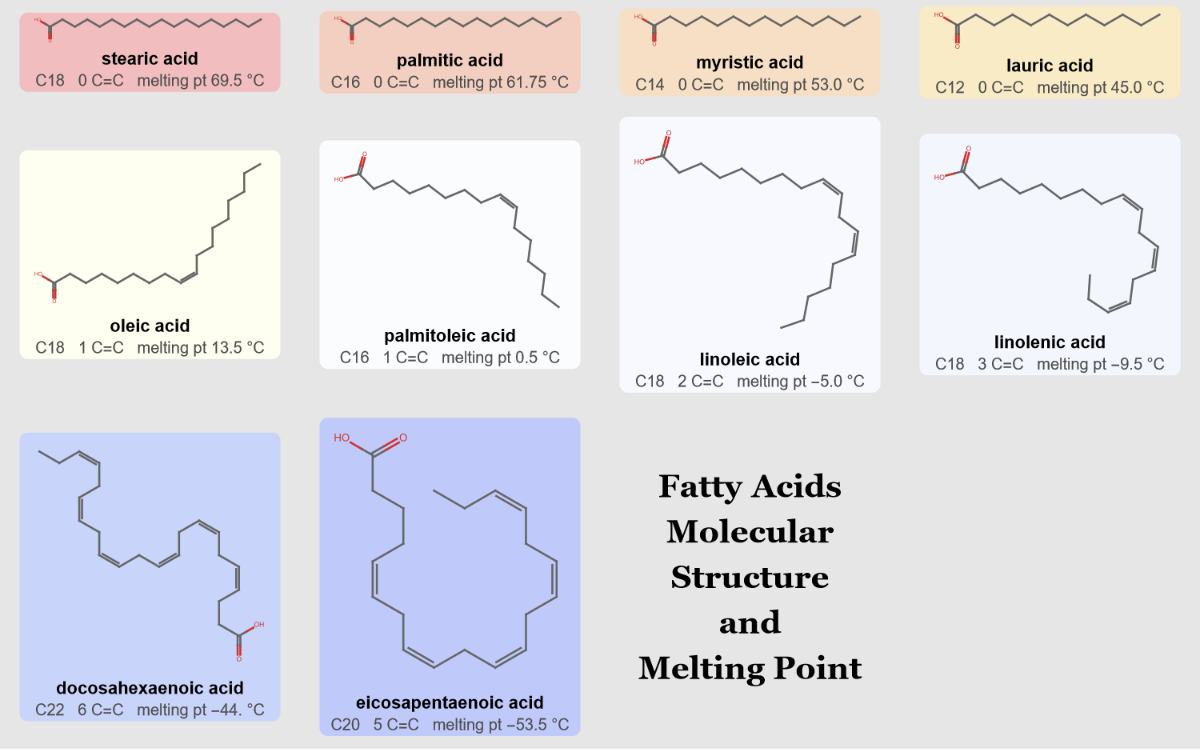
Docosahexaenoic acid (DHA) and eicosapentaenoic acid (EPA) are omega-3 long-chain PUFAs, known to reduce the risk of cardiovascular disease. Fatty fish such as salmon, mackerel and sardines are good dietary sources. In early life, human milk or fortified infant formula are important sources of DHA because of DHA’s critical role in healthy brain and eye development.
Making a triglyceride
Making a triglyceride
Glycerol is a sugar alcohol found in fats and oils:
In[]:=
ResourceFunction["MoleculeView"]
Out[]=
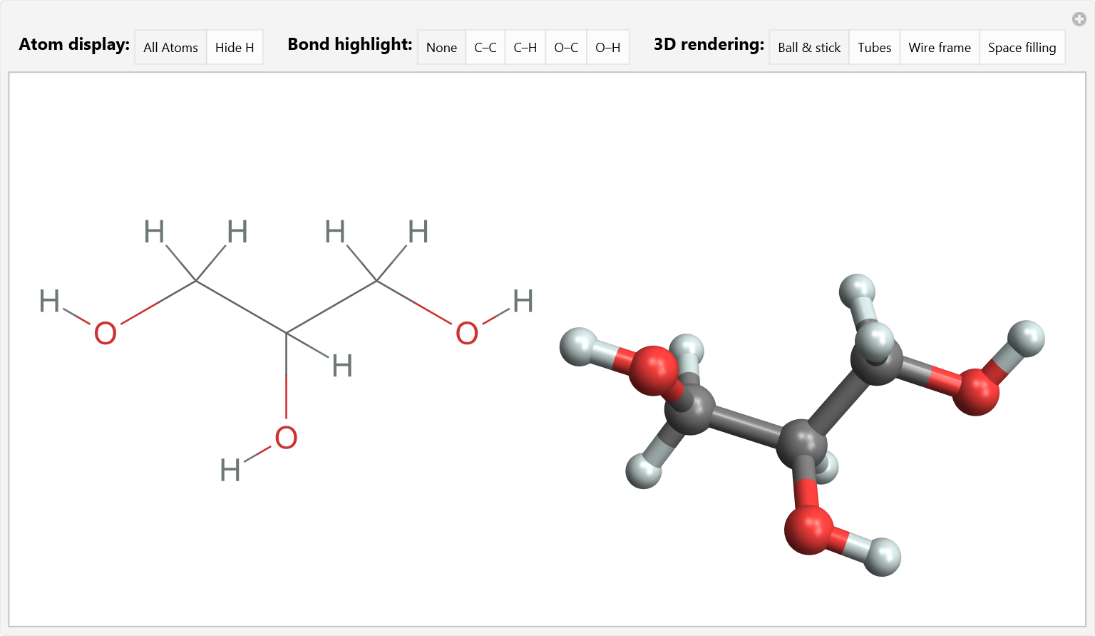
A fatty acid can bond to a hydroxyl group on the glycerol molecule to form an ester. Because glycerol has three hydroxyl groups available, it can bond with three fatty acids to form a triglyceride. Glycerol is considered the “backbone” of the triglyceride.
By forming ester bonds between glycerol and three oleic acid molecules, we get the triglyceride triolein, which is prevalent in monounsaturated fats like olive oil:
In[]:=
MoleculePlot,ImageSize->300
Out[]=
When glycerol forms ester bonds with three palmitic acid molecules, it produces the triglyceride tripalmitin, found in saturated fats like palm oil and lard:
In[]:=
MoleculePlot,ImageSize->300
Out[]=
Compare the phases and melting points of these two forms of triglyceride:
In[]:=
DatasetEntityValue,,{"Phase","MeltingPoint"},"EntityPropertyAssociation"
Out[]=

FattyAcidsExplorer
FattyAcidsExplorer
Use the FattyAcidsExplorer resource function to interactively explore the fatty acid composition of cooking fats and oils:
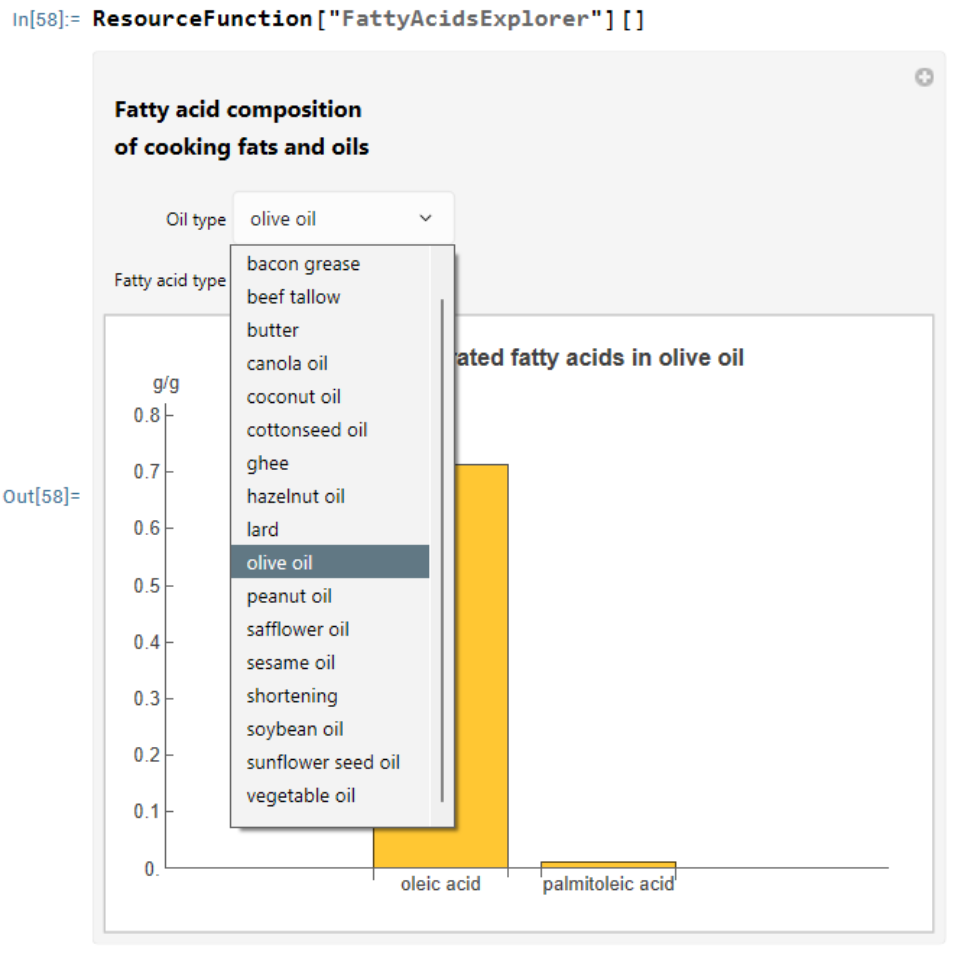
Dataset is a quick way to see which fatty acids are MUFAs, PUFAs and saturated:
By making direct comparisons between monounsaturated and saturated fats, such as canola oil versus butter, you can make informed cooking choices:
Tabular analysis
Tabular analysis
Plotting the tabular data reveals a surprising result: hazelnut oil ranks highest in heart-healthy oleic acid, with the popular favorite olive oil a close second:
Bacon grease, lard, beef tallow and ghee lead the list in saturated palmitic acid per gram:
Statistical correlation
Statistical correlation
ListFitPlot shows the slight negative correlation between monounsaturated oleic acid and polyunsaturated linoleic acid in fats and oils—as oleic acid increases, linoleic acid tends to decrease, and vice versa:
Fatty acids and smoke point
Fatty acids and smoke point
Fatty acids influence the smoke point of a fat or oil during cooking. Smoke point is the temperature at which an overheated fat or oil begins to visibly smoke. It’s determined mostly by the amount of free fatty acids (FFAs) the fat or oil contains. Plant-based oils generally have fewer FFAs than animal fats.
Use "Smoke Point" in the Wolfram Data Repository to plot the smoke point values for all fats and oils in the data:
Fats and oils with lower smoke points, such as butter, sesame oil and extra virgin olive oil, can burn more quickly. They are best suited for low–medium heat cooking and dressings. Fats and oils with higher smoke points, generally 400°F or greater, can tolerate high heat and are appropriate for searing and frying.
Back to the question
Back to the question
For me, it’s a daily balancing act between nutrition and flavor. I sauté with canola oil, drizzle olive oil over pastas, and scramble eggs with butter. Although not always successful, I aim for a reasonable mix of fatty acids in my diet.
To answer my own question: Yes, fat is a friend. And like our friends, some fats in our food are loud and bold, others are subtle and smooth, but we love them all.
CITE THIS NOTEBOOK
CITE THIS NOTEBOOK
Fat in our food: friend or foe?
by Gay Wilson
Wolfram Community, STAFF PICKS, May 27, 2026
https://community.wolfram.com/groups/-/m/t/3723011
by Gay Wilson
Wolfram Community, STAFF PICKS, May 27, 2026
https://community.wolfram.com/groups/-/m/t/3723011