Epidemiological Model for repetitive rapid testing for COVID19
Diego Zviovich
September 13, 2020
September 13, 2020
Introduction
Introduction
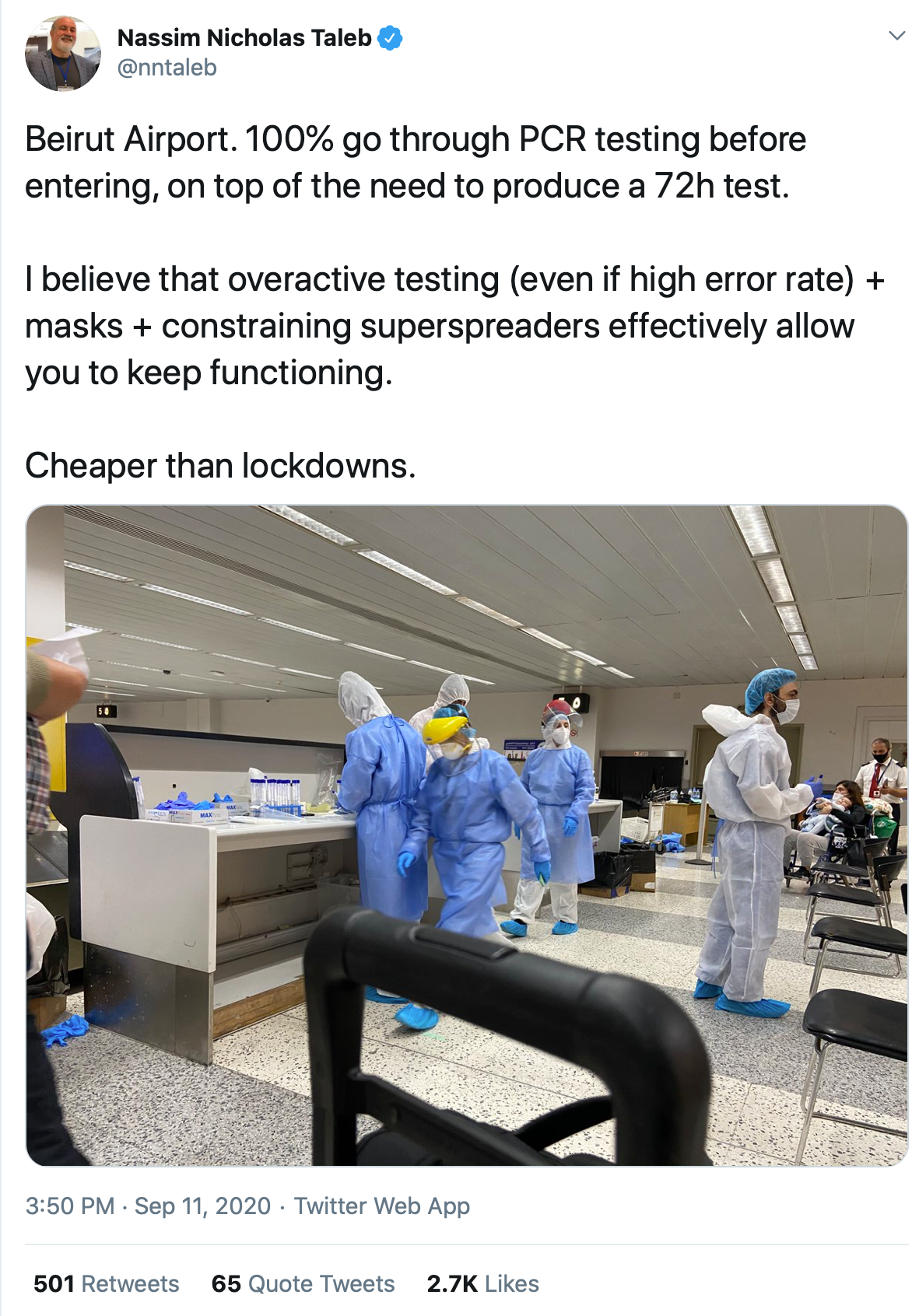
Nassim Nicholas Taleb posted a very interesting tweet a couple of days ago.Given that rapid inexpensive tests, like , which is estimated to cost 5 USD/EA, will be available soon, it is important to explore the ramification of overactive testing as an alternative to stringent lock-downs, as observed in countries like Argentina, or in several states across the US.
Types of tests available
Types of tests available
Real-Time Reverse Transcriptase (RT)–PCR Test
Real-Time Reverse Transcriptase (RT)–PCR Test
The RT-PCR test detects the SARS-CoV-2 virus in upper and lower respiratory specimens. Tests results take approximately 3-5 days to be reported back to the patients.
Searching for information on the type I error (false positive), the median error reported between 2.3% and 5%.
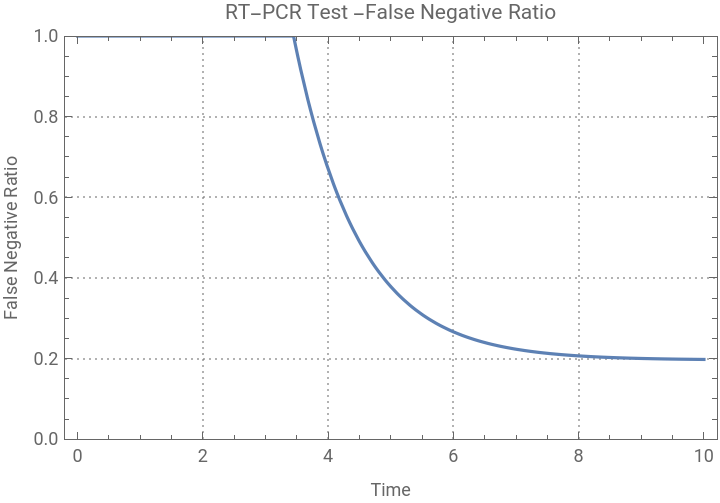
Regarding type II error (false negative), the literature reports a 67% median 4 days after the infection, 38% false positive at the beginning of the symptoms with the low 20% reached 3 days after the onset (~ 8 days after the onset of symptoms).
I was unable to find any information of either false negatives on asymptomatic patients.
In[]:=
solFit=FindFit[{{4,0.67},{5,0.38},{8,0.2},{10,0.2},{20,.2}},dExp[-a(t-b)]+c,{a,b,c,d},t]
Out[]=
{a0.956174,b1.68847,c0.196381,d4.32205}
In[]:=
f[t_]:=Evaluate[dExp[-a(t-b)]+c/.solFit]
In[]:=
Plot[dExp[-a(t-b)]+c/.solFit,{t,2,10},PlotRange{0,1}]
Out[]=
In[]:=
Clear@g
In[]:=
g[t_]:=dExp[-a(t-b)]+c/.solFit
In[]:=
cut=t/.First@NSolve[g[t]1.,t,Reals]
Out[]=
3.44794
We’ll calculate the false negative probability for the slow test with the function
fs.
fs.
In[]:=
fns[t_]:=Piecewise[{{1.,t≤cut},{g[t],t>cut}}]
In[]:=
Plot[fns[t],{t,0,10},PlotRange{0,1},PlotLabel"RT-PCR Test -False Negative Ratio",PlotTheme"Detailed",FrameLabel{"Time","False Negative Ratio"}]
Out[]=

Rapid test via Antigen qualitative detection device
Rapid test via Antigen qualitative detection device
On August 26th, the US FDA issues and Emergency Use Authorization for a $5, 15 minute, Covid-19 antigen test, that requires no instrumentation, with demonstrated sensitivity of 97.1% and specificity of 98.5% in clinical study. Paired with a no-charge complementary phone app, which allows people to display their BinaxNOW test results when asked by organizations where people gather, such as workplaces and schools.
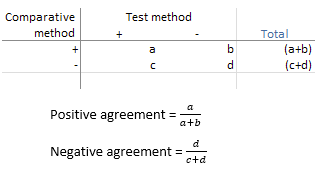
In the literature, sensitivity is also referred as positive agreement while specificity is known as negative agreement.
This will allow us to calculate the false negative error in the rapid test.
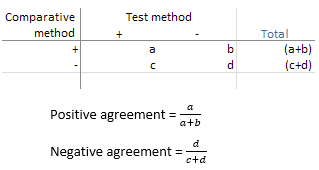
In the literature, sensitivity is also referred as positive agreement while specificity is known as negative agreement.
This will allow us to calculate the false negative error in the rapid test.
In[]:=
Out[]=
The false negative for the quick test will be defined by the function fq.
In[]:=
fnq[t_,sensitivity_:0.971]:=(1-fns[t])(1-sensitivity)+fns[t]
In[]:=
Plot[{fns[t],fnq[t]},{t,0,10},PlotRange{0,1},PlotLabel"False vs Slow -False Negative Ratio",PlotTheme"Detailed",FrameLabel{"Time","False Negative Ratio"}]
Out[]=
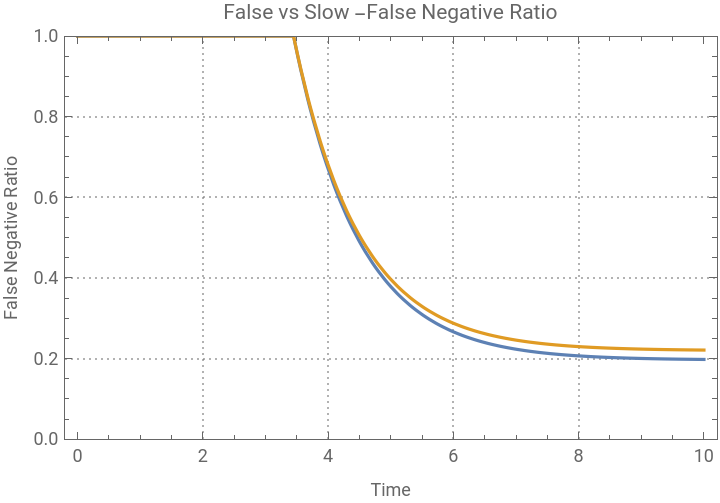

False positive for the RT-PCR test is estimated to be 7.3%. Given that the specificity is 98.5%
Modeling the different scenarios with Agent Based Modelling
Modeling the different scenarios with Agent Based Modelling
Model Description
Model Description
The availability of a rapid test that can be performed by any individual without the intervention of a health worker opens the possibility to allow for events or locations where people gather. By performing the test, and certifying through a mobile application that the user has no detectable antigens, the person might then be allow to engage with others in a close space event.
The scenario described above would require the following protocol:
The scenario described above would require the following protocol:
◼
An individual would submit to a rapid test to determine the presence of antigens on a periodic basis.
◼
In the case that the test returns a positive result, the individual would move to isolation and will perform a detailed RT-PCR slow test to determine if the individual remains infectious or not (the rapid tests shows only if the person was exposed to the virus).
◼
People fully recovered will not need to be submitted for further testing
◼
It is expected that a certain ratio of individuals will break the protocol outlined above: we can expect individuals tat will avoid being tested. Also, a proportion of individuals will break the quarantine.
Compartmental Model
Compartmental Model
Parameters
Parameters
Functions
Functions
Algorithm Description
Algorithm Description
◼
Identify infected cells
◼
Identify susceptible neighbors
◼
Determine if contagion succeeds.
◼
Perform rapid tests > Change agent status
◼
Perform slow tests > Change agent status.
◼
Determine if still infected.
Experiments
Experiments
Experiment 1 - No rapid test availability
Experiment 1 - No rapid test availability
No rapid tests available, 20% asymptomatic get tested with RT-PCR, 80% of the symptomatic, 75% respect quarantine.
The chart below shows the state of each agent (represented by a column) through time (represented by each row). We can observe a significant proportion of the population getting infected.
Tests performed were RT-PCR only.
Results
Results
Without rapid testing, tests are limited to people that have developed symptoms, and expanded to family members or other people with whom they might have been in contact with. This limited testing is not enough to eliminate the transmission within the population. Thus it requires societies to perform certain amount of lockdown or other restrictions to limit super-spreader events.
Experiment 2
Experiment 2
In this case,the whole population is tested with the rapid test. We assume in this experiment that only 65% comply with the testing protocol, 35% of the population either refuse or avoid getting the rapid testing.
As in the previous experiment, the quarantine is not fully complied with. We have used a quarantine compliance rate of 75%.
As in the previous experiment, the quarantine is not fully complied with. We have used a quarantine compliance rate of 75%.
Epidemic is considered to have ended after 14 days without infected people.
Approximately 25-30% of the population will remain (or obey) the quarantine at a given time.
The majority of the quarantined agents are driven by the false positive rate results of the tests.
Results
Results
Rapid, overactive testing + quarantine followed by individual that tested positive could allow to prevent the virus to continue to expand through the population while reducing the impact on the economy by quarantining those that have tested positive.
Conclusion
Conclusion
Nassim’s intuition of overactive testing that would be enabled by cheap fast and easy to administer rapid tests, seems to be a robust alternative to the current protocols being followed by the different public health officials at the county, state and country levels.
Initialization
Initialization
References
References