Woods-Saxon and Square-Well Potentials for Nuclear Shell Model
Woods-Saxon and Square-Well Potentials for Nuclear Shell Model


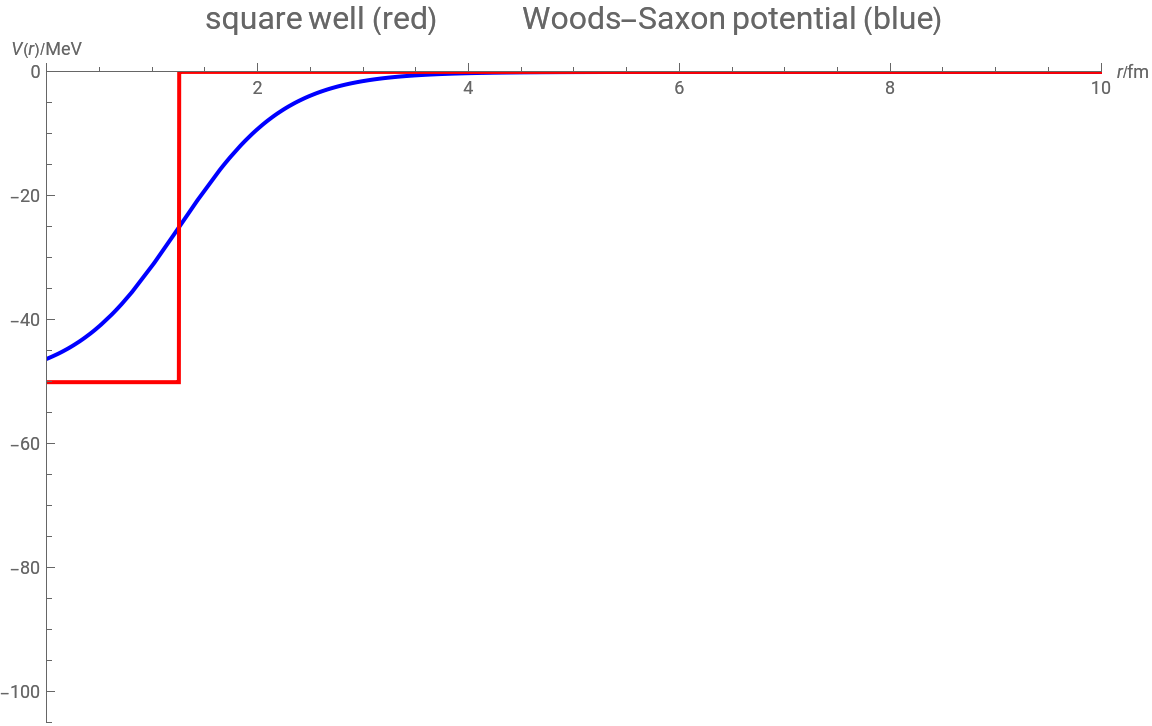
The shell model is extensively used in nuclear physics to describe the properties of nuclei. According to this model, a given nucleon moves in an effective attractive potential produced by all other nucleons. Several models of potentials have been proposed to explain experimental data and modified to improve agreement between theory and experiment. In this Demonstration, we consider the square-well potential and Woods–Saxon potential.
The square-well potential is defined by for and for , where is the radius of the well.
V(r)=-
V
0
r<
R
0
V(r)=0
r>
R
0
R
0
The Woods–Saxon potential is given by , where:
V(r)=-(1+)
V
0
(r-R)/a
e
V
0
a
r
A
R
R=
r
0
1/3
A
r
0
This Demonstration shows the dependence of these potentials on atomic mass, potential well depth, and thickness. The square-well potential graph is colored red and the Woods–Saxon potential graph is colored blue.
Either of these potentials can be used in the Schrödinger equation for the nucleons to predict the distribution of nuclear energy levels. The most striking result is the appearance of magic numbers that enumerate the most stable shells of protons and neutrons.
References
References
[2] C. R. Nave. "Hyperphysics: Shell Model of Nucleus." (Sep 18, 2015) hyperphysics.phy-astr.gsu.edu/hbase/nuclear/shell.html#c1.
Permanent Citation
Permanent Citation
Milos Adamovic
"Woods-Saxon and Square-Well Potentials for Nuclear Shell Model"
http://demonstrations.wolfram.com/WoodsSaxonAndSquareWellPotentialsForNuclearShellModel/
Wolfram Demonstrations Project
Published: September 29, 2015