What happens when an observer, like Wigner’s friend, measures a system using her measurement device?
PacletInstall["Wolfram/QuantumFramework"]Needs["Wolfram`QuantumFramework`"]
In[]:=
QuantumCircuitOperator[{"M"->"Wigner's friend's\nmeasurement device"}]"Diagram",
Out[]=
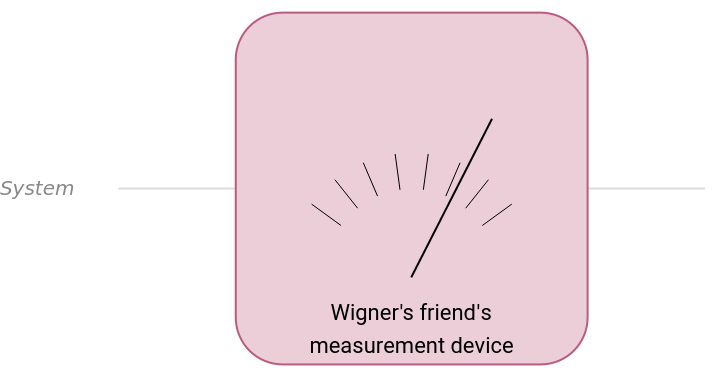
And then what happens when Wigner himself performs a measurement of the system himself or asks his friend about her outcome:
In[]:=
QuantumCircuitOperator[{"M"->"Wigner's friend's\nmeasurement device","M"->"Wigner's\nmeasurement device"}]"Diagram",
Out[]=
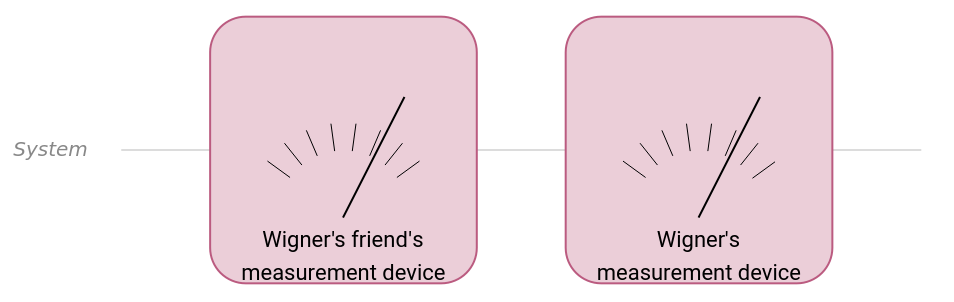
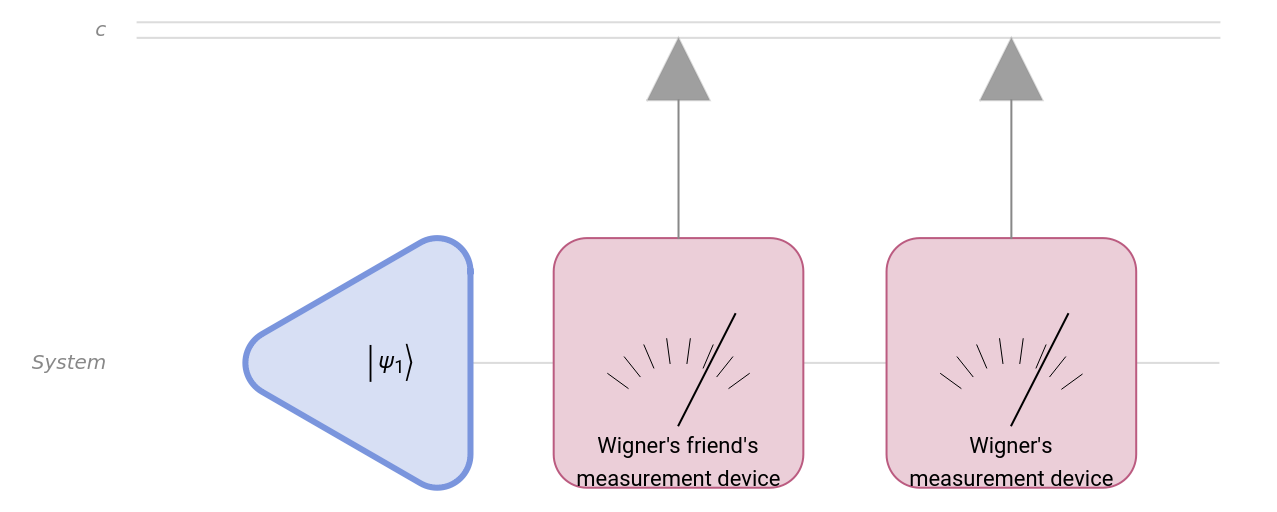
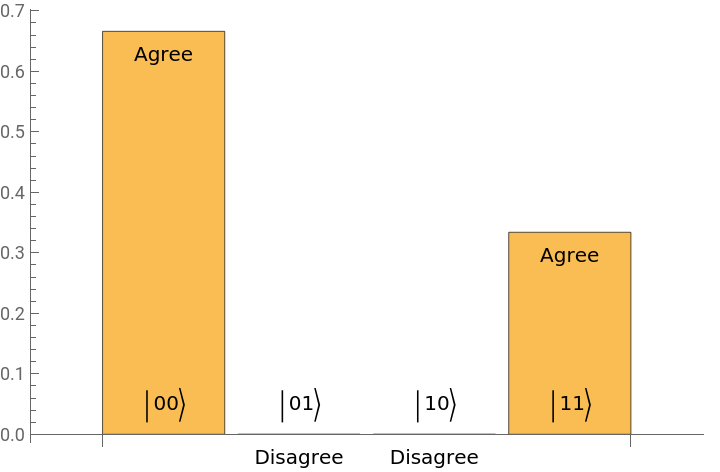
What in the formalism of quantum theory leads to the agreement of two measurement outcomes, while Copenhagen interpretation trying to confuse the matter with collapsing superposition states depending from which perspective the story is being told?
In[]:=
QuantumCircuitOperator[{"RandomMixed","M"->"Wigner's friend's\nmeasurement device","M"->"Wigner's\nmeasurement device"}]"Diagram",
Out[]=
QuantumCircuitOperator[{"RandomMixed","M"->"Wigner's friend's\nmeasurement device","M"->"Wigner's\nmeasurement device"}][]"ProbabilitiesPlot",
Out[]=
Let’s break this classic thought experiment down by first understanding how measurement works under the quantum rules.
The measurement device first creates a correlation between the system in question and the friend herself:
In[]:=
QuantumCircuitOperator[{"M"->"Wigner's friend's\nmeasurement device"}]"Diagram",
Out[]=
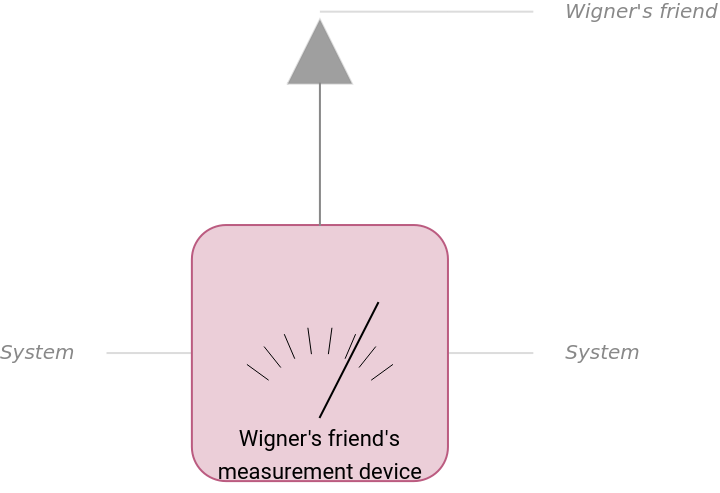
The correlation is performed with an auxiliary system, which is interpreted as friend’s state of knowledge about the system. This is like creating a copy of the system in some sense:
In[]:=
QuantumCircuitOperator[{"Copy"->1->{0,1}}]"Diagram",
Out[]=
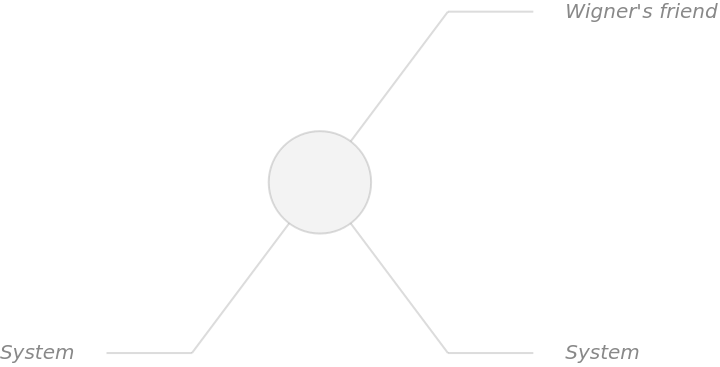
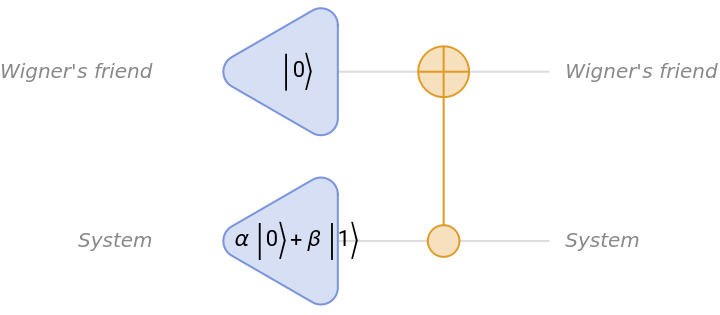
But this is not the same as cloning the system, which is known to be impossible by the rules of quantum theory. Copying in practice merely means performing an entanglement between a system and a state, performed by conditioning the NOT gate with the system acting as its control. Which together is modeled by the CNOT gate (controlled NOT):
|0〉
In[]:=
QuantumCircuitOperator[{"0"->0,QuantumState[{α,β},"Label"->α|0〉+β|1〉]->1,"CNOT"->{1,0}}]"Diagram",
Out[]=
Out[]=
α|00〉+β|11〉
Copying can also be thought of as adding redundancy to the system by encoding it into two or more multiple systems. This mechanism can then be used for quantum error correction for example, when the redundancy helps to mitigate noise as duplicated systems are expected to behave the same and any disagreement is an indicator for errors:
In[]:=
QuantumOperator["Copy"]@QuantumState[{α,β}]
Out[]=
α|00〉+β|11〉
In[]:=
QuantumOperator["Copy"]@QuantumOperator["Copy"]@QuantumState[{α,β}]
Out[]=
α|000〉+β|111〉
After the measurement device acted as a correlator between the system and the friend, the classical information about the system gained by the friend is then effectively modeled by tracing out degrees of freedom of the system and discarding any information associated with it:
In[]:=
QuantumCircuitOperator[{"Copy"->{1,0},"Trace"}]"Diagram",
Out[]=
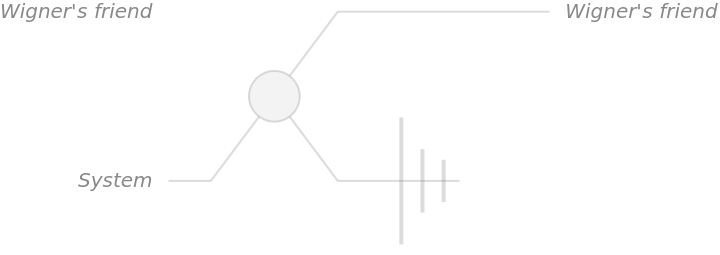
For example, if the system is a particle spin and it was prepared, say in a superposition of being up 37.6% of the time and 62.3% being down:
In[]:=
SeedRandom[2];spin=QuantumState["RandomPure",{"↑","↓"},"Label"->"spin"]
Out[]=
(0.474029+0.389393)|↑〉+(-0.215283+0.759818)|↓〉
In[]:=
spin["Probability"]
Out[]=
|↑〉0.37633,|↓〉0.62367
In[]:=
QuantumCircuitOperator[{spin,"Copy"[{"↑","↓"}]->1->{1,0}}]
Then the resulting state is a classical mixture of being spin up or spin down, which means it is represented by the diagonal density matrix, and friend will get either of the outcomes with the corresponding probabilities indicated by its diagonal elements:
Now, let’s introduce Wigner himself into the picture, who’s interested in the system, and wants to ask his friend whether it was spin up or down. Initially Wigner has no information about the system, which is represented by a mixed state, or the uniform mixture, ant it is also a classical state:
As both Wigner and his friend are in classical states they, the act of interaction between them doesn’t have to be quantum anymore, but can still be simply modeled by the same copy gate and its opposite, which work on classical probability distributions as well as quantum amplitudes (and no-cloning theory applies to classical probability theory too):
The resulting classical state then shows the perfect agreement between them as expected:
Alternatively this interaction could have also be modeled as a CNOT again to produce the same result, even though the gate acts classically in this case by swapping Wigner’s prior belief about the system being spin up based on his friend’s answer:
Instead of getting encoded probabilities of all outcomes as a state, Wigner can ask a direct question and the diagram representing it would effectively compute a single probability scalar of that question answered affirmatively:
Of course, instead of asking his friend, Wigner could’ve interacted with the measurement apparatus, after the measurement is performed, to get the exact same result. Which is seen by the corresponding diagrams looking almost exactly the same, only being slightly differ in their wiring:
The seeming collapse and decoherence of the system is indicated by the way information is being discarded after correlation with friend’s measurement device.
Also the way we’ve set things up, the information was being effectively discarded twice, as Wigner’s initial zero knowledge state is equivalent to discarding all information, but in reverse:
But anyway, it is possible to apply all sorts of diagramatic manipulation to the diagram and look at it from all kind of different angles. All that was being showed here is that diagramatic approach can make the flow of information more obvious, help to distinguish classical and quantum information and dispute all possible arguments about the seemingly mysterious nature of quantum theory.
CITE THIS NOTEBOOK
CITE THIS NOTEBOOK
Diagrammatic adventures of Wigner and his friend
by Nikolay Murzin
Wolfram Community, STAFF PICKS, June 6, 2024
https://community.wolfram.com/groups/-/m/t/3188652
by Nikolay Murzin
Wolfram Community, STAFF PICKS, June 6, 2024
https://community.wolfram.com/groups/-/m/t/3188652