In this project, we consider a string substitution system based on cyclic strings. We pick out some string configurations as Leibnizian, that is, physical. The basic idea for being a Leibnizian string has roots in Leibniz’s “Monadology.” Once we determine Leibnizian strings, we consider physical paths on the multiway system such that they only include Leibnizian strings. After finding the physical paths, we look for paths that maximizes the action, defined as the sum of variety of each string on the path. The last strings on maximal variety paths are interpreted as ontological basis elements in line with ‘t Hooft’s cellular automaton interpretation of quantum mechanics. Using a path sum approach (discrete version of path integrals) we find the complex amplitudes for the quantum states of abstract strings. By creating sentences from physical paths and interpreting them as grammatically correct in some abstract language, we find the vectors for abstract strings using the Word2Vec algorithm. What we posit is a tentative quantum theory of abstract cyclic strings. What we provide in the project is a set of ideas and concepts and these should be investigated to the last extent in the future.
Loading Software Packages
Loading Software Packages
We set the directory.
SetDirectory[NotebookDirectory[]];
Please download “wws25fsd.wl” from GitHub (https://github.com/fsdundar/wws25) and place it in the notebook directory.
<<wws25fsd`
If not installed, please install the Wolfram Multicomputation paclet by uncommenting the following line.
(*PacletInstall["https://www.wolfr.am/Multicomputation.paclet",ForceVersionInstall->True]*)
We import the Multicomputation paclet.
In[]:=
<<Wolfram`Multicomputation`
Introduction
Introduction
Motivation
Motivation
Interpretations of physical systems in terms of Leibniz’s monads (2005), which are “metaphysical atoms”, has attracted attention in recent decades to some extent, for example see (Barbour and Smolin, 1992; Barbour 2003; Dündar 2022; Dündar 2024). Monadic interpretation of Wolfram Model has been studied in (Dündar 2024). In this project, rather than dealing directly with hypergraphs for which computations are more time consuming, we consider cyclic (character) string model of (Barbour and Smolin, 1992). Our aim in this project is to provide a tentative quantum theory for such abstract strings. It is our hope that our results on cyclic strings will be extended to the hypergraph ontology in Wolfram Model.
Basic definitions
Basic definitions
A cyclic character string (from now on we drop the terms “cyclic” and “character”) is called non-Leibnizian if there are at least two characters at different positions whose neighborhoods are isomorphic (same or mirror-symmetric) to each other even when the whole string is exhausted. Examples of non-Leibnizian strings are “A”, “AB”, “AAABBB”, “ABCABC”. More generally, a repeated sum of a string or the union of a string with its reverse are non-Leibnizian. When one considers added substrings as quantum objects, this picture suggests a fermionic behavior. Because the sum of two same strings or sum of one string and its mirror image are non-Leibnizian. If a string is not non-Leibnizian, it is called Leibnizian. We will use the terms Leibnizian and physical interchangeably. Let us have a look at the following plot.
In[]:=
joinStr2PtPlot[5,{"A","B"},PointSize[Large]]
Out[]=
In the plot above, there is a black dot if the sum of string on the horizontal position with the one on the vertical position is Leibnizian. The order of strings is alphabetical order and the strings are length-5 words of “A” and “B”. The strings on each direction are all non-Leibnizian. However the Leibnizian structure of their sums shows fractal-like effects. Even this simple looking phenomenon is worth a separate investigation.
On Leibnizian strings, one can define a function called as BSD variety (the prefix term coined in (Dündar, 2024) and “BSD” stands for Barbour, Smolin and Deutsch.) For that purpose we need two concepts: relative and absolute indifference (We summarize the definition of Barbour and Smolin (1992)). Relative indifference is defined for two positions i and j. It is the smallest radius of neighborhoods of these two vertices that become non-isomorphic. Absolute indifference is defined for a single position i, and it is the maximum of relative indifference values between all i and j such that j is not i. Once the absolute indifference is defined, the BSD variety is simply the sum of over all i, where is the absolute indifference of the i’th position. Since >0 and integer for all i, the BSD variety is a positive rational number. In our code, we assigned the zero value for BSD variety (from now on we drop “BSD”) to non-Leibnizian strings in order to distinguish them using the variety function.
1/
a
i
a
i
a
i
The Multiway System
The Multiway System
Here we will consider the following multiway system. We use a four letter alphabet, in order to create a rich structure. (For a detailed account of ideas in this Section, such as multiway systems and branchial graphs, please see (Wolfram, 2020). As a brief introduction (Dündar, 2024) may be useful.)
In[]:=
mw=MultiwaySystem[{"BA""AB","BC""CB","AC"->"CA","DD"->"AC","DDD"->"CA"},"DDDCCCBBBAAA",Method->{"String","Cyclic"->True}]["GraphStructure",6,"CanonicalStateFunction"->Full]
Out[]=

The following function calculates the variety of each strings on the multiway system.
In[]:=
vr=VarRule[mw];
In[]:=
Take[vr,3]
Out[]=
{DDDCCCBBBAAA12,DDDCCCBBABAA12,AAAACDCCCBBB0}
The part highlighted with red color is the part of the multiway system that contains Leibnizian strings.
In[]:=
HighlightGraph[mw,PhysicalMultiwaySystem[mw,vr]]
Out[]=

We create the following branchial graph.
In[]:=
mwbg=MultiwaySystem[{"BA""AB","BC""CB","AC"->"CA","DD"->"AC","DDD"->"CA"},"DDDCCCBBBAAA",Method->{"String","Cyclic"->True}]["BranchialGraphStructure",6,"CanonicalStateFunction"->Full]
Out[]=
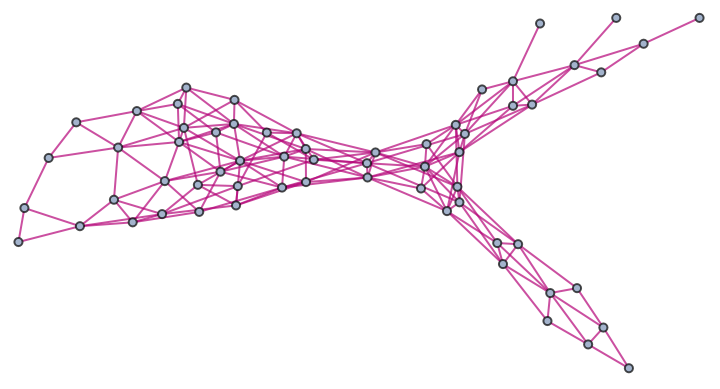
Let us store the strings on the branchial graph. These will represent our “target strings” in the multiway evolution.
In[]:=
lv=VertexList[mwbg]
Out[]=
{CCCABABBACA,CCCABBAABCA,CCACCABBABA,CCCABBABCAA,CCCBAABABCA,CCACCBAABBA,CCCBAABBCAA,CCCBABAACBA,AABCCACCBAB,CCCACABBBAA,BBBACACACCA,CCCACBABABA,CCBABABCACA,AAACBCACCBB,AAABCCCACBB,CCCCABABBAA,CCACBABBACA,CCCCABBAABA,CCACBBAABCA,CCCABBABACA,AAACCCABBBC,CCCBABACBAA,AAACCCBABCB,AACACCBABBC,CCCBBAACABA,CCBBAACBACA,CCCBBACABAA,AACACCBBACB,CCCBBCABAAA,AAAACCCBCBB,AAACACCBBCB,CCACBBABCAA,AAACCACBBBC,CCCABBBACAA,CCCABABBAACD,CCCABBAABACD,CCCABBABACAD,CCCBAABABACD,CCCBAABBACAD,AAABCDCCCBAB,CCCBABAABCAD,BBBACAADCCCA,CCCBABABCAAD,CCCBBAAACBAD,CCCCABABBADA,CCCCABBAABDA,CCCABBABADCA,CCCCBAABABDA,CCCBAABBADCA,CCCBABAABDCA,BBBAADCCACCA,CCACCBABABAD,AAABDCCACCBB,CCCACBABBAAD,CCCACBBAABAD,CCCCABBABAAD,DDDCCCAABBBA,DDDCCCABABAB,DDDCCCBAAABB,CCCBABBCAAAD,CCCBBAACBAAD,CCCBBACBAAAD}
Paths on the Multiway System
Paths on the Multiway System
Here we consider paths in the multiway system beginning from the head node to the elements of the branchial graph, e.i. the “target strings”.
In[]:=
pathList=Table[PathsBetween[mw,"DDDCCCBBBAAA",lv[[n]],6],{n,Length[lv]}];
We define an action on a physical path, a path that does not contain any non-Leibnizian strings, as the sum of variety of each string (Dündar, 2024).
In[]:=
pathActionList=Table[{ActionOnPath[#,vr],#}&/@pathList[[n]],{n,Length[pathList]}];
Non-physical paths have the action value “Non-Physical-Path.”
In[]:=
MemberQ[Flatten[pathActionList,2],"Non-Physical-Path"]
Out[]=
True
We now calculate the maximum value of action on physical paths. This information will be used later to determine the “maximal variety paths.”
In[]:=
maxAction=Max[Select[Flatten[pathActionList],NumberQ]]
Out[]=
79
Now we select maximal variety paths.
In[]:=
maxVarPaths=Select[Flatten[pathActionList,1],First[#]==maxAction&]
Out[]=
{{79,
},{79,

}}

The Ontological Basis
The Ontological Basis
In the cellular automaton interpretation of ‘t Hooft (2016), one basis of the Hilbert space of quantum mechanics is singled out as the “ontological basis.” (For a brief introduction, see the Appendix.) In the same vein with the maximal variety interpretation (Barbour and Smolin 1992) of Leibniz’s theodicy (“we live in the best of all possible worlds”) it is natural to consider the last vertices of maximal variety paths (which are members of the branchial graph or equivalently the “target strings”) as representatives for such an ontological basis.
For the multiway system considered in this study, they are:
In[]:=
ontologicalBasis=Last/@VertexList/@(Last[#]&/@maxVarPaths)
Out[]=
{DDDCCCAABBBA,DDDCCCBAAABB}
What we have at hand are abstract strings that are yet to be interpreted in quantum mechanical terms. Hence, we need a way to represent strings as vectors. This is the subject of the next Section.
Word2Vec Algorithm and Word Embeddings
Word2Vec Algorithm and Word Embeddings
Each vertex on a path from the head string to target strings is a string. (This is because we have a string substitution system and the we have string ontology.) We consider a path representing a sentence in (some probably alien) language terms. Physical paths correspond to correct grammatical sentences where as non-physical paths correspond to incorrect grammatical sentences. We need a list of grammatically correct sentences. (The letter “L” before following variable definitions stands for “Leibnizian.”)
In[]:=
Lpaths=Select[Flatten[pathActionList,1],First[#]>0&];
We construct sentences.
In[]:=
Lsentences=pathToSentence[#[[2]]]&/@Lpaths;
Let us have a look at a few sentences.
In[]:=
StringJoin[Riffle[#," "]]&/@Take[Lsentences,4]
Out[]=
{DDDCCCBBBAAA AAACACCCBBB CCCBBABAACA CCCBBAABACA CCCBABABACA CCCBAABBACA CCCABABBACA,DDDCCCBBBAAA AAACACCCBBB CCCBBABAACA CCCBBAABACA CCCBABABACA CCCABBABACA CCCABABBACA,DDDCCCBBBAAA AAACACCCBBB CCCBBABAACA CCCBABBAACA CCCBABABACA CCCBAABBACA CCCABABBACA,DDDCCCBBBAAA AAACACCCBBB CCCBBABAACA CCCBABBAACA CCCBABABACA CCCABBABACA CCCABABBACA}
Having calculated the grammatically correct sentences, we use Word2Vec algorithm to represent each string as a vector. The dimensionality of the vector space should be equal to the number of ontological basis vectors. In the case here, it is two dimensional.
We export the sentences and words, then do the analysis in Python and import the results.
In[]:=
Export["Lsentences.txt",StringJoin[Riffle[#," "]]&/@Lsentences]
Out[]=
Lsentences.txt
There are 956 sentences
and 95 distinct words in total.
We crunch the data using the “gensim” library in Python. The code is shown below. You may also find the Jupyter notebook on the GitHub repository (https://github.com/fsdundar/wws25).
For the convenience of readers, the following file to be imported is attached to the post.
Let us find the vector representation of ontological basis.
We now plot all the vectors that words correspond to on a 2D plane. Red arrows denote the ontological basis.
We have obtained a vector representation for the ontological basis elements of the quantum Hilbert space of abstract cyclic strings as well as for other target strings. We now focus on the question of what the complex amplitudes are for strings. This is the topic of the next Section.
S-Matrix
S-Matrix
These are the non-normalized elements of the S-matrix. Let us plot the values on the complex plane.
When interpreted in the Copenhagen interpretation, the elements of the S-matrix gives one all the details about the probability amplitude of obtaining a certain state in the branchial graph. If we would like a cellular automaton type interpretation we need to focus on the ontological basis. Let us also have a look at the S-matrix elements for the ontological states.
Conclusion
Conclusion
In the present project, we considered a multiway system of cyclic string substitution system, interpreted in monadic terms of Leibniz.
What we have provided in this project--by using variety, action, path sums, word embeddings--is a tentative proposition for a quantum theory of abstract cyclic character strings using the multiway system. We believe that our results are suggestive. They should be investigated to the last extent in the future. One idea is to generalize the ideas presented here to the hypergraph ontology of the Wolfram Model (Wolfram, 2020). Codes to calculate the BSD variety on hypergraphs is already available on GitHub (https://github.com/fsdundar/wolfram-model-variety).
Acknowledgements
Acknowledgements
I would like to thank Enes Burak Dündar for useful discussions, and for my mentors Hatem Elshatlawy and Xerxes Arsiwalla for guidance and useful discussions throughout the project.
References
References
◼
Barbour, J., & Smolin, L. (1992). Extremal variety as the foundation of a cosmological quantum theory. arXiv preprint hep-th/9203041.
◼
Barbour, J. (2003). The deep and suggestive principles of Leibnizian philosophy. Harvard Review of Philosophy, 11, 45-58.
◼
Dündar, F. S. (2022). A Use of Variety as a Law of the Universe. Complex Systems, 31(2).
◼
Dündar, F. S. (2024). A Case Study for Leibnizian Ideas in Wolfram Model. Foundations of Physics, 54(3), 43.
◼
Leibniz, G. W. (2005). Discourse on Metaphysics and the Monadology. Dover Publications.
◼
‘t Hooft, G. (2016). The cellular automaton interpretation of quantum mechanics (p. 298). Springer Nature.
◼
Wolfram, S. (2020). A Class of Models with the Potential to Represent Fundamental Physics. Complex Systems, 29(2).
Appendix
Appendix
Here we provide a few key concepts from the cellular automaton interpretation of quantum mechanics of ‘t Hooft (2016).
Among all possible bases of a Hilbert space, one basis is selected as the “ontological basis”. The time evolution of a quantum state is to hop from one basis element to one of other basis elements. In this sense, the quantum state of a system is definite and does not include superpositions. When one has limited knowledge of the physical system, the concept of “template states” appears. These template states directly maps to wave-vectors in the Copenhagen interpretation.
CITE THIS NOTEBOOK
CITE THIS NOTEBOOK
A suggestive quantum theory for cyclic character strings
by Furkan Semih Dündar
Wolfram Community, STAFF PICKS, January 16, 2025
https://community.wolfram.com/groups/-/m/t/3357778
by Furkan Semih Dündar
Wolfram Community, STAFF PICKS, January 16, 2025
https://community.wolfram.com/groups/-/m/t/3357778