Analysis of Simple Distillation by Arc-Length Continuation for a Ternary Mixture with Chemical Reaction
Authors: Housam Binous and Ahmed Bellagi
Analysis of Simple Distillation by Arc-Length Continuation for a Ternary Mixture with Chemical Reaction
Authors: Housam Binous and Ahmed Bellagi
Authors: Housam Binous and Ahmed Bellagi
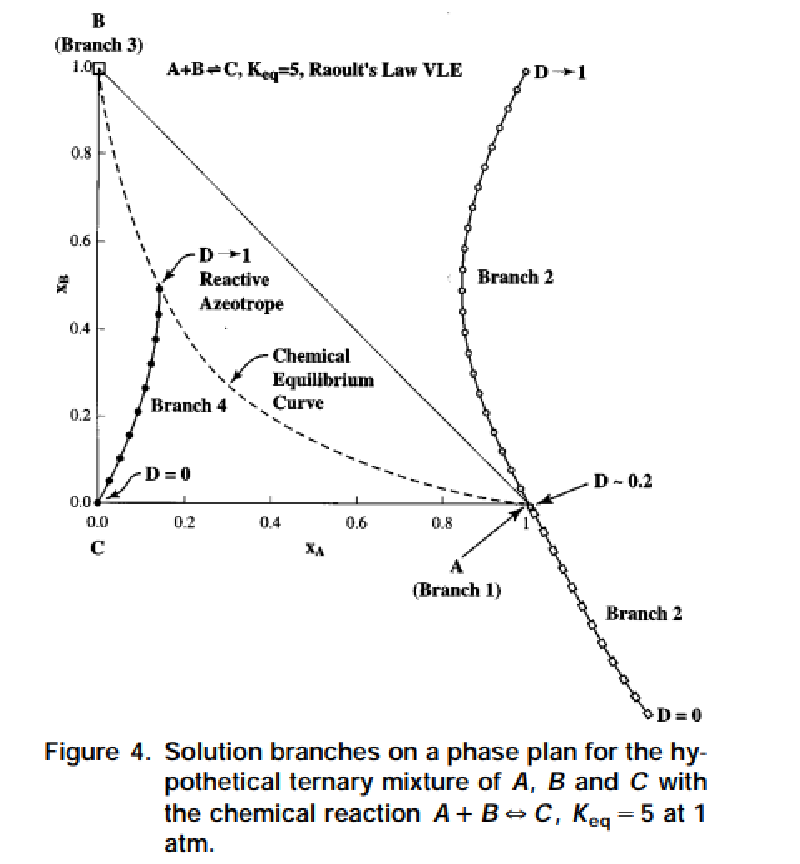
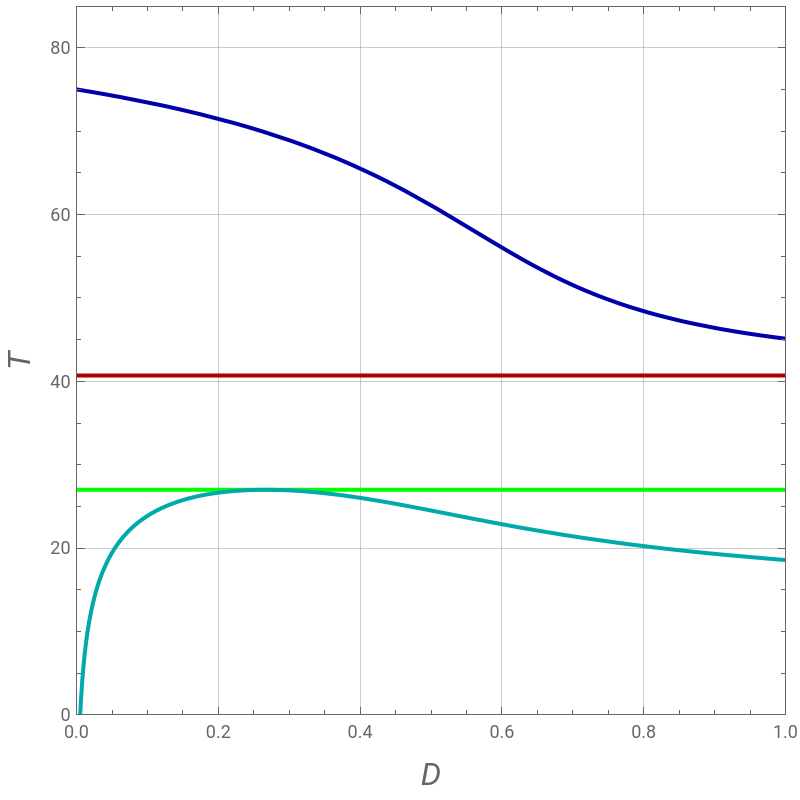
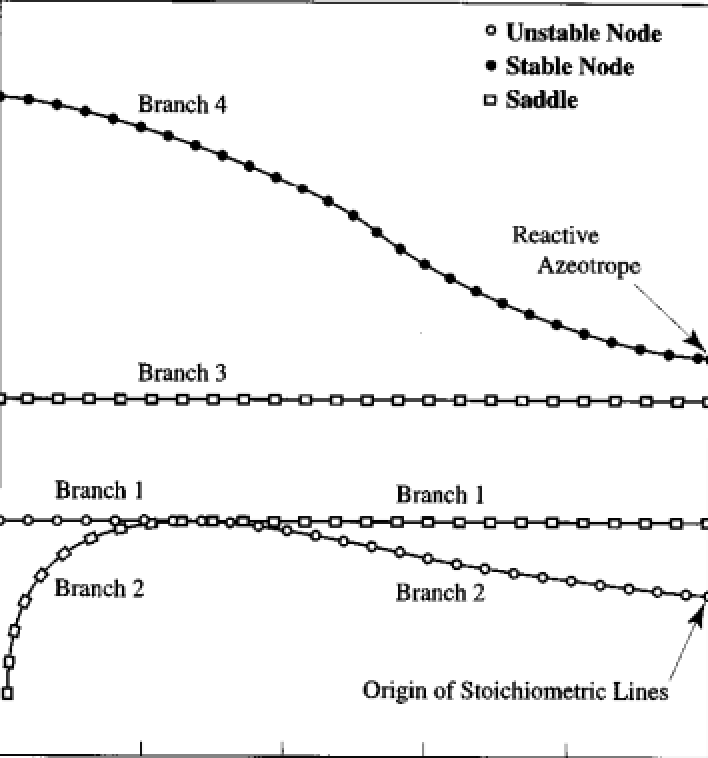
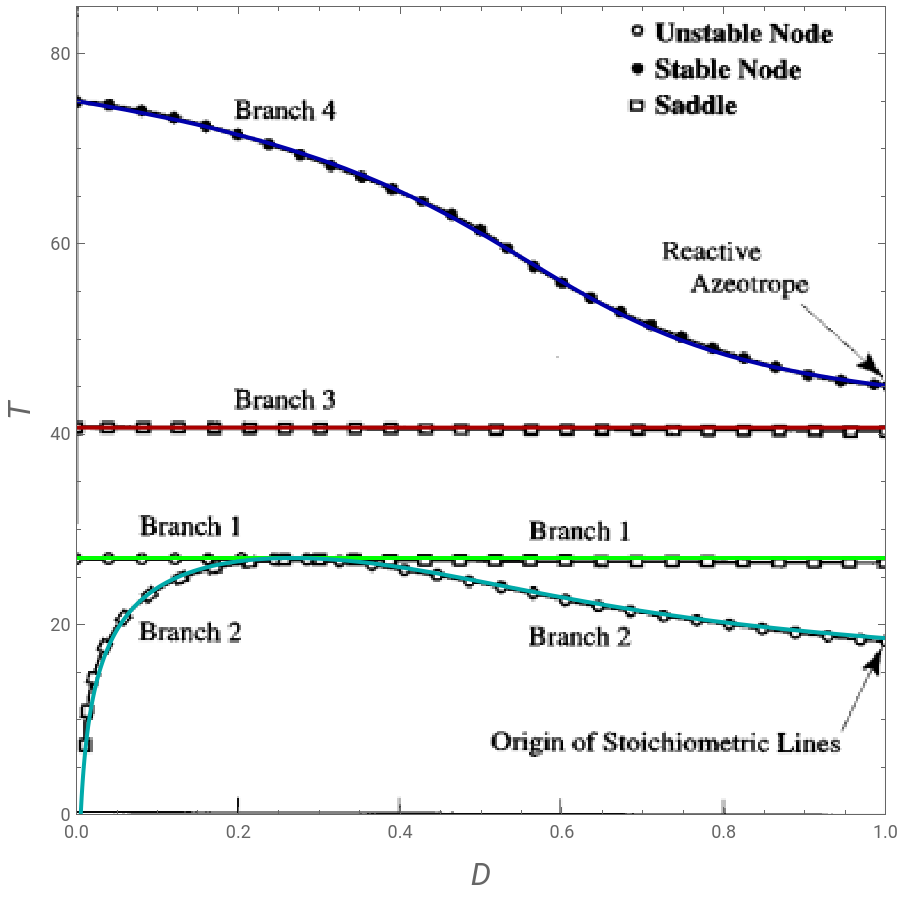
We apply the arc-length continuation technique in order to plot Figures 3 and 4 of the paper by G. Venimadhavan et al. [1]. Figure 3 is the bifurcation diagram for the hypothetical ternary mixture of A, B and C with chemical reaction for Keq=5 and at 1 atm. Figure 4 is the solution branches on a phase plan for the hypothetical ternary mixture of A, B and C with the same chemical and condition.Reference :[1] G. Venimadhavan, M. F. Malone and M. F. Doherty, Bifurcation Study of Kinetic Effects in Reactive Distillation, AIChE Journal, March 1999, Vol. 45, No. 3, pp 546-556.
A+B⇌C
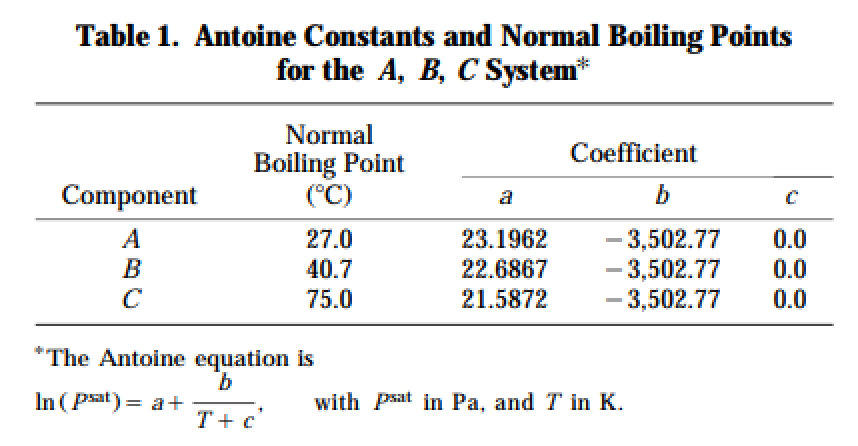
Vapor Pressure of components A, B and C
In[]:=
a1=23.1962;a2=22.6867;a3=21.5872;b1=-3502.77;b2=-3502.77;b3=-3502.77;c1=0;c2=0;c3=0;Psat[1]=Exp[a1+b1/(c1+T)];Psat[2]=Exp[a2+b2/(c2+T)];Psat[3]=Exp[a3+b3/(c3+T)];
Total Pressure
In[]:=
P=1.0132510^5;
Raoult’s law
In[]:=
y1=Psat[1]x1/P;y2=Psat[2]x2/P;y3=Psat[3]x3/P;
Summation rule
In[]:=
x3=1-x1-x2;
Equilibrium constant for the reaction A + B ⇄ C
In[]:=
Keq=5;
Computing Branch 4
Computing Branch 3
Computing Branch 1
Computing Branch 2
Bifurcation diagram for the hypothetical ternary mixture of A, B and C with chemical reaction A+B ⇄ C, =5 at 1atm.Comparison with Figs. 3-4 of Ref 1. indicates very good agreement.
K
eq
In[]:=
p=Show[plt1,plt3,plt5,plt7,PlotRange{{0,1},{0,85}},AspectRatio1,FrameTrue,AxesOrigin{0,0},FrameLabel{Style["D",16,Italic],Style["T",16,Italic]}]
Out[]=
In[]:=
IMG=
;
In[]:=
Show[p,ImageSize450{1,1},Prolog{Raster[ImageData[IMG,DataReversedTrue],{Scaled[{0.0,0.0}],Scaled[{1,1.01}]}]},FrameLabel{Style["D",16,Italic],Style["T",16,Italic]}]
Out[]=
Chemical equilibrium curve
In[]:=
plt9=ContourPlot[x1x2-x3/Keq0,{x1,0,1},{x2,0,1},ContourStyle{Magenta,Thick}]
Out[]=
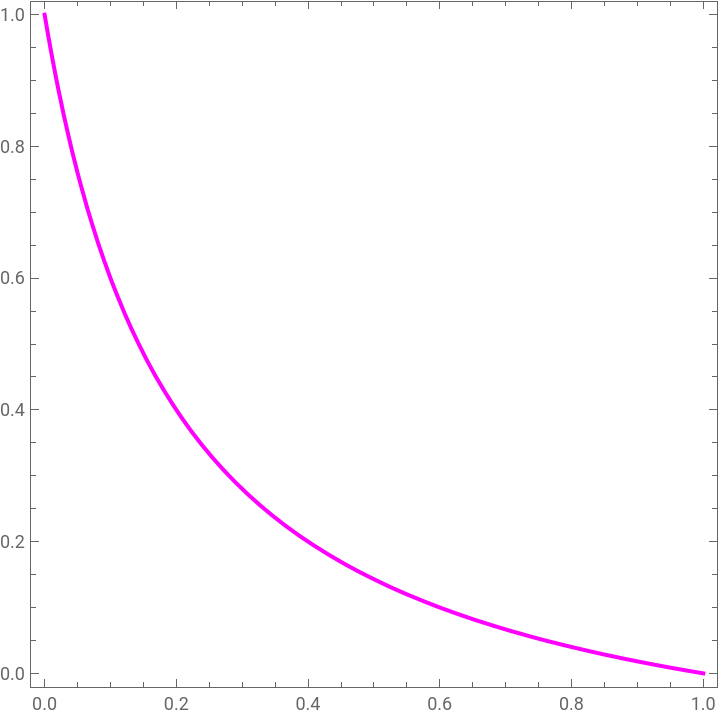
Solution branches on a phase plan for the hypothetical ternary mixture of A, B and C with chemical reaction A+B ⇌ C, =5 at 1 atm.
K
eq