Introduction to Machine Learning
Introduction to Machine Learning
Machine Learning by Examples: Examples of Machine Learning
Machine Learning by Examples: Examples of Machine Learning
Let’s look at some examples of Machine Learning.
It can be used to answer questions as follows, automatically by machines, without explicit human programming:
It can be used to answer questions as follows, automatically by machines, without explicit human programming:
What language is this?
What language is this?
What’s in this image?
What’s in this image?
What sort of sentiment does this text express?
What sort of sentiment does this text express?
The Machine is trying to answer a Question: Is this A or B (or C or D or E)?
The Machine is trying to answer a Question: Is this A or B (or C or D or E)?
◼
Is this English or French (or Arabic or Hindi)?
◼
Is this a cheetah or a tiger or an owl?
◼
Is this an example of positive or negative or neutral sentiment?
Build your own classifier: Human
Build your own classifier: Human
Build your own classifier: Machine Learning Program
Build your own classifier: Machine Learning Program
More Classifiers
More Classifiers
How do the Classifiers Work? (Hint: Remember Vector Spaces)
How do the Classifiers Work? (Hint: Remember Vector Spaces)
Calculate distance using numbers
Calculate distance using numbers
Nearness as step to identifying
Nearness as step to identifying
So what is machine learning?
So what is machine learning?
◼
How computers recognize patterns without being explicitly programmed...
◼
A different way to program a computer.
Instead of writing rules and providing explicit instructions, you are programming with help of data
(showing lots and lots of examples;
learning by trial and error, lots of practice and data).
Instead of writing rules and providing explicit instructions, you are programming with help of data
(showing lots and lots of examples;
learning by trial and error, lots of practice and data).
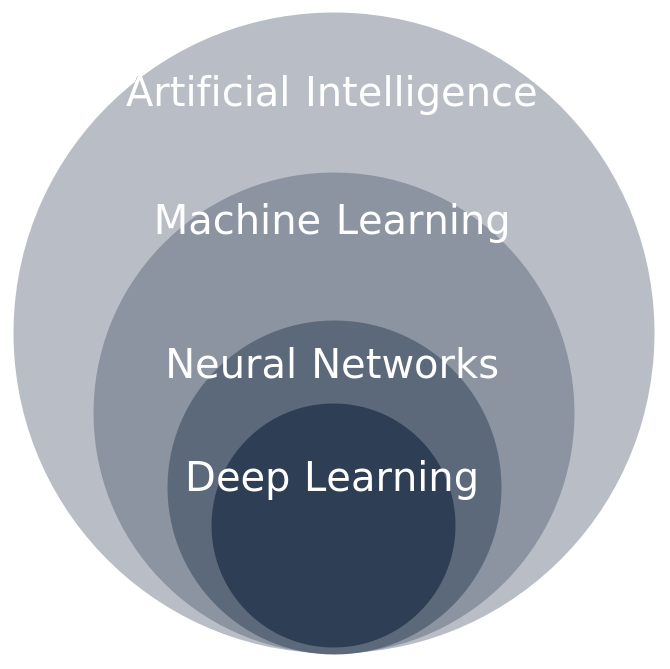
AI, Machine Learning and Neural Networks
AI, Machine Learning and Neural Networks
Out[]=
Supervised vs. Unsupervised Machine Learning
Supervised vs. Unsupervised Machine Learning
In machine learning, one often gives training that explicitly says, for example, “this is a cheetah”, “this is a lion”.
This is known as “Supervised Learning”. You provide labeled examples that were created by some expert.
This is known as “Supervised Learning”. You provide labeled examples that were created by some expert.
But one also often just wants to automatically pick out categories of things without providing specific labels.
This is “Unsupervised Learning”.
This is “Unsupervised Learning”.
Supervised Learning
Supervised Learning
Unsupervised Learning
Unsupervised Learning
Take Away
Take Away
Terminology
Terminology
◼
Machine learning
◼
Vector space
◼
1 dimension
◼
2 dimensions
◼
3 dimensions
◼
n dimensions
◼
Features
◼
Nearness
◼
Supervised learning
◼
Labels
◼
Classification
◼
Regression
◼
Unsupervised learning
◼
Clustering
Concepts
Concepts
◼
Examples of machine learning
◼
Identifying language from example text
◼
Identifying contents in an image
◼
Identifying sentiment from example text
◼
Answering questions of the type “Is this A or B (or C or D or E)?”
◼
Features/identifying properties of a sample
◼
Any type of data can be represented by numeric features
◼
Computers recognize patterns without being explicitly programmed
◼
Machine learning is a way to now program with data instead of writing explicit code
◼
“Supervised Learning”needs labeled examples
◼
Classification can answer questions of the type: Is this A or B (or A or B or C or D or E?
◼
Dog or cat
◼
Day or night
◼
Sneaker or boot
◼
Regression can answer questions of the type: How much or how many?
◼
Cost of a home
◼
Score representing quality of wine
◼
Price of stock
◼
“Unsupervised Learning” can be done when the data does not have labels.
◼
Clustering can answer questions like:
◼
How is the data organized?
◼
Do the samples separate into groups of some kind?
◼
Are there samples that are very different from most of the group (outliers)?
◼
The goal of clustering is to partition a dataset into clusters of similar elements