Our skies are in the beginning phases of being graced by the appearance of a naked-eye comet. Comet C/2023 A3 (Tsuchinshan-ATLAS) was discovered last year and is approaching the Sun, soon to pass behind it, from an Earth point of view. As of this post, the comet is visible in the morning skies in bright twilight. It will get a bit higher each day before sinking towards the Sun and then becoming an evening comet. Your location, mainly your latitude, has an effect on how easily it will be to observe comet C/2023 A3 (Tsuchinshan-ATLAS). We can examine the position of the comet during morning civil twilight in the coming days by defining a set of observing latitudes.
In[]:=
latitudes={-60,-40,-20,0,20,40,60};
We can then compute a list of morning civil twilight times for each latitude over a range of dates in September and early October.
In[]:=
dintmorning=DateInterval[{DateObject[{2024,9,5}],DateObject[{2024,10,10}]}];
In[]:=
morningciviltwilight=Tableloc=GeoPosition[{lat,-88.22}],AstroRiseSet,"Rise",loc,dintmorning,ReferenceAltitude->"Civil",{lat,latitudes};
For each set of latitude and morning civil twilight dates, we can compute the altitude angle as a function of day.
In[]:=
cometAltitudes[{loc_,dates_List}]:=Transposedates,QuantityMagnitudeEntityValue,EntityProperty["Comet","Altitude",{"Location"->loc,"Date"->#}]&/@dates,"AngularDegrees"
In[]:=
morningdata=cometAltitudes/@morningciviltwilight;
Then we can plot how high the comet will appear at morning civil twilight through September and early October before the comet sinks below the morning eastern horizon for various observing latitudes.
In[]:=
DateListPlot[morningdata,PlotRange->{0,20},PlotLabel->"Altitude of Comet C/2023 A3 at morning Civil Twilight",ImageSize->600,FrameLabel->{None,"altitude (degrees)"},PlotLegends->Placed[LineLegend[Quantity[#,"AngularDegrees"]&/@latitudes,LegendLabel->"Latitude",LegendFunction->(Framed[#1,FrameMargins->0]&),LegendLayout->{"Row",1}],Bottom]]
Out[]=
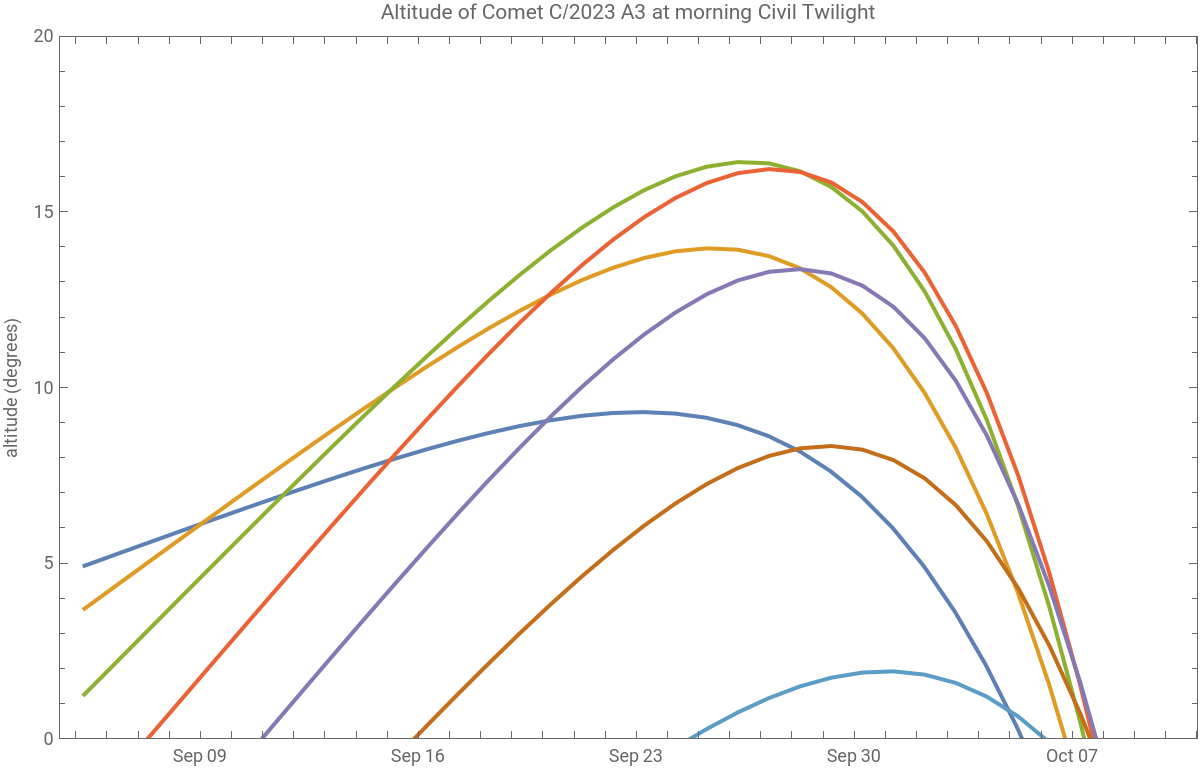


By inspection, here in Champaign, the maximum morning altitude is around Sept 29. Civil twilight on that day can be found with the following.
In[]:=
rise=AstroRiseSet,"Rise",Here,DateObject[{2024,9,29,0,0,0}],ReferenceAltitude->"Civil"
Out[]=
The position of the comet from Champaign at that time can be computed using the following.
In[]:=
ap=AstroPosition,"Horizon",AstroRiseSet,"Rise",,rise,ReferenceAltitude->"Civil"
Out[]=
AstroPosition

We can visualize the location of the comet in the Champaign sky with the following view centered on the local zenith with the entire horizon visible along the blue gray circle.
In[]:=
AstroGraphics{Red,PointSize[Large],Point[ap],White,Text["C/2023 A3",ap,{-1.2,0}]},AstroReferenceFrame->"Horizon",rise,,AstroRange->All
Out[]=
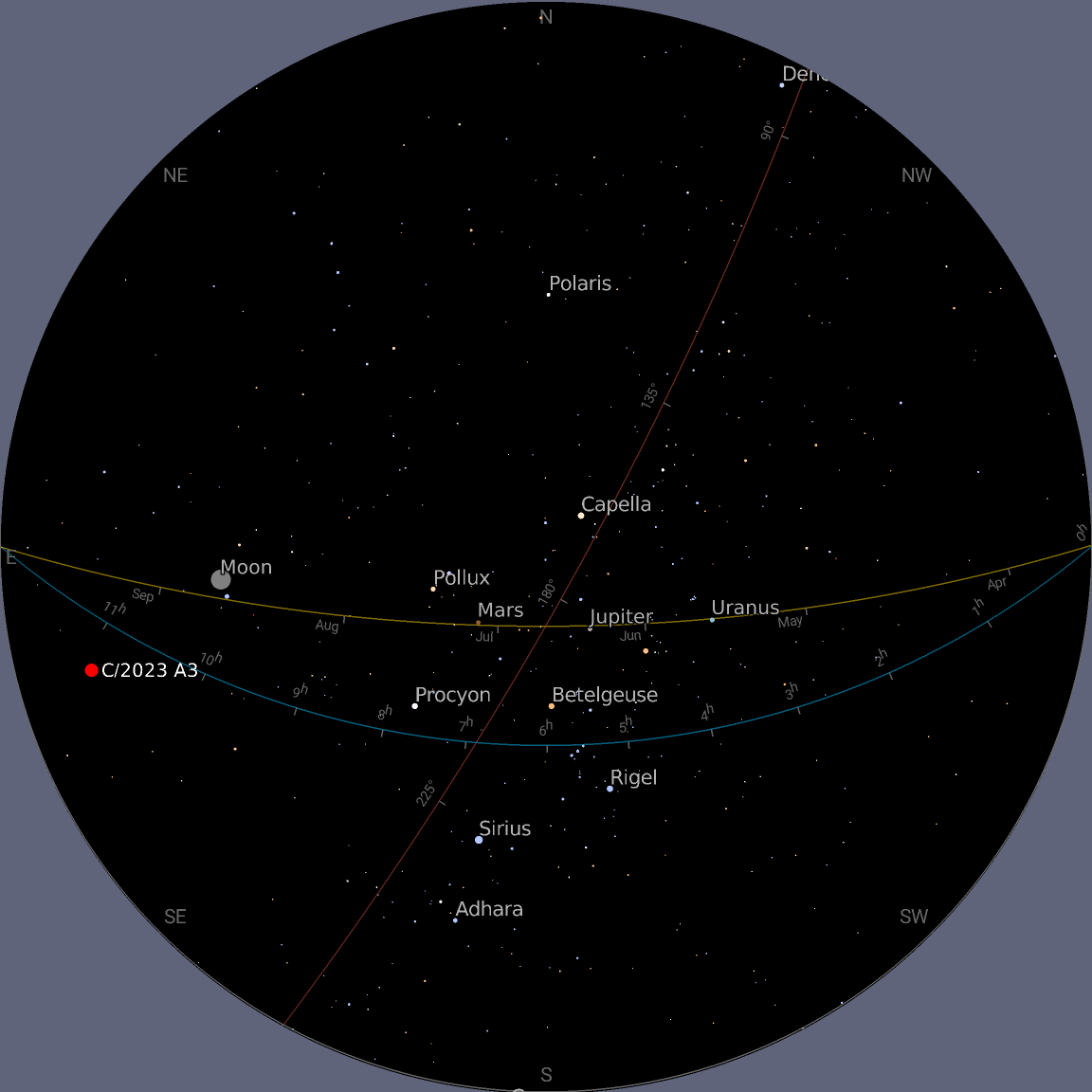
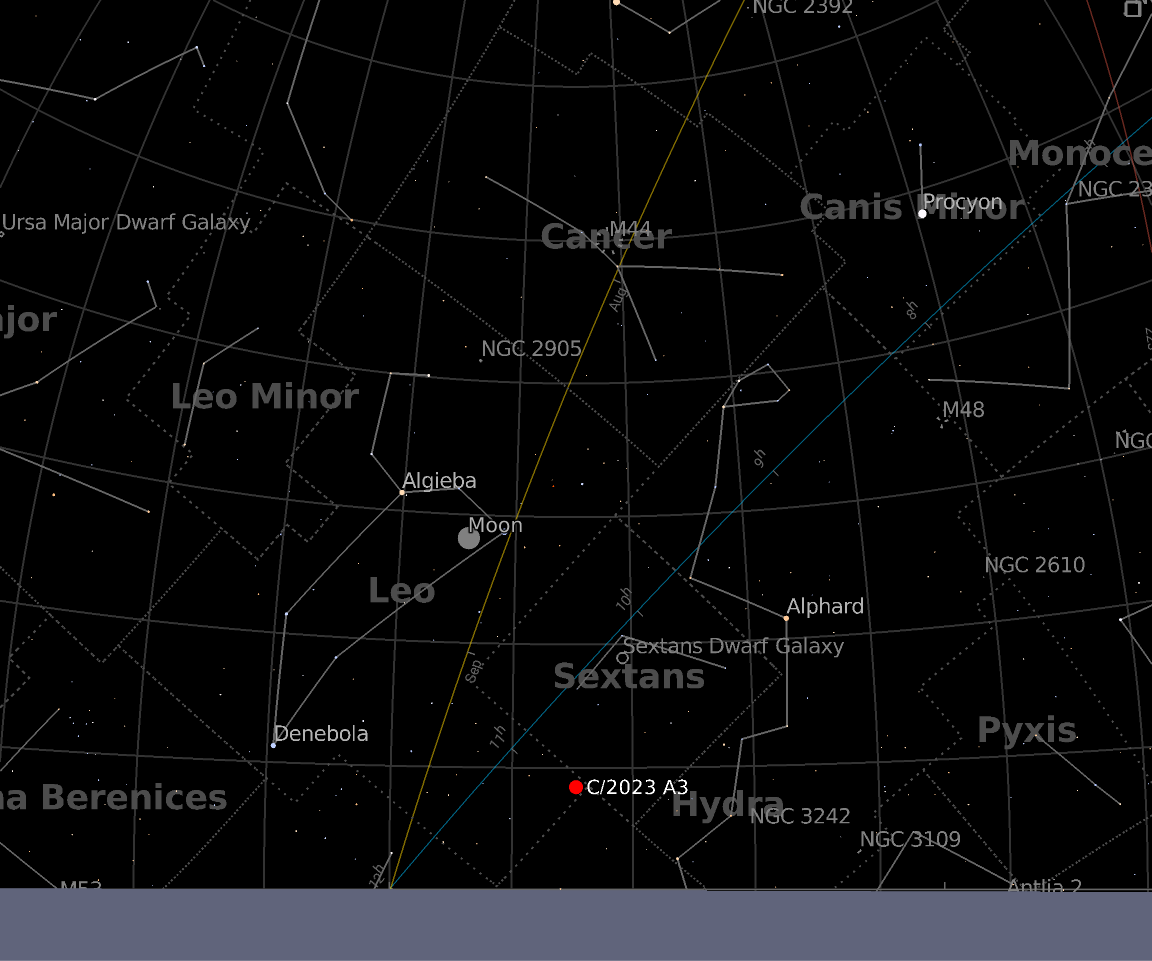
For a more “human” view, we can change the projection to look at the horizon in the direction of the comet, just south of east (azimuth 105°). The comet, from Champaign, is only 8° above the horizon at it highest so it will be hiding in the glare of sunrise.
In[]:=
AstroGraphics{Red,PointSize[Large],Point[ap],White,Text["C/2023 A3",ap,{-1.2,0}]},AstroReferenceFrame->"Horizon",rise,,AstroRange->{ap["Azimuth"]+{-45,45},{-5,60}},AstroProjection->{"Stereographic","Centering"->{0,ap["Azimuth"]}},AstroGridLines->Automatic
Out[]=
By Oct 7 or so, the comet will become invisible in the morning skies as it dives towards the Sun and reappears after about a week or so in the evening skies.
We can do the same analysis as we did for the morning appearance for evening. Here we observe from Oct 10, 2024 through Dec 1, 2024.
In[]:=
dintevening=DateInterval[{DateObject[{2024,10,10}],DateObject[{2024,12,1}]}];
In[]:=
eveningciviltwilight=Tableloc=GeoPosition[{lat,-88.22}],AstroRiseSet,"Set",loc,dintevening,ReferenceAltitude->"Civil",{lat,latitudes};
In[]:=
eveningdata=cometAltitudes/@eveningciviltwilight;
Compared to the morning apparition, the comet will get much higher in the western sky making it easier to see against darker skies. This plot shows how how the comet will be against the western horizon during evening civil twilight for various observing latitudes.
In[]:=
DateListPlot[eveningdata,PlotRange->{0,52},PlotLabel->"Altitude of Comet C/2023 A3 at evening Civil Twilight",ImageSize->600,FrameLabel->{None,"altitude (degrees)"},PlotLegends->Placed[LineLegend[Quantity[#,"AngularDegrees"]&/@latitudes,LegendLabel->"Latitude",LegendFunction->(Framed[#1,FrameMargins->0]&),LegendLayout->{"Row",1}],Bottom]]
Out[]=
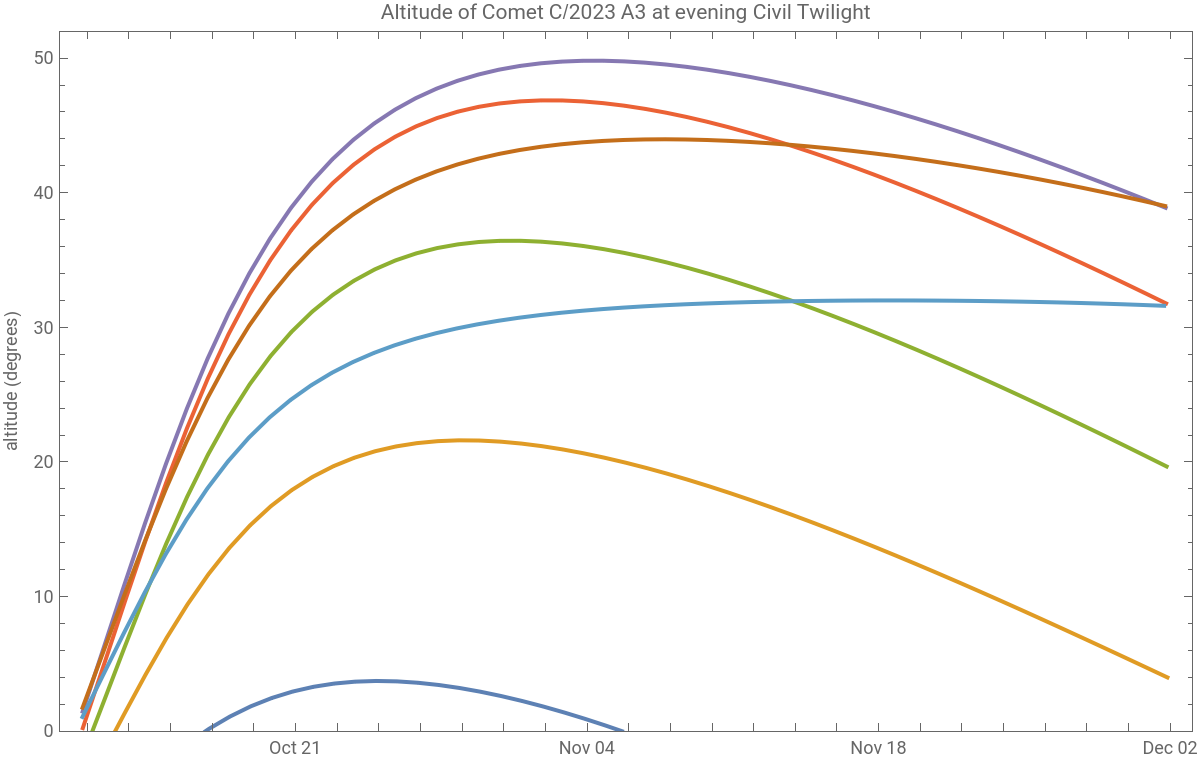
By inspection, here in Champaign, the maximum evening altitude is around Nov 7. Civil evening twilight on that day can be found with the following.
The position of the comet from Champaign at that time can be computed using the following.
We can visualize the location of the comet in the Champaign evening sky with the following.
We can extend this idea to show how the comets position will change from Oct 10 to Dec 11 against the western sky. In actuality, the star ba ckdrop will also change a bit during this time interval. The sky here is shown as it will be on Nov 7.
Predicting the brightness of a comet is often more art than science. Comets often come with high potential, only to disappoint. But recent observation show the comet is healthy and sports a tail easily visible in photographs of morning twilight. Some predictions claim that the comet will be easily naked eye during its evening apparition. Keep your eyes on the skies and hope for a visual spectacle!
CITE THIS NOTEBOOK
CITE THIS NOTEBOOK
Comet C/2023 A3 (Tsuchinshan-ATLAS) could be visible to the naked-eye
by Jeffrey Bryant
Wolfram Community, STAFF PICKS, September 26, 2024
https://community.wolfram.com/groups/-/m/t/3285041
by Jeffrey Bryant
Wolfram Community, STAFF PICKS, September 26, 2024
https://community.wolfram.com/groups/-/m/t/3285041