The code builds left-left and right-right mirror versions of Tivadar Csontváry Kosztka’s *Old Fisherman* by reflecting each half across the vertical axis. The result amplifies the face’s natural asymmetry, making structural imbalances explicit. It shows how real faces rely on subtle asymmetries to feel alive—while forced symmetry pushes them into the uncanny.
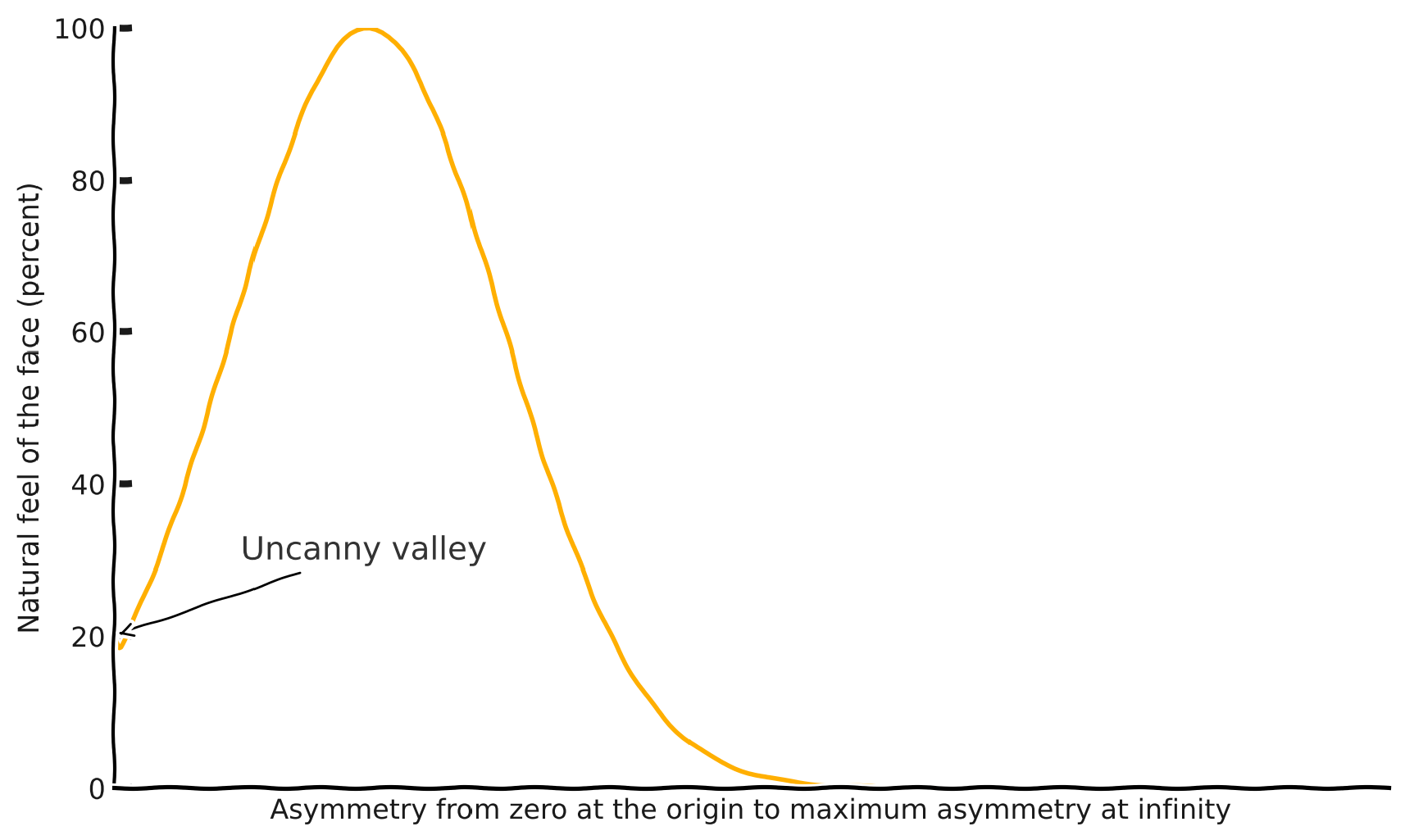
Research shows that no human face is perfectly symmetrical—tiny left-right differences are universal and shaped by genetics, development, and even childhood stress. Strangely, the left side of the face is usually more emotionally expressive, which is why artists and viewers tend to prefer it. When one side is mirrored, these subtle differences get amplified, often making one version look gentle and wise, and the other severe or unnatural. Scientists also found that people are so used to their mirror image that even seeing their true face reversed can feel unfamiliar. This means that how we see ourselves—and others—is shaped as much by perception as by anatomy.
Studies also show that facial asymmetry becomes more pronounced with age, making mirrored versions of older faces appear even more distorted. In art, perfect symmetry was often avoided—not to hide flaws, but because slight asymmetries made portraits feel more lifelike and expressive. When these asymmetries are artificially removed or exaggerated, as in mirror composites, the brain picks up on subtle inconsistencies: the left-left version often feels warmer and more human, while the right-right can seem colder or distant, reflecting how our brains process emotion and facial cues.
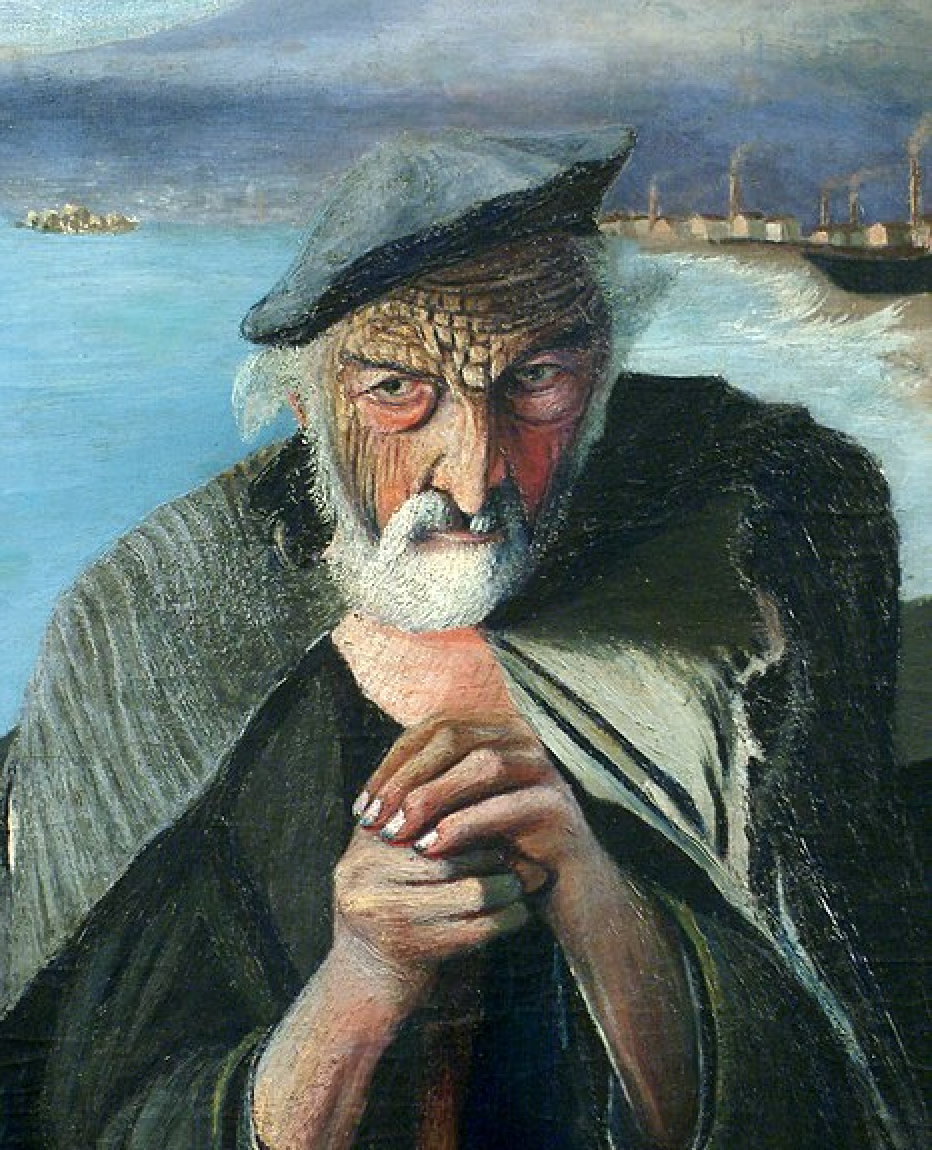
The *The Old Fisherman* painting
The *The Old Fisherman* painting
Tivadar Csontváry Kosztka (1853–1919) was a Hungarian painter whose work stood apart from the mainstream of his time—self-taught, often isolated, and now recognized for a distinct, expressive style that bridged symbolism, post-impressionism, and psychological portraiture. *The Old Fisherman*, painted in 1902 during his travels along the Adriatic coast, shows a solitary man seated by the sea. The face is deeply weathered, the body sunlit, the scene quiet. Nothing in Csontváry’s surviving notes or exhibition records suggests symbolic layering or optical illusions.
And yet, this painting became the center of a viral meme in popular media. Viewers noticed that splitting and mirroring each side of the fisherman’s face produced two radically different figures—one appearing calm or prayerful, the other dark or menacing. The effect circulated widely online as a curiosity: “Are there two hidden men?” “Is this good and evil?” While there’s no evidence Csontváry intended any of this, the mirrored images reveal genuine facial asymmetry, and with it, how perception can turn anatomy into narrative.
Animation design
Animation design
We get the image of the painting from Wikipedia:
Import image from URL and get its dimensions
In[]:=
i=Import["https://wolfr.am/1wBNkoes0"];i//ImageDimensions
Out[]=
{500,673}
Crop the imported image to make it more symmetric around central face line and get new dimensions
In[]:=
ii=ImageTake[i,50{1,-1},{35,-1}];ii//ImageDimensions
Out[]=
{466,575}
Create interactive split-mirror visualization:
In[]:=
DynamicModule[{mid=233,il,ir},il=ImageAssemble[{#,ImageReflect[#,Left]}]&@ImageTake[ii,All,{1,mid}];ir=ImageAssemble[{ImageReflect[#,Left],#}]&@ImageTake[ii,All,{mid+1,-1}];Manipulate[ImageAssemble[{ImageTake[il,All,{1,mirror}],ImageTake[ir,All,{mirror+1,-1}]}],{{mirror,mid},1,465},SaveDefinitions->True]]
Out[]=


Overlay red numbers (3,2,1) on the image as countdown frames
In[]:=
count=ImageCompose[ii,Style[#,30,Red,FontFamily->"Arial Black"],Scaled[{.5,.95}]]&/@{3,2,1};
Sample every 7th frame from precomputed frames and construct a full animation sequence
In[]:=
st=7;edit2=Join[count,frames1[[;;;;st]],Reverse[frames1[[;;;;st]]],count,frames2[[;;;;st]],Reverse[frames2[[;;;;st]]]];edit2//Length
Out[]=
142
Export the animation as a GIF with specific frame durations for countdown and mirror transitions
In[]:=
Export["edit2.gif",edit2,"DisplayDurations"->Join[Table[.5,3],Table[.05,68],Table[.5,3],Table[.05,68]]]
CITE THIS NOTEBOOK
CITE THIS NOTEBOOK
"The Old Fisherman" painting by Kosztka: mirroring myth and meme, face symmetry, and uncanny valley
by Vitaliy Kaurov
Wolfram Community, STAFF PICKS, July 10, 2025
https://community.wolfram.com/groups/-/m/t/3498102
by Vitaliy Kaurov
Wolfram Community, STAFF PICKS, July 10, 2025
https://community.wolfram.com/groups/-/m/t/3498102