Balance and harmony are key to a satisfying pairing of food and wine. A good pairing considers multiple attributes of the wine and accompanying dish — flavor, intensity, acidity, sweetness, bitterness, texture and origin. in the Wolfram Function Repository features 32 wine varieties — from Barbera to Zinfandel — and offers a range of foods that pair well with each wine, including meats, cheeses, sauces and desserts:
In[]:=
Out[]=
{Barbera,Cabernet Sauvignon,Champagne,Chardonnay,Chenin Blanc,Côtes du Rhône,Gamay,Garnacha,Gewürztraminer,Madeira,Malbec,Merlot,Moscato,Mourvèdre,Muscat,Müller-Thurgau,Nebbiolo,Pinot Grigio,Pinot Noir,Riesling,Rosé,Ruby Port,Sauternes,Sauvignon Blanc,Sémillon,Sherry,Shiraz,Sparkling Wine,Syrah,Tempranillo,Vintage Port,Zinfandel}
What pairs with a bold Cab?
What pairs with a bold Cab?
Get the foods that pair well with a bold, rich Cabernet Sauvignon, both as food entities and text strings:
In[]:=
Out[]=
WineEntity,CheeseAndNuts,,,MeatAndSeafood,,,,,,,,FruitsAndVegetables,,,SaucesAndDips,,,Desserts,,

In[]:=
cabSauvPairings=["Cabernet Sauvignon","Names"]
Out[]=
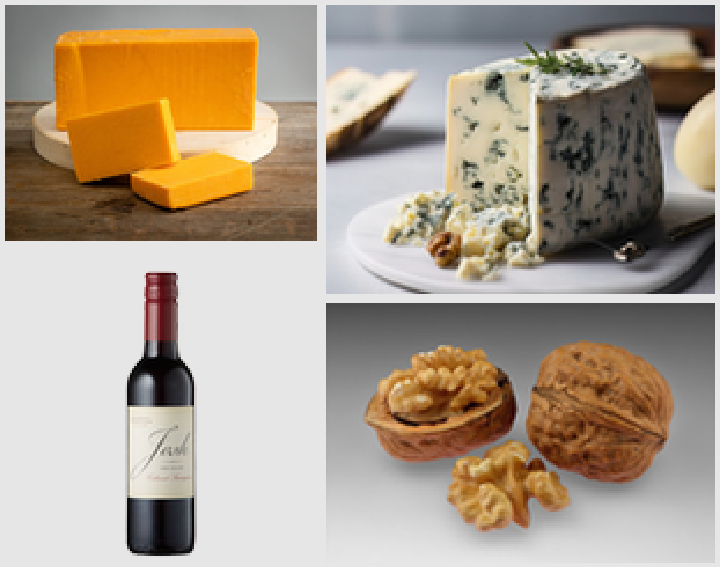
WineEntityCabernet sauvignon wine,CheeseAndNuts{cheddar cheese,gorgonzola cheese,walnut},MeatAndSeafood{beef ribeye,beef stew,burgers,lambs,venison,grilled tuna,steaks,barbecue chickens},FruitsAndVegetables{black cherries,broccoli,tomatoes},SaucesAndDips{brown sauce,tomato sauce,chimichurri},Desserts{bittersweet chocolate,gelato,espresso}
In[]:=
cabSauvWineCheesesNuts=Values[cabSauvPairings[[{1,2}]]]//Flatten;cabSauvImages=ImageResize[#,150]&/@WebImageSearch[#,1]&/@cabSauvWineCheesesNuts//Flatten;ImageCollage[cabSauvImages,ImagePadding->2,Background->GrayLevel[0.9],ImageSize->Medium]
Out[]=
Alcohol content
Alcohol content
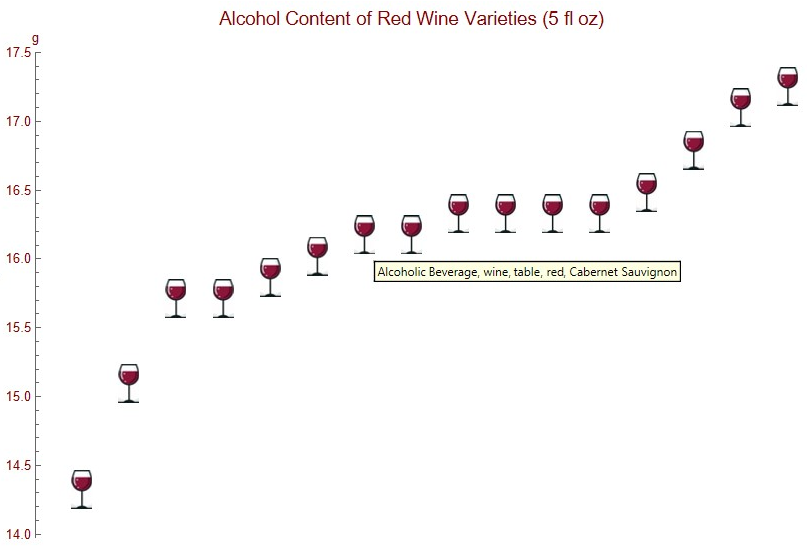
Check the alcohol content in a 5oz glass of Cabernet Sauvignon and see how it compares with other red wines:
In[]:=
EntityInstance,Quantity[5,"FluidOunces"]["AbsoluteAlcoholContent"]//N
Out[]=
In[]:=
redWineEntities=EntityList;redWineAlcoholContent=N[DeleteMissing[AssociationThread[redWineEntities,(EntityValue[EntityInstance[#1,Quantity[5,"FluidOunces"]],"AbsoluteAlcoholContent"]&)/@redWineEntities]]];sortedRedWineAlcoholContent=SortBy[redWineAlcoholContent,QuantityMagnitude];redWineValues=QuantityMagnitude/@Values[sortedRedWineAlcoholContent];redWineNames=EntityValue[Keys[sortedRedWineAlcoholContent],"Name"];ListPlot
Red wine osmolality
Red wine osmolality
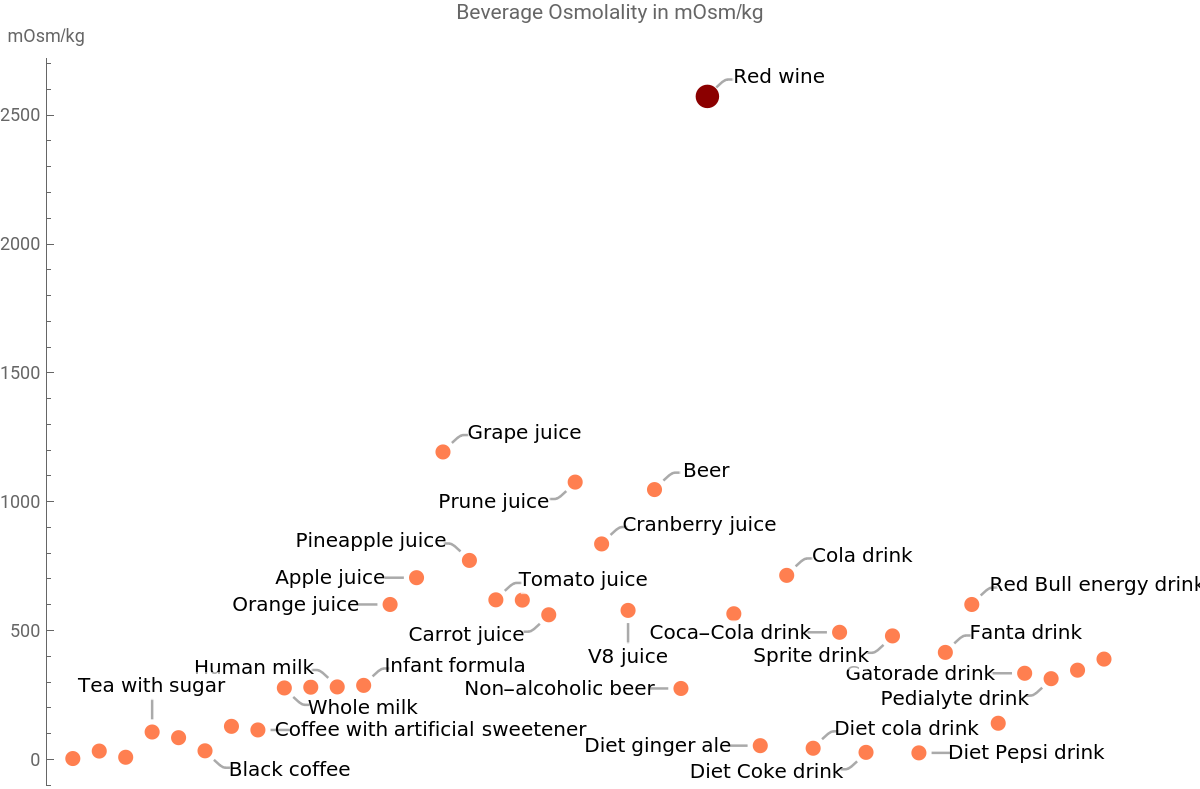
Red wine is hypertonic, with much higher osmolality than other beverages and the resulting risk of dehydration, so include a glass of water for you and each of your guests.
In[]:=
osmolalityRulesAssoc=Association["OsmolalityRules"];highlightIndex=25;highlightedPoint={highlightIndex,osmolalityRulesAssoc[[highlightIndex]]};ListPlotTooltip[osmolalityRulesAssoc],
Out[]=
For more about beverage osmolality, read "Role of osmolality in sports, exercise and hydration" in Wolfram Community.
Worldwide winemaking
Worldwide winemaking
Winemaking is popular in regions globally that can provide the right sunlight and soil:
To check a particular grape variety:
Dry versus sweet wines
Dry versus sweet wines
Wines are classified as dry, semi-dry, semi-sweet and sweet by the amount of sugar that was not converted into alcohol during fermentation. This residual sugar left in the wine after fermentation is commonly measured in grams per liter (g/L). There are differing views on the actual value ranges, but dry wines typically have up to 4 g/L of residual sugar, semi-dry wines between 4 and 12 g/L, and semi-sweet wines between 12 and 45 g/L. Sweet wines generally have more than 45 g/L of residual sugar.
Marsala cooking wine, featured in the popular chicken Marsala dish, takes the top spot in sugar content:
LLM as sommelier
LLM as sommelier
CITE THIS NOTEBOOK
CITE THIS NOTEBOOK
Wine-food pairing in Wolfram Language
by Gay Wilson
Wolfram Community, STAFF PICKS, May 5, 2025
https://community.wolfram.com/groups/-/m/t/3455752
by Gay Wilson
Wolfram Community, STAFF PICKS, May 5, 2025
https://community.wolfram.com/groups/-/m/t/3455752