CITE THIS NOTEBOOK: Framework for liquid crystal based particle models by Jarek Duda. Wolfram Community MAR 20 2023.
ORIGINAL ARTICLE: Jarek Duda,Framework for liquid crystal based particle models, arXiv: 2108.07896
DOI: https://doi.org/10.48550/arXiv.2108.07896.
GITHUB: https://github.com/JarekDuda/liquid-crystals-particle-models/
SLIDES: https://www.dropbox.com/s/9dl2g9lypzqu5hp/liquid%20crystal%20particles.pdf
RECORDING: https://www.youtube.com/watch?v=od85ljeS4jA
Abstract: Liquid crystals, widely used e.g. in LCD, allow for topologically nontrivial structures e.g. hedgehog-like. For such quantized topological charges there were experimentally observed long-range e.g. Coulomb-like interactions (∝ for (n)n), Gauss law counts topological charge - getting missing charge quantization. Higgs-like potential allows to regularize charge to finite energy (511keV mass for electron), leading to running coupling-like corrections of Coulomb. Further topological excitations resemble 3 leptons, baryons with proton lighter than neutron, nuclei and other particles.
[1]
,[2]
,[3]
,
[4]
), suggesting to explore the boundaries of its resemblance with particle physics . This article introduces to modification of popular Landau-de Gennes model (awarded Nobel prize) with Lorentz invariant EM-like Lagrangian to recreate electromagnetism for such topological charges. Interpreting field curvature as dual electromagnetic F tensor (*
F
μν
R
μν
Γ
μ
Γ
ν
Γ
i
∂
i
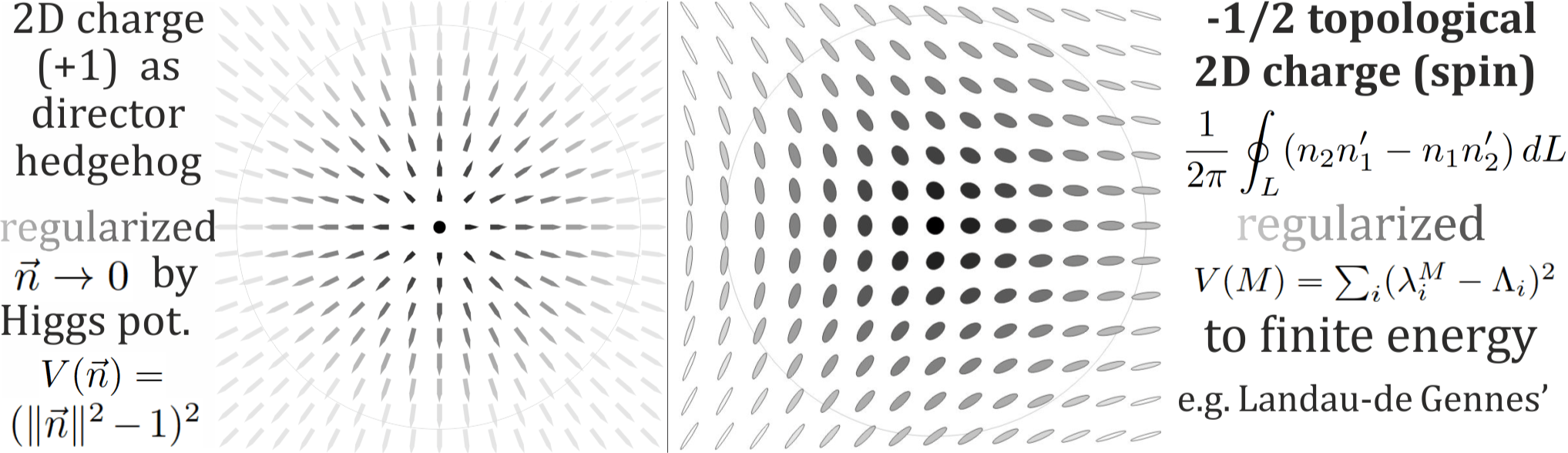
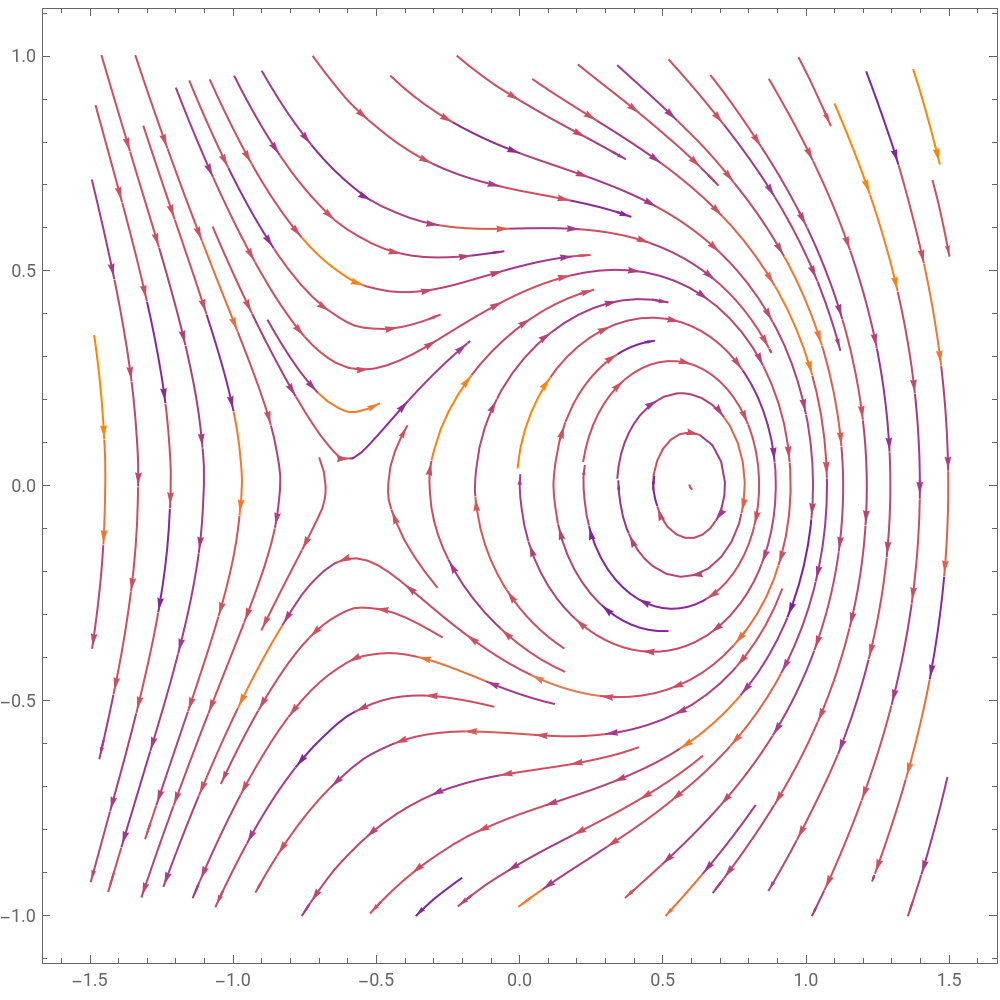
Topological defects in liquid crystals have particle-like behavior for quantized topological charges (experimentally e.g. , define its curvature as dual electromagnetic F tensor (with switched E and B) - this way Gauss law counts topological charge gives tendency for unitary vectors ( case referred as vacuum), still allowing to deform the center of singularity to a finite energy (2), experimentally leading to low distance deformation of Coulomb force in agreement with the running coupling effect To calculate 2D topological charge above, also called winding number, imagine going along a loop around - counting rotation of the field. Naively it is an integer multiplicity of full rotations, e.g. +1 topological charge for the hedgehog configuration above. However, analogously calculating for the configuration on the right above, we get -1/2 full rotations. It is thanks to symmetry of used ellipses: that rotating it by 180 degrees, it is already the same ellipse. This type of 2D topological charges are common as cross-sections of vortices e.g. in superconductors or superfluids - carrying quants of magnetic field or angular momentum ( https://en.wikipedia.org/wiki/Macroscopic_quantum_phenomena ) due to such topological quantization. Possibility of 1/2 topological charges here, related with magnetic field and angular momentum, suggests to interpret such 2D topological charge as spin. Additional argument for this spin resemblance is offered by quantum rotation operator - saying that rotating spin particle by angle, rotates quantum phase by - exactly as for the above 2D topological charges. Here is a demonstration to play with pairs of such 2D topological charges in various distances: https://demonstrations.wolfram.com/SeparationOfTopologicalSingularities/ - e.g. to rotate global (quantum) phase, not changing the topological charges as in gauge invariance.
[1]
,[2]
,[3]
,
[4]
), suggesting to explore the boundaries of this resemblance with particle physics. This article briefly introduces to such approach modifying popular Landau-de Gennes model, its further elaboration can be found in arXiv:2108.07896, available notebooks, video lecture, and slides used below. Classical electromagnetism has two basic issues: (1) no charge quantization (that Gauss law returns charge as a real number), and (2) infinite energy of electric field of a charge. Manfried Faber has proposed a simple way to repair both: consider field of unitary vectors n:
4
R
2
S
[5]
, enforcing its quantization (1). Using Higgs-like potential e.g. V(n)
2
(∥n-1)
2
∥
V(n)0
[6]
.
s
θ
s·θ


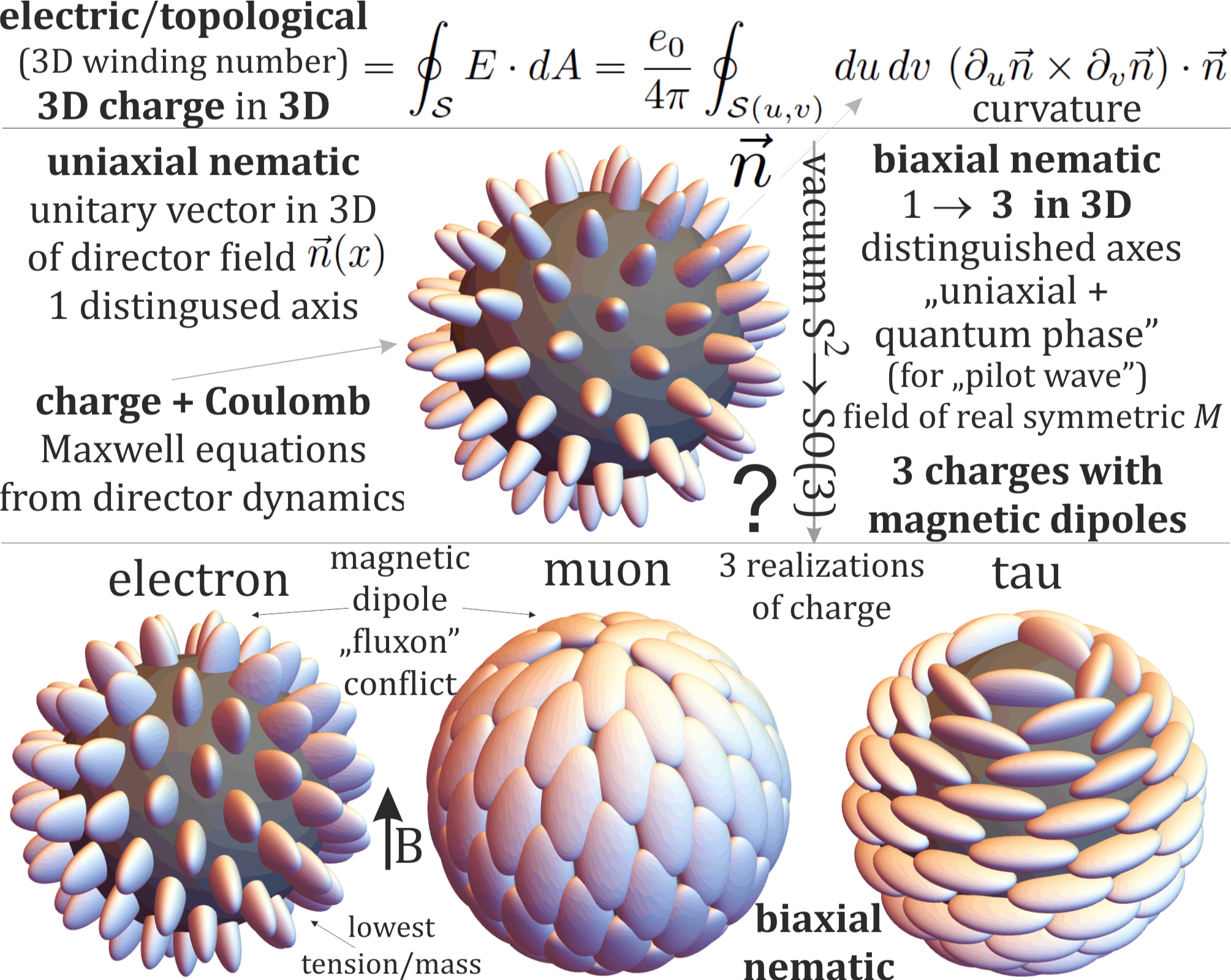
While 2D topological charges (e.g. in cross-section of a vortex) resemble spin, in 3D there are also point-like 3D topological charges resembling electric charges, e.g. below hedgehog. While the above number of rotations can be calculated integrating derivative over the loop like in argument principle, we can analogously calculate this 3D topological charge by integration of curvature over a closed surface - using Gauss-Bonnet theorem. Hence interpreting this curvature as electric field, Gauss law counts topological charge, getting built-in charge quantization. For example in liquid crystals there are observed long-range interactions for such topological charges: While the mentioned experiments mainly use uniaxial nematic liquid crystals (assuming molecules of cylindrical symmetry), a natural generalization are biaxial nematics without such symmetry - modeled as ellipsoids of 3 different axes. Like in the figure above, for biaxial nematic we can build hedgehog configuration with one of 3 axes - getting three objects of the same topological/electric charge, but different energy (mass) - resembling 3 leptons as we live in 3D. Additionally, forming hedgehog of one axis, then trying to align the second axis on the sphere, the hairy ball theorem says it cannot be done - there is a topological conflict requiring additional vortex-like singularities like below: here suggesting why there are no naked charges: leptons require to also have spin, magnetic dipole moment.  Such hedgehog still has freedom for evolution of internal rotation - low energy twist of the field, which resembles Berry/quantum phase rotation in so called de Broglie clock/zitterbewegung: required by stationary Schrödinger equation ψ = for relativistic , confirmed experimentally for electron interpreted as quantum phase:
[1]
,[2]
,[3]
,
[4]
.
ψ
0
iEt/ℏ
e
Em
2
c
[7]
. Below is a short code drawing such hedgehogs for evolving arg()
ψ
In[]:=
={0.1,0.01,0.001};(*eigenvaluesasshapeofmolecule*)Gx={{0,0,0},{0,0,-1},{0,1,0}};Gy={{0,0,1},{0,0,0},{-1,0,0}};Gz={{0,-1,0},{1,0,0},{0,0,0}};(*generators*)Q=Simplify[MatrixExp[ϕ*Gz].MatrixExp[θ*Gy].MatrixExp[ψ*Gx]/.{ϕ->ArcTan[x,y],θ->-ArcTan[Sqrt[x^2+y^2],z]}];(*hedgehog*)M=Simplify[Q.DiagonalMatrix[].Transpose[Q]];pts=SpherePoints[300];Row[Table[Graphics3D[{Table[Ellipsoid[p,M/.{x->p[[1]],y->p[[2]],z->p[[3]]}],{p,pts}],Gray,Sphere[{0,0,0},1]},Boxed->False,ImageSize->Tiny],{ψ,0,Pi,Pi/6}]]
Out[]=


Here is a demonization from https://demonstrations.wolfram.com/TopologicalChargesInBiaxialNematicLiquidCrystal/ allowing to play with such 3 types of 3D topological charges:
Out[]=

References
References
[1] Y. Shen and I. Dierking, “Annihilation dynamics of topological defects induced by microparticles in nematic liquid crystals,” Soft matter, vol. 15, no. 43, pp. 8749–8757, 2019, https://pubs.rsc.org/en/content/articlelanding/2019/sm/c9sm01710k
[2] P. Poulin, H. Stark, T. Lubensky, and D. Weitz, “Novel colloidal interactions in anisotropic fluids,” Science, vol. 275, no. 5307, pp. 1770–1773, 1997, https://pubmed.ncbi.nlm.nih.gov/9065396/
[3] R. Ruhwandl and E. Terentjev, “Long-range forces and aggregation of colloid particles in a nematic liquid crystal,” Physical Review E, vol. 55, no. 3, p. 2958, 1997, https://journals.aps.org/pre/abstract/10.1103/PhysRevE.55.2958
[4] Lee, Beom-Kyu, et al. “Coulomb-like elastic interaction induced by symmetry breaking in nematic liquid crystal colloids.” Scientific reports 7.1 2017, https://www.nature.com/articles/s41598-017-16200-z
[5] M.Faber, “A geometric model in 3+ 1d space-time for electrodynamic phenomena,” Universe, vol. 8, no. 2, p. 73, 2022, https://www.mdpi.com/2218-1997/8/2/73
[6] J. Wabnig, J. Resch, D. Theuerkauf, F. Anmasser, and M. Faber, “Numerical evaluation of a soliton pair with long range interaction,” 2022, arXiv preprint arXiv:2210.13374
[7] P. Catillon, N. Cue, M. Gaillard, R. Genre, M. Gouanere, R. Kirsch, J.-C. Poizat, J. Remillieux, L. Roussel, and M. Spighel, “A search for the de Broglie particle internal clock by means of electron channeling,” Foundations of Physics, vol. 38, no. 7, pp. 659–664, 2008, https://link.springer.com/article/10.1007/s10701-008-9225-1
[8] P.-G. De Gennes and J. Prost, The physics of liquid crystals. Oxford university press, 1993, no. 83.