In this computational essay i explore how a Kerr Non Linear Resonator(KNR) with a two photon driving provides foundations of the implementation of Kerr-cat qubits. I will briefly describe the KNR Hamiltonian and the concept of cat qubit encoding, and i will focus on the results of state initialization and stabilization. I reproduced results from the paper: Puri, S., Boutin, S. & Blais, A. Engineering the quantum states of light in a Kerr-nonlinear resonator by two-photon driving. npj Quantum Inf 3, 18 (2017). https://doi.org/10.1038/s41534-017-0019-1 using the second quantization functionalities of the Wolfram Quantum Framework.
Paclet Installation
Paclet Installation
Install and load the Quantum Framework with the second quantization functionalities:
PacletInstall["https://wolfr.am/DevWQCF",ForceVersionInstall->True];<<Wolfram`QuantumFramework`<<Wolfram`QuantumFramework`SecondQuantization`
Helper definitions
Helper definitions
In[]:=
a:=AnnihilationOperator[];
In[]:=
coherent:=CoherentState[]["Normalize"]
Cat qubits and manifold of coherent states
Cat qubits and manifold of coherent states
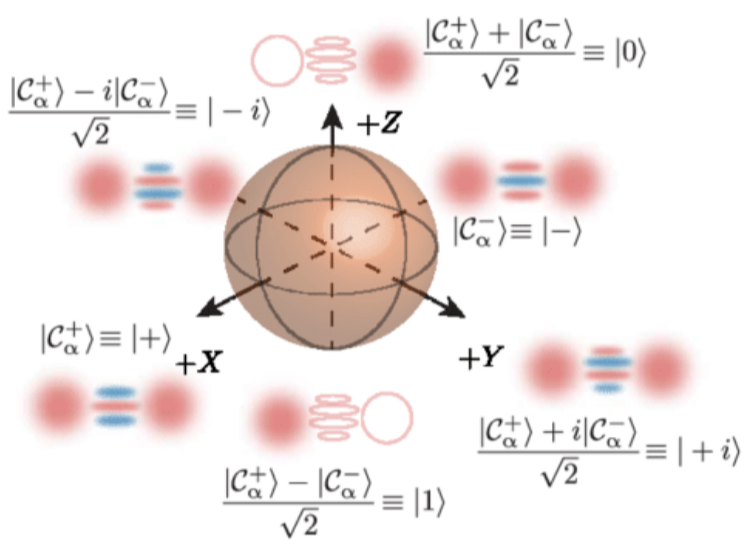
It’s possible to encode a qubit in a two dimensional subspace generated by the even and odd cat states. Let the logical states |0〉 = and |1〉 = , we can represent any state of a qubit within this subspace also known as a coherent state manifold. The states |0〉 and |1〉 are degenerate states of the parametrically driven Kerr non linear oscillator, this allows implementations of cat qubits that can be useful in fault tolerant quantum computing. The implementation of this encoding with Kerr Non Linear Resonators are called Kerr-cat qubits.
|〉+|〉
+
α
-
α
2
|〉-|〉
+
α
-
α
2
Diagram taken from Bias-preserving gates with stabilized cat qubits:
Cat states are orthogonal :
〈|〉=0
+
α
-
α
In[]:=
@CatState[][α,π]["Scalar"]
†
CatState[][α,0]
Out[]=
0
In the limit of high α and , approach coherent states |α〉 and |-α〉 respectively:
|〉+|〉
+
α
-
α
2
|〉-|〉
+
α
-
α
2
In[]:=
SetFockSpaceSize[100];
In[]:=
1
2
(CatState[][6.6,0]+CatState[][6.6,π])-CoherentState[][6.6]["Normalize"]["AmplitudeList"]Out[]=
{}
In[]:=
1
2
(CatState[][6.6,0]-CatState[][6.6,π])-CoherentState[][-6.6]["Normalize"]["AmplitudeList"]Out[]=
{}
Kerr Nonlinear Resonator and steady state solutions
Kerr Nonlinear Resonator and steady state solutions
Two photon drive KNR Hamiltonian in a frame rotating at the resonator frequency, where K is the Kerr nonlinearity amplitude and is the amplitude of the two photon drive:
ϵ
p
H
0
†
a
†
a
a
a
ϵ
p
†2
a
*
ϵ
p
2
a
Which can be re-written as:
H
0
†2
a
ϵ
p
K
2
a
ϵ
p
K
ϵ
p
2
|
K
The form of equation (2) indicates that coherent states |± α 〉 with α = K are degenerate states of the Hamiltonian
ϵ
p
Considering single photon loss, we have the following master equation where (ρ) is a term related to the jump operator =:
ℒ
loss
L
1
γ
a
dρ
dt
H
0
L
loss
KNR Hamiltonian :
In[]:=
SetFockSpaceSize[12];
In[]:=
H0=-Ka@-epKa@(a@a-ep/Ka)+Ka;
†
a
†
a
2
Abs[]
e
p
Initial state:
In[]:=
ρ0=FockState[0];
Hamiltonian including single photon loss mechanism:
In[]:=
ℋ=QuantumOperator["Hamiltonian"[H0,{a},{κ}],"Parameters"->{Ka,ep,κ}];
Steady state solution, when κ = 0 the solutions just reduces to coherent states of α = :
±K
ϵ
p
1
2
α
0
α
0
α
0
α
0
α
0
r
0
θ
0
r
0
1/4
4-4
2
ϵ
p
2
κ
4
2
K
tan(2)
θ
0
κ
16-
2
ϵ
p
2
κ
In[]:=
α0[Ka_,ep_,κ_]:=ExpArcTan2
1/4
(4-4)
2
ep
2
κ
4
2
Ka
κ
16-
2
ep
2
κ
To get results close to exact we want the quantity << 1, but even with the value around 1/4 its possible to get accurate results (converge towards coherent state manifold) in the presence of single photon loss:
κ8
2
Kα
0
Case K = 4, ep=16, κ = 4
Case K = 4, =16, κ = 4
e
p
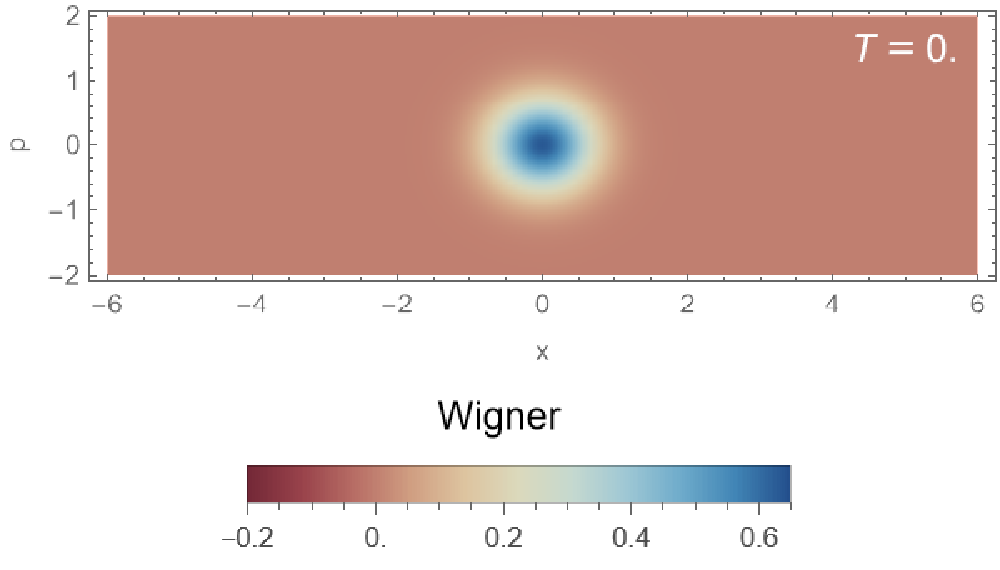
Computing evolution numerically from :
t=0tot=2
In[]:=
expℋ=QuantumEvolve[ℋ[4,16,4],None,{t,0,2}];
In[]:=
frames=TableModule{wig=WignerRepresentation[expℋ[t][ρ0],{-6,6},{-2,2},"GaussianScaling"->2]},LegendedDensityPlotwig[x,p],{x,-6,6},{p,-2,2},PlotRange{-0.2`,0.65`},PlotPoints->100,ColorFunctionColorData["RedBlueTones"]&,ColorFunctionScalingFalse,FrameLabel{"x","p"},AspectRatio0.3`,Epilog{FontSize14,White,Text[Tt,{5,1.5`}]},Placed[BarLegend[{"RedBlueTones",{-0.2`,0.65`}},LegendLayout"Row",LegendLabel"Wigner"],Below],{t,0,1.5,0.05};
#1+0.2`
0.85`
In[]:=
AnimatedImage[Rasterize/@frames,FrameRate->2]
Out[]=
Computing the fidelity:
In[]:=
ρs=1/2coherent[#]["MatrixState"]&/@{α0[4,16,4.],-α0[4,16,4.]}//Total;QuantumSimilarity[expℋ[2.][FockState[0]],ρs]
For this case the evolution was smoother but the coherent states distorted a bit by dephasing and noise from photon loss channel, hence smaller fidelity:
Cat state initialization
Cat state initialization
Adiabatic initialization
Adiabatic initialization
Computing fidelities respect to even and odd cat state at t = 6.5/K , if κ = 0 they would be even higher :
Non adiabatic initialization
Non adiabatic initialization
For this we consider τ = 1/K , instead of τ = 5/K:
Comparing the evolution at t = 1.5 τ using just one drive to the case where the additional orthogonal drive is used:
Stability of cat states in a lossy KNR
Stability of cat states in a lossy KNR
Initial even cat state with α = 2:
Without a drive there is noticeable reduction of the Wigner fringes of the representation due to dephasing of the components:
References
References
◼
PURI, Shruti; BOUTIN, Samuel; BLAIS, Alexandre. Engineering the quantum states of light in a Kerr-nonlinear resonator by two-photon driving.
npj Quantum Information, 2017, vol. 3, no 1, p. 18.
https://www.nature.com/articles/s41534-017-0019-1.pdf
npj Quantum Information, 2017, vol. 3, no 1, p. 18.
https://www.nature.com/articles/s41534-017-0019-1.pdf
◼
PURI, Shruti, et al. Bias-preserving gates with stabilized cat qubits.
Science advances, 2020, vol. 6, no 34, p. eaay5901.
https://www.science.org/doi/pdf/10.1126/sciadv.aay5901
Science advances, 2020, vol. 6, no 34, p. eaay5901.
https://www.science.org/doi/pdf/10.1126/sciadv.aay5901
CITE THIS NOTEBOOK
CITE THIS NOTEBOOK
Two-photon driven Kerr nonlinear resonators for Kerr-Cat qubit initialization
by Bruno Tenorio
Wolfram Community, STAFF PICKS, November 11, 2024
https://community.wolfram.com/groups/-/m/t/3318245
by Bruno Tenorio
Wolfram Community, STAFF PICKS, November 11, 2024
https://community.wolfram.com/groups/-/m/t/3318245