National Chemistry Week is celebrated each October. This year’s theme is The Hidden Life of Spices. It’s a great opportunity to explore the molecular science of spices with Wolfram Chemistry.
Pumpkin spice blend
Pumpkin spice blend
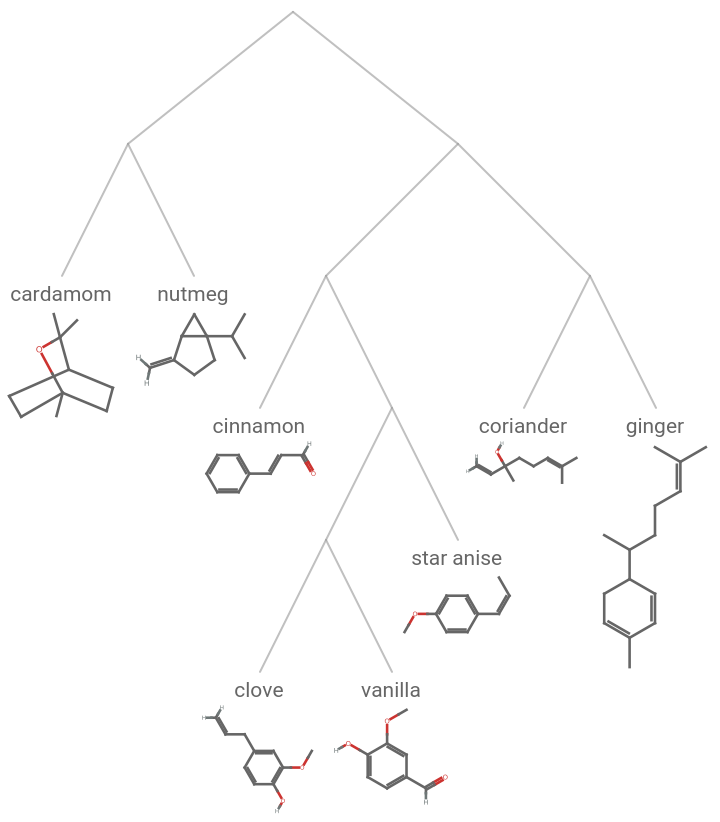
Autumn is here, and pumpkin spice is making its seasonal appearance in coffees, pastries and even treats for our four-legged family members. Pumpkin spice blends can be personalized with a variety of warming spices, but one thing is true about all of them—there’s no pumpkin!
With the MoleculeFeatureDistance function, also known as molecule fingerprint distance, you can compute the dissimilarity between two molecules. On a scale of 0 to 1, a smaller distance indicates higher similarity; a larger distance indicates greater dissimilarity.
In[]:=
pumpkinSpiceBlendAssoc=<|"cardamom"->,"cinnamon"->,"clove"->,"coriander"->,"ginger"->,"nutmeg"->,"star anise"->,"vanilla"->|>;tree=ClusteringTree[pumpkinSpiceBlendAssoc,DistanceFunction->MoleculeFeatureDistance];labels=AnnotationValue[tree,"LeafLabels"];vertexLabels=Lookup[AbsoluteOptions[tree],VertexLabels]/.{s_StringMoleculePlot[pumpkinSpiceBlendAssoc[s],PlotLabels,ImageSize60],CenterBelow};Graph[tree,VertexLabels->vertexLabels,ImageSize->Medium]
Out[]=
Monoterpenes
Monoterpenes
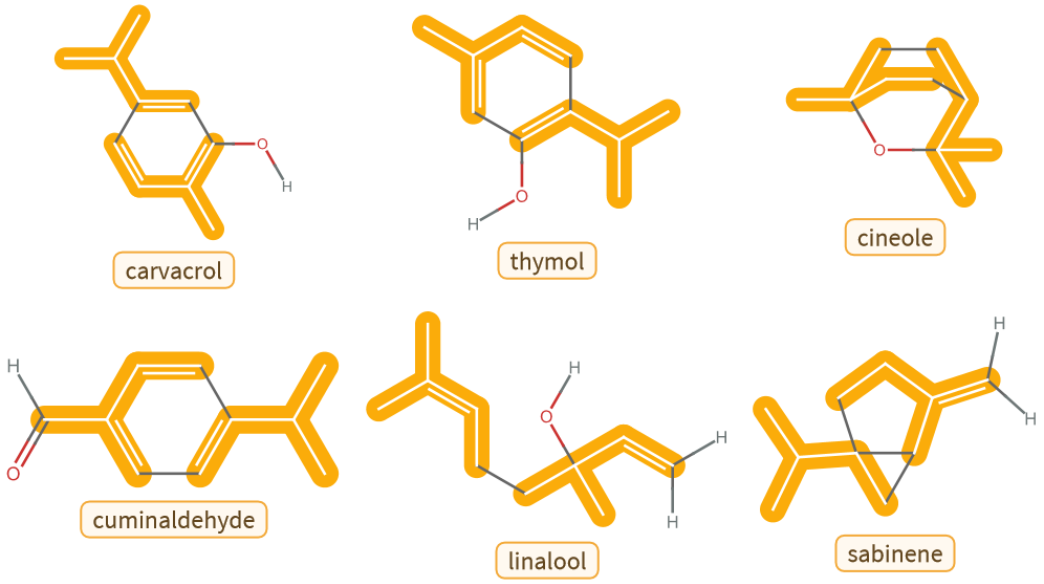
Many of our favorite spices feature monoterpenes or monoterpenoids in their chemical structure, including oregano (carvacrol), thyme (thymol), cardamom and rosemary (cineole), cumin (cuminaldehyde), coriander (linalool), and nutmeg (sabinene).
In addition to providing delectable aromas and flavors, what do these molecules have in common? Ten carbon atoms and two isoprene units, visualized with Wolfram Language.
In[]:=
monoterpenePattern=MoleculePattern["[#6]~[#6](~[#6])~[#6]~[#6].[#6]~[#6](~[#6])~[#6]~[#6]"];Labeled[MoleculePlot[Molecule[#],monoterpenePattern,AtomDiagramCoordinates->"OpenBabel"],#]&/@,,,,,//Partition[#,3]&//Grid
Out[]=
Common structure of spicy mustard, wasabi and horseradish
Common structure of spicy mustard, wasabi and horseradish
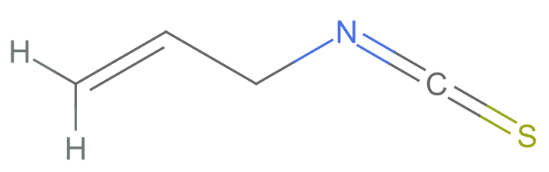
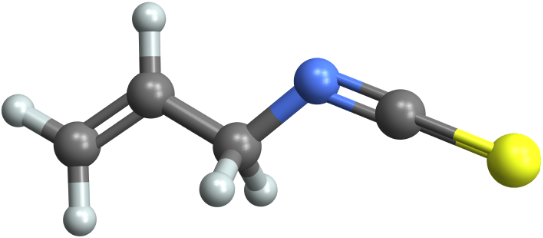
You know that sudden burning sensation in your nose when you eat spicy mustard, wasabi or horseradish?
That sensation is due to the highly volatile and reactive isothiocyanate group (R−N=C=S) in allyl isothiocyanate (AITC). AITC is released when we disrupt the cells of mustard seeds, wasabi and horseradish through chopping, grating or chewing.
The sensation subsides quickly—just in time for your next bite!
In[]:=
MoleculePlot
Out[]=
In[]:=
MoleculePlot3D
Out[]=
Oregano and thyme isomers
Oregano and thyme isomers
We love the smell of oregano in our pasta sauce and the earthy flavor of thyme infusing our baked chicken and glazed carrots.
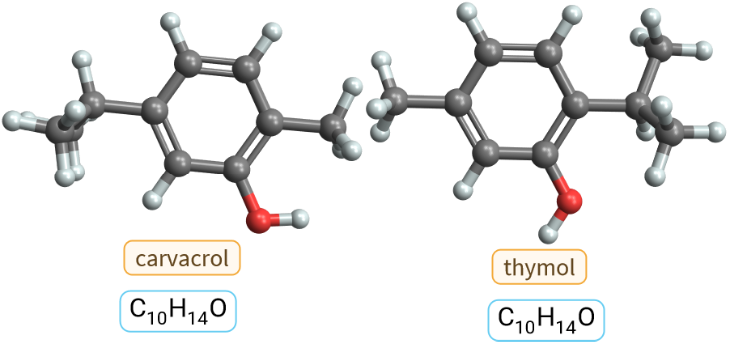
The monoterpenoid compounds in oregano and thyme—carvacrol and thymol—are phenolic isomers. They have the same molecular formula, but differ in their structural arrangements.
They make a great pair in cooking and chemistry!
In[]:=
Labeled[MoleculePlot3D[#,ImageSize->Small],Column[{#,Molecule[#]["ChemicalFormula"]}]]&/@,//Row
Out[]=
Colors of turmeric, saffron and paprika
Colors of turmeric, saffron and paprika
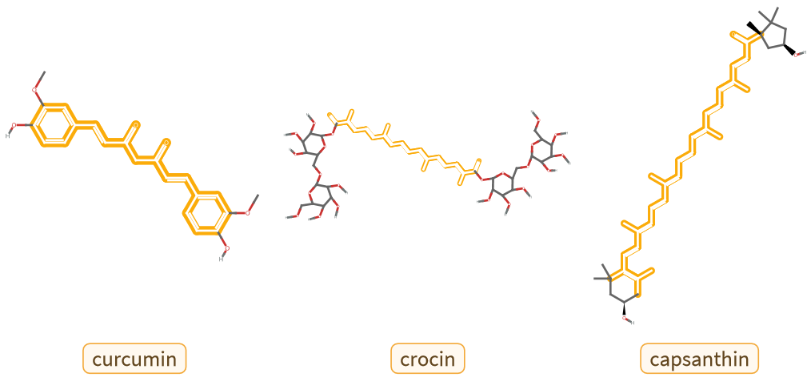
What gives the spices turmeric, saffron and paprika their vibrant colors? It’s their molecular structure.
When a molecule has a conjugated system of alternating single and double bonds, it can absorb energy from visible light.
Curcumin primarily absorbs blue light, which causes turmeric to appear yellow. Crocin molecules absorb blue-violet light, resulting in saffron’s orange-red color. Capsanthin absorbs green-blue light, giving paprika a deep red color.
In[]:=
colorfulSpicesAssoc=<|"turmeric"->,"saffron"->,"paprika"->|>;KeyValueMap[{MoleculePlot[#2,{{MoleculePattern["[#6]:[#6]"],MoleculePattern["[#6]-[#6]=[#6,#8]"]}}],#2}&,colorfulSpicesAssoc]//Thread//Grid
Out[]=
Saffron’s color, aroma and flavor
Saffron’s color, aroma and flavor
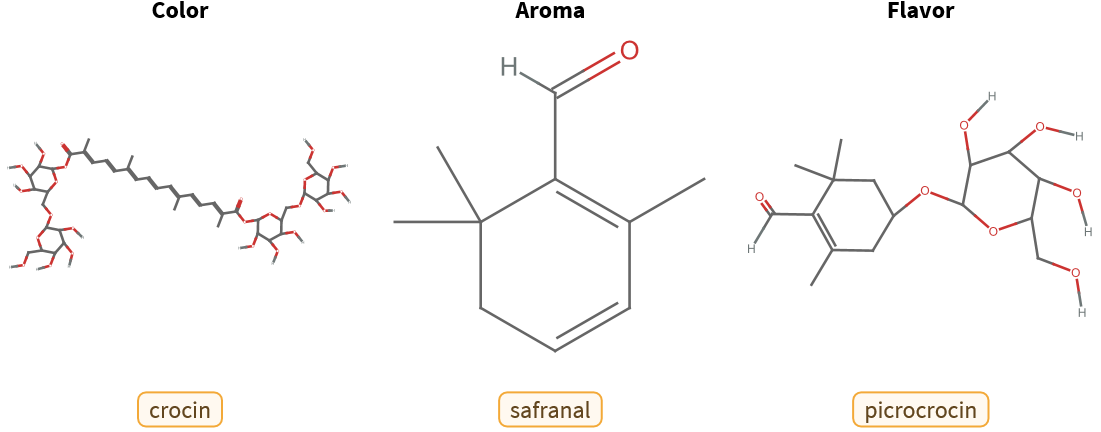
As the world’s most expensive spice, saffron is often called “red gold.” What are the molecules that produce the color, aroma and flavor of this precious commodity?
The carotenoid crocin composes about 80% of saffron’s chemical make-up and is responsible for its golden orange-red color. Safranal in its essential oil produces saffron’s aroma, and picrocrocin is responsible for saffron’s earthy, bitter taste.
In[]:=
KeyValueMap{Style[Capitalize[#1],"Text",Medium,Bold],MoleculePlot[Molecule[#2],ImageSize->Small],#2}&,<|"color"->,"aroma"->,"flavor"->|>//Thread//Grid
Out[]=
Scents of the holidays
Scents of the holidays
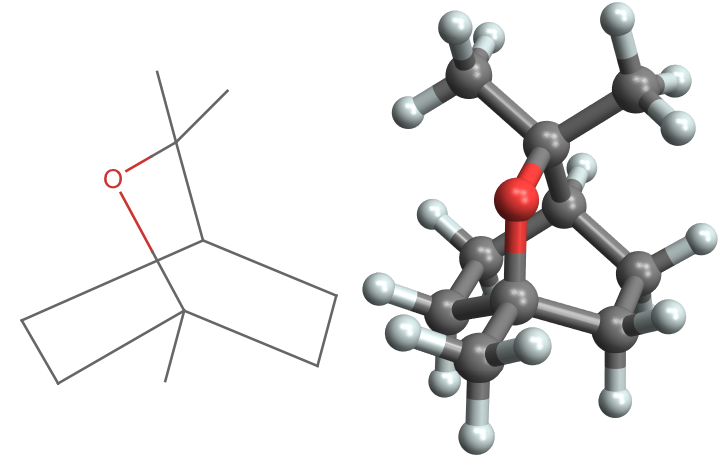
The season for festive holiday meals is approaching. The monoterpenoid cineole, also known as eucalyptol because of its presence in the essential oils of eucalyptus trees, is responsible for some of our favorite aromas of the holiday season—rosemary, sweet basil, cardamom, bay leaf and sage. Bring on the turkey and stuffing!
In[]:=
RowMoleculePlot,ImageSize->Small,MoleculePlot3D,
Out[]=
CITE THIS NOTEBOOK
CITE THIS NOTEBOOK
Seasoned with science: the chemistry of spices
by Gay Wilson
Wolfram Community, STAFF PICKS, October 24, 2025
https://community.wolfram.com/groups/-/m/t/3564888
by Gay Wilson
Wolfram Community, STAFF PICKS, October 24, 2025
https://community.wolfram.com/groups/-/m/t/3564888