The Wagenbreth–Blanke equation is an empirical correlation widely used to represent the density of ethanol–water mixtures over a broad range of alcohol concentrations and temperatures. The equation relates mixture density to the ethanol content by accounting for the non-ideal volumetric behavior of the binary system. Unlike an ideal mixture, ethanol and water undergo volume contraction upon mixing due to strong intermolecular interactions, particularly hydrogen bonding.
The Wagenbreth–Blanke formulation incorporates these effects through polynomial correction terms fitted to experimental density data:
The Wagenbreth–Blanke formulation incorporates these effects through polynomial correction terms fitted to experimental density data:
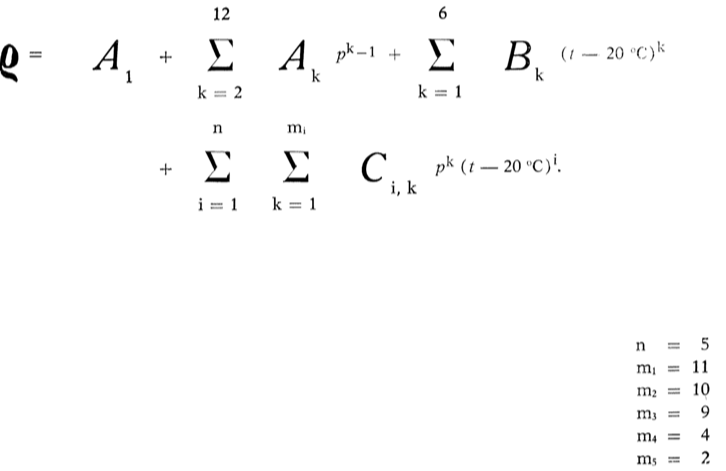
This equation has 54 parameters:
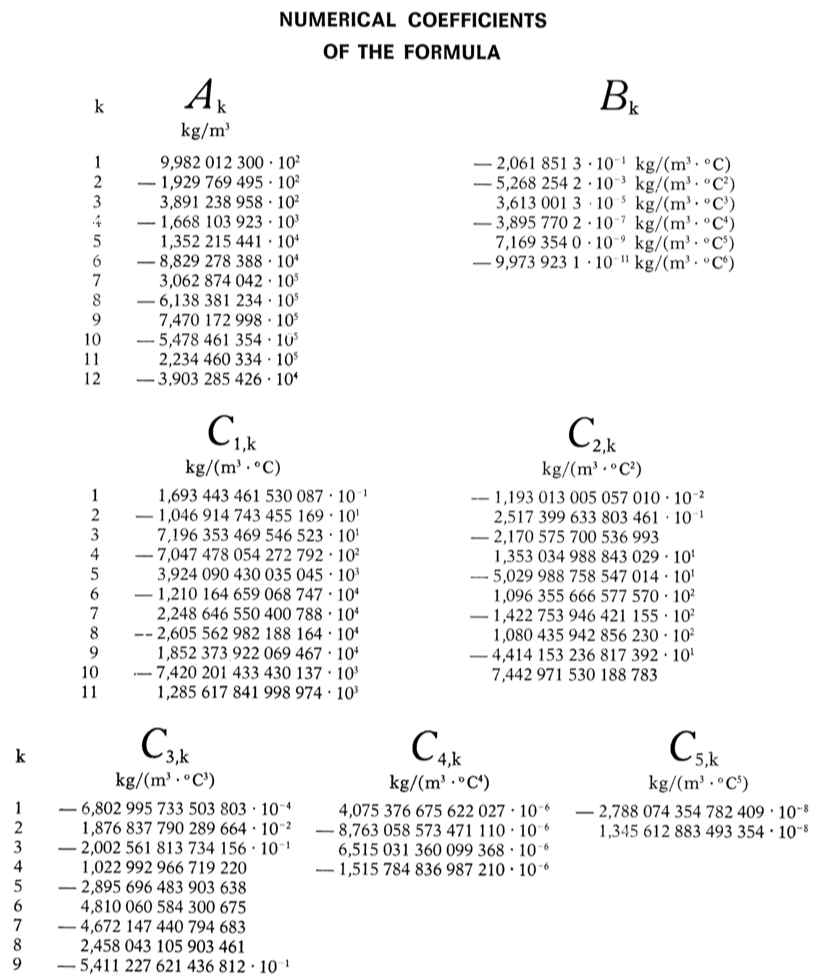
Because of its simplicity and high accuracy, the Wagenbreth–Blanke equation has been extensively applied in alcoholometry, beverage analysis, distillation calculations, and process simulation. It provides reliable estimates of density as a function of alcohol concentration and temperature without requiring detailed thermodynamic models.
Wagenbreth and Blanke developed the correlation using experimental alcoholometric data to reproduce the density behavior of aqueous ethanol solutions over the concentration range encountered in industrial and laboratory applications. The equation remains a practical alternative to tabulated density data such as those published by OIML and standard alcoholometric tables.
Wagenbreth and Blanke developed the correlation using experimental alcoholometric data to reproduce the density behavior of aqueous ethanol solutions over the concentration range encountered in industrial and laboratory applications. The equation remains a practical alternative to tabulated density data such as those published by OIML and standard alcoholometric tables.
Coefficients:
(*Acoefficients(k=1..12)*)A={9.982012300*10^2,(*k=1*)-1.929769495*10^2,(*k=2*)3.891238958*10^2,(*k=3*)-1.668103923*10^3,(*k=4*)1.352215441*10^4,(*k=5*)-8.829278388*10^4,(*k=6*)3.062874042*10^5,(*k=7*)-6.138381234*10^5,(*k=8*)7.470172998*10^5,(*k=9*)-5.478461354*10^5,(*k=10*)2.234460334*10^5,(*k=11*)-3.903285426*10^4(*k=12*)};(*Bcoefficients(k=1..6)-*)B={-2.0618513*10^(-1),(*k=1kg/(m^3.degC)*)-5.2682542*10^(-3),(*k=2kg/(m^3.degC^2)*)3.6130013*10^(-5),(*k=3kg/(m^3.degC^3)*)-3.8957702*10^(-7),(*k=4kg/(m^3.degC^4)*)7.1693540*10^(-9),(*k=5kg/(m^3.degC^5)*)-9.9739231*10^(-11)(*k=6kg/(m^3.degC^6)*)};C1={(*i=1,k=1..11,unitskg/(m^3.degC)*)1.693443461530087*10^(-1),-1.046914743455169*10^1,7.196353469546523*10^1,-7.047478054272792*10^2,3.924090430035045*10^3,-1.210164659068747*10^4,2.248646550400788*10^4,-2.605562982188164*10^4,1.852373922069467*10^4,-7.420201433430137*10^3,1.285617841998974*10^3};C2={(*i=2,k=1..10,unitskg/(m^3.degC^2)*)-1.193013005057010*10^(-2),2.517399633803461*10^(-1),-2.170575700536993,1.353034988843029*10^1,-5.029988758547014*10^1,1.096355666577570*10^2,-1.422753946421155*10^2,1.080435942856230*10^2,-4.414153236817392*10^1,7.442971530188783};C3={(*i=3,k=1..9,unitskg/(m^3.degC^3)*)-6.802995733503803*10^(-4),1.876837790289664*10^(-2),-2.002561813734156*10^(-1),1.022992966719220,-2.895696483903638,4.810060584300675,-4.672147440794683,2.458043105903461,-5.411227621436812*10^(-1)};C4={(*i=4,k=1..4,unitskg/(m^3.degC^4)*)4.075376675622027*10^(-6),-8.763058573471110*10^(-6),6.515031360099368*10^(-6),-1.515784836987210*10^(-6)};C5={(*i=5,k=1..2,unitskg/(m^3.degC^5)*)-2.788074354782409*10^(-8),1.345612883493354*10^(-8)};
Group all C rows; mi values
Ccoeff={C1,C2,C3,C4,C5};mi={11,10,9,4,2};
In[]:=
(*Densityfunction:p[%w/w],t[degC]andrho[kg/m^3]*)Density[p_?NumericQ,t_?NumericQ]:=Module[{tau=t-20.0,termA,termB,termC},(*polynomial:A1+Sum_{k=2}^{12}Ak*p^(k-1)*)termA=A[[1]]+Sum[A[[k]]*p^(k-1),{k,2,12}];(*polynomial:Sum_{k=1}^{6}Bk*tau^k*)termB=Sum[B[[k]]*tau^k,{k,1,6}];(*Crossterms:Sum_{i=1}^{5}Sum_{k=1}^{mi}C[i,k]*p^k*tau^i*)termC=Sum[Sum[Ccoeff[[i,k]]*p^k*tau^i,{k,1,mi[[i]]}],{i,1,5}];termA+termB+termC];
Example evaluations
Generate a 2D table: density versus Alcohol by Weight (ABW) at specific temperatures: 5°C, 10°C, 15°C, 20°C, 25°C
% w/w
degC
Density vs ABW at several temperatures
Pure component properties (Water and Ethanol)
Generate a 2D table: density versus Alcohol by Volume (ABV) at specific temperatures: 5°C, 10°C, 15°C, 20°C, 25°C
% w/w
degC
Density vs ABV at several temperatures
References
References
CITE THIS NOTEBOOK
CITE THIS NOTEBOOK
Wagenbreth-Blanke equation for ethanol-water density prediction
by Housam Binous
Wolfram Community, STAFF PICKS, June 4, 2026
https://community.wolfram.com/groups/-/m/t/3726585
by Housam Binous
Wolfram Community, STAFF PICKS, June 4, 2026
https://community.wolfram.com/groups/-/m/t/3726585