In[]:=
PrimePi[12]
Out[]=
5
In[]:=
12./Log[12]
Out[]=
4.82916
In[]:=
PrimePi[22]
Out[]=
8
In[]:=
22./Log[22]
Out[]=
7.11734
In[]:=
Table[(-1)^n(E^(1/PrimePi[n])-1),{n,2,17}]//TableForm
Out[]//TableForm=
-1+ |
1- |
-1+ |
1- 1/3 |
-1+ 1/3 |
1- 1/4 |
-1+ 1/4 |
1- 1/4 |
-1+ 1/4 |
1- 1/5 |
-1+ 1/5 |
1- 1/6 |
-1+ 1/6 |
1- 1/6 |
-1+ 1/6 |
1- 1/7 |
In[]:=
Table[nn=Prime[2n]-1;(-1)^nn(E^(1/PrimePi[nn])-1),{n,2,4}]//TableForm
Out[]//TableForm=
-1+ 1/3 |
-1+ 1/5 |
-1+ 1/7 |
In[]:=
Table[nn=Prime[n];(-1)^nn(E^(Log[nn]/nn)-1),{n,2,4}]//TableForm
Out[]//TableForm=
1- 1/3 3 |
1- 1/5 5 |
1- 1/7 7 |
Thefunction,whichcountsthenumberofprimenumberslessthanorequaltoagivennumber,isasymptoticallyequivalenttoasapproachesinfinity.Thismeansthatforlargevaluesof,theratioapproaches1.ThisrelationshipisaresultofthePrimeNumberTheorem,whichdescribesthedistributionofprimenumbersamongtheintegers.
n
n/logn
n
n
PrimePi(n)
n/logn
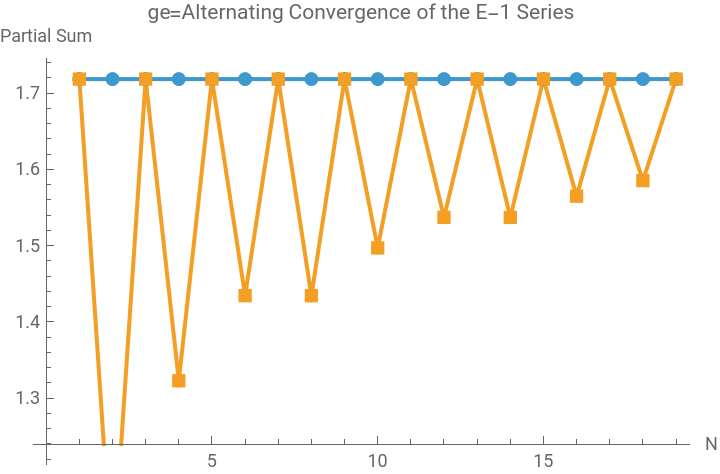
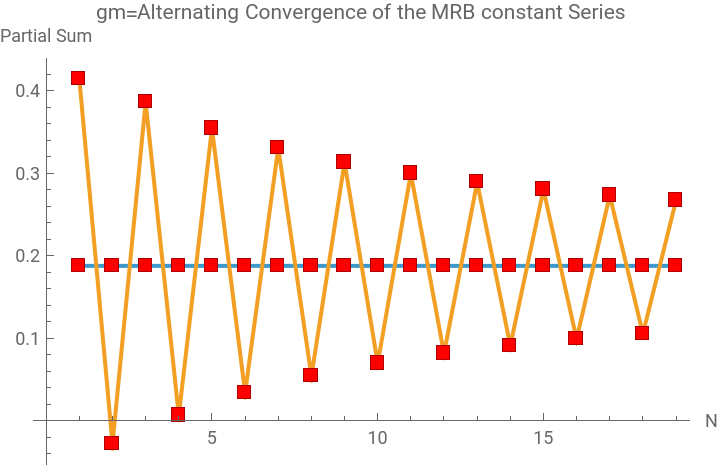
Theseries(-1)isbeingcomputed,andwe'reobservingthatasincreases,theresultalternatesfromto-(-1)convergestotheMRBconstant,exceptheretheconvergenceistoduetothesubstitutioninvolvingtheprimecountingfunction.
N
∑
n2
n
(-1)
1/PrimePi[n]
E
N
E-1
+backtoE-1,andalternatetoacloserpointtoE-1.Thenitrepeatsgettingcloser,asshownintheplotbelow.Thisisanalogoustohowtheseries∞
∑
n1
n
(-1)
log(n)/n
E
E-1
In[]:=
ge=With[{maxN=20},ListLinePlot[{Table[E-1,{N,2,maxN}],Table[NSum[(-1)^n(E^(1/PrimePi[n])-1),{n,2,N}],{N,2,maxN}]},PlotMarkers->Automatic,AxesLabel->{"N","Partial Sum"},PlotLabel->"ge=Alternating Convergence of the E-1 Series",PlotLegends->{"E-1","Partial Sums"}]]
Out[]=


In[]:=
gep=With[{maxN=20},ListLinePlot[{Table[E,{N,2,maxN}],1+Table[NSum[(-1)^n(E^(1/PrimePi[n])-1),{n,2,N}],{N,2,maxN}]},PlotMarkers->Automatic,AxesLabel->{"N","Partial Sum"},PlotLegends->{"E","E-series Partial Sums"}]];
In[]:=
m=NSum[(-1)^n(n^(1/n)-1),{n,1,Infinity},Method->"AlternatingSigns",WorkingPrecision->30]
Out[]=
0.18785964246206712024857897184
In[]:=
gm=With[{maxN=20},ListLinePlot[{Table[m,{N,2,maxN}],Table[NSum[(-1)^n(E^(Log[n]/n)-1),{n,2,N}],{N,2,maxN}]},PlotMarkers->Red,AxesLabel->{"N","Partial Sum"},PlotLabel->"gm=Alternating Convergence of the MRB constant Series",PlotLegends->{{"CMRB","Partial Sums"}}]]
Out[]=


In[]:=
gmp=With[{maxN=20},ListLinePlot[E-m+{Table[m,{N,2,maxN}],Table[NSum[(-1)^n(E^(Log[n]/n)-1),{n,2,N}],{N,2,maxN}]},PlotMarkers->{Red,Green},AxesLabel->{"N","Partial Sum"},PlotLegends->{{"CMRB+E-CMRB","CMRB-series Partial Sums +E-CMRB"}}]];
In[]:=
Show[{gep,gmp},PlotLabel->"ge overlaid with gm"]
Out[]=
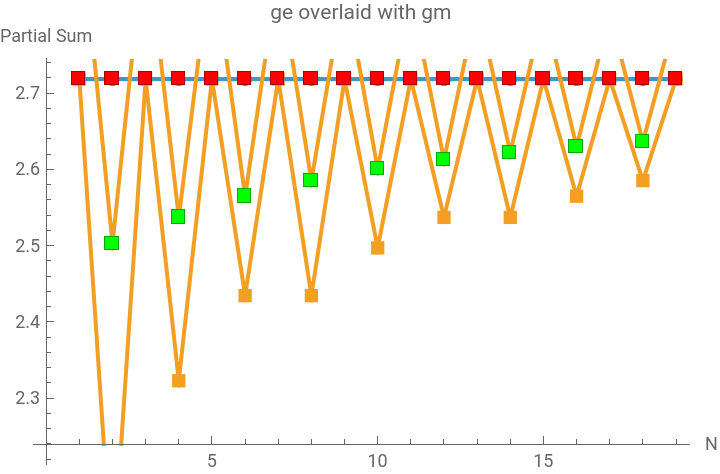

Since limit of CMRB =CMRB, of course the limit of CMRB-series Partial Sums +E-CMRB=E.
The structural similarities imply that the series share common mathematical features and convergence behaviors, even though they converge to different limits.
Induction
Induction
Approach:
Approach:
1. Alternating Signs:
2. Analyzing the Functions:
3. Recursive Structure:
Let's reason through this in the Wolfram Language to verify:
I will evaluate this expression to see if the inequality holds under these assumptions.
Let's analyze the problem based on the structure of the series:
Proof Outline:
Proof Outline:
1. Alternating Signs:
2. Asymptotic Behavior:
3. Dominance of Terms:
4. Alternating Series Behavior: